AI Readiness Assessment for Startups and Small Businesses

AI is becoming increasingly accessible to companies of all sizes, but having access to AI tools doesn't automatically mean a business is ready to use them effectively. Before investing in automation, machine learning, or AI-powered products, startups and small businesses need to understand whether their data, technology, workflows, and teams can support these initiatives.
The gap between AI adoption and actual readiness is bigger than many companies expect. According to McKinsey's 2026 State of Organizations survey, 86% of business leaders say their organizations aren't prepared to adopt AI in day-to-day operations. The main obstacles include concerns about AI itself, regulatory and ethical issues, and organizational challenges. For smaller companies with limited budgets and technical resources, identifying these gaps early can help avoid costly experiments and investments that don't deliver results.
In this article, we'll walk you through how to evaluate your company's AI readiness without relying on a complex AI readiness assessment framework or expensive consulting engagements. You'll learn about the six key areas to assess, use a 15-minute AI readiness scorecard, interpret your results, and check whether your data is suitable for projects.
Key Takeaways:
- AI readiness depends on the specific use case, not overall AI maturity. A startup doesn't need an advanced AI infrastructure or a dedicated AI department to launch its first project. It needs the right resources, data, and capabilities to make one particular use case work.
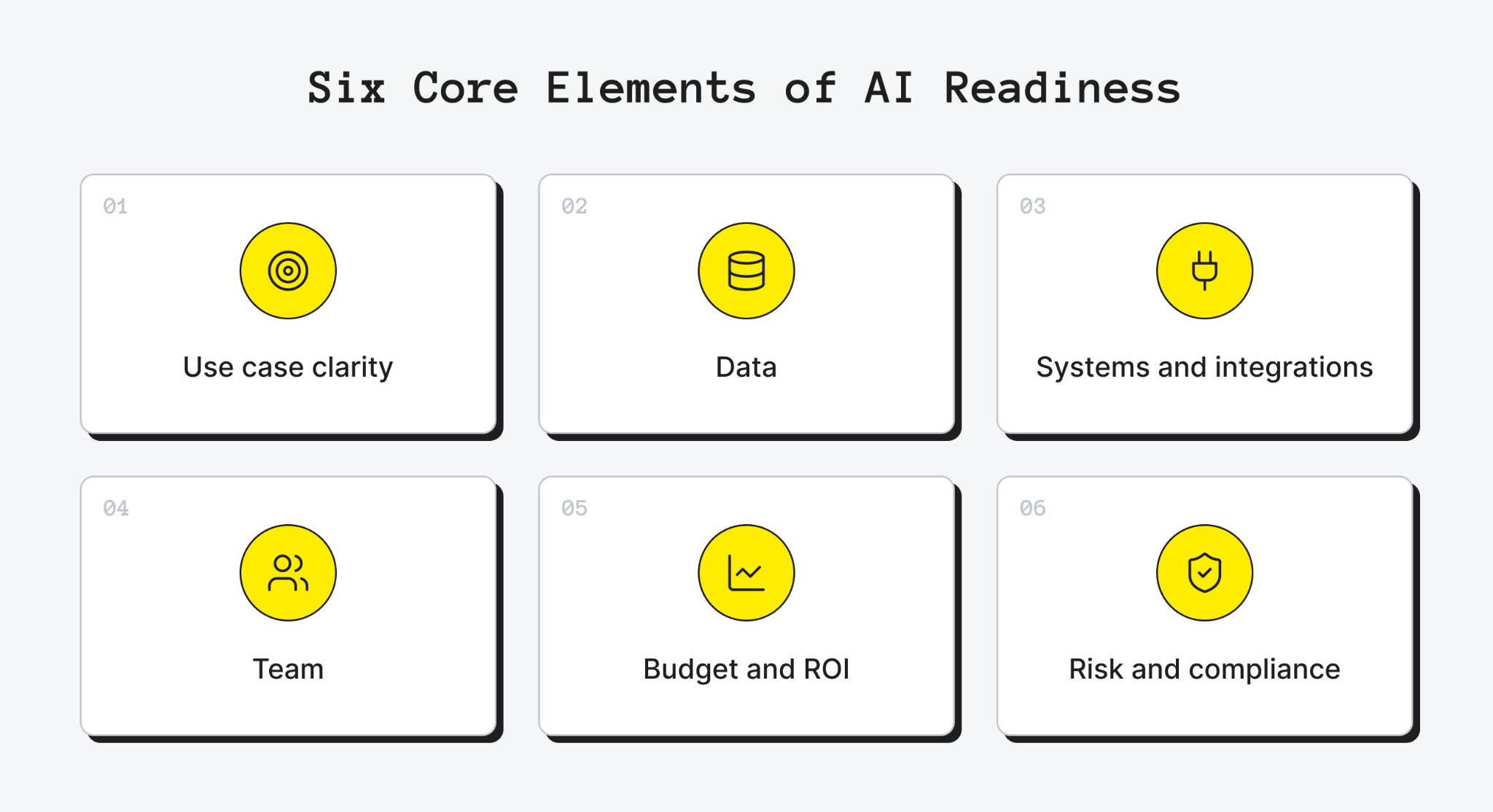
- Six areas determine whether a business is ready for AI: use case clarity, data, systems and AI integrations, team, budget and ROI, and risk and compliance. Gaps in any of these areas can delay implementation or undermine the project's results.
- Data readiness is one of the most important factors in AI adoption. Before development, make sure the required information is documented, accessible, up to date, legally available for use, and supported by real examples for testing.
- An AI readiness score helps determine the most practical next step. On the 18-point scorecard, 0–6 points suggest starting with an off-the-shelf AI tool, 7–12 indicate that a proof of concept (PoC) is appropriate, and 13–18 suggest moving into discovery and MVP planning.
What Is an AI Readiness Assessment?
An AI readiness assessment is a structured evaluation of how prepared a company is to adopt artificial intelligence and put it to practical use. It examines factors such as data quality and accessibility, existing technology, business processes, team skills, and management support to identify potential gaps before an AI initiative begins. The goal is to understand what a business already has, what it lacks, and which steps will help it move forward.
It's also important to distinguish between AI readiness assessment and AI maturity assessment. Although the terms are sometimes used interchangeably, they address different questions:
- AI readiness assessment determines whether a company has the resources, infrastructure, and conditions needed to implement a specific AI product idea. For example, whether a small e-commerce business can introduce an AI-powered customer support assistant with its current data and technical setup.
- AI maturity assessment evaluates how developed an organization's AI capabilities are overall. It looks at how deeply AI is integrated into business operations, whether teams have established AI workflows, and how consistently the company manages and improves AI initiatives.
The distinction matters because a company doesn't need advanced AI capabilities across every department to launch its first successful MVP project. It needs to be ready for the particular use case it wants to pursue.
Many established AI readiness assessment framework templates were originally designed for large enterprises. They often assume dedicated AI teams, formal governance structures, substantial data infrastructure, and significant implementation budgets. Startups and small businesses rarely have all these resources, so applying enterprise criteria can make them appear unprepared even when they have everything needed for a focused AI initiative. A more practical assessment considers the company's size, available resources, business goals, and the specific project it wants to implement.


The Six Dimensions of AI Readiness
AI readiness isn't about having an advanced tech stack or a dedicated AI department. It's about having the right conditions to turn an AI idea into a working solution. Let's go over the six areas that determine whether a startup or small business is ready to move from experimentation to implementation and where potential gaps might hold a project back.
1. Use Case Clarity
A company needs a clearly defined task, an understanding of who handles it today, how much time it takes, and what a successful outcome looks like. A broad goal like "use AI in sales" isn't specific enough to guide implementation. A more actionable use case would be "draft follow-up emails after discovery calls, a task that currently takes each sales rep three hours per week."
2. Data
AI needs access to relevant, reliable information in a format it can use. That means knowing what data the project requires, where it is stored, whether it's accessible, how good its quality is, and whether the company has permission to use it. Data gaps are among the most common reasons AI initiatives stall.
3. Systems and Integrations
Even a well-performing AI solution needs to fit into existing workflows. Check whether the tools that hold your data provide APIs or other integration options, and determine where the AI-generated output should go. If employees have to switch between multiple platforms or manually transfer results, adoption becomes much harder.
4. Team
A successful project needs more than someone interested in experimenting with AI. It requires a designated owner who can dedicate time to the initiative, a domain expert who can evaluate the quality of AI outputs, and access to an engineer with experience building and deploying features powered by large language models (LLMs).
5. Budget and ROI
Before committing to MVP development, establish how much the current process costs in time and money, what improvement would justify the investment, and how much funding is available for implementation. The startup budget should also account for ongoing AI expenses, including API usage, infrastructure, maintenance, and potential model upgrades.
6. Risk and Compliance
Companies need to understand what types of data an AI solution will process, whether any of it is personal or regulated, and what customer agreements or industry requirements allow. They should also decide where human review is necessary, who is accountable for AI-generated decisions, and how potential errors will be handled.
These six areas share common ground with the pillars in Cisco's AI Readiness Index: strategy, infrastructure, data, governance, talent, and culture. The difference is in how readiness translates into practice. An enterprise with 5,000 employees may need formal governance structures, dedicated AI departments, and company-wide adoption programs.
A startup with 15 people needs answers to more immediate questions:
- Does anyone have time to own the project?
- Can the existing systems support it?
- Does a customer contract restrict the use of their data?
At this scale, readiness is less about building an organization-wide AI strategy and more about having the right conditions to make one specific use case work.
Data Readiness for AI: The Checklist Behind Your Data Score
Data readiness for AI goes beyond simply having information stored somewhere in your company. The data needed for a specific AI task must be documented, accessible, up to date, and legally available for use. It should also include enough real-world examples to test the AI's outputs and determine whether they meet business requirements.
Below, you’ll find an AI readiness checklist to evaluate your data readiness. For each statement, answer yes or no, then count your yes answers to calculate your score.
- You know exactly what data the AI task requires. For example, the last 12 months of customer support tickets and your current help center documentation.
- The required information is documented. It exists in files, databases, or internal systems rather than being stored only in employees' heads.
- Someone is responsible for the data. A specific team member knows where it is stored and can help resolve questions about its accuracy or completeness.
- The data is accessible. You can export it or retrieve it through an API without depending on a vendor to provide manual access.
- The information is up to date. The documents and records an AI solution would rely on reflect the processes, products, and policies your team currently uses.
- You have enough real examples to test the AI. Ideally, this includes at least 100 examples of typical inputs paired with the correct outputs, which can serve as a test dataset.
- You have the right to use the data. Your customer contracts, privacy policy, and AI provider's data processing terms permit the intended use.
- You can identify and protect sensitive information. You know which fields contain personal or confidential data and can mask or remove them when necessary.
Your score gives you a quick picture of how prepared your data is for AI development:
- 3 points (7–8 Yes answers): Strong data readiness. Most of the essentials are in place. There may still be a few gaps to address, but your data foundation looks solid.
- 2 points (5–6 Yes answers): Moderate data readiness. You have some important pieces in place, but a few weaknesses could slow down development. It's worth addressing them before moving forward.
- 1 point (3–4 Yes answers): Low data readiness. Several important requirements are missing. Data organization, accessibility, or quality may need significant improvement before AI implementation.
- 0 points (0–2 Yes answers): Data is not ready yet. Your company still needs to establish the basics, including identifying relevant information, assigning ownership, and checking data access and permissions.
One item deserves particular attention: having real examples of inputs and their expected outputs. It's easy to overlook this requirement, especially when a startup is eager to test an AI prototype. However, without a reliable test dataset, there's no consistent way to measure the quality of AI-generated results. For example, a company building an AI support assistant needs examples of customer questions paired with the replies an experienced support agent would consider correct. A sales automation tool needs examples of successful proposals or follow-up messages. These examples provide a benchmark for evaluating AI performance rather than relying on a few impressive demos.
This isn't a minor issue. Gartner research found that 63% of organizations either lack the right data management practices for AI or are unsure whether they have them. For smaller companies, establishing basic data ownership, accessibility, and quality standards early can prevent significant problems during implementation.

The AI Readiness Assessment: A 15-Minute Scorecard
An AI readiness assessment doesn't have to involve lengthy audits or expensive consultations. For a startup or small business, a simple scorecard can reveal whether a specific AI agent use case is realistic with the resources currently available. The idea is to evaluate six areas, assign each a score from 0 to 3, and use the results to identify the biggest gaps before committing to development.
For starters, you should choose one AI use case to assess, such as automating customer support replies, qualifying sales leads, or generating first drafts of business proposals. After that, score each area based on your company's current situation, not what you expect to have after hiring new employees or upgrading your systems. Add the six scores to get a total out of 18.
Use the table below to score each area. You should choose the description that most accurately reflects your current situation. If your company falls between two levels, go with the lower score until the missing requirements are in place.
Score each use case separately. A company might be well prepared to introduce an AI assistant for internal documentation but not ready to automate customer-facing decisions. Readiness depends on the task, the data it requires, and the potential consequences of getting it wrong.
For a more reliable result, it’s better to have two people complete the scorecard independently: the person responsible for the task and the person most familiar with the data it involves. Their perspectives will naturally differ. Founders may have a clearer picture of business priorities and available budgets but overlook data limitations or compliance risks. Domain experts, meanwhile, may understand the data and operational requirements better but have less visibility into the project's financial feasibility.
So, it’s worth comparing their scores and discussing any significant differences. The goal isn't to average the numbers blindly but to understand why people assess the same area differently. These disagreements often reveal gaps that need attention before development begins.
If scoring a table feels too abstract, you can approach the assessment as a short interview with the task owner. Ask one question for each area and use the scorecard above to evaluate the answers.
- Use case clarity: Which specific task should AI handle, how many hours per week does it currently take, and what would an acceptable result look like?
- Data: Where does the information required for this task live, and who can provide at least 100 examples of the task being completed correctly?
- Systems and integrations: Can your existing tools export the required information or connect through an API? Where should the AI-generated output appear?
- Team: Who will own the project and dedicate at least four hours a week to it? Who has the expertise to distinguish a good AI response from a bad one?
- Budget and ROI: How much can the company invest in the next stage, and what does the current process cost in time and money?
- Risk and compliance: Does the task involve personal or confidential information? Do your customer agreements and AI vendor terms allow this data to be processed by an AI provider?
Pay attention to how specific the answers are. Vague responses usually indicate that an area needs further investigation. For example, "The data is probably in our CRM" suggests limited visibility into data readiness. "We have 4,000 support tickets in our CRM, and Maria manages access to them" gives the team something concrete to work with.
You can also turn the scorecard into an AI readiness assessment template by copying the table into a spreadsheet. Save the results for each use case and repeat the assessment as your company addresses the identified gaps. Re-scoring the same project three months later will help you see whether your data, systems, team, and processes have improved enough to move forward.
Need a hand with product development?
Upsilon is a reliable tech partner with a big and versatile team that can give you a hand with creating your AI app.

How to Interpret Your AI Readiness Score
Once you've scored all six areas, add the points to see what your company should do next. The total score helps determine whether it's better to start with an existing AI readiness assessment tool, test a specific use case through a proof of concept (PoC), or move into project discovery and development.
There's one important exception: if your data score is 0 or 1 for a project that depends on proprietary company data, address the data gaps before moving forward, regardless of your total score. Even a strong team, a healthy budget, and a clearly defined use case won't compensate for missing, inaccessible, or unusable data.
The table below will help you match your result with the most practical next step. The cost and timeline estimates reflect a single AI use case at startup or small-business scale, as of November 2026.
Here's a closer look at what each path involves and when it makes sense.
Start with an off-the-shelf AI tool (0–6 points). A low score suggests that investing in custom development would be premature. The company may still be figuring out which tasks benefit from AI, what employees need, and what results are realistic. Instead, give five team members access to an AI assistant for a month. Ask them to track the tasks they use it for, how much time it saves, and where the outputs fall short. At the end of the trial, identify the most promising use case and assess it again.
Run a proof of concept (7–12 points). At this stage, you have a defined business problem and some of the necessary foundations, but you still need to establish whether AI can solve the task reliably using your actual data. A proof of concept (PoC) tests that assumption on a limited scope, usually within one to three weeks. Before starting, define what success looks like: for example, whether an AI assistant can produce acceptable answers for 80% of customer support queries. This gives the team a measurable way to evaluate the results and decide whether further investment is justified.
Start discovery and prepare for MVP development (13–18 points). A high score indicates that the company has a clearly defined use case, accessible data, the right people, and a realistic budget. The next step is to work out how the solution should be built. A discovery phase helps determine the most suitable technical approach, whether that's prompt engineering, retrieval-augmented generation (RAG), or fine-tuning. It also establishes the expected cost per request, defines the MVP scope, and produces a development estimate before implementation begins. After discovery, a functional MVP typically takes around three months to develop.
Fix data readiness first (data score of 0–1, regardless of the total). A high overall score can be misleading if the project depends on company data that is scattered, inaccessible, outdated, or unavailable for legal use. Before investing in a PoC or custom solution, consolidate the relevant information, assign someone to maintain it, and collect at least 100 examples of the task completed correctly. Then repeat the assessment. This step is worth the effort: Gartner predicts that organizations will abandon 60% of AI projects unsupported by AI-ready data through 2026.
The key is to treat your score as a guide to the next investment, not a verdict on your company's ability to adopt AI. A low score doesn't mean you should abandon the idea. It means you should address the fundamentals before committing to a more expensive solution.


Scoring Mistakes That Make a Company Look More Ready Than It Is
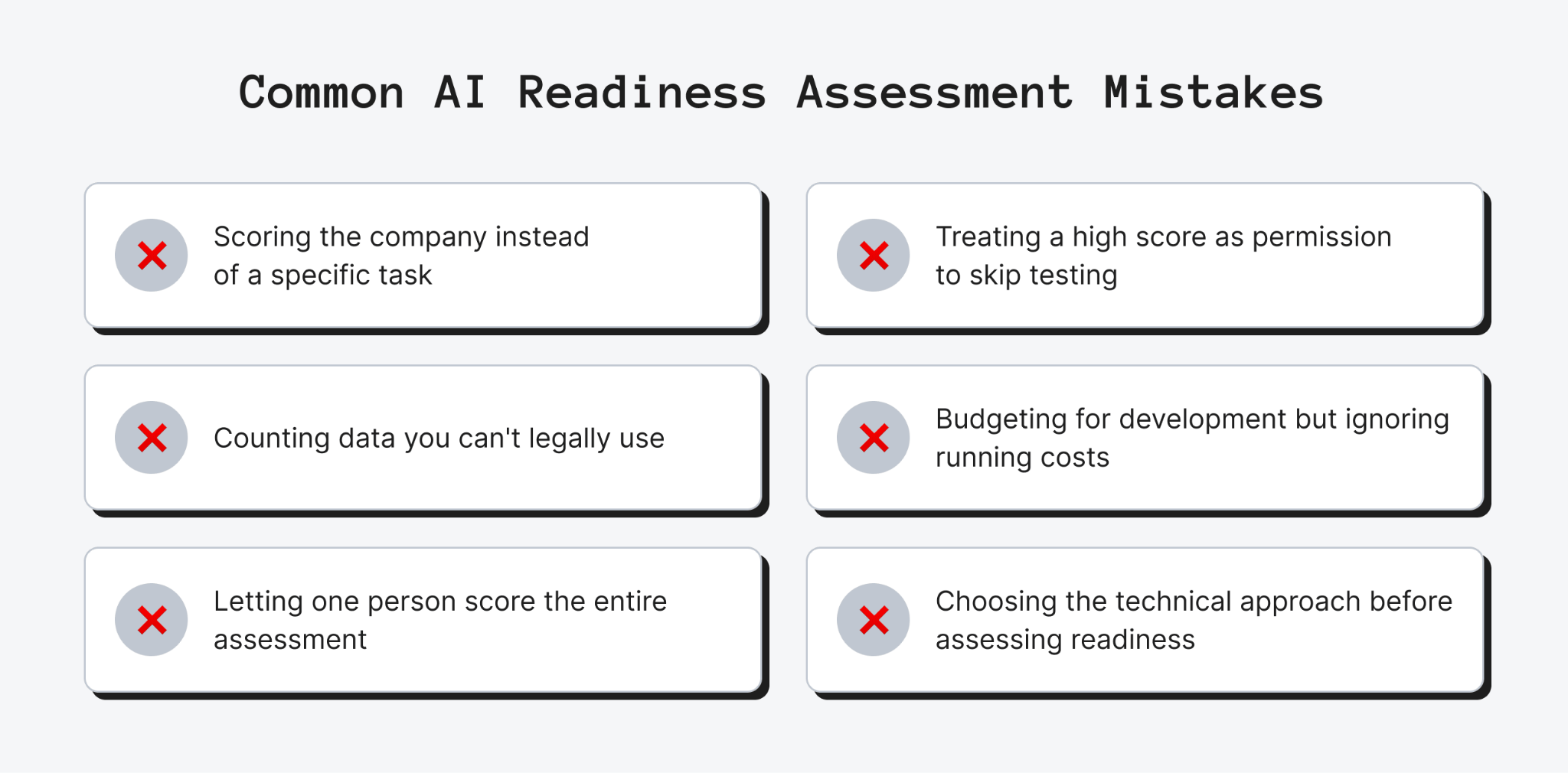
Most AI readiness assessments don't fail because companies lack resources. They fail because the evaluation itself is inaccurate. Certain scoring mistakes can make a business appear more prepared than it really is, leading to premature investments, unrealistic expectations, and avoidable development costs. Here are six common mistakes to watch for and how to avoid them.
1. Scoring the Company Instead of a Specific Task
A company-wide score can hide important differences between departments. For example, a business may have well-organized financial data but poorly documented customer support records. Averaging the two can produce a misleading result that doesn't reflect readiness for either AI use case.
It's better to assess each potential AI initiative separately. You should evaluate the data, workflows, and resources required for one specific task rather than assigning a single readiness score to the entire business.
2. Counting Data You Can't Legally Use
Having access to information doesn't automatically mean a company has the right to process it with AI. For example, client files covered by confidentiality agreements shouldn't count as available data if the relevant contracts don't permit sharing them with an AI provider.
It's advisable to check customer agreements, privacy requirements, and vendor data processing terms before including any information in the assessment. Data that can't legally be used for the intended purpose should receive a score of zero until the necessary permissions are in place.
3. Letting One Person Score the Entire Assessment
A founder may see a promising business opportunity and assume the company has everything needed to pursue it. However, the person managing the actual process may know that important data is missing, workflows aren't documented, or nobody has time to oversee implementation.
For a more balanced assessment, it's better to involve both the task owner and someone familiar with the underlying data. Comparing their scores can reveal blind spots and help establish a more realistic picture of readiness.
4. Treating a High Score as Permission to Skip Testing
A score of 16 out of 18 suggests that a company has strong foundations for an AI project. It doesn't prove that the chosen model will produce accurate results, integrate smoothly with existing systems, or deliver the expected business value.
You should still validate the idea through a proof of concept or discovery phase before committing to full development. The assessment indicates that you're ready to explore implementation, while testing determines whether the proposed solution actually works.
5. Budgeting for Development but Ignoring Running Costs
An AI project doesn't stop generating expenses once the solution is launched. Depending on the implementation, the company may need to pay for API requests, cloud infrastructure, monitoring, maintenance, and model updates.
It's better to include these recurring expenses in the initial budget and estimate how they might change as usage grows. The AI MVP cost guide explains how development and operating costs vary across different project stages.
6. Choosing the Technical Approach Before Assessing Readiness
Some founders start with a preferred solution, such as fine-tuning a large language model, before establishing what the actual use case requires. However, a project that involves answering questions from internal documents may be better suited to retrieval-augmented generation (RAG) than fine-tuning.
You should first clarify the task, available data, and expected outcomes. Once these requirements are understood, it's easier to compare technical approaches and choose one that fits the project.
Two Examples of AI Readiness Assessments for Small Businesses
The same AI readiness scorecard can lead to very different decisions depending on a company's data, resources, and business goals. To see how this works in practice, let's look at two small businesses evaluating potential AI projects. Each example shows how the assessment helps identify bottlenecks and determine the most sensible next step.
Example 1: A Recruiting Agency
A 12-person recruiting agency wants to use AI to generate candidate summaries from CVs and interview notes. Currently, recruiters spend around 40 minutes preparing each summary and produce approximately 60 per month. That's 40 hours of manual work every month, making the process a promising automation opportunity.
However, the assessment reveals that the agency isn't quite ready to start development.
Total: 11/18
Data score: 1/3
Although the total score suggests moving to a proof of concept, the low data score changes the recommendation. The agency should address its data gaps before testing an AI solution.
A practical six-week improvement plan would involve moving interview notes into the applicant tracking system using a standardized five-heading template. The senior recruiter could also select and review 100 previous candidate summaries to create a reliable set of examples for testing. Meanwhile, the operations lead should establish clear rules for handling candidate information and determine which data can be shared with an AI provider.
Once these changes are in place, the agency can repeat the assessment and move toward a proof of concept using consistent, accessible data.
Example 2: A B2B SaaS Startup
An eight-person, seed-stage B2B software startup wants to introduce an AI assistant that answers customer questions using account-specific information. The idea is to help users find relevant data and understand their accounts without contacting customer support.
Unlike the recruiting agency, this startup already has most of the necessary foundations. Its assessment looks like this:
Total: 14/18
With 14 points, the startup is ready to move into discovery. Unlike the recruiting agency, it doesn't need to spend several weeks consolidating its data before proceeding. Its main gap is technical experience with LLM-powered products, alongside questions about response accuracy and operating costs.
During discovery, the team should evaluate the most suitable architecture, determine how the assistant will retrieve account-specific information, estimate the cost per answer at expected usage levels, and define the scope of the first MVP. The engineers' experience gap can also be addressed by involving an external AI specialist or development partner. Understanding which roles and skills an AI development team needs can help clarify which capabilities the company should develop internally and where external support may be necessary.
Both companies have clear business reasons to adopt AI, but their readiness assessments point to different next steps. The recruiting agency needs to improve its data practices before investing in a PoC, while the SaaS startup has enough foundations to begin discovery and address its technical gaps along the way.
This is also why validating the business idea should come before choosing a technical solution. If you're still deciding whether an AI-powered feature solves a real customer problem, a startup idea validation checklist can help evaluate the concept, test market demand, and identify assumptions worth validating before development begins.
How Much Does an AI Readiness Assessment Cost?
The cost of AI readiness assessment services depends on how deeply you need to evaluate your business and who conducts the analysis. For startups and small businesses, the process can range from a free self-assessment using a scorecard to a paid expert audit or structured discovery engagement.
Free self-assessment. A company can evaluate its AI readiness internally using a checklist or scorecard without hiring external specialists. This approach works well when the goal is to identify obvious gaps in data, technology, team skills, budget, and compliance. It typically takes 15–30 minutes and requires input from people who understand the business processes and data involved. The main limitation is that the results depend on how accurately the team evaluates its own capabilities.
Paid AI readiness audit. An external consultant or AI specialist can provide a more detailed assessment of the company's infrastructure, data quality, workflows, technical requirements, and potential risks. Depending on the scope, this may include stakeholder interviews, data reviews, technical analysis, and recommendations for suitable AI use cases. A focused audit can cost anywhere from a few thousand dollars to $10,000 or more. It's particularly useful when a company has several potential AI initiatives or needs an independent evaluation before making a significant investment.
AI discovery phase. Discovery goes beyond assessing readiness. It translates a promising AI use case into a defined development plan. The process typically covers business requirements, technical architecture, data sources, model selection, integrations, project scope, development timeline, and budget. At Upsilon, a two-week Discovery sprint costs $6,000 and helps startups establish what to build and how to approach implementation.
For most small businesses, a free self-assessment is a sensible starting point. If the scorecard reveals significant technical or data-related questions, an external audit can help clarify the gaps. And when the company already has a validated use case and wants to move toward implementation, a structured discovery phase provides a more concrete foundation for development.
Seeking help with building your product?
Upsilon has an extensive talent pool made up of experts who can help bring your AI ideas to life!
Final Thoughts: What to Do After Your AI Readiness Assessment
An AI readiness assessment is a starting point for making informed decisions about AI adoption, not a guarantee that a project will succeed. Its main value is helping you understand what your business is ready for today, where the gaps are, and which investments make sense next. Whether you need to organize your data, experiment with an existing AI tool, or validate a more ambitious idea, the next step should address your most significant readiness gaps rather than rush into development.
If you need expert guidance to turn your assessment results into an actionable plan, Upsilon can help. With experience in AI product development, our team can evaluate your use case, identify technical requirements, and determine the right approach for your project. Our AI readiness assessment services can also help clarify whether you're ready to move forward or need to address certain gaps first.
Ready to explore your AI idea? Start with a two-week Discovery sprint to validate your concept, define the technical scope, and establish a realistic development budget. Or contact our team to discuss your goals and find the right next step for your business.



FAQs
What is an AI readiness assessment?

An AI readiness assessment for business checks whether a company can get value from AI on a specific task, and what has to change first. For a startup or SMB it covers six areas: use case clarity, data, systems and integrations, team, budget and ROI, and risk and compliance. The output should be one next step, such as buying a tool or running a proof of concept, not a maturity label.
How much does an AI readiness assessment cost?
A self-assessment with the scorecard in this article costs nothing and takes about 15 minutes. Free tools from Microsoft and Cisco are also available, though Cisco benchmarks you against companies with 500+ employees. A paid AI readiness assessment service tied to one product idea is part of a discovery phase; at Upsilon, discovery costs $6,000 for 2 weeks and ends with a fixed scope and budget.
What is the difference between an AI readiness assessment and an AI maturity assessment?
An AI readiness assessment asks whether you are ready to start one AI project and what to fix first. An AI maturity assessment measures how far AI use has spread across a whole company, on a scale of four or five levels. Startups and SMBs need the readiness version: the decision in front of them is one use case, not a company-wide program.
What are the five pillars of AI readiness?
Most enterprise frameworks use five or six pillars: strategy, data, technology or infrastructure, people and skills, and governance or risk. Cisco's index adds culture as a sixth. At startup scale, strategy narrows to use case clarity and a budget with a payback estimate, and infrastructure becomes the question of whether your current tools have APIs.
What is a good AI readiness score?
On the 18-point scorecard in this article, 13 or more means you are ready to scope an AI build in a discovery phase, and 7 to 12 means a proof of concept should come first. Below 7, an off-the-shelf tool is the better buy. Any data score of 0 or 1 overrides the total for tasks that depend on your own data.
How long does an AI readiness assessment take?
Scoring the six areas takes about 15 minutes if one person who knows the task fills it in with a domain expert. Checking the data answers takes an afternoon: open the systems, count real examples, and read the vendor terms. A discovery phase that turns a good score into a fixed scope and budget takes 2 weeks.
to top