How AI Reduces Startup Costs: Practical Ways to Cut Burn and Spend


Starting a startup has always meant facing a mountain of expenses. Salaries, agency fees, software subscriptions, and operational costs could quickly consume every dollar, leaving founders constantly worried about running out of cash. Today, AI is quietly changing that story. Startups are discovering that AI cost savings are not just a bonus but a practical way to stretch their runway and reduce financial risk in the earliest stages of growth.
The shift is not about replacing people but about rethinking how work gets done. According to a recent survey, 88% of companies now leverage AI in some part of their operations, often to drive productivity and achieve cost savings. Customer support can be managed efficiently without hiring a full team, marketing campaigns can run without an expensive agency, and data analysis can be handled without a dedicated specialist.
So how does AI reduce costs? By automating routine tasks, speeding up decision-making, and removing layers of tools and manual work that used to drain resources.
On this page, we’ll explore practical ways startups are using AI to lower burn and control spending. You’ll discover the key areas where AI delivers cost savings, a practical 5-step process to improve efficiency, and ways to measure AI ROI to make sure your investments pay off.
Key Takeaways:
- AI as a force multiplier. For startups, AI isn’t just a buzzword, it’s a game changer. By automating repetitive tasks, reducing errors, and speeding up decisions, teams achieve more with fewer resources, stretching a startup budget and accelerating growth without extra headcount.
- Targeted application drives real savings. To truly understand “How does AI reduce costs?”, focus on key areas such as product development, project management, customer support, corporate training, marketing, HR, and finance where AI can deliver immediate, measurable cost efficiency.
- Measure what matters. Track tangible metrics like time saved, costs avoided, errors reduced, and customer outcomes. Even small AI initiatives can deliver strong ROI, making artificial intelligence a cost-effective, strategic asset for startups at any stage.
- Leverage ready-made tools and expertise. Off-the-shelf solutions and partnerships save time and money. With Upsilon’s generative AI development services, startups can quickly move from concept to production, ensuring smooth implementation and avoiding costly missteps.
Why AI Is a Game Changer for Startup Cost Management
Launching a startup has always been a challenge of managing scarce resources while keeping up the pace. Every choice, hire, and tool comes with a price, and early MVP mistakes can quickly deplete funds and hinder growth. Beyond the buzz, startups are discovering that cost savings with AI go far beyond small gains, they can transform the way a business runs, letting teams accomplish more with fewer resources and speed up progress without adding proportional costs.
What makes AI particularly valuable for startups can be summarized in three core strengths:
- Automation: artificial intelligence handles repetitive and time-consuming tasks, freeing founders and small teams to focus on strategy, product development, and growth for startups.
- Speed: AI accelerates workflows and decision-making, allowing startups to move faster than larger competitors.
- Scalability: its solutions grow with the business, delivering increasing value without proportional increases in cost or headcount.
This directly addresses a common concern founders have – “Is AI expensive for startups?”. In practice, one of the biggest shifts AI brings is collapsing the traditional “cost of starting up.” There is less need for large founding teams, massive initial funding rounds, or heavy upfront infrastructure. Many tasks that once required multiple early hires can now be handled with AI tools, letting startups launch an MVP and iterate with a fraction of the resources.
At the same time, AI acts as a new leverage layer for founders. Instead of building entire departments from day one, startups can “rent” capabilities through AI services. This means coding, design, marketing, and support are available on demand, giving founders access to expertise and capacity without the long-term overhead. By turning AI into a force multiplier, startups can focus on strategy, finding a product-market fit, and growth, rather than being weighed down by operational costs.


How Does AI Reduce Costs for Startups?
AI is quickly becoming a critical tool for startups looking to do more with less. Through AI-driven cost reduction, startups can streamline operations, cut unnecessary expenses, and maximize the impact of every team member. Here’s how bringing AI into the mix can help founders achieve quick, meaningful savings.
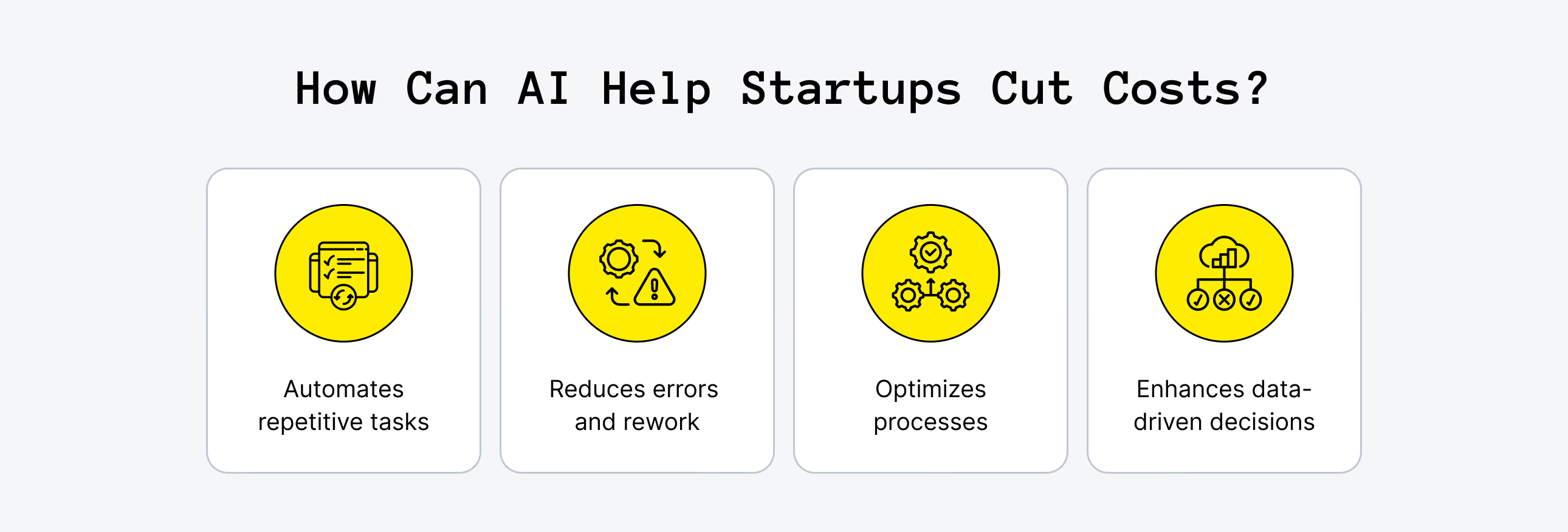
Automating Repetitive Tasks
Artificial intelligence can take over routine and time-consuming work such as data entry, scheduling, content generation, or responding to standard customer inquiries through AI-powered business texting. By automating these tasks, startups not only save labor costs but also free up their teams to focus on strategic priorities. This means a small team can accomplish far more without adding headcount, reducing the need for early hires and allowing resources to be invested where they have the highest impact.
Reducing Errors and Rework
Mistakes in early-stage operations can be expensive, whether it’s incorrect data, mismanaged campaigns, or product flaws. AI minimizes human error by performing repetitive or complex tasks consistently and accurately. This reduces costly rework, prevents delays, and ensures higher quality outputs, directly contributing to lower operational expenses and more predictable outcomes for the business.
Optimizing Processes
AI analyzes workflows and operations to identify inefficiencies, bottlenecks, and redundant steps that are difficult for humans to spot. By streamlining processes and optimizing resource allocation, startups can cut unnecessary spending, improve team productivity, and accelerate time-to-market. This operational efficiency is especially valuable when every dollar counts and rapid iteration is critical. In sales workflows, AI sales roleplay tools further optimize performance by helping teams practice real scenarios, refine messaging, and improve efficiency in handling prospects.
Enhancing Data-Driven Decisions
With the help of AI, startups can make smarter, faster decisions by analyzing large datasets, uncovering trends, and providing actionable insights that would be impossible to detect manually. This means startups can use AI project cost estimation to map out MVP scope, fine-tune marketing budgets, target the right customers, and forecast demand more accurately. By backing every move with real data, AI helps cut costs and makes sure each investment drives the biggest possible return.
Seeking help with building your product?
Upsilon has an extensive talent pool made up of experts who can help bring your AI ideas to life!

Key Areas Where Startups Can Gain AI Cost Savings
AI cost efficiency becomes most visible when startups know exactly where to apply it. Rather than spreading artificial intelligence across every function, successful teams focus on the areas where automation, speed, and smarter decision-making translate directly into lower costs. Let’s take a closer look at the areas where these gains are most effective.
Product Development
This area is one of the most resource-intensive areas for any startup, making it a prime candidate for AI-driven cost savings. AI tools for development can support developers across the entire lifecycle, from writing and reviewing code to MVP testing, debugging, and documentation. This reduces development time, lowers the need for large engineering teams, and helps startups ship faster with fewer iterations.
Artificial intelligence also improves cost efficiency by minimizing rework. Automated testing, code analysis, and error detection reduce bugs earlier in the process, preventing expensive fixes later. For early-stage startups, this means achieving higher output with smaller teams and avoiding the cost of overengineering before product-market fit is validated.
Beyond internal tooling, many startups accelerate results by working with AI-augmented development partners. These companies typically have experienced LLM engineers on board and often come with ready-made, modular AI-based solutions that can help you, for example, deliver MVPs faster while reducing time-to-market risk. And their support is especially valuable when you need to build a custom generative AI solution from scratch. These developments also contribute to ongoing discussions about AI replacing programming jobs and how software roles may evolve alongside increasing automation.
By the way, in this context you might find this handpicked list of generative AI development companies useful. It was selected and ranked by Upsilon’s experts and can help you quickly find the tech partner that’s the best fit for your startup.
Project Management and Resource Allocation
Poor coordination and unclear priorities often lead to wasted time and budget in startups. AI-driven project management tools help optimize task planning, resource allocation, and timelines by analyzing workloads, dependencies, and progress in real time. This allows founders to identify bottlenecks early and adjust plans before delays become costly.
By improving visibility and forecasting, AI helps startups avoid overstaffing, missed deadlines, and inefficient use of talent. The result is better alignment between effort and outcomes, which directly contributes to improved AI cost efficiency across teams.
Customer Service and Support
Customer support can quickly become expensive as a startup grows, especially when handled entirely by human agents. AI-powered chatbots and support systems can resolve a large portion of routine inquiries, such as onboarding questions, order tracking, or basic troubleshooting.
This reduces the need to scale support teams linearly with user growth while maintaining fast response times. AI also helps prioritize complex cases for human agents, ensuring resources are used where they create the most value. For startups, this translates into reliable service quality with significantly lower support costs.

Marketing and Lead Generation
Marketing for startups is another area where costs can escalate rapidly without clear returns. AI helps startups improve targeting, personalize messaging, and optimize campaigns based on real-time performance data. By analyzing customer behavior and engagement patterns, AI reduces wasted ad spend and improves conversion rates.
AI-driven content generation, campaign optimization, and lead scoring allow small marketing teams to operate with the efficiency of much larger departments. This enables startups to test, learn, and scale marketing efforts while maintaining strict control over budgets. Startups can also leverage lead distribution software toefficiently route and manage incoming leads.
HR Management
Hiring too early or inefficiently is a common cost trap for startups. AI supports HR processes by automating resume screening, candidate matching, and interview scheduling, significantly reducing time-to-hire and recruitment costs. Leveraging AI recruitment software helps startups streamline hiring while avoiding unnecessary expenses.
Beyond hiring, AI can assist with onboarding, performance analysis, and workforce planning. This helps startups build lean teams aligned with actual needs rather than projected ones, improving long-term cost efficiency while supporting sustainable growth. For startups that want to launch automation fast without building infrastructure from scratch, an AI agent builder can reduce implementation effort while keeping support experiences consistent as the business scale
Finance Management and Accounting
Financial operations are often manual and error-prone in the development of early-stage startups. AI-driven tools help automate bookkeeping, expense tracking, invoice processing, and financial forecasting. This reduces reliance on external accounting services and minimizes costly errors.
AI also provides better financial visibility by identifying spending patterns, managing renewal automation, forecasting cash flow, and flagging risks early. For founders, this means more accurate decision-making and stronger control over burn rate without adding administrative overhead.
5-Step Process to Achieve AI Cost Efficiency
For startups, the ability to use AI to reduce costs depends less on the technology itself and more on how it is applied. Cost efficiency comes from a structured approach that connects intelligent tools to real business needs, clear metrics, and scalable processes. A phased approach to AI adoption can also help startups introduce automation gradually while minimizing operational disruption and improving long-term efficiency. The following steps outline a practical, scalable approach to long-term cost control.
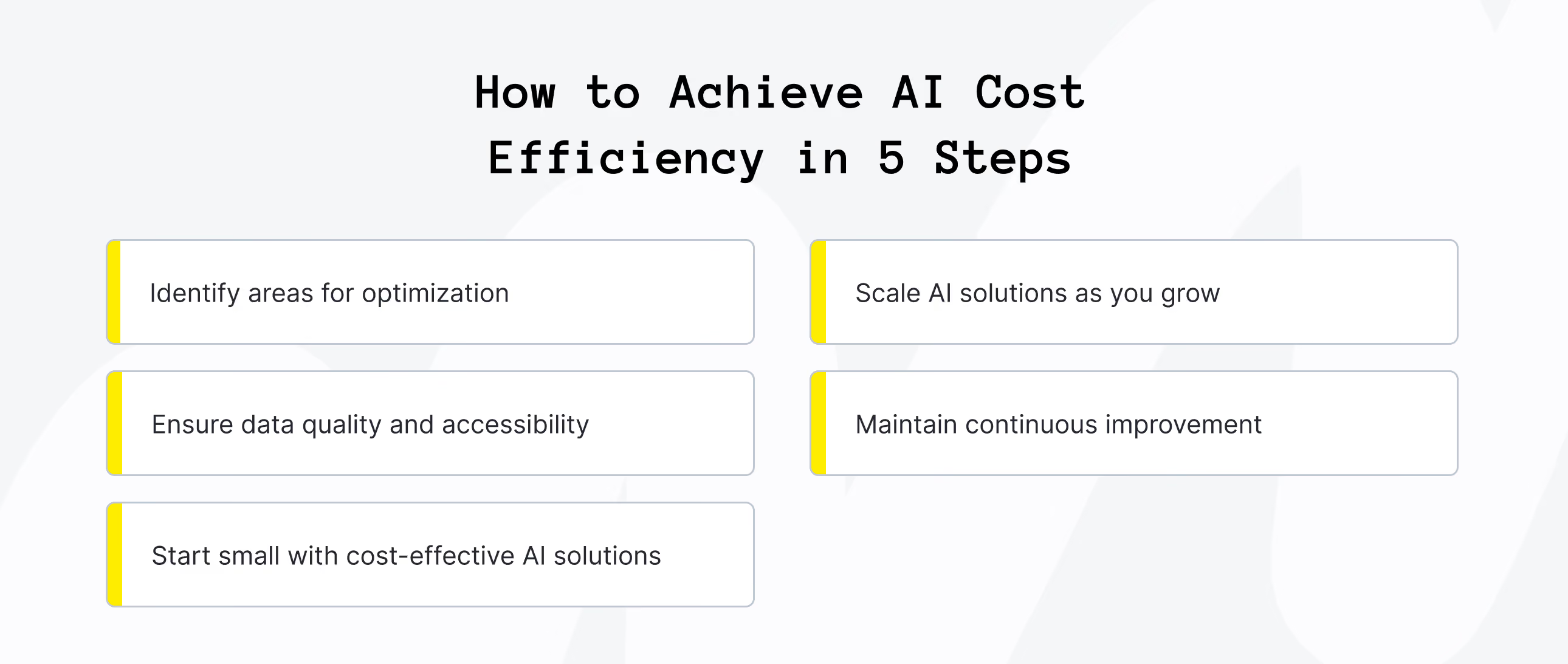
Identify Areas for Optimization
The first step is understanding where artificial intelligence can have the greatest impact on costs. Startups should analyze their workflows to identify repetitive tasks, bottlenecks, and high-effort processes that consume time and budget. By focusing on areas where inefficiencies are most visible, teams can prioritize AI initiatives that deliver fast and tangible cost savings.
Ensure Data Quality and Accessibility
AI systems are only as effective as the data they rely on. Startups should prepare data for AI thoroughly, thus, it’s wise to ensure that the data is accurate, consistent, and easily accessible across teams and tools. Investing early in clean data pipelines and clear data ownership reduces errors, improves AI outputs, and prevents costly rework later as AI adoption expands.
Start Small with Cost-Effective AI Solutions
Rather than committing to large, complex implementations, startups should begin with cost-effective AI solutions that address specific problems. This allows teams to validate value, measure impact, and refine their approach without overinvesting. Starting small helps control risk while building confidence in AI-driven cost efficiency across the organization. Many startups also rely on AI integration services to seamlessly connect AI tools with existing systems, ensuring faster implementation and smoother workflows without increasing operational complexity.
Scale AI Solutions as You Grow
Once AI solutions prove their value, they can be expanded across additional workflows, development teams, or products. Scaling should be guided by performance metrics, cost savings, and operational impact rather than hype. This ensures AI investments grow in line with the business and continue to deliver returns as complexity increases.
Maintain Continuous Improvement
AI implementation is not a one-time effort. Startups should regularly monitor performance metrics, review outcomes, and adjust models or workflows as business needs evolve. Continuous improvement helps maintain AI cost efficiency over time and ensures that AI remains aligned with both growth goals and budget constraints.

How to Measure AI ROI in Your Startup
Measuring ROI from AI often sounds complex, but for startups it doesn’t have to be. Especially at early stages, the goal is not perfect financial modeling, but finding the right balance between the value of tracking and the effort it takes. Overly detailed calculations can quickly become a distraction, while simple, focused metrics are often enough to understand whether AI is delivering real impact.
A good starting point is to track a small set of core indicators that reflect how AI affects costs, efficiency, and outcomes. These metrics are easy to measure, require minimal overhead, and provide clear signals of value:
- Time savings: Measure how many hours are saved by automating tasks or accelerating workflows. This shows how AI increases productivity and reduces the need for additional headcount.
- Cost avoidance: Track expenses that were never incurred thanks to AI, such as delayed hires, reduced outsourcing, or lower infrastructure usage.
- Error reduction: Monitor decreases in mistakes, rework, or failed processes, which often translate directly into cost savings and faster execution.
- Customer metrics: Look at improvements in response time, satisfaction, retention, or conversion rates that result from AI-supported processes.
Once these metrics are in place, calculating ROI becomes much simpler. At a basic level, AI ROI compares the financial benefits generated by artificial intelligence to the total cost of implementing and running it.
A simplified formula looks like this:
(Total Savings + Added Revenue – Total Costs) ÷ Total Costs × 100 = ROI %
- Total Savings include time savings converted into monetary value, avoided hiring or outsourcing costs, and reduced expenses from fewer errors or rework.
- Added Revenue reflects additional income generated through improved customer experience, higher conversion rates, or faster execution.
- Total Costs cover software licenses, infrastructure usage, staff training, and ongoing maintenance.
Example:
An AI-powered customer support assistant handles 15,000 requests over three months, reducing support costs by $2.50 per interaction and generating $6,000 in additional upsell revenue. The total cost of implementing and running the solution during this period is $18,000.
ROI = (($37,500 + $6,000 – $18,000) ÷ $18,000) × 100 = 142%
That’s a 142% return in one quarter, showing how even a targeted AI initiative can deliver meaningful value without requiring large upfront investment.
Expert Tips for Reducing Costs with AI Technology
Knowing how to use AI to reduce costs goes beyond strategy and business frameworks. In practice, real savings come from tactical decisions made during selection, implementation, and scaling. Startups that treat AI as a business tool rather than an experiment tend to avoid common pitfalls such as overengineering, unclear metrics, or premature scaling. The tips below highlight how startups use AI to reduce operational costs through smart, practical choices that minimize startup risks and maximize value.
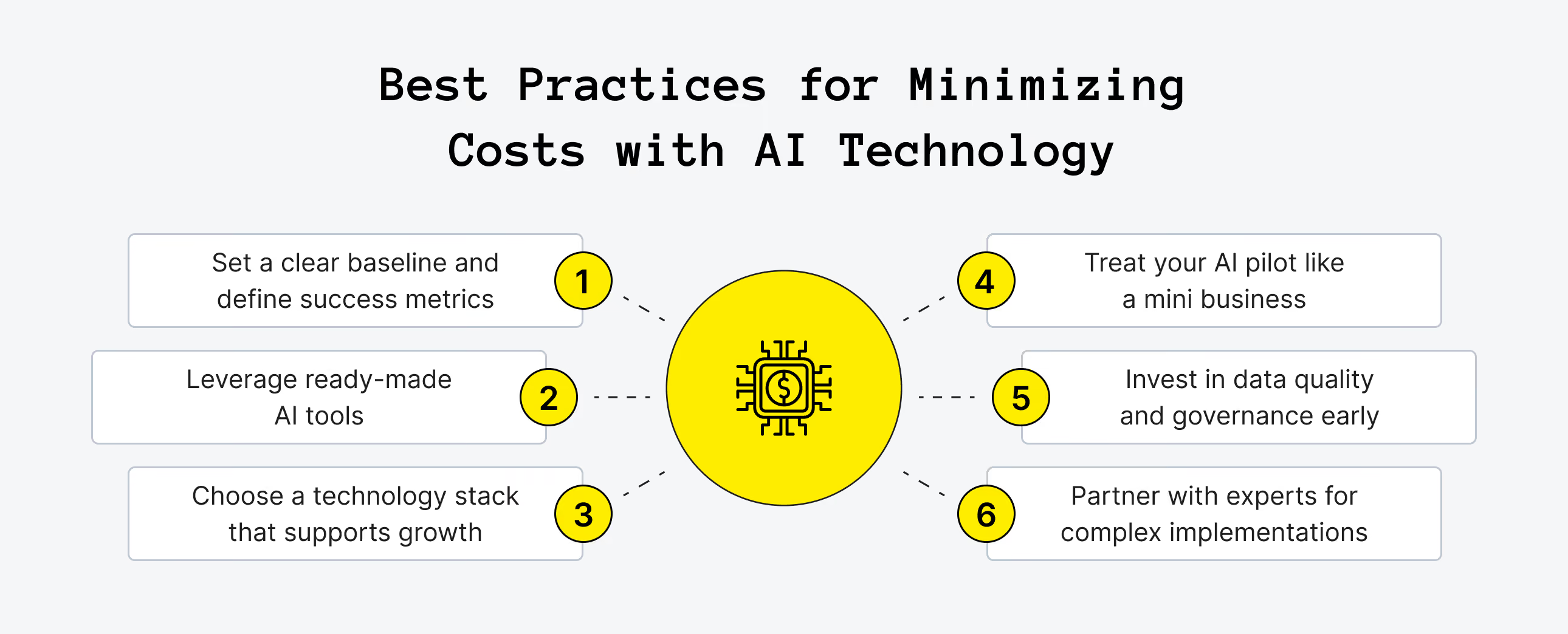
Set a Clear Baseline and Define Success Metrics
Before introducing any AI solution, you should document how things work today. Measure basic indicators such as time spent per task, cost per transaction, error rates, or support resolution time. For example, it’s advisable to track how long it takes a developer to write and test a feature, or how many hours your team spends responding to repetitive customer questions each week.
Leverage Ready-Made AI Tools
One of the most effective ways to use AI to save money in a startup is to avoid building everything from scratch. Many off-the-shelf AI tools already cover common needs such as customer support, content creation, analytics, and workflow automation. Using proven solutions reduces implementation time, lowers upfront investment, and delivers value faster with minimal technical overhead.
For instance, startups integrate ChatGPT into their apps for content creation and internal knowledge support, use Intercom or Zendesk AI for customer service automation, and Notion AI for documentation and workflow support. These tools require minimal setup, cost far less than hiring additional staff, and deliver immediate productivity gains.
Choose a Technology Stack That Supports Growth
For startups, the most important factor isn’t the brand name of a tool, but how well it fits your specific use case. Different AI capabilities serve different purposes: computer vision can streamline inspections both on-site and remotely, forecasting models can optimize inventory, and retrieval-augmented generation helps teams quickly access policies or knowledge. In industries that require compliance and safety checks, fire inspection software systems can also be integrated to automate reporting, reduce manual errors, and ensure regulatory standards are consistently met.
A flexible, modular setup allows you to swap components, adjust model sizes as demand changes, and integrate seamlessly with existing business systems like ERP, CRM, or MES. Keeping your data and embeddings portable also avoids vendor lock-in, ensuring your AI investments remain useful as your startup grows. Partnering with experienced teams, like ours at Upsilon, can help you choose the best tech stack that balances performance, scalability, and cost-effectiveness for the long term.
Treat Your AI Pilot Like a Mini Business
An AI pilot works best when treated as a focused business initiative rather than an open experiment. Choose a narrow use case, set a clear timeline of around six to ten weeks, and define product success metrics from the start. Regular KPI check-ins help teams understand early whether the solution is delivering real value.
To keep costs under control, compare results against a baseline and set a clear “scale or stop” decision point at the end of the pilot. Documenting key elements such as data preparation, prompt or feature settings, quality thresholds, approval flows, and third-party integrations turns a one-off test into a repeatable approach. This makes future AI rollouts faster, cheaper, and easier to scale.
Invest in Data Quality and Governance Early
Cost savings from intelligent systems depend heavily on data quality. A practical approach for startups is to define a “minimum viable data setup” for each use case, including only the data features, validation checks, and access rules needed to achieve the desired outcome. This avoids overengineering while still ensuring reliable results.
Clear data ownership, basic lineage tracking, and role-based access become especially important in areas like finance, healthcare, or safety-critical workflows. Building simple feedback loops that capture user corrections and feed them back into the system helps improve accuracy over time and reduces the cost of errors and manual rework.
Partner with Experts for Complex Implementations
Some AI initiatives, especially those involving generative models, deep product integration, or large-scale automation, require specialized expertise to succeed. Trying to implement these solutions in-house without experience can lead to delays, wasted resources, or suboptimal performance.
Working with experienced teams helps startups avoid these pitfalls, accelerate deployment, and ensure the solution delivers real operational value. At Upsilon, we have extensive experience designing and implementing scalable AI solutions for startups and growing businesses. If you’re exploring advanced AI use cases, our generative AI development services can help turn your ideas into production-ready systems efficiently and cost-effectively.
Looking for a reliable tech partner?
Upsilon can help you develop your product that'll grow to be a success!
Concluding Thoughts on AI Cost Reduction
AI is no longer a futuristic luxury for startups, it is a practical tool for controlling expenses, optimizing workflows, and scaling efficiently. Knowing the right answer to “How does AI reduce costs?” question helps founders make smarter decisions about where to implement it, whether in development, customer support, marketing, or finance.
By automating repetitive tasks, improving decision-making, and reducing errors, artificial intelligence enables startups to do more with less, extending runway and accelerating growth. Observing real-world AI use in startups shows that even early-stage teams can achieve meaningful savings without heavy upfront investment.
For startups with ambitious ideas, particularly those involving generative artificial intelligence, implementation can feel daunting. At Upsilon, our team of experts provides support for turning AI concepts into production-ready solutions through our generative AI development services. Drawing on extensive hands-on experience in gen AI development, we’ve helped numerous startups build and scale their AI products efficiently and with confidence, delivering real results while reducing risks. Don’t be shy to contact us if any questions arise – we’re here to help!
FAQs
1. How does AI help in cost reduction?

So, how does AI reduce costs?Artificial intelligence helps in cost reduction by automating repetitive tasks, optimizing workflows, and minimizing human errors. It also enables faster data-driven decisions, which reduces operational inefficiencies and waste. Overall, AI allows businesses to do more with fewer resources, lowering costs effectively.
2. How much can a startup realistically save by implementing AI tools?
A startup can realistically save between 10% and 40% of operational costs by implementing AI tools, depending on the areas automated. The most noticeable savings usually come from automating customer support, marketing, and inventory management. Over time, these efficiencies can significantly improve the startup’s bottom line.
3. Which industries benefit most from AI-driven cost savings?
Industries like e-commerce, logistics, healthcare, and finance benefit most from AI-driven cost savings. These sectors handle large amounts of data and repetitive tasks, making automation and optimization especially effective. AI helps reduce operational costs while improving speed and accuracy in these industries.
4. What are the common challenges in implementing AI for cost reduction?
Common obstacles in implementing AI cost reduction include high initial setup costs, poor data quality, and difficulty integrating artificial intelligence with existing systems. Startups may also face a lack of in-house expertise to manage and maintain AI solutions.
5. Should startups build, buy, or partner for AI solutions?
Most startups are better off buying or partnering for AI solutions rather than building them from scratch. This approach reduces upfront costs, speeds up implementation, and allows the team to focus on core business growth. Building in-house is usually only practical for startups with strong technical expertise and sufficient resources.



to top