How to Rescue a Failing Software Project Before It’s Too Late


A 2025 study published in the Systems journal reveals some sobering numbers: 50% of all projects go over budget, and almost 20% fail to deliver on their goals. Taken together, it’s no wonder that roughly 75% of software initiatives are seen as unsuccessful.
For startup founders and engineering leaders, project issues aren’t a matter of if — they’re a matter of when. The real challenge is how fast and effectively you react once the warning signs appear, before a small setback turns into a full‑scale project crisis.
That’s where a structured software project rescue comes in. It provides a clear, methodical way to stabilize the situation, regain control, and prevent further damage. In this guide, we’ll break down what a software project recovery plan actually involves, how to recognize when you need it, and the steps required to execute it successfully.
Key Takeaways
- Software projects often fail due to compounding delivery and communication issues.
- Rescue focuses on stabilizing delivery, not rushing fixes.
- Early intervention preserves scope, budget, and team morale.
- An in-depth audit and clear plan lead to steady progress.
- A rescue needs an endpoint, so you’re not stuck in emergency mode.
What Is Software Project Rescue and When Do You Need It?
In the fast-paced world of SaaS development, even the most promising software can veer off track due to missed deadlines, declining code quality, growing technical debt, and mounting frustration across teams. Founders usually feel that something is off long before the situation becomes critical, but they may not know exactly how to rescue a failing software project effectively. When it happens, bringing in an outsourced development team becomes the fastest way to get back on track. Before defining what this support looks like, it helps to understand why it becomes necessary.
Software Project Rescue: Clear Definition for Founders
Software project rescue is a corrective process that steps in when a software development project starts struggling or failing. When things start to slip, teams often feel stuck between two bad options:
- abandon the software project entirely;
- rush into fixes without a clear plan.
But both paths increase risk. Software development project rescue takes a different approach. It replaces panic decisions with a structured recovery plan.
The first step is a technical and process assessment, a deep look into both your system and how work flows through it. The goal is to uncover what’s broken and what can still be saved. This means conducting code audits, reviewing the delivery pipeline, and applying project workflow tips to identify and eliminate bottlenecks such as performance issues, architecture debt, or inefficient engineering practices.
Just as importantly, a thorough rescue plan tackles the organizational issues that caused those problems. Common culprits often include:
- poor visibility into progress and risk;
- bottlenecks or broken handoffs between teams;
- conflicting priorities;
- unclear ownership;
- weak planning.
The rescue itself is the corrective process that follows. Using insights gathered from the assessment phase, the team decides whether a full product redesign or just some targeted fixes are needed. It’s about figuring out what’s worth keeping, what needs improvement, and what should be dropped for good. By doing this, the team shifts its focus from “catching up” to restoring control over scope, timelines, and quality.
Project Rescue vs Rebuild vs Upgrade
Choosing the right path forward depends entirely on the health of your existing assets and your long-term goals. While they may sound similar, software project rescue is not the same as rebuilding or upgrading a product — each path is designed to solve a fundamentally different problem.
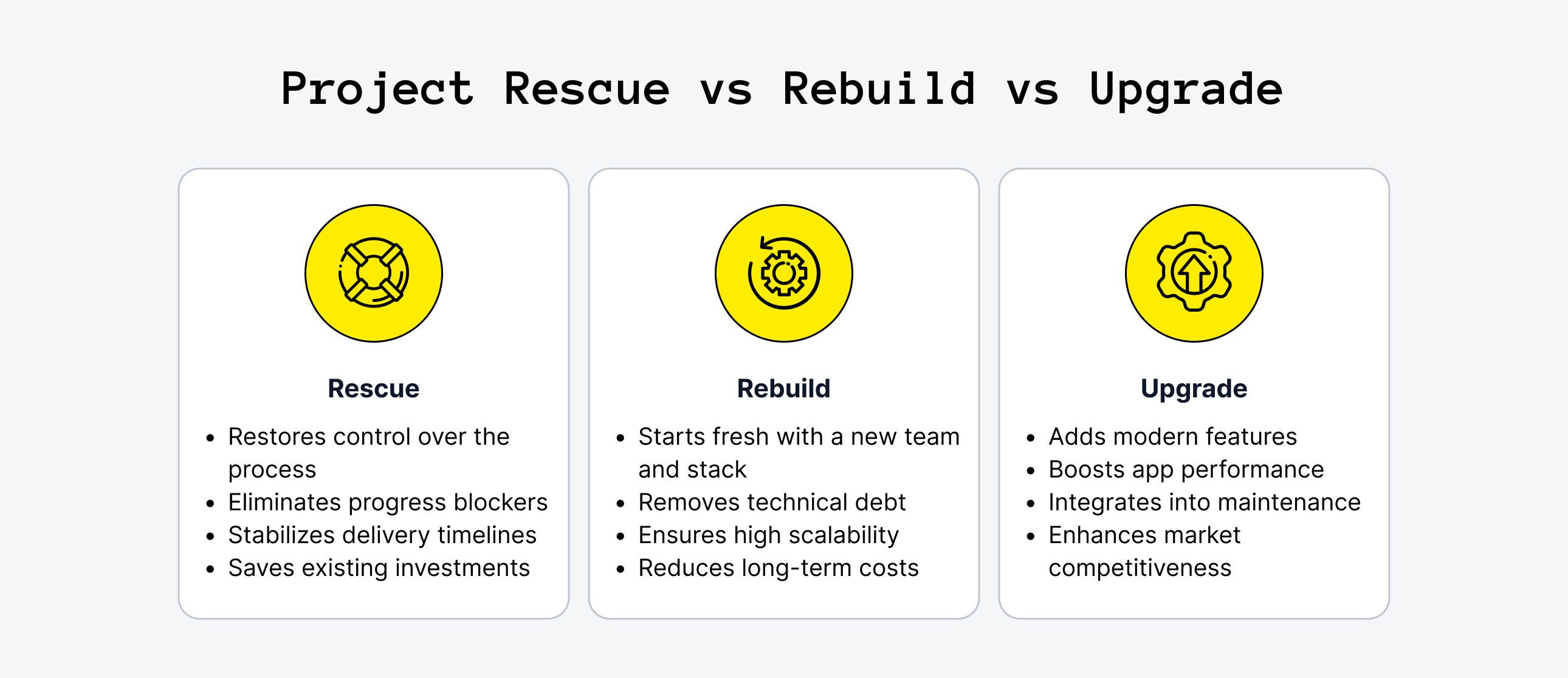
- Software project rescue restores control when a software project struggles. It stabilizes delivery, fixes progress blockers, and resets scope. This supports teams to move forward without starting over.
- A rebuild means starting from scratch with a new team or tech stack because the old code is too broken to save. This is the best move if fixing the current system is more expensive than replacing it. While a rescue fixes what you have, a rebuild clears the slate to create something more scalable and secure.
- An upgrade adds features or enhances a healthy project — and can actually be part of app maintenance. This process doesn’t change how the project is run.
Understanding these distinctions allows leadership to make the right call: if you need to restore control and stop a "death spiral" while saving your investment, you need a rescue. If your foundation has become a liability that prevents growth, a rebuild is the only path forward. And if your project is still functional, making some improvements will be enough.


Early Signs Your Software Project May Need Rescue
The first signs of software project failure often show up long before things become critical but they’re easy to overlook in the moment. Spotting these red flags early gives founders a chance to step in before the project drifts too far off course.
Here’s what to watch out for:
- Lack of delivery clarity: Teams struggle to explain what’s finished or what might break next. This often signals gaps in tracking, ownership, escalation paths, and overall project management.
- Mounting technical debt: Quick fixes might solve problems fast, but they make every new change harder. Each release takes more effort and comes with more uncertainty. And here’s the thing — a 2025 study by Edbert et al found that most quick compromises don’t match the project’s overall architecture and are usually oversimplified. That’s how technical debt keeps piling up.
- Uncontrolled requirements and changes: New features and changes enter mid-stream. Timelines stretch, and priorities blur.
- Repeated deadline slippage: Developers consistently push deadlines and fail to complete tasks on time, all while providing vague or defensive explanations for the delays. Instead of addressing the root causes, managers squeeze schedules even tighter, ultimately breaking the delivery process and making long-term success impossible.
- The budget is draining — no tangible results: When costs rise without a single feature to show, managers’ confidence in the development process quickly disappears.
- Chronic firefighting mode: Engineers have to jump from one urgent crisis to another, working in a state of constant stress. This leaves them with no time to stabilize the architecture or perform planned system improvements. It becomes a vicious cycle: the more you "fight fires" today, the more you create for tomorrow.
Detecting these early warning signs is often the most challenging part of the process, as they tend to blend into the daily noise of development. However, identifying them early provides a unique window of opportunity. At this stage, the project doesn't necessarily need a total teardown; a strategic upgrade is often enough to restore momentum and protect your investment before those small cracks widen into something bigger.
The real challenge is that most warning signs are symptoms, not root causes. To uncover what’s truly behind them, you need to dig into your project’s underlying structure and internal processes. And that’s exactly what we’ll explore next.
When to Use Software Project Rescue Services
As we mentioned earlier, understanding the deeper context of how your project operates — from decision‑making loops to cultural bottlenecks — is the only way to tell whether a quick fix will be enough or if it’s time to start a full software project rescue. So, let’s take a closer look at the parts of your project that might be quietly shouting it’s time to bring in professional software project rescue services.
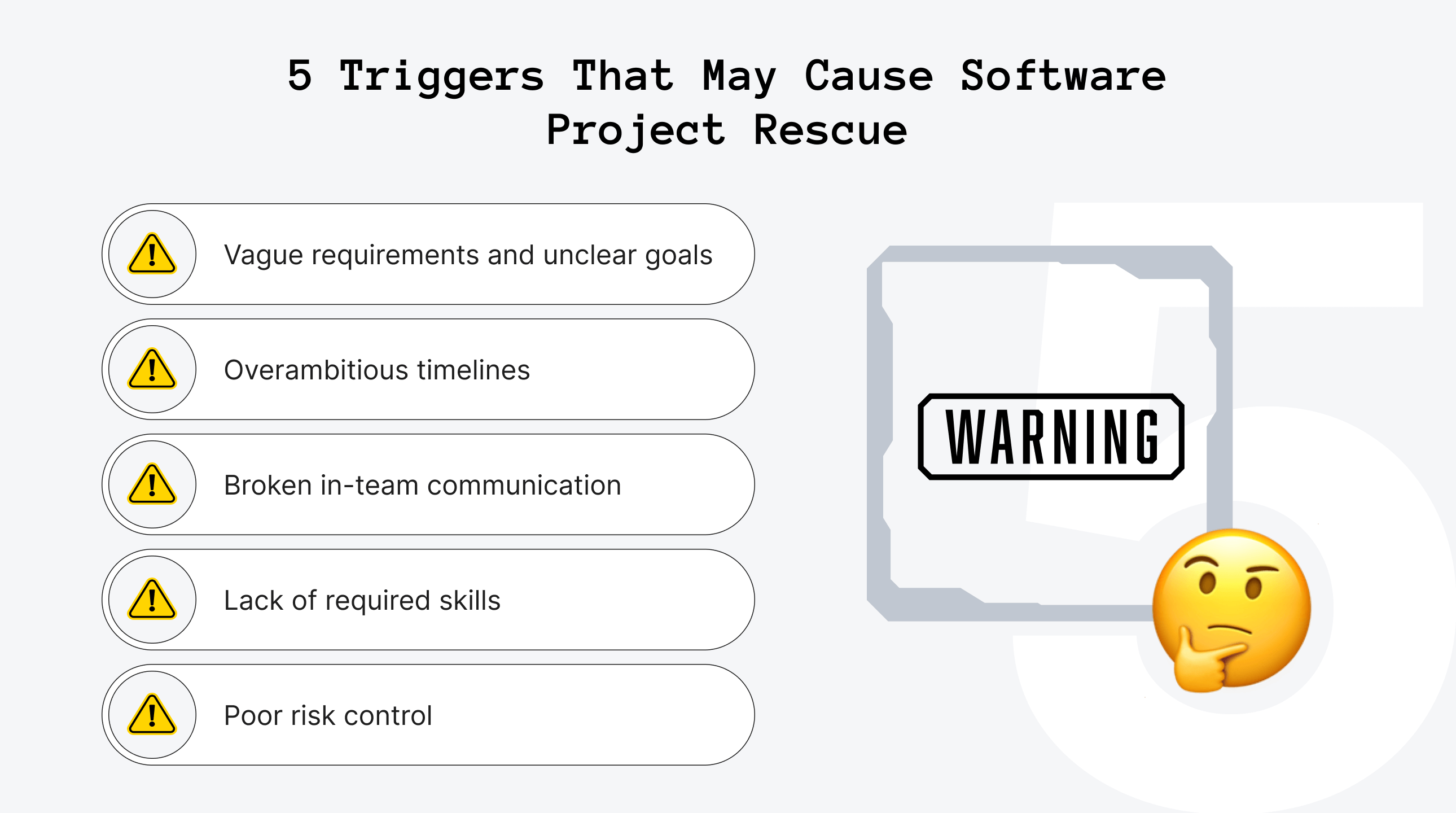
Vague Requirements and Lack of Clear Project Goals
Many projects start without a shared understanding of what a successful outcome should look like. Developers receive tasks, but no one explains the criteria that define “done” or “done right.” As work progresses, goals shift, the backlog grows, and the overall focus slowly fades. What’s more, the performance monitoring system is failing because the staff ignores key metrics or even manipulates them to hide real issues.
Roadmaps Are Driven by Ambitions Rather Than Reality
Unrealistic expectations are one of the most common reasons software projects fail. Teams create and approve product roadmaps long before real technical challenges surface. Instead of adjusting timelines, founders try to speed up later phases to stay “on schedule.” As a result, there’s no time for proper refinement, and technical debt accumulates rapidly.
Broken Communication between Teams
Even strong teams struggle when there’s no clear decision‑making within the startup org structure. When business, management, and engineering operate in separate bubbles, critical information reaches others too late to influence the project. Status updates lose meaning and become routine, while real issues stay hidden until they escalate into a full‑blown crisis.
Internal Team Misalignment and Skill Gaps
Another common source of trouble is an unbalanced team. Every project needs people with the right expertise who can spot risks and bottlenecks early. When such specialists are missing, the team stalls — instead of finding effective solutions and moving the product forward.
Siloed Risk Management
In many teams, risk management is little more than passive observation. People notice potential threats but don’t treat them as actionable signals. Early warnings are dismissed as noise, and responsibility for addressing issues becomes blurred. Mature teams behave differently: they’re willing to pause development if quality or security is at risk. Where this culture is missing, risks accumulate quietly until they turn into expensive crises that require major intervention.
When these signs stack up, you’re seeing a slow march toward complete software project failure. The question is how can startups reduce the business risks before it’s too late? The answer lies in a clear, well-structured software project rescue strategy. Let’s break down how it works.
Tired of battling a failing project all by yourself?
Partner with Upsilon to stabilize your development, mitigate risks, and finally hit your launch goals.

Software Project Rescue Strategy: 5 Essential Steps
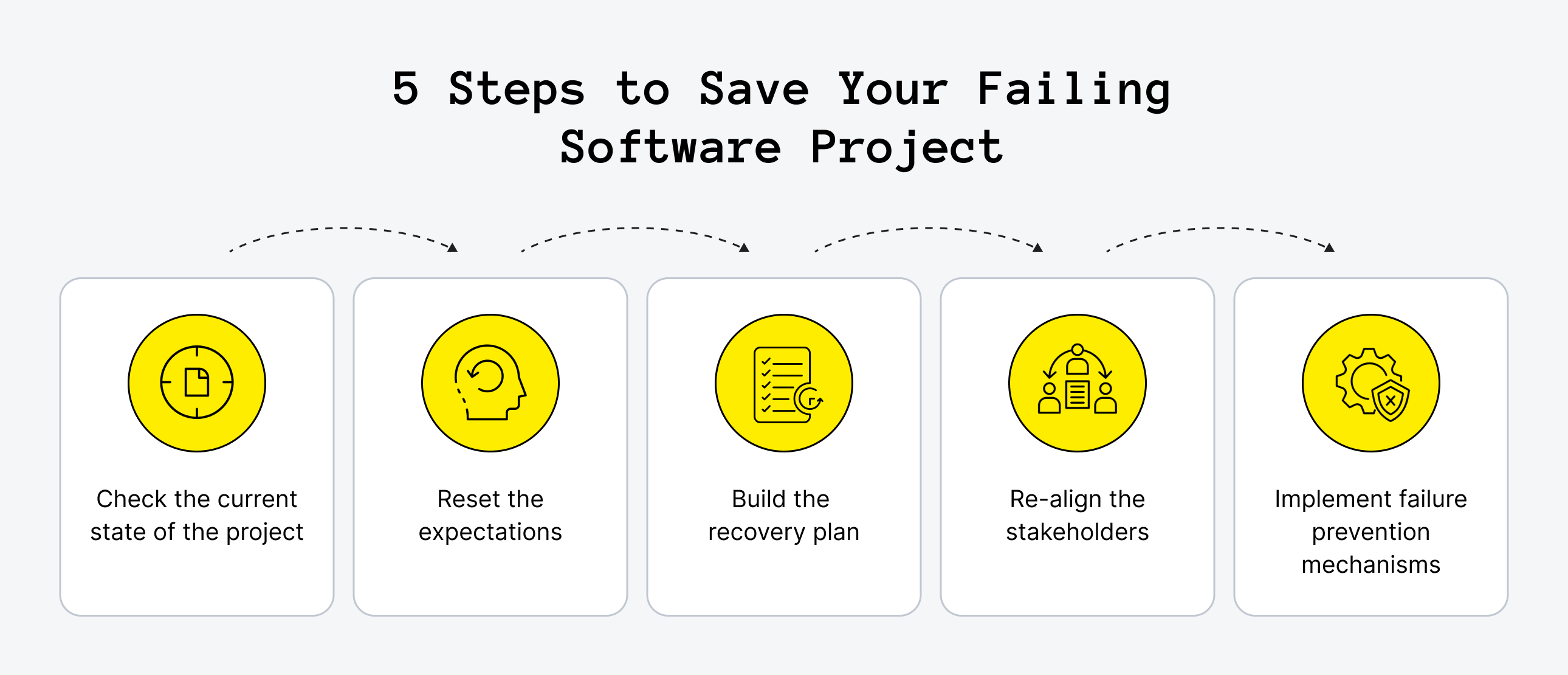
A solid rescue plan isn’t about “finishing everything as originally planned”. It’s about stabilizing the project, rebuilding stakeholder trust, and delivering real value within the new constraints. Here’s what typically goes into the rescue planning process:
Step 1: Conduct a Software Project Audit
Start with a software project audit. This shows you what’s really happening. Look for risks that block progress at both the technical foundation and project workflow level. To do this, assess:
- software testing coverage and reliability;
- code quality and maintainability;
- deployment and release setup;
- data flows and integrations;
- software architecture;
- legacy systems;
- tech stack.
You also need to surface delivery gaps, like unclear ownership or weak project management. These factors are often the root cause of your technical issues.
Step 2: Reassess Goals, Scope, Timeline, and Budget
Once you have a clear understanding of your project’s current state, it’s time for a full project re-estimation: goals, scope, timelines, and budget. Base this reassessment on actual progress rather than early optimism. If deadlines continue to slip, the team should either reduce the scope or divide the work into smaller, achievable milestones that can be delivered more quickly.
If funding becomes part of the challenge, focus on stabilizing delivery first and ensuring the resources are in place for corrective work. It can also help to model different financing options to see how repayment might affect your budget before making any major commitments. Tools like a SBA loan payment calculator can be useful for exploring these scenarios.
Step 3: Build a Software Project Recovery Plan
At this stage, you should turn all the insights from the audit into clear, actionable steps, grounded in proven project management principles.
Based on our experience, for a recovery plan to be both realistic and achievable, you need to take a series of deliberate, structured steps:
- Define your priorities first. You need to identify the tasks that require immediate attention. List every bug, unfinished item, and missed deadline, then filter them thoroughly. The most important thing is not to tackle everything at once — focus on the issues that are most critical to the project's success.
- Assign clear ownership. When a project stalls, it’s often because the wrong people are tackling the wrong tasks. Reassign tasks so that your most experienced team members are handling the complex issues. If your team lacks specific expertise, don’t hesitate to bring in external consultants for a short period. The primary goal here is to eliminate the bottleneck, wherever it may be, and empower the team to work at full capacity.
- Establish сlear сommunication. Once you have reassigned tasks, you must establish a transparent exchange of information. Your staff needs to understand what is being fixed right now, why plans have changed, and what goal you are working toward. Regular sync-ups and honest feedback eliminate fear and uncertainty. When people see the real picture (even if it’s a difficult one) they work more cohesively and feel a sense of ownership in rescuing the project.
- Break the necessary work into achievable steps. A massive rescue plan can be intimidating due to its scale. Break it down into short, clear phases with firm deadlines. Set specific timeframes for every stage from fixing key bugs to stabilizing the architecture. This creates healthy pressure and prevents the team from getting distracted by minor details again.
- Adopt agile methodologies. Agile practices allow you to quickly respond to issues. Instead of spending months preparing a perfect release, deliver improvements in small increments. Short daily meetings help identify roadblocks immediately, while weekly reviews let you pivot your strategy in a timely manner. This approach enables the project to do more than just survive. It allows it to constantly evolve and adapt to market demands.
Step 4: Communicate the Plan and Align Stakeholders
Even the most robust recovery plan will fail without full alignment. This stage is about rebuilding trust, reducing friction, and ensuring every stakeholder understands the new trajectory.
To achieve this, focus on the following:
- Clarify the "Why": Transparently explain what is changing and the data-driven reasoning behind these decisions.
- Define key product performance metrics: Demonstrate exactly how you will track progress moving forward, using clear KPIs and milestones.
- Establish accountability: Clearly define new roles and responsibilities to eliminate overlapping tasks or gaps in ownership.
- Centralize information: Instead of overwhelming the team with constant meetings (by the way, you need them as it was mentioned above, but keep it balanced), leverage intranet software platforms to create a single source of truth for project updates, documentation, and real-time reporting.
By maintaining this level of transparency, you transform stakeholders from cautious observers into active supporters of the project’s rescue.
Step 5: Add Failure Prevention Measures
Once the project is back on track, the next task is making sure it stays that way. To avoid slipping into the same problems again, you need to set up long‑term safeguards. They can include:
- identifying main factors affecting costs and applying cost reduction strategies;
- using risk‑management practices and continuous threat exposure management to spot potential issues early and cut uncertainty;
- introducing a clear change‑request process to control scope and keep delivery predictable;
- running regular code audits to maintain quality, avoid technical debt, and keep long‑term costs down;
- setting up an early‑warning system to catch deviations before they turn into real trouble.
When these habits become part of your everyday workflow, the lessons from the rescue don’t fade — they become part of how your organization operates. This protects not just the current project but strengthens your ability to avoid similar failures in the future.


Practical Tips to Implement Your Software Project Rescue Plan
Once your recovery plan is ready, the real challenge begins: execution. This phase often unfolds under pressure, with limited time, tight budgets, and low stakeholder confidence. Easier said than done, right? That’s exactly when hand-on experience of digital product studios truly makes a difference.
Teams that have launched dozens of their own and client products know what it’s like to be on the edge of failure. In this guide, we’ve gathered the most practical tips on how to implement a software project rescue plan effectively. Here they are:
Treat the Rescue as a New Software Project
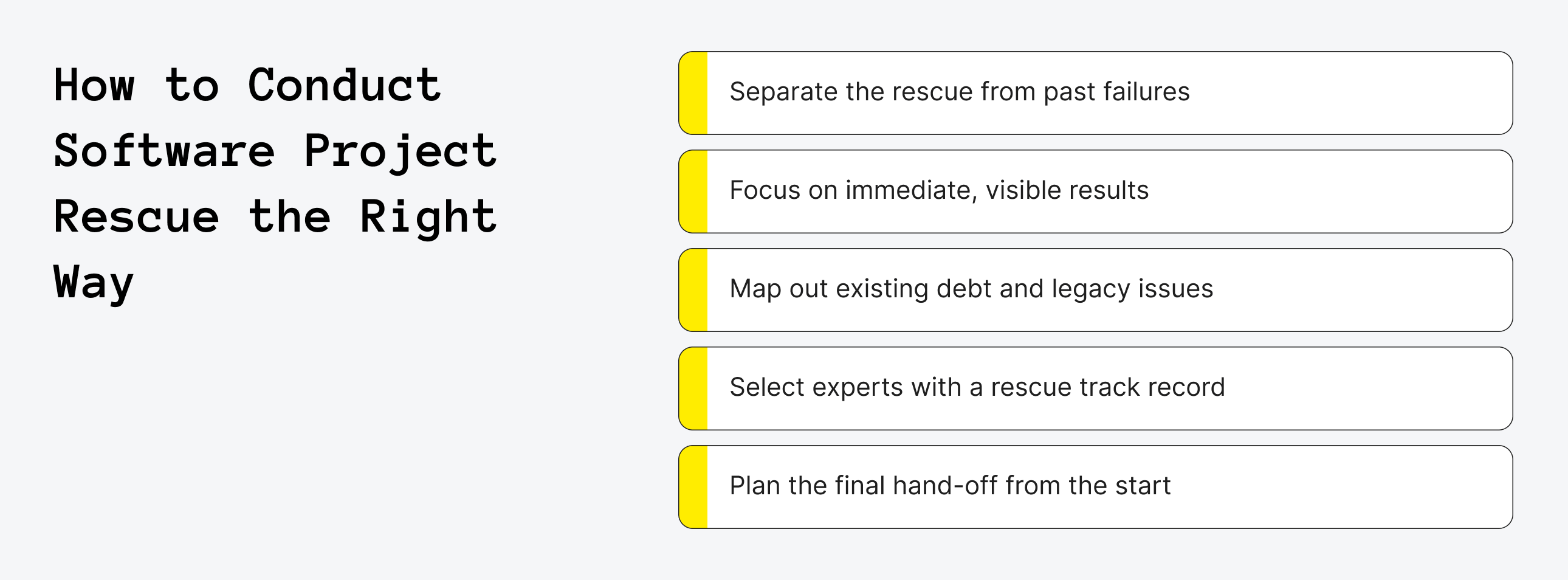
The fastest way to fail a rescue is to treat it like a patch on the old plan. A software project rescue works best when teams approach it as a fresh start — a clean slate. This means creating new assumptions, timelines, workflows, and constraints. This reset helps you step away from sunk costs. Instead, you’re focusing on what’s realistically deliverable now.
Prioritize Quick Wins and Critical Fixes First
Early momentum matters. With this in mind, focus first on fixes that reduce risk or unblock delivery. These quick wins restore confidence and create breathing room for larger improvements, provided you resist the urge to tackle everything at once and risk slipping back into overload.
Document Technical Debt and Shortcuts
Rescue efforts often uncover years of technical debt, architecture debt, inefficient workflows, and rushed decisions. Documenting these issues gives you visibility into what’s slowing you down and why. To do this properly, you need to track technical shortcuts and prioritize the most harmful ones. This allows you to make informed tradeoffs, so debt doesn’t grow unchecked.
Choose an Experienced Software Rescue Partner
Not every startup has the skills or capacity to handle a rescue project alone. A reliable dedicated development team brings technical depth and firsthand experience dealing with project setbacks, so they can make the tough calls when it counts. Look for teams that ask the right questions, run structured audits, and communicate transparently with stakeholders. If they’ve also launched their own products and lived through near‑failures themselves, that matters more than a low price or fast promise.
Define an Exit Strategy
A project rescue is a targeted operation, not an endless marathon. Without a clear finish line, you risk being stuck in firefighting mode for months, draining both your budget and your team’s morale. An exit strategy ensures you know exactly when to transition back to normal operations or when to call it quits.
How do you know it’s time to end the rescue phase?
- Define "Done": What specific metrics signal that the project is saved? For example, zero critical bugs, all core features functional, and a stable development velocity.
- Set a checkpoint: Agree on a deadline (say, in two months or after three sprints) to have an honest conversation: "Are we actually moving forward, or are we just treading water?"
- Assign a decision-maker: You need someone with a cool head to make the final call based on facts rather than emotions or the fear of admitting failure.
Sometimes, during the rescue process, it becomes clear that the project simply isn't viable. A professional approach requires you to pre-plan two tough but necessary scenarios if the rescue plan fails:
- Project shutdown: If the cost of recovery outweighs the potential profit, the best move is to shut it down. It’s better to stop now than to keep pouring resources into something that provides no value.
- Vendor takeover: If you realize the current team or partner cannot meet the new standards even after all the fixes, your exit strategy should be a full handover to a different vendor who specializes in complex project turnarounds.
An exit strategy turns a rescue mission from a gamble into a disciplined project with a clear finale. You either regain control, or you make the strategic choice to change course entirely.
Looking for a rescue partner?
Contact Upsilon today to identify the bottlenecks and implement a strategic recovery plan before it’s too late.
Final Thoughts
Rescuing a failing software project means clarity, structure, and decisive action. Most troubled projects can be brought back on track once teams stop guessing, surface the real issues, and commit to a disciplined recovery plan. The earlier you act, the more of your original vision, budget, and momentum you can preserve.
A successful software project rescue rebuilds trust, restores alignment, and gives your team a healthier foundation for long‑term growth. Whether you’re dealing with slipping timelines, mounting technical debt, or a roadmap that no longer reflects reality, the path forward is the same: understand what’s broken, reset expectations, create a solid recovery plan, and start executing it with focus and confidence.
Most importantly, a rescue is not a permanent state. Its purpose is to guide the project out of crisis and return it to predictable, sustainable development. With the right structure, the right expertise, and the right mindset, even a struggling project can become a strong one again — and often stronger than before.
If you recognize the early warning signs in your own project, don’t wait for the situation to become irreversible. Our team has rescued more than a few complex software projects, so we know exactly what kind of challenges startups run into. Feel free to reach out to discuss your options, and let’s breathe some new life into your project together.
FAQ
1. What is a software project rescue, and when does a failing project actually need one?

A software project rescue is a structured rescue process for failing projects. Teams usually need it when progress feels risky. This might manifest as missed deadlines, poor user experience, or repeated communication breakdowns. But it’s not a guessing game. The software rescue process uses root-cause analysis, code review, and performance audits to identify blockers. This helps founders understand how to fix it without causing more disruption.
2. When is it better to rescue a software project instead of starting from scratch?
Having someone take over a failed software project makes sense when your core product vision still holds and parts of the system are usable. If the architecture supports future growth, rescues save time and cost. Starting from scratch is usually the last option. You only want to do this if the foundation can’t viably support delivery.
3. How long does a typical software project rescue take?
If you need to rescue a software project, note that most recovery efforts take between a few weeks and a few months. It depends on the scope and complexity of your project. Early phases focus on assessment, while later stages apply fixes using proven recovery frameworks. The goal is steady progress, not rushed delivery.
4. How much does a software project rescue cost?
Costs vary based on the development team size, technical debt, scope of your project, and delivery gaps. Smaller rescues may focus on targeted code review and planning. Larger efforts include architecture fixes and process changes. In most cases, rescue costs far less than restarting a project from zero.



to top