Top SaaS Development Companies for Startups


Building a SaaS product in 2026 is a completely different game than it was even two years ago. The days of throwing spaghetti at the wall to see what sticks are over. Investors are tighter with their wallets, users are more demanding about UX, and if your product doesn’t have at least a hint of AI integration, you’re likely already behind the curve.
According to recent forecasts, the global SaaS market is projected to hit nearly $375 billion this year. That’s a massive pie, and everyone wants a slice. But having a good idea isn't enough anymore. Execution is the only metric that matters.
For a non-technical founder (or even a technical one who is busy raising capital), choosing a SaaS development company is the single biggest risk factor. The wrong choice can drain your startup budget before launch. The right one can help you build a robust, scalable product that delivers recurring revenue long after the initial release.
In this guide, we’ll break down SaaS software development companies that have proven experience building real products for startups, not just delivering slide decks and invoices. You’ll also discover how to choose the right development partner, what red flags to watch for, and how much it realistically costs to build a SaaS product in 2026, so you can plan your budget with confidence and avoid expensive MVP mistakes.
How We Selected the Best SaaS Development Companies
The market is crowded with agencies that look impressive on paper, promise fast delivery, and showcase glossy portfolios, yet very few consistently deliver scalable SaaS products that survive real-world startup pressure. That’s why we approached this list with a healthy level of skepticism. Instead of relying on brand awareness, paid placements, or surface-level reviews, we’ve focused on three core layers:
- SaaS DNA check: Agencies that just build marketing sites or one-off projects didn’t make the cut. Priority went to teams with proven experience in true SaaS architecture, including multi-tenancy, scalable backends, and subscription-based business logic, which are clearly reflected in their case studies.
- Startup friendliness: Not every development firm understands the realities of early-stage startups. Preference was given to companies that regularly work with Seed and Series A teams, can operate within a limited startup runway, and adapt quickly to pivots in business without derailing timelines or budgets.
- Reputation and reality: Ratings and reviews were double-checked. Clutch scores were compared with verified client feedback, paying close attention to communication, transparency, and support after MVP launch, not just flashy sales promises.
Comparative Matrix: Top SaaS Development Companies for Startups in 2026
If you’re skimming this article between investor meetings, this table is for you. It highlights the essential stats and capabilities of leading SaaS development companies, so founders can quickly see which teams are best suited for building SaaS product ideas. Use it to quickly compare expertise, startup experience, and pricing insights, everything needed to start building a shortlist without getting lost in endless portfolios.
Note: Ratings and rates are based on public data available on Clutch and company profiles as of early 2026.
The data shows a clear trend: you don't need to pay $150/hr to get high-quality code from a SaaS product development company, but going too cheap also means sacrificing communication quality. The sweet spot for most funded startups remains in the $40–$80 range, where you get senior talent without the Big 4 consultancy markup.
Top SaaS Development Companies for Startups (2026 Edition)
Here is the deep dive. We’ve looked at what makes these best SaaS development companies tick and why they might be the right partner for your MVP stage of growth.
Upsilon
- Team size: 60+
- Hourly rate: $25–$49
- Client rating: 5.0
- Key services: Discovery phase, MVP development, SaaS architecture, generative AI integration, team augmentation
Upsilon is a SaaS development company that is more like a co-founder than a vendor. The company focuses on early-stage startups and growth-stage companies that need to move fast without sacrificing stability. Its tech stack is modern (Python/Django, React, Node.js), and its culture is built around transparency. Clients get production-ready code, a dedicated Slack channel with direct access to developers, and a project manager who understands business logic, not just tickets.
For teams that need more than individual developers, Upsilon provides flexible team augmentation services. A fully integrated, experienced team can be brought in to treat a SaaS product as its own, ensuring consistent high-quality delivery, as showcased on their products page. Alternatively, if you need only a few specialists with a specific stack, developers can be added on-demand, providing European-level expertise at competitive rates without any long-term commitment.
Upsilon stands out by addressing one of the biggest outsourcing pain points: pricing uncertainty. The sprint-based pricing model means you know exactly what you’re paying for every two weeks. No hidden fees, no scope creep surprises.
Plus, Upsilon’s recent expansion into Generative AI integration has positioned the company as a strong choice for founders looking to embed LLM-powered features into their SaaS products.
Dreamix
- Team size: 250–999
- Hourly rate: $25–$49
- Client rating: 5.0
- Key services: Custom software development, AI development, accelerators
Dreamix is a Bulgaria‑based SaaS and custom software development company that’s been building products since 2006 and now operates as part of Synechron’s global technology group. That mix of boutique roots and enterprise backing is useful if you’re aiming beyond an MVP and need a team that can handle complex, regulated domains like fintech, regtech, aviation, transportation, pharma, and healthcare.
For founders, the real value is in how they work: engineers who challenge requirements, think in terms of long‑term product health, and stay around long enough to see your SaaS evolve. With very high employee retention and multi‑year client relationships, the people who help you ship v1 are likely the same ones modernizing your platform or scaling it 10x later. If you’re looking for a SaaS partner that can support both new builds and serious modernization, Dreamix is a strong candidate to have on your shortlist.


The Nine Hertz
- Team size: 250–999
- Hourly rate: $50–$99
- Client rating: 4.8
- Key services: SaaS product development, AI transformation, mobile app development, IoT development
The Nine Hertz is a SaaS development company focused on cloud‑native, subscription‑based products rather than one‑off web apps. They put the basics that matter to founders—multi‑tenancy, security, and integrations—into the architecture from day one so you’re not fighting technical debt when you start to scale.
If your product vision includes AI features or automation, The Nine Hertz can help tie analytics, machine learning, and workflow automation directly into your SaaS rather than leaving them as side projects. With experience across mobile and IoT as well, they’re a solid option if you need a SaaS platform that can eventually extend beyond the browser into devices and native apps.
Talentelgia Technologies
- Team size: 50–249
- Hourly rate: $25–$49
- Client rating: 4.9
- Key services: AI development, SaaS development, cloud solutions
Talentelgia Technologies is a product‑oriented software development partner with more than a decade of experience building scalable applications for startups, SMEs, and enterprises. They’ve helped teams in the US, UAE, India, and beyond ship over 1,200 digital products, which means they’ve seen quite a few startup journeys — from early MVP to full‑scale SaaS platforms.
What stands out for early‑stage teams is that Talentelgia doesn’t default to a one‑size‑fits‑all playbook. Instead, they start by digging into your business model, your edge cases, and your growth plan before jumping into code. That mindset helps startups avoid overbuilding on day one while still creating a foundation that can handle more users, more features, and more data when traction picks up.
IT Craft
- Team size: 330+
- Hourly rate: $50–$99
- Client rating: 4.9
- Key services: Custom software development for startups, SaaS MVP development, DevOps and cloud services
IT Craft focuses on custom SaaS development for startups that need to move from “idea on paper” to a market‑ready product without painting themselves into a technical corner. They are comfortable taking a team from MVP to full platform, handling the unglamorous parts like integrations, infrastructure, and DevOps so you are not forced into major rewrites once real customers arrive.
Their case work gives a good sense of how they operate. Peakfactor, a modular white‑label SaaS for corporate intranets and communities, started with a tight MVP and then scaled to support a growing user base while staying stable in production. JAK STAT, a web‑based SaaS product that helps US pre‑med students track applications and build resumes, went from zero to a trusted tool used by thousands of students. For a founder, the takeaway is that IT Craft is used to building SaaS products that have to work in the real world, not just in demos, and that can be evolved over years rather than months.
Azumo
- Team size: 50–249
- Hourly rate: $50–$99
- Client rating: 4.9
- Key services: AI development, AI agents, generative AI, data engineering, custom software development, staff augmentation
Azumo is an AI native software development partner for SaaS startups where AI is central to the product. Since 2016, it has delivered over 100 production AI projects across generative AI, agents, RAG, computer vision, NLP, data engineering, and cloud delivery.
For founders, Azumo focuses on making AI products work in production by connecting models with customer data and tools, preserving permissions, measuring quality, controlling inference costs, and maintaining reliability. Its agentic workflows include audit trails, clear automation limits, and human approvals for sensitive actions.
Azumo suits data heavy or AI enabled SaaS teams moving from a proven use case to a reliable product. Its nearshore engineers can support both targeted builds and long term development as product and AI needs grow.
Ontik Technology
- Team size: 50–249
- Hourly rate: $25–$49
- Client rating: 4.8
- Key services: SaaS product development, AI and machine learning development, MVP development, staff augmentation
Ontik Technology is a trusted SaaS development company that helps startups and growing businesses build scalable, high-performing software products. With strong expertise in SaaS development, MVP development, custom software, AI solutions, and dedicated development teams, Ontik focuses on creating practical digital products that support faster growth and long-term success. With its global talent and offshore development advantage, Ontik delivers cost-effective SaaS solutions without compromising quality.
The team uses modern technologies and product-focused thinking to build secure, scalable, and user-friendly SaaS platforms that help businesses launch faster, improve operations, and grow with confidence. Beyond initial development, Ontik supports clients throughout the full product journey, from idea validation and MVP launch to scaling, optimization, and continuous improvement. As a long-term technology partner, Ontik offers flexible engagement models and reliable teams that work closely with clients to turn ideas into successful SaaS products.
Looking for a reliable tech partner?
Upsilon can help you develop your SaaS product that'll grow to be a success!

Blackthorn Vision
- Team size: 50–249
- Hourly rate: $50–$99
- Client rating: 4.8
- Key services: SaaS development, AI/ML integration, application modernization, cloud development
Blackthorn Vision is a SaaS-focused product engineering partner with roots in Lviv, Ukraine, and additional offices in Poland. They concentrate on designing and scaling secure, compliant SaaS products for teams in healthcare, biotech, energy, and B2B software—areas where data sensitivity and reliability really matter.
For founders, they’re most useful when SaaS, AI, and modernization intersect: turning legacy workflows into cloud-native SaaS products or threading ML and AI into existing platforms instead of just building simple CRUD apps. Their experience on long-running, embedded engagements means the people who help you ship v1 can also stick around to harden, scale, and evolve the product as you grow, which is especially valuable if you’re going after regulated or data-heavy markets.
EXR Webflow
- Team size: 50–249
- Hourly rate: $25–$49
- Client rating: 4.5
- Key services: Generative AI development, SaaS development, MVP development, custom software development
EXR Webflow is a custom AI and SaaS development company that helps startups and growing teams turn AI heavy product ideas into production ready software. They start with AI strategy, product discovery and UX, which is helpful if you have a rough SaaS concept and need support shaping it into something users can understand and actually adopt.
For SaaS founders, EXR Webflow is most relevant when the product needs automation, workflow intelligence or AI powered decision making from day one. Their teams focus on shipping SaaS MVPs quickly on a backend that is built around data, machine learning and integration needs, so you can validate the core value with real users and then scale the platform without rebuilding it later.
Octal IT Solution
- Team size: 250–999
- Hourly rate: $10–$24
- Client rating: 5.0
- Key services: Mobile app development, SaaS development, web development
Octal IT Solution is a long standing software partner with almost two decades of experience building digital products, from SaaS platforms and mobile apps to large scale cloud solutions. For founders, the key advantage is their focus on scalable architecture so your SaaS can grow in users, features and integrations without forcing a full rebuild later.
If your roadmap includes AI, automation or connecting different channels and devices, Octal IT Solution can fold machine learning, IoT and cloud capabilities directly into your product instead of treating them as side projects. With experience across fintech, healthcare, logistics, ecommerce and media, they are a solid choice if you want one partner to take a SaaS idea from MVP to a mature platform that works consistently on web, mobile and connected environments.
Tezeract
- Team size: 50+
- Hourly rate: $25–$49
- Client rating: 5.0
- Key services: Custom SaaS development, agentic AI development, multi-tenant SaaS platforms, cloud app development
Tezeract is an AI and SaaS development company that helps startups turn complex ideas into secure, scalable cloud platforms rather than one off apps. They cover the full SaaS lifecycle, from product strategy and UX to development and cloud deployment, which is helpful if you have a clear market but need a partner to shape and ship a production ready product.
Their sweet spot is the overlap between SaaS engineering and practical AI. Instead of bolting AI on later, Tezeract designs multi tenant SaaS where agents, machine learning and predictive analytics are built into core workflows and decision making. That makes them a strong fit for founders planning automation heavy products, AI driven recommendations or intelligent dashboards, not just basic CRUD tools.


EnactOn Technologies
- Team size: 50–249
- Hourly rate: $25–$49
- Client rating: 4.9
- Key services: SaaS MVP development, full‑cycle SaaS product development, mobile app development, generative AI integration, dedicated teams
EnactOn Technologies is a SaaS‑focused development partner with more than a decade of experience building products for startups worldwide. Their main value for founders is what happens before anyone writes code: mapping the business model, defining success metrics, and validating scope so the MVP is built around what users actually care about rather than a bloated feature list.
That upfront discipline carries into later stages of the SaaS lifecycle. EnactOn stays involved from MVP through scaling and ongoing product evolution, using the initial research as guardrails to avoid feature creep. For early‑stage teams that want one partner for both initial launch and long‑term growth—covering SaaS architecture, selective generative AI features, and dedicated teams that grow with the product—they’re set up to support that entire journey.
Instinctools
- Team size: 250–999
- Hourly rate: $25–$49
- Client rating: 4.7
- Key services: Innovation consulting, digital transformation, cloud computing, business intelligence
With headquarters in Germany and a large presence across the DACH region, Instinctools is the biggest SaaS development company on our list. The company combines startup agility with enterprise-level scale, offering deep expertise in business intelligence and data visualization, which are key strengths for building sophisticated SaaS analytics dashboards.
If your startup is successful, you will eventually outgrow a 10-person agency. Instinctools has the bench strength to ramp up your team from 5 to 50 developers relatively quickly, making them a good long-term partner for scale-ups. As a result, you won’t have to partner with multiple SaaS application development companies.
Leobit
- Team size: 50–249
- Hourly rate: $25–$49
- Client rating: 4.9
- Key services: .NET development, web application development, mobile app development, architecture design
Based in Ukraine (Lviv) and the US, Leobit is another strong .NET SaaS application development company, though its expertise spans other tech stacks as well. The company is recognized for high employee retention, which translates to project stability for clients, so you won't have a new developer rotating onto your project every month. Leobit also has a particularly strong portfolio in proptech, or real estate technology.
High retention is a quiet but powerful advantage; it keeps knowledge within the team and reduces onboarding delays. If you are building a complex B2B platform in the real estate sector, this SaaS product development company is a top-tier choice.
You Are Launched
- Team size: 50–249
- Hourly rate: $25–$49
- Client rating: 5.0
- Key services: Lean startup development, MVP development, mobile app development
The name says it all. You Are Launched is a SaaS development agency focused on taking startups from zero to one. The team follows a methodology that prioritizes validation before code, ensuring founders prove their concept on paper and in design before investing heavily in backend development.
This approach is the perfect antidote to feature creep. For founders who struggle to prioritize, You are launched acts as a strict gatekeeper, making sure only the features necessary to validate the market get built.


What Is the SaaS Model and Why It Works for Startups
Software as a Service (SaaS) is a software delivery model where applications are hosted in the cloud and accessed through a web browser rather than installed locally. Customers pay a recurring fee to use the product, while the provider manages infrastructure, security protocols, maintenance, and updates. This shifts software from a one-time purchase into an ongoing service.
The SaaS model has become the dominant way successful startup companies are built and scaled. By delivering products through the cloud and charging customers on a subscription basis, it changes not just how software is sold, but how businesses operate, grow, and compete. Below are the key benefits that make SaaS such a powerful and widely adopted business model.

1. Predictable Recurring Revenue
Subscription-based pricing turns sales into an ongoing revenue stream instead of a single transaction. Each new customer adds to monthly or annual recurring revenue, making startup growth more measurable and financial planning more reliable. For startups, this predictability reduces volatility, improves cash flow management, and makes the business far more attractive when pitching to investors who value consistency over one-time wins.
2. Lower Upfront Costs for Customers
Instead of asking customers to commit to large upfront license fees or long procurement cycles, this model allows them to start small and pay over time. Customers can try the product, see value quickly, and expand usage as their needs grow. This reduces sales friction, shortens time-to-value, and helps startups reach a much broader market.
3. High Scalability and Operating Leverage
Cloud-based delivery allows a single product instance to serve many customers simultaneously. Once the infrastructure and core features are in place, onboarding additional users requires relatively little incremental cost. This creates strong operating leverage, where revenue can grow faster than expenses, enabling startups to scale efficiently without linear increases in headcount.
4. Continuous Updates and Faster Innovation
Since the product is centrally hosted, teams can release updates, bug fixes, and new features in real time. Customers don’t need to install anything or manage upgrades, and everyone stays on the same version. This setup allows startups to iterate quickly, collect user feedback and respond to it faster, and continuously improve the product without disrupting users.
5. Data-Driven Customer Retention
Ongoing usage creates a constant feedback loop between the product and the customer. Startups can track behavior, identify churn startup risks, and understand which features drive value. This data enables proactive support, smarter product decisions, and targeted upsells, turning customer relationships into long-term assets rather than one-off sales.

How to Choose the Right SaaS Development Company for Your Startup
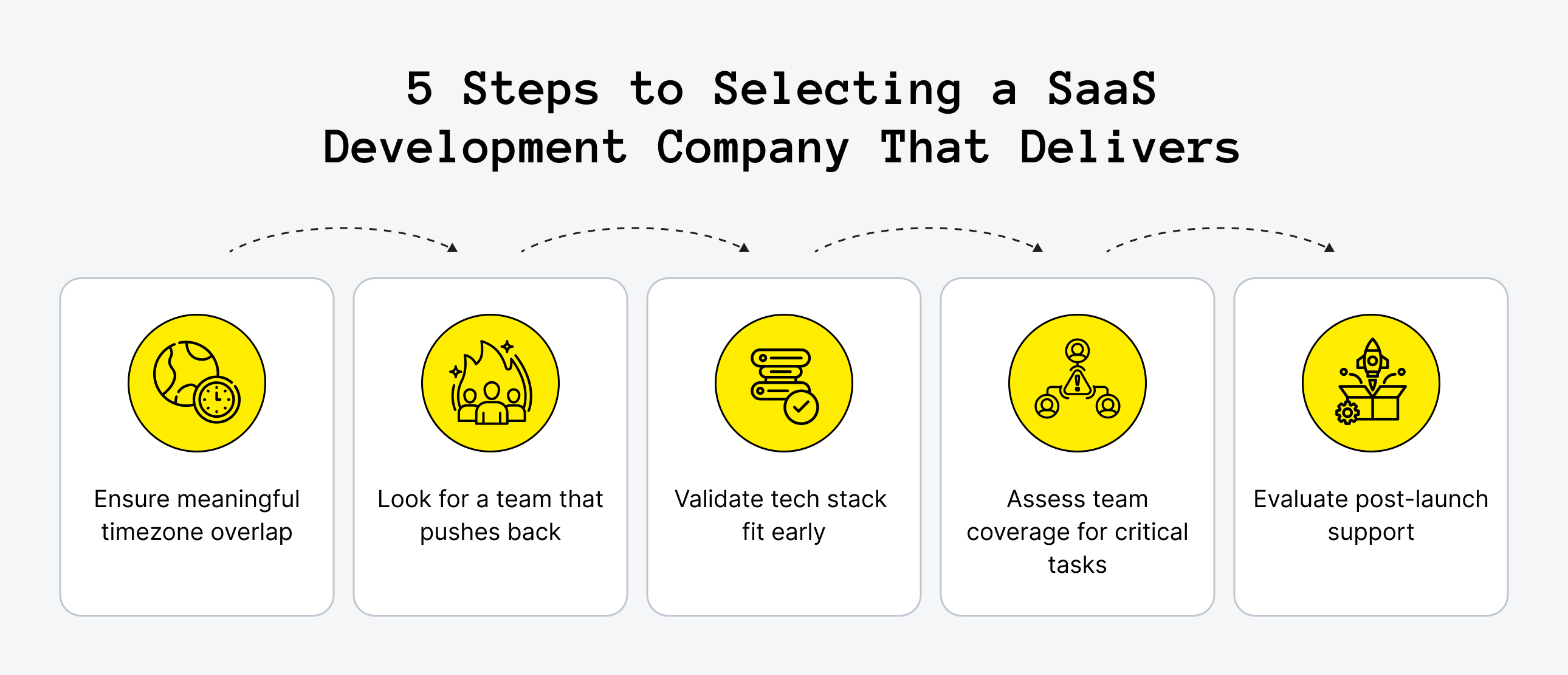
The real challenge isn’t finding a list of top SaaS development companies, it’s choosing a dedicated development team that won’t miss deadlines, overpromise on features, or disappear when things get complicated. Instead of relying on rankings or sales decks, use the steps below to evaluate whether a team can actually deliver your product and grow with your startup.
Step 1. Ensure Meaningful Timezone Overlap
While asynchronous communication works for routine updates, complex product decisions and urgent issues require real-time discussion. Thus, you should make sure your SaaS development company has at least 3-4 hours of daily overlap to collaborate directly. This reduces delays, speeds up problem-solving, and prevents small misunderstandings from turning into week-long blockers.
Step 2. Look for a Team That Pushes Back
If a SaaS application development company agrees with every idea you propose, that’s a warning sign. A strong partner challenges assumptions, explains trade-offs, and isn’t afraid to say “no” when a feature adds complexity without real value. You’re paying for experience and judgment, not just execution.
Step 3. Validate Tech Stack Fit Early
Don’t assume all top companies for SaaS product development can work with any startup technology. Different products have different technical requirements, and the stack matters. If you’re building an AI-driven product, Python expertise is critical. If your app depends on real-time interactions, Node.js may be essential. So, it’s better to check whether the team’s proven strengths align with your product’s core needs, not just their preferences.
Step 4. Assess Team Coverage for Critical Tasks
Startups move fast, and people leave. Ask how the company documents code, shares knowledge internally, and handles handovers. If your lead developer disappears, the project shouldn’t grind to a halt. Clean architecture, proper documentation, and shared ownership are signs of a mature MVP development process.
Step 5. Evaluate Post-Launch Support
Building the product is only half the battle since bugs, updates, and scaling SaaS challenges inevitably appear after launch. Ask how the company handles ongoing support, response times for critical issues, and software maintenance. A partner who offers structured post-launch support ensures your product remains stable, secure, and continuously improved, reducing the risk of downtime or costly emergency fixes.
How Much Does It Cost to Build a SaaS Application in 2026?
The classic answer “It depends” is frustratingly vague, but it’s also true: product development costs vary widely depending on complexity, team location, and technology choices. When estimating your budget, consider how much investment you’ll need to set up automated client onboarding processes. It can significantly reduce support workload and improve time-to-value for your users. To give you a practical framework, here are rough cost brackets based on current market rates and the features of modern web applications:
- Micro-SaaS MVP ($25k - $40k): Designed to validate a niche idea quickly, this level includes core functionality, a standard user interface, and limited integrations. It’s lean, fast to market, and perfect for testing product-market fit before investing heavily.
- Funded seed MVP ($40k - $80k): For startups ready to impress investors, this tier adds custom UX MVP design, a more robust backend, mobile-responsive interfaces, and basic AI or automation features. This is typically what you’d take to VCs when aiming for a Series A raise, it balances polish with speed.
- Full-scale platform ($100k+): A full-featured SaaS platform is built for long-term growth and enterprise clients. Expect multi-tenancy support, complex user roles and permissions, enterprise-grade security, extensive third-party integrations, and automated billing or subscription logic. Costs escalate with scale, advanced features, and the need for high reliability.
Remember, coding is only 30–40% of total costs. You also need to budget for startup marketing, sales, customer support, and server infrastructure, e.g. cloud hosting on AWS, Azure, or GCP can quickly add thousands per month. Maintenance, updates, and scalability planning are ongoing investments that often exceed initial app development costs over time.
Need a hand with your SaaS product idea?
Upsilon was once a startup too, so we can help build and scale your product!
Final Say on SaaS Development Companies
Choosing the right partner from the many top SaaS development companies is critical for your startup’s success. It’s not just about finding skilled developers, it’s about finding a team that understands your vision, communicates clearly, and can grow with your product. A thoughtful selection process ensures you avoid delays, overcomplicated features, or gaps in knowledge that could stall your launch.
At Upsilon, we help startups and growing businesses bring their SaaS ideas to life with solutions built for scale from day one. Our team works closely with you to design the right architecture, choose the most effective tech stack, and implement features that align with your long-term goals. Whether you’re launching a lean MVP to validate your concept or expanding an existing platform, our team provides full-cycle development support, from initial product discovery and prototyping to full-scale development and ongoing team support.
Our experts focus on solving potential roadblocks before they occur, so your product scales smoothly. Through our MVP development and team augmentation services, we help accelerate your launch while building a scalable, maintainable platform. Feel free to contact us, if you have any concerns. We’re here to help!
FAQs
1. What does a SaaS product development company do?

They handle the technical lifecycle of your product. This includes the Discovery Phase (figuring out what to build), UI/UX Design (making it usable), Coding (Frontend and Backend), QA Testing (breaking it before users do), and Deployment (putting it on the cloud). Good partners also provide post-launch maintenance.
2. What key services do they provide?
Beyond writing code, best SaaS development companies provide Architecture Design, Cloud Consulting (AWS/Google Cloud/Azure), Security Audits, and increasingly, AI/ML integration. A good SaaS application development company might also offer CTO as a Service for non-technical founders.
3. How long does it take to build a SaaS MVP?
In 2026, with the help of AI coding assistants and modern frameworks, a solid MVP usually takes 3 to 4 months for top SaaS development companies. Anything less is likely a prototype; anything more implies you are building too many features.
4. Is it better to hire an in-house team or a SaaS development company?
For early-stage startups (Pre-Seed/Seed), an agency is usually better. It’s faster to start (no recruiting time), flexible (scale up/down instantly), and requires less management overhead. In-house teams make sense once you have found product-market fit and have the budget to sustain full-time salaries and benefits.
5. What tech stack is best for SaaS development?
There is no single best SaaS development company, but the industry standards for 2026 are:
- Frontend: React.js or Next.js (for SEO).
- Backend: Node.js (for speed) or Python/Django (for AI capabilities).
- Database: PostgreSQL (reliable and scalable).
- Cloud: AWS remains the market leader, though many startups thrive on Google Cloud or Vercel for ease of use.



to top