AI MVP Development: How to Build and Validate an AI Product Fast

This page isn’t about throwing together a minimum viable product using AI no-code builders or other AI tools in five minutes. You won’t find drag-and-drop shortcuts here.
And there’s a good reason to take AI startup MVP development seriously. According to a recent McKinsey’s survey, 88% of organizations now use AI in at least one business function, yet nearly two-thirds are still experimenting with or piloting AI rather than scaling it across the enterprise. In other words, there’s plenty of interest in artificial intelligence, but turning that interest into a useful, scalable product still requires more than simply adding an AI feature.
Instead, we’re going to walk you through how to build a minimum viable product (MVP) that’s actually fitted with real AI capabilities, not just a shiny wrapper around someone else’s model. We’ll talk about how to plan, build, and improve an AI MVP that’s smart, useful, and ready to evolve into a full product.
We’ll also share tips on how to integrate generative AI the right way so you’re not just “using AI” for the sake of it, but actually solving problems and delivering value from day one. If you’re intrigued, keep reading and visualizing your future product!
Key Takeaways:
- An AI MVP should solve one specific problem. Focus on a single AI capability, such as classification, prediction, recommendation, or content generation, rather than trying to build a fully automated AI product from day one.
- Custom development gives you more room to test and adapt. While no-code tools can work for quick demos, custom MVP development AI provides greater control over models, data, integrations, and future scaling.
- Start with the simplest viable AI approach. Pre-trained models, AI APIs, and existing frameworks can help you validate your idea without the cost and complexity of training a model from scratch.
- AI-powered MVP development typically costs $25,000–$100,000+. The final budget depends on the AI approach, data requirements, product scope, integrations, infrastructure, and level of customization.
- Measure whether the AI creates real value. Usage alone isn’t enough. Track AI feature adoption, corrections and overrides, user trust, and whether users would actually miss the feature if it disappeared.
What AI MVP Development Means
A plain MVP can sometimes simulate a workflow. It might use a form that sends an email to a human behind the scenes or a screen that always displays the same result. An AI MVP doesn’t have that option when it comes to its core feature. Artificial intelligence needs to do real work using real data.
For example, AI might need to:
- classify a support ticket
- predict a no-show
- recommend a product
- generate a useful first draft
The output should be reliable and useful enough for a real user to trust. That’s what separates an actual AI MVP from a scripted demo that only looks intelligent.
That distinction explains why AI MVP development, with around 500 searches a month and growing, and AI MVP development services, with around 250 searches per month, point to the same question founders are asking: how can you test whether an AI feature actually works without building the entire product around it first?
An AI MVP typically focuses on one core AI capability, such as classification, recommendation, prediction, or generation. This capability is integrated into a product where users can interact with the results and provide feedback. The goal is not to make artificial intelligence handle everything from day one. It is to determine whether the AI can solve a specific problem well enough to create real value for users.


No-Code vs. Custom AI MVP Development: How to Choose
No-code tools are great when you want to show off a quick idea, get a landing page live, or test a basic concept. Platforms like Hostinger Horizons, Bubble, Glide, or Adalo can definitely help you move fast. But this article isn't about drag-and-drop tools or stitching together pre-built components.
We're talking about building an MVP with real AI capabilities, from scratch. When you're adding machine learning, natural language processing, or generative AI into your product, you need control. And that's exactly what custom MVP development for AI gives you. Let's quickly compare two approaches: using a no-code AI MVP builder and custom development.
With a custom MVP, you're not stuck with someone else's development roadmap and limitations. You're building on your own terms, using real user data, and laying the groundwork for something scalable and flexible.
Let's say you're building an MVP to detect fake product reviews. You could use a no-code platform with a plug-in that flags suspicious comments. It might look decent, but it won't evolve based on your specific domain or dataset. Or, you could build a small NLP model trained on real examples from your platform: learning the tone, structure, and patterns of fake vs. real reviews in your niche.
The first option shows that the idea might work. The second one actually proves if the idea has value, can scale, and is worth further investment. Here's more context about how these two approaches differ.
Flexibility and Customization
Custom MVP development allows you to tailor your AI logic exactly to your business case. Whether you're adding AI for personalization, automation, prediction, or decision-making, you're in control of how it works and how it grows over time.
Let's say you're building a micro SaaS MVP for personalized learning paths. Off-the-shelf AI might give you some general suggestions. But custom development lets you integrate your own content, understand your specific audience, and fine-tune recommendations using reinforcement learning or feedback loops.
By contrast, no-code platforms often force you into pre-defined workflows, fixed APIs, or limited datasets. That's not ideal if your AI features are central to your MVP's value proposition.
Successful AI MVPs now focus on both shipping fast and delivering real functionality that matches user expectations. And that means building features, not just designing interfaces.
Innovation and Competitive Advantage
The best AI-driven MVP for startups stands out. When you build custom AI features, you're opening the door to creating something your competitors don't have.
For example, an MVP in legal tech might use AI to instantly generate draft contracts based on a few prompts. A generic solution may use GPT to spit out text, but a custom MVP can:
- add rules based on specific jurisdictions;
- integrate legal review logic;
- flag missing clauses based on your own legal templates.
This level of innovation is only possible when you build your MVP AI to solve a specific problem with a clear business case. And that can be your biggest competitive advantage.
Custom MVP development also works well for niche markets. Imagine you're building something for precision farming. Off-the-shelf models may not understand crop cycles or local weather patterns, but your custom model could, especially if trained on your own sensor data.
That's how AI MVPs become SaaS-worthy: they solve hard problems in smarter ways, even at the product prototype stage.
Scalability and Adaptability
One of the biggest benefits of building a custom MVP in AI is future-proofing. As your user base grows, your AI system needs to keep up. With a custom approach, you're not boxed into rigid structures or limited scaling options.
For example, you launch with a basic AI model that recommends insurance products based on user input. Later, you want to add dynamic pricing, multi-lingual support, or even real-time underwriting decisions. If your MVP was built custom from the start, evolving it is much simpler. You can swap models, plug in new APIs, retrain with better data, and whatever the product demands.
Compare that with trying to bend a no-code solution to fit those needs later. It becomes a nightmare to maintain, expensive to customize, and hard to debug.
Plus, with AI changing so fast, adaptability is everything. You might start with GPT-3, but want to shift to Claude, Mistral, or other large language model in six months. Or maybe you'll switch from OpenAI's API to a fully open-source LLM hosted on your own infrastructure. Custom MVP development lets you do that.
Startups working in sprints to build agile MVPs also benefit: you can test features, collect feedback, and push changes every week without fighting against someone else's framework.
In short, building a custom MVP means you're setting your product up for learning, evolving, and competing from day one. Let's take a look at a few more things to anticipate before you even start developing something.

How to Build an AI MVP, Step by Step
So, you’ve got a solid idea, and you're ready to bring AI into the mix. Awesome. But before you dive headfirst into code or expensive APIs, here’s a smart and lean way to build an AI MVP that actually helps you learn.
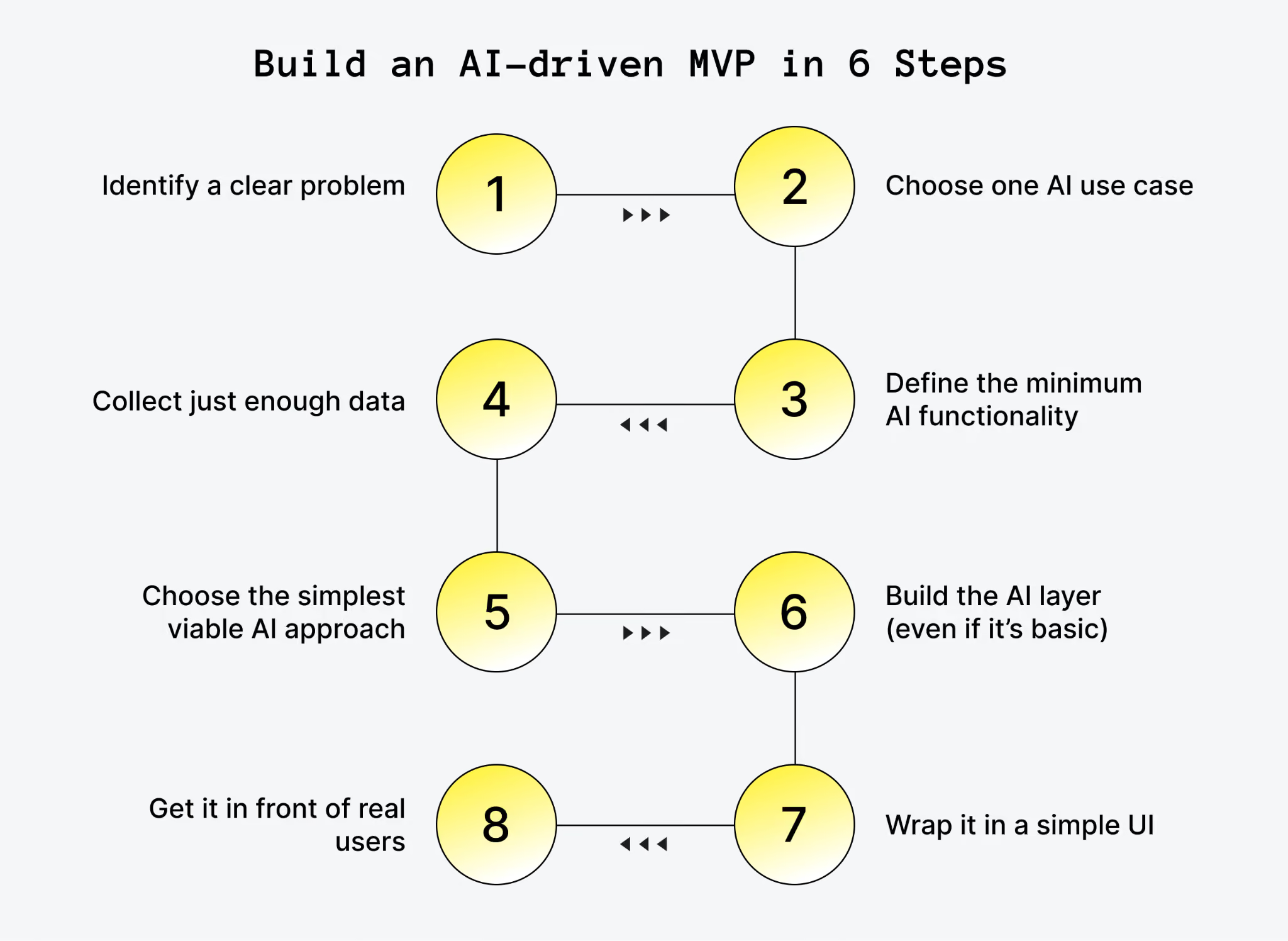
Step 1: Identify a Clear Problem
Not all problems need AI, so before writing a single line of code, define the one problem you're solving, and make sure it's specific and painful.
Examples:
- "Small businesses are losing money because invoices are often miscategorized."
- "HR managers are overwhelmed by hundreds of job applications and can't screen them fast enough."
AI makes the most sense when the solution involves:
- unstructured data (text, images, audio);
- repetitive decision-making;
- prediction;
- classification;
- content generation.
If your solution needs human-like judgment at scale, AI could be a great fit.
Step 2: Choose One AI Use Case
Don't try to boil the ocean. Instead, focus on one thing AI will help you do. For example:
It's best to stick with a narrow slice of value. One smart feature is all you need to prove demand and collect real feedback.
Step 3: Define the Minimum AI Functionality
Once you’ve chosen the AI use case, define what the AI actually needs to do for the MVP to be useful. Avoid trying to make the model handle every possible scenario from the start. The goal is to identify the smallest AI capability that can solve the target problem and give you meaningful feedback from real users.
For example, the minimum functionality might include:
- Classify incoming customer messages into a few predefined categories
- Recommend the most relevant products based on a user’s preferences
- Generate a short first draft from a user’s input
- Predict the likelihood of a specific outcome based on historical data
It’s also important to define what counts as a good enough result. You don’t necessarily need production-level accuracy at the MVP stage, but the AI should perform well enough to test whether the feature delivers real value. This gives you a clear scope for development and helps prevent unnecessary time and budget from going into features that haven’t been validated yet.
Step 4: Collect Just Enough Data
You don't need millions of rows either. A few hundred well-labeled examples can do the job at this stage. Here are some data sources to bootstrap quickly:
- Kaggle Datasets
- Hugging Face Datasets
- Common Crawl
You can even simulate AI behavior at first (a.k.a. Wizard-of-Oz types of MVPs for testing) to validate the workflow. Show users how the system works, but handle the "AI" part manually behind the scenes. Just be honest about it. You're not fooling anyone, but you're learning fast.
Need a hand with MVP development?
Upsilon is a reliable tech partner with a big and versatile team that can give you a hand with creating your AI product.

Step 5: Choose the Simplest Viable AI Approach
You don’t always need to train a custom model from scratch. For an MVP, the simplest approach is usually the best one if it can deliver the required result. Depending on your use case, you might use a pre-trained model, an AI API, a traditional machine learning algorithm, or a combination of existing tools.
Consider these options:
- Use an AI API when you need text generation, summarization, classification, or other LLM-based capabilities without training your own model.
- Use a pre-trained model when an existing model can handle your task with little or no additional training.
- Use traditional machine learning for structured data and relatively straightforward prediction or classification problems.
- Fine-tune a model only when an off-the-shelf model cannot provide the required performance or needs to work with a specific type of data.
The right choice depends on the problem, available data, expected accuracy, and development budget. At the MVP stage, the priority is to validate whether the AI capability creates value, not to build the most sophisticated model possible. A simple solution that works reliably is often more useful than a technically impressive model that takes months to develop.
Step 6: Build the AI Layer (Even If It's Basic)
For your MVP, you don't need to reinvent GPT or run massive GPU clusters. You just need enough AI to prove your point. Save this table until you have to choose your stack.
You will also make some hosting and infrastructure decisions for early AI.
If you're using OpenAI/Cohere APIs, you don't need GPUs, only a solid backend that calls the API and returns the response to your UI.
Step 7: Wrap It in a Simple UI
The UI doesn't need to be fancy, but it needs to support real interaction with your AI. Your stack here depends on how technical your team is.
Finally, your UI and AI model will need some communication:
Whenever you're unsure about the stack and your first steps, refer to these best practices:
- start with familiar tools and don't overengineer;
- use hosted models or APIs if time or compute is limited;
- keep your architecture modular so you can swap models or UIs later;
- choose tools that support fast feedback and iteration.
Next, you'll want to show your users what you have for them!
Step 8: Get It in Front of Real Users
No matter what MVP in AI you choose, it means nothing without feedback:
- share your MVP with early adopters (Slack groups, LinkedIn DMs, Reddit);
- watch how they use it (screen recordings, behavior logs);
- ask what surprised or frustrated them;
- track where the AI adds value vs. where it confuses or slows them down.
This real-world input is gold because it helps you improve both the product and the model.
How Much Does AI MVP Development Cost?
AI MVP development usually costs more than building a conventional MVP because you’re adding another layer of technical complexity. The final price depends on the type of AI, the amount and quality of data, the number of features, integrations, and whether you use an existing AI model or build something more customized.
For a realistic starting point, an AI MVP with generative AI functionality can cost around $50,000–$100,000. A simpler AI-powered MVP may fall closer to the lower end of this range, while products that require custom models, extensive data processing, or more complex AI workflows can go well beyond it. By comparison, a conventional MVP typically costs around $25,000–$75,000.
Typical AI MVP Development Costs
These are ballpark figures rather than fixed prices. The actual estimate depends heavily on what the AI needs to do and how much infrastructure is required to make it work reliably. Upsilon's current MVP estimates put general MVP development at $25,000–$75,000, while its AI development estimates put a generative AI MVP at around $50,000–$100,000.
Challenges of Integrating AI into an MVP
Of course, AI isn't plug-and-play. If it were, everyone would be doing it, and doing it well.
The truth is, adding AI into an MVP introduces a whole new level of complexity. It's not like embedding a calendar or adding a payment gateway. When you're working with AI, you're often dealing with things that don't behave the same way twice.
If you're planning AI MVP development, here are some key challenges you'll want to think through first.

1. Data Dependency
AI needs lots of good, clean, labeled, and structured data. That's a problem, because most MVPs are built before any meaningful user base exists. You may have zero customer data or just enough to build basic logic.
So what do early-stage teams usually do?
- Scrape public data from websites, forums, or datasets on platforms like Kaggle
- Purchase access to data providers like AWS Data Exchange, Data & Sons, or RapidAPI
- Manually collect data from early users via forms, surveys, or beta versions of the app
Let's say you're building an MVP for resume screening - AI resume scanner. You'll need hundreds, maybe even thousands, of labeled resumes and hiring outcomes to train your model. Without that data, the AI won't be useful.
2. Expensive Experiments
Next, training even a relatively lightweight model (especially with deep learning) can be surprisingly pricey, increasing the overall cost to build an AI solution. You might start with fine-tuning a large language model on a cloud service like AWS, GCP, or Azure, and soon notice the bill creeping up. GPU usage, storage, and inference costs add up fast.
The worst thing is that even if your idea flops, the cloud bill sticks around. This is why custom MVP development AI teams often use pre-trained models (like GPT-4 or Mistral) and AI frameworks and libraries to start small, test cheaply, and validate demand before investing in heavier infrastructure.
3. Unclear Outputs
AI isn't always predictable:
- your generative AI MVP chatbot might give wrong answers (or weird ones);
- your image recognition feature might mistake a dog for a cat;
- your recommendation engine might suggest irrelevant items.
Why does this matter for MVPs? Because early users expect the core value prop to be reliable. If your AI fails in the first few interactions, it can damage user trust fast.
To handle this, you need to bake testing into the MVP process, especially for AI components:
- Build quick feedback loops.
- Add flags when confidence scores are low.
- Let users give feedback on AI performance so the system learns over time.
This will save you a lot of time guessing around what might not be ready for release.
4. Ethical and Legal Risks
This one's easy to ignore at the MVP stage, but it can come back to haunt you. If your MVP operates in regulated spaces, you'll need to consider fairness, accuracy, bias, and transparency from the start. This can include:
- healthcare (HIPAA, data privacy);
- finance (transparency, audit trails);
- recruitment or HR (bias, explainability);
- among others.
For example, if your AI makes decisions about who gets an interview or who qualifies for a loan, you may need to explain how the AI made that decision and prove that it wasn't discriminatory.


5. Tech Stack Selection
Even though you won't build a huge infrastructure for your MVP in AI, you need to keep it in mind. Picking the right tech stack for your product means choosing tools and platforms that can grow with you even after the idea's validated.
- Will your model scale to thousands of users?
- Can you swap out APIs or upgrade models later?
- Will the backend support GPU-based workloads when you move from testing to production?
Choosing the wrong tools early on can create serious technical debt. That's why custom MVP development AI projects often prioritize modularity and flexibility, even if it means more work upfront. You need to find a balance between shipping fast and laying a foundation that won't break later.
6. No-Code MVP Builders Aren't Enough for AI
A lot of founders are tempted to use drag-and-drop tools with AI plugins (like OpenAI in Bubble) to spin up something fast. And for showing off a demo, that might be fine. But when it comes to real AI minimum viable product development:
- you can't fine-tune the AI;
- you're limited by someone else's integrations;
- it's harder to test, customize, or scale.
If you're serious about AI MVP development, you need direct access to models, data, and infrastructure. That's how you learn what works, what doesn't, and what needs to improve.
7. AI Can Extend Timelines and Increase Costs
Yes, adding AI makes your MVP "smarter," but it also makes it more complex. You'll need:
- additional planning for architecture;
- more testing and QA;
- data pipelines;
- monitoring for inference and accuracy;
- fail-safes in case models break.
This often means longer sprints, more engineering hours, and a bigger MVP cost even before the product launches.
8. Data Security Still Matters at MVP Scale
Plus, a lot of teams overlook data security at the MVP stage. That's risky, especially when you're dealing with personally identifiable information (PII), sensitive business data, or proprietary inputs used for AI training.
You don't need to over-engineer it, but encryption, access controls, and compliance practices should be baked into your MVP from the start. Remember: you don't get a "free pass" on security just because it's an MVP.
9. Post-Launch Maintenance Can Be Tough Without Experts
Here's something most guides forget to tell you: launching a minimal product is just the beginning. Once real users start interacting with your AI, you'll find edge cases, bad outputs, and performance gaps. Improving AI post-launch in the after-MVP phase often requires:
- retraining with new data;
- tuning hyperparameters;
- updating model architectures;
- adjusting prompt engineering (for gen AI MVP).
If you don't have someone technical on your team or a trusted partner, it can get overwhelming fast. But enough of the challenging sides, read on and get a step-by-step plan for your first (or next) MVP AI launch!
AI MVP Tools and Tech Stack
The right tech stack for an AI MVP doesn’t need to be complicated. The goal is to choose tools that are reliable enough to test the core AI functionality without spending time and budget on infrastructure you may not need later. The best choice depends on what the AI needs to do, how much data you have, and how quickly you need to get a working version in front of users.
Here are some of the most practical options for different parts of an AI MVP:
A working AI MVP needs no more than one tool from each row — the goal is the thinnest stack that answers the test, not the most complete one.
The tools matter less than the discipline behind picking them: start with what the team already knows, lean on a hosted API when time or budget is tight, and keep the pieces modular enough to swap a model or a UI layer without a rebuild. Picking the right AI for MVP development starts with naming the one job it needs to do, not the platform it might become.
AI MVP Case Study: How Jasper Shipped in 30 Days
Jasper, originally launched as Conversion.ai in January 2021 by Dave Rogenmoser, Chris Hull, and John Philip Morgan, is a good example of how a narrow AI MVP can be built and tested quickly. Morgan developed the first working version in about a month using early access to OpenAI’s GPT-3 API.
Instead of trying to build a full AI writing platform from the start, the team focused on a single use case: generating ad copy templates for marketers. The early version was simple, but it was enough to put the core AI capability in front of potential customers.
What made Jasper’s MVP work? A few decisions helped the team move from an idea to a working product quickly:
- One specific use case. The MVP focused on generating marketing copy rather than trying to solve every writing task.
- An existing AI model. The team used GPT-3 instead of developing and training a proprietary language model.
- Early customer feedback. Rogenmoser demonstrated the rough version to potential customers through video calls before investing in a larger product.
- A clear validation question. The team wanted to know whether GPT-3 could produce ad copy valuable enough that marketers would actually pay for it.
The answer was yes. About 18 months after the first working version, Jasper reached unicorn status with a $1.5 billion valuation.
Jasper’s early story highlights an important principle of AI MVP development: prove one AI capability before building an entire platform around it. Data wasn’t a major blocker for the first version because GPT-3 was already pretrained. Instead, the team could focus on the more important question: could a hosted AI model generate output good enough to solve a real customer problem and support a viable business?
How to Measure Whether Your AI MVP Is Working
High usage numbers alone don’t tell you whether an AI MVP is actually working. This is one of the reasons teams offering AI-driven MVP development services need to look beyond basic engagement metrics. A support chatbot might get plenty of clicks, for example, but if a human agent has to override every response, the feature is only adding another step to the workflow.
The right metrics depend on what your AI feature does, but several signals can help you understand whether it is delivering real value.
Step 1: Track Actual AI Feature Usage
For starters, look at whether people are actually using the AI capability rather than simply using the product around it. For example, if your MVP recommends products, track how often users interact with those recommendations, not just how often they open the app.
Your analytics should distinguish between users who accept or interact with an AI output and those who ignore it and complete the task manually. Otherwise, high product usage can give you a false sense that the AI feature is working.
Step 2: Monitor Corrections and Overrides
Some incorrect outputs are normal for an early AI MVP. What matters is what happens over time.
It’s vital to track how often users correct, reject, or override the AI’s output. A healthy MVP should ideally show a downward trend as the system gets more real-world data and the team improves the model or prompts.
If the correction rate stays consistently high, it may indicate that the AI capability isn’t reliable enough to solve the problem.
Step 3: Measure How Much Users Trust the Output
Trust is another important signal, especially when the AI generates recommendations, predictions, or content that users need to verify.
One useful metric is how often users double-check the AI’s output before acting on it. If fewer users feel the need to verify the result over time, that can indicate that the feature is becoming more useful and trustworthy.
This change probably won’t happen immediately, so it’s worth tracking separately rather than assuming that high usage automatically means high trust.
Step 4: Ask What Happens If the AI Disappears
There’s also a simple qualitative test: what would happen if the AI feature were switched off tomorrow?
Would users:
- complain because they rely on it?
- find another way to complete the same task?
- barely notice that it’s gone?
The first response is a strong sign that the feature has become valuable. The second suggests that the AI is useful but replaceable. If users wouldn’t notice its absence, the MVP may have validated the product around the AI rather than the AI capability itself.
Ultimately, an AI MVP is working when the AI does more than attract attention. Users should actively rely on its output, need to correct it less over time, and see enough value in the feature that removing it would make the product noticeably worse.
Seeking help with building your MVP?
Upsilon can help you select the optimal tech stack and bring your AI ideas to life!
Conclusion: Why You Should Consider AI MVP Development Services
AI opens up new possibilities for MVPs, but the fundamentals of product development haven’t changed. You still need to solve a real problem, focus on the most important functionality, and get your product in front of users as quickly as possible. What AI changes is what you can test within that first version, from intelligent recommendations and predictions to content generation and automated decision-making.
At the same time, AI adds another layer of complexity to MVP development. Choosing the right model, preparing data, evaluating outputs, managing API costs, and making sure the AI actually delivers value all require careful planning. That’s why keeping the scope focused is so important. Instead of trying to build a fully automated AI product from day one, a well-designed MVP can help you validate one core AI capability and learn from real users before making a larger investment.
If you have an AI product idea but don’t have the technical expertise or resources to build it in-house, working with an experienced development partner can make the process more predictable. With our MVP development services, Upsilon can help you turn an early-stage idea into a functional product, from defining the MVP scope and selecting the right technology to development, testing, and launch.
For products that rely heavily on generative AI, our generative AI development services can help you integrate the right models and AI capabilities into your product. Whether you’re exploring an AI writing assistant, recommendation engine, fraud detection tool, hiring platform, or another AI-powered concept, the focus remains the same: build enough to test the idea, learn from real users, and have a solid foundation for what comes next.
If you’re willing to see what your AI idea could look like as an MVP, feel free to contact us to discuss your project and explore the best way to bring it to life.



FAQs
What does AI MVP mean?

An AI MVP is the smallest working version of a product that includes one real AI capability, not a mockup of one, built to test whether that capability holds up against real data and real users before committing to a wider build.
What is the 30% rule in AI?
It refers to Gartner's July 2024 prediction that 30% of generative AI projects would be abandoned after proof of concept by the end of 2025, stalled by poor data quality, unclear ROI, or cost that outran the budget. For an AI MVP, the fix is the same discipline this guide argues for: scope the AI to one measurable use case before chasing the platform ambition that prediction describes.
How much does it cost to develop an MVP?
A standard MVP runs from the low tens of thousands into six figures depending on scope; adding a real AI capability adds data preparation, model or API costs, and testing time on top of that baseline. Upsilon's guides on MVP cost and AI solution cost break down both baselines in detail.
What is an MVP in development?
A minimum viable product is the smallest version of a product that lets real users complete a real task, built to test demand and usage before a team commits to the full feature set. An AI MVP applies that same idea to one AI capability.
How is an AI MVP different from a regular MVP?
A regular MVP can fake its way through a workflow with hardcoded rules or a person behind the curtain. An AI MVP has to prove the AI part works: that a model can classify, predict, recommend, or generate well enough on real data, not only that the screens connect in the right order.
How long does it take to build an AI MVP?
A few weeks if the AI runs through a hosted API and the team scopes one narrow use case. Longer, often months, if the plan involves training a custom model from scratch or working with data that needs heavy cleanup first. The gap between those two timelines is the real decision a founder needs to make early, not late.
to top