LLM Comparison in 2026: How to Choose the Right Foundation Model

The idea of using generative AI to enhance your product is a hot topic, and it seems straightforward: take a large language model (LLM) API as the foundation for your chatbot, AI assistant, or other AI-powered tool. Providers like OpenAI, Anthropic, or Google do the heavy lifting, and all that's left is some tweaking and training.
Well, spoiler: it is much harder than that. A comparison of large language models quickly shows that they differ in capability, output accuracy, pricing, and many other factors. No single model wins across every use case.
Datadog’s AI Engineering report found that more than 70% of organizations use three or more models, concluding that there is “no clear winner for model choice” in 2026. Their analysis shows that teams increasingly maintain model portfolios to match different workloads with the right balance of latency, cost, operational risk, and task requirements.
Cost matters as often as quality. In McKinsey’s latest global AI survey, about one in five respondents said that AI related operating costs, including token costs, were already limiting their organizations’ use of AI. Choose the wrong model and the consequences extend beyond weaker outputs. They can appear as unnecessary spending on your invoice or as a deprecation notice that forces a costly migration six months later.
That's why the question isn't which model is best, but which is best for what you're building. On this page, we compare LLMs and the options available to help you weigh the key factors: what benchmarks and pricing really tell you, which models suit which use cases, how open-source and proprietary differ, and the mistakes founders repeat most often.
Key Takeaways:
- An LLM’s value depends on how well its capabilities, cost, latency, and context window match the product’s actual requirements, rather than on overall model rankings alone.
- A proper comparison of LLM models should consider practical factors such as benchmark performance, cost per task, scalability, customization options, integration requirements, and data governance.
- Leading model families such as GPT, Claude, Gemini, Llama, Mistral, DeepSeek, Qwen, GLM, and Kimi offer different trade-offs between reasoning, coding, context length, pricing, and deployment flexibility.
- The best LLM for a product depends on its use case: coding and agents may require stronger reasoning models, while high-volume workloads can benefit from smaller, more cost-efficient options.
- Model selection should not be treated as a one-time decision. As usage grows and new models become available, products can reassess performance, costs, and infrastructure requirements to keep the LLM stack efficient.
What Is a Large Language Model (LLM)?
Let's start by noting that generative AI is a distinct segment of artificial intelligence and machine learning which puts the generation of new content in focus. It leverages deep learning models to identify patterns from existing datasets and produce original outputs such as text, images, code, and others as if a human would do it. This becomes possible thanks to the use of large language models (LLMs) and different deep learning frameworks trained on extensive datasets. In fact, with the rapid growth of such tools, the role of an AI detector has become essential for distinguishing between human-written and machine-generated content.
So, what exactly are large language models? Sometimes referred to as foundation models, LLMs are sophisticated AI systems capable of processing, analyzing, and generating natural language.
Importantly, they differ from conventional natural language processing (NLP) methods which depend on manually crafted and pre-written text interpretation rules. Unlike them, LLMs analyze vast amounts of text data to recognize language patterns. They utilize neural networks to understand word usage, context, and the relationships between words to form a language model and perform an array of tasks.
One of the most exciting aspects of such AI technologies is their ability to learn and self-improve over time. Trained on substantial text datasets, image datasets, and data annotation, they grow in size and expand their ability to comprehend prompts created by humans, better adapting to their needs as time goes on.


What Are LLM APIs and Where Are They Applied?
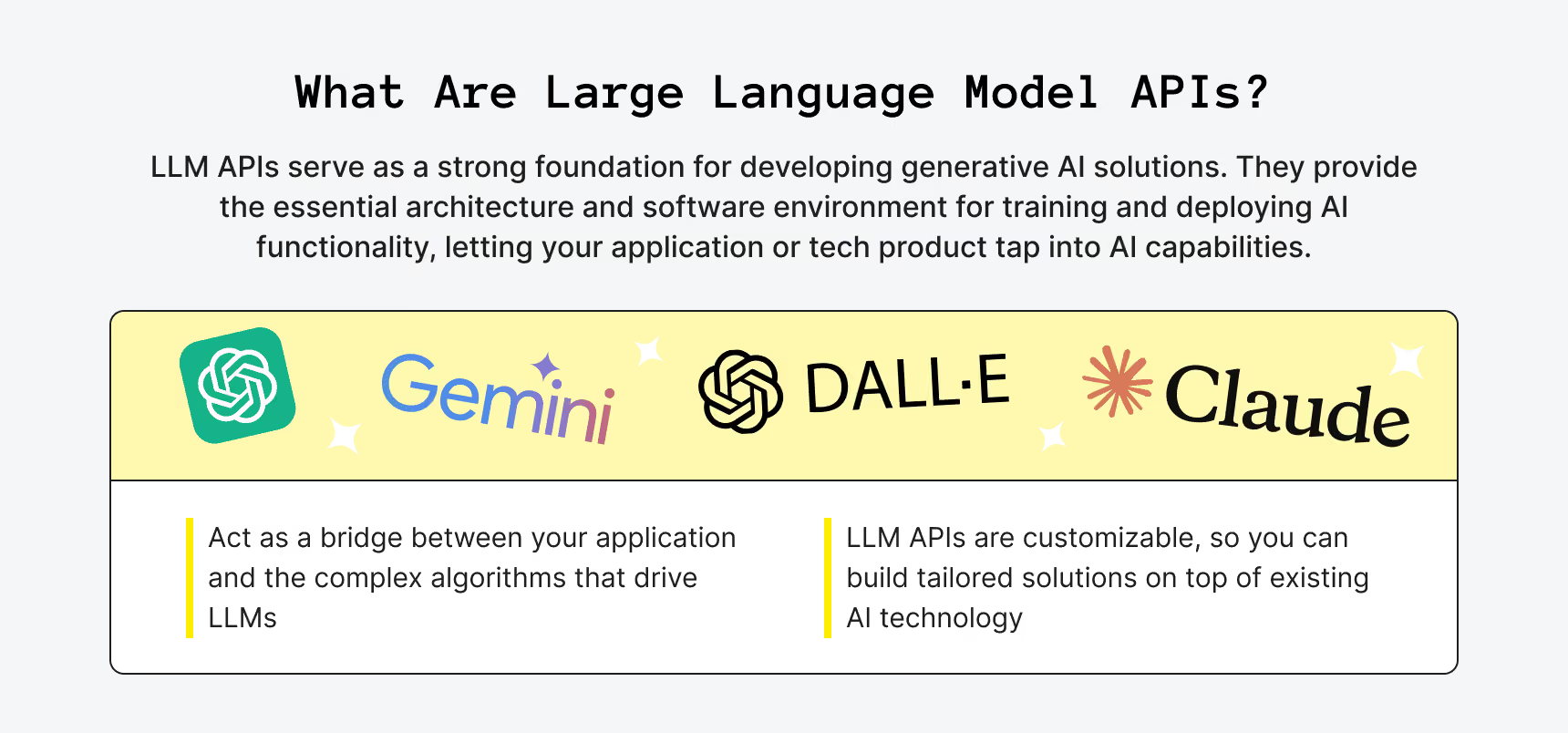
There are tons of LLM API use cases, but at their core, large language model API connections serve as a strong foundation for developing generative AI solutions. They're like the backbone linking your software or tech product to powerful AI systems.
In simpler terms, LLM APIs act as a bridge between your applications and the complex algorithms that drive LLMs. They provide the essential architecture and software environment for customizing, training, and deploying AI functionality.
If you integrate something like the GPT API into your app, your tech solutions and business ecosystems can tap into AI capabilities. For example, a medical laboratory that provides clinical blood test services can integrate an LLM to develop a chatbot that helps users interpret their blood test results. This chatbot could guide patients through understanding various markers, explain what each test measures, and answer common questions in real-time.
And the best part of AI integration into an app is that you don't have to be an expert in the billions of parameters forming the basis of these artificial intelligence models. In the case of the blood test clinic, they would need to train the selected LLM by "feeding" it with unique and tailored data about blood tests, including specific test names, reference ranges, potential health implications, and common patient concerns to enable the chatbot to provide relevant, accurate, and personalized responses to users.
Why else is this awesome for various business applications? First off, such a comprehensive toolkit has a high level of customizability which allows developers to build more complex and tailored solutions on top of existing ones. This means you can tweak and fine-tune LLMs to cater to specific domains or tasks, making them more functional for your use cases, specialized contexts, or diverse industry needs. Topping that, LLM APIs can simultaneously handle large volumes of requests, so they're highly scalable.
How exactly are they applied to empower software solutions and apps? Generating unique content like images and text, as well as engaging in conversations is their strength. That is exactly why they're used for creating numerous solutions, such as a free AI detector, a content generator, and a customer support bot.
- Generating content (creating all kinds of human-like text for writing purposes or content production like marketing copy, social media posts, articles, and so on);
- Chatbots, assistants, and customer support (conversational AI makes dialogues and real-time interaction with users possible, as such technology can manage frequently asked questions and give replies to queries). A TTS API can extend these applications with natural voice responses, allowing AI assistants and support bots to communicate through speech as well as text;
- Analyzing sentiment (this ability helps dig into customer insights and spot market trends, facilitating data-driven decision-making);
- Translating languages (such AI also helps localize websites and translate text, broadening horizons to reach new global audiences);
- Games and entertainment (LLMs can assist in creating lots of things for games, including character dialogues).


The 2026 LLM Landscape: Who the Main Providers Are
The LLM market in 2026 is shaped by a handful of major providers, but the landscape is no longer just about individual models. Providers increasingly offer entire model families with different levels of performance, speed, cost, and capabilities. For founders, the important distinction is therefore not simply which company has the “best” LLM, but which model family makes the most sense for a particular product, use case, and budget. A focused LLM comparison can help make that choice clearer by looking at these trade-offs in context.
OpenAI (GPT)
OpenAI remains one of the most prominent names in the LLM landscape, with its GPT family covering a broad range of use cases. GPT models are widely used for natural language processing, content generation, summarization, conversational AI, and AI assistants. The family is designed to support both general-purpose applications and more demanding reasoning tasks, while different tiers can be used to balance capability, speed, and API costs.
For startups and product teams, GPT is often a practical choice when versatility and broad tooling support matter. Its models can serve as the foundation for everything from customer support features and AI chatbots to more complex agents and productivity tools.
Anthropic (Claude)
Anthropic develops the Claude family of LLMs, with a strong focus on conversational AI, reasoning, safety, and responsible AI use. Claude models are designed to handle complex instructions and long-form content while maintaining a careful approach to potentially sensitive applications.
The Claude family includes models positioned for different performance and cost requirements, making it suitable for use cases ranging from everyday text processing to advanced reasoning. This can make Claude particularly relevant for products that work with sensitive documents, research, or other tasks where reliability and careful responses are important.
Google (Gemini)
Google's Gemini family is its central line of foundation models, replacing earlier products such as PaLM and Bard. Gemini is built with multimodal capabilities in mind, allowing models to work across text, images, and audio rather than being limited to text generation alone.
This makes Gemini a natural fit for applications where different types of information need to be processed together. Beyond conversational experiences, the family can support tasks such as translation, content generation, document understanding, coding, and other applications that require a combination of language and multimodal capabilities.
Meta (Llama / Open-Weight)
Meta's Llama family stands out from proprietary API-based offerings because its models are open-weight and can be self-hosted and fine-tuned. This gives development teams considerably more control over how a model is deployed and adapted to a particular application.
Llama is particularly relevant when infrastructure control, customization, or data-handling requirements are important. It can also be an attractive option for high-volume applications where running a model on your own infrastructure may eventually make more economic sense than paying for every API request.
Mistral
Mistral has gained attention for developing efficient, high-performance models with an emphasis on scalability and relatively low latency. Its model family includes options designed for different deployment requirements, making Mistral relevant to teams looking for an alternative to the largest proprietary providers.
Mistral is also part of the broader open-weight ecosystem, which gives developers more flexibility around deployment and customization. Its models can be particularly useful when performance needs to be balanced against infrastructure and operating costs.
Open-Weight Challengers: DeepSeek, Qwen, GLM, Kimi
The open-weight LLM landscape has expanded significantly, with providers such as DeepSeek, Qwen, GLM, and Kimi becoming important alternatives to the largest proprietary model families. These models compete across areas such as reasoning, multilingual text generation, coding, and general-purpose language tasks.
DeepSeek has become particularly well known for strong reasoning capabilities and cost efficiency. Qwen offers a broad family of models covering language, coding, and multimodal use cases, while GLM and Kimi have also gained attention for their language and reasoning capabilities. Together, these providers demonstrate why open-weight models are increasingly considered alongside proprietary APIs when choosing the technology for an AI product.
The key point is that there is no permanent winner in the LLM market. Model families evolve quickly, and a model that performs exceptionally well today may be overtaken by another after only a few release cycles. This makes a framework based on the product's actual requirements more useful than relying on a static ranking of individual models.

How to Compare LLMs: The Criteria That Actually Matter
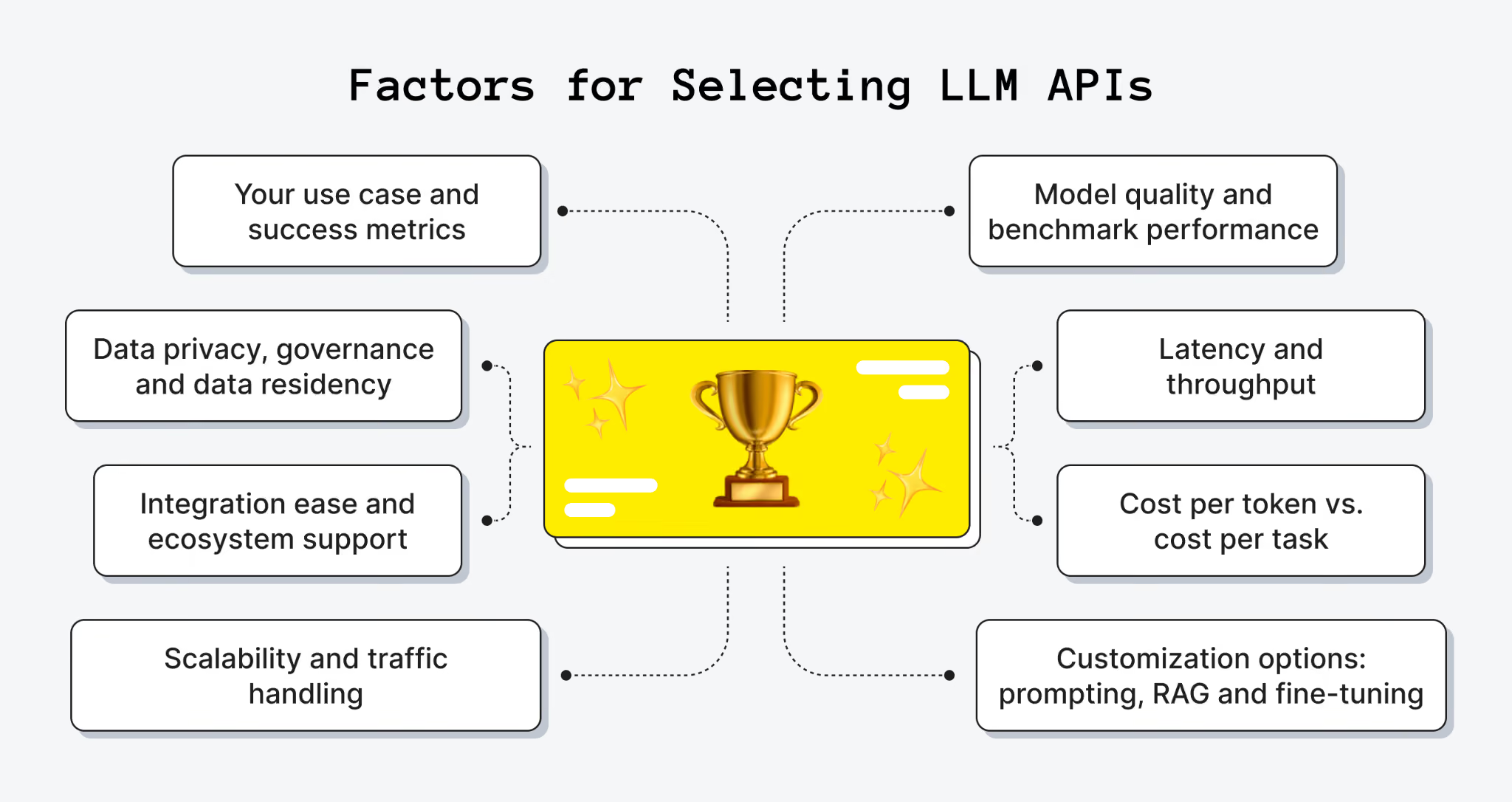
Many business owners find the idea of integrating generative AI capabilities into their apps tempting. Whether you’re looking into GPT, Gemini, Mistral, or other options and aren’t sure how to compare LLM models, this list of factors can help you determine which LLM engines are worth your time.
Your Use Case and Success Metrics
The most important starting point in any LLM comparison is the task the model needs to perform. “AI feature” is too broad a category to be useful: a support-ticket classifier, document summarizer, coding assistant, and multi-step research agent all place different demands on an LLM.
The product's success metrics should therefore be part of the comparison from the beginning. Depending on the use case, these might include accuracy, relevance, task completion rate, response quality, or the ability to handle domain-specific information. The amount of specialized knowledge required is also worth considering, since some applications can rely on a general-purpose model while others need additional customization.
Model Quality and Benchmark Performance
Model quality remains one of the obvious criteria when comparing LLMs, but benchmark scores are most useful when they are relevant to the actual workload. A larger or more powerful model does not automatically make it the better choice. More capable models can deliver stronger results on complex reasoning tasks, while smaller models may provide sufficient quality for simpler workloads with lower latency and cost.
General benchmarks can provide a useful starting point for comparing reasoning, coding, multilingual performance, and other capabilities. Still, testing representative inputs from the intended use case can reveal differences that general leaderboards do not capture. A model that performs well across broad benchmarks may not necessarily be the strongest option for a specific company's documents, terminology, or workflows.
Latency and Throughput
Response speed can be just as important as output quality, particularly for interactive applications. A highly capable model that takes noticeably longer to respond may create a poor experience in a real-time chatbot, while a lightweight model can often handle straightforward requests much faster.
Throughput matters as traffic grows. The comparison should account for how many requests a model and its API can handle, as well as how performance changes during periods of high demand. For some products, slightly lower model quality may be an acceptable tradeoff for faster responses and higher throughput.
Cost per Token vs. Cost per Task
LLM pricing is often presented as a cost per million input and output tokens, but this is only part of the picture. The real cost of an AI feature depends on how many tokens and API calls are required to complete a task successfully.
A cheaper model can become more expensive in practice if it needs several attempts, longer prompts, additional context, or more complex processing to produce an acceptable result. Conversely, a more expensive model may deliver better value if it completes the task correctly in a single request. This makes cost per completed task a more useful metric than token pricing alone when comparing LLMs.
The pricing model itself also matters. Providers can charge according to token usage, API calls, or different pricing tiers, while self-hosted open-weight models shift more of the expense toward infrastructure and compute. The relevant comparison is therefore the total cost of achieving the required output, rather than simply choosing the lowest price per token.
Customization Options: Prompting, RAG and Fine-Tuning
Customization determines how well an LLM can be adapted to a particular product or domain. Some applications can achieve the desired results through carefully designed prompts alone, while others need access to proprietary information through retrieval-augmented generation (RAG) or require fine-tuning for more specialized behavior.
The flexibility of the model and its API is therefore an important part of the comparison. Fine-tuning capabilities, context handling, structured outputs, function calling, and compatibility with RAG systems can all affect how precisely the model can be adapted to the product.
Open-weight models can provide additional freedom for teams that need to modify or self-host a model, although this usually comes with greater infrastructure and technical requirements. The right balance depends on how much customization the application actually needs.
Scalability and Traffic Handling
An LLM solution that works well for a few hundred requests may behave very differently once an application starts receiving thousands or millions. Scalability should therefore cover more than whether an API can technically handle higher traffic.
Rate limits, throughput, uptime, infrastructure requirements, and the provider's ability to maintain consistent performance during traffic spikes can all affect the long-term viability of the integration. Hosted APIs generally remove much of the infrastructure burden, while self-hosted models provide more control but put responsibility for capacity and reliability on the product team.
Integration Ease and Ecosystem Support
The practical effort required to integrate an LLM can vary significantly between providers. Clear documentation, mature SDKs, stable APIs, examples, and compatibility with the existing technology stack can reduce development time and make future maintenance easier.
The surrounding ecosystem also matters. An active developer community, third-party tools, integrations, and responsive provider support can make it easier to troubleshoot issues and keep the AI feature up to date as models evolve.
This is particularly relevant because an LLM integration is rarely a one-time decision. A product may eventually need to change models, add another provider, or introduce a new AI capability. An ecosystem that supports these changes can reduce the technical cost of doing so.
Data Privacy, Governance and Data Residency
Data requirements can narrow the list of suitable LLMs before performance or pricing even enter the discussion. Products handling confidential, regulated, or otherwise sensitive information need to consider how data is processed, stored, and protected by the provider.
Data residency requirements can also influence the choice, especially when information needs to remain within a particular country or region. For some organizations, proprietary APIs with specific enterprise controls may be sufficient; others may need the additional control offered by self-hosted open-weight models.
These considerations should be evaluated alongside security, compliance, data retention policies, and governance requirements rather than treated as an afterthought. For products operating in regulated environments, the most capable model is not necessarily a viable model if its deployment or data-handling conditions do not meet the organization's requirements.

LLM Model Comparison: Benchmarks, Pricing and Trade-Offs
An LLM comparison is only useful when the numbers are evaluated in the right context. For this comparison, we use data from Artificial Analysis, which tracks hundreds of LLMs and compares them across intelligence, coding, pricing, latency, speed, and context window. The benchmark data below is based on the Artificial Analysis Intelligence Index, which combines multiple evaluations, including AA-Briefcase, GDPval-AA, AutomationBench, Terminal-Bench, SciCode, Humanity’s Last Exam, and others. Prices are shown in USD per 1 million tokens and reflect publicly available API pricing checked in September 2026.
LLM Model Comparison Table (2026)
The Artificial Analysis Intelligence Index is a composite rather than a single reasoning test, so the benchmark scores should be treated as an overall capability signal rather than a universal ranking. For example, Claude Opus 5 scores 51 and GPT-5.6 Sol 47, while their Terminal-Bench results are 49% and 40%, respectively. Looking at both general intelligence and task-specific coding performance therefore gives a more useful picture than relying on one benchmark alone.
Price differences are also significant. Flagship proprietary models can cost $5–$25 per million tokens, while open-weight and efficiency-focused alternatives can be available for well under $1 per million input tokens. For example, DeepSeek V4 Pro costs $1.32 / $3.96, while Mistral Large 3 costs $0.50 / $1.50 per million input/output tokens. This makes smaller or open-weight models worth considering for applications that process large volumes of relatively straightforward requests.
Context window is another major differentiator. Llama 4 Scout supports up to 10 million tokens, compared with around 1 million for several other models in the table. A larger context window can be especially useful for long documents, extensive codebases, or large RAG datasets, although a larger window does not automatically mean more accurate use of that context.
Speed and cost can also point toward a different choice than the benchmark leader. Gemini 3.7 Flash combines a 1M-token context window with pricing of $0.75 / $3.75, while Qwen3.7 Plus offers a similar context window at $0.40 / $1.60. Ultimately, there is no single “best LLM”: the right choice depends on the balance of quality, context, speed, and price for the specific workload.
Need a hand with LLM API integration?
Upsilon is a reliable tech partner with a big and versatile team that can give you a hand with adding generative AI to your app.

Which LLM Is Best for Your Use Case?
Choosing the best LLM API for your product depends largely on what you expect it to do. Let’s look at which models are best suited to the most common use cases. This can help you compare LLM models based on the type of product you are building and the tasks the model needs to handle.
Best LLM for Coding and Developer Tools
Claude Opus 5 and GPT-5.6 Sol are strong options for advanced coding, debugging, and developer tools. Opus 5 is well suited to repository-level tasks and complex code reasoning, while Sol performs particularly well in terminal-based development workflows. For simpler coding assistance, smaller models can offer a better balance between capability and cost.
Best LLM for RAG and Document-Heavy Products
Claude Opus 5 is a strong choice for RAG applications that need to process large amounts of text, with its 1M-token context window making it suitable for long documents and extensive knowledge bases. Gemini is worth considering when the product needs to combine text retrieval with images, audio, or other multimodal content. For most RAG systems, retrieval quality and chunking strategy will matter just as much as the model itself.
Best LLM for Customer-Facing Chat and Support
GPT-5.6 and Claude models are good fits for customer-facing assistants where response quality, instruction following, and conversational context are important. Flagship models such as GPT-5.6 Sol or Claude Opus 5 make more sense for complex support scenarios, while smaller variants can handle routine questions more economically. The best choice depends on how much reasoning each interaction actually requires.
Best LLM for Agentic Workflows and Tool Use
GPT-5.6 Sol and Claude Opus 5 are particularly suitable for agents that need to reason through several steps, interact with external tools, and complete tasks autonomously. Sol is a strong option for workflows involving terminals, browsing, and execution, while Opus 5 is well suited to complex orchestration and multi-step reasoning. In practice, tool reliability and error handling should also be evaluated alongside model benchmarks.
Best LLM for High-Volume, Low-Complexity Tasks
For classification, extraction, tagging, summarisation, and other repetitive workloads, a smaller model can be more practical than a flagship system. DeepSeek V4 Pro and Mistral Large 3 offer attractive price-performance ratios, while lighter GPT variants can also work well when response requirements are straightforward. At high request volumes, even a small difference in cost per task can have a significant impact on the overall budget.
Best LLM for Multilingual and Localisation Work
Gemini, GPT-5.6, and Claude are all viable options for multilingual applications, but their performance can vary considerably between languages and task types. Gemini can be particularly useful for broad multilingual and multimodal workloads, while GPT and Claude are strong choices for translation, rewriting, and language-sensitive generation. For localisation, testing the exact languages, dialects, terminology, and tone used by the product is more reliable than choosing a model based on general benchmark scores alone.
Open-Source vs. Proprietary LLMs: What Changes
A proprietary model (GPT-5.6, Claude 5, Gemini 3) ships through an API a product calls, with the provider handling hosting, scaling, and model updates. The main advantage is speed to market: there is no infrastructure to run, and the product gets access to whichever model is strongest at the time without having to manage a migration.
An open-weight model (Llama 4, DeepSeek, Mistral) runs on infrastructure the product owns or rents, trading some of that convenience for greater control. Self-hosting can make sense when:
- a contract or regulation requires data to stay inside a company's own infrastructure;
- a narrow, fine-tuned version of the model could outperform a general-purpose model on a specific task;
- per-token API costs at real scale become higher than the cost of running the model in-house.
For most early-stage products, proprietary models are the more practical starting point because speed to a working first version matters more than infrastructure control before the product has proven it needs to exist.
A move to self-hosting, when it happens, usually comes later. By that point, real usage data can show which specific task would benefit enough from a fine-tuned, self-hosted alternative to justify the added infrastructure and operational complexity.
Mistakes Founders Make When Comparing LLMs
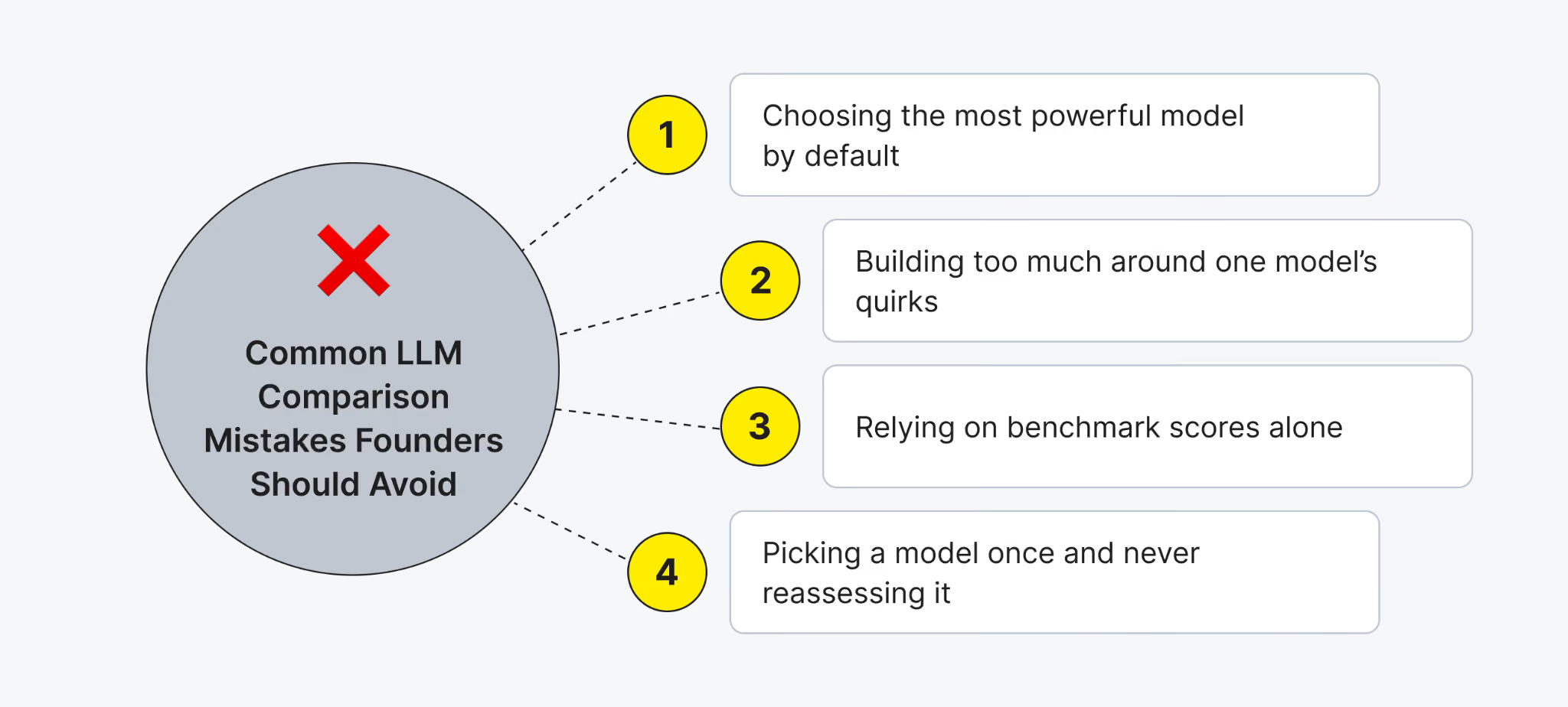
Choosing an LLM is not just about finding the model with the highest score or most impressive capabilities. The wrong choice can lead to unnecessary costs, technical lock-in, or disappointing results once the model meets real product requirements. Here are some of the most common mistakes founders should avoid.
Choosing the Most Powerful Model by Default
A flagship reasoning model can cost several times more than a lighter tier, even when the task does not require multi-step reasoning. For simple generation, classification, extraction, or summarisation, a smaller model may deliver the same practical result at a much lower cost. Testing the cheaper option first and moving up only when it falls short helps prevent unnecessary recurring expenses.
Building Too Much Around One Model’s Quirks
A product can become difficult to change when its core logic depends on one model’s specific prompt format or behaviour. Hardcoding these assumptions means switching providers may require a substantial rebuild rather than a simple configuration change. Keeping the model layer flexible from the beginning makes it easier to replace or upgrade the LLM later.
Relying on Benchmark Scores Alone
A model that tops a general leaderboard will not necessarily perform best on a specific company’s documents, terminology, or workflows. General benchmarks provide a useful starting point, but they cannot fully represent the inputs and edge cases a product will encounter. Testing several models on real, representative examples gives a much more reliable basis for the final choice.
Picking a Model Once and Never Reassessing It
The model that makes sense in January may no longer be the strongest option by September, especially in a market where new models and pricing changes appear frequently. Treating the initial choice as permanent can leave a product paying more or getting weaker results than necessary. A product built without hardcoded model-specific assumptions can adopt a newer or better-performing model without requiring a complete rebuild.
Seeking help with building your gen AI product?
Upsilon has an extensive talent pool made up of experts who can help bring your generative AI ideas to life!
Concluding Thoughts on the LLM Model Comparison
Foundation models like Gemini, GPT, Llama, and others allow you to build upon the LLM’s architecture and access AI capabilities. But they differ in many ways, including pricing, degree of customizability, difficulty in integration, performance speed, output accuracy, operational efficiency, and so on. A comparison of LLMs should evaluate not only these technical differences but also the overall fit of each solution for your specific use case.
If you’re seeking a hand with the tech side and need someone experienced to handle your LLM API integration, Upsilon’s generative AI services can be a good fit. Feel free to reach out to us to discuss which generative AI you’d like to add to your application or existing solution. Our pros can advise on which model to choose and how to approach the process most optimally in terms of your budget and business case.



FAQs
What is the best LLM?

There is no single best LLM, only the best one for a specific task and budget. A flagship reasoning model like GPT-5.6's Sol tier or Claude's Opus 5 leads on complex, multi-step reasoning; a cheaper tier or an open-source model like Llama 4 often performs as well on a narrow task like classification or a support widget, at a fraction of the cost. The right question is never which model is best. It is which model is best for this feature, at this budget.
What's the difference between an LLM and a foundation model?
A foundation model is the broader category: any large model trained on a wide dataset and adapted for many downstream tasks, including image and audio models. A large language model, or LLM, is the text case, a foundation model built to understand and generate language. Every LLM is a foundation model; not every foundation model is an LLM.
How do I compare LLM pricing?
Compare price per million input tokens and price per million output tokens as two distinct numbers, since output almost always costs more. OpenAI's GPT-5.6 lineup, for example, spans $1 to $5 per million input tokens across its three tiers, with output priced several times higher on each. Pricing changes every few months across every major provider, so check the provider's own pricing page before budgeting rather than relying on a fixed number from an article.
Should I choose an open-source or proprietary model?
Choose proprietary (GPT-5.6, Claude 5, Gemini 3) when speed to market and consistent quality matter more than infrastructure control, which covers most early-stage products. Choose open-source (Llama 4, DeepSeek, Mistral) when data privacy requires self-hosting, when a narrow fine-tuned model would outperform a general one, or when per-token API cost at scale outweighs the infrastructure cost of running the model yourself.
Where can I find live LLM benchmark data?
Artificial Analysis, LiveBench, and LLM Stats all track real-time benchmark scores, pricing, and context windows across every major model, updated as new models ship. A static article's benchmark numbers go stale within weeks of a new model release, so treat this guide as the framework for choosing and a live leaderboard as the source for today's exact numbers.
Can I switch LLM providers after building on one?
Yes, if the integration was built without hardcoding assumptions about one specific model's quirks. An app that calls a provider's API through a thin, swappable layer can switch models with a code change measured in days, not a rebuild. An app built to depend on one model's exact prompt format and behavior makes switching far more expensive later, a real cost of the initial technical decision, not a hypothetical one.
to top