10 Top AI Product Development Companies to Partner With in 2026

AI is changing what businesses build, not just how they run. A recent survey found that 30% of CEOs plan to use AI for new product and service development, while 47% expect to integrate AI into their technology platforms over the next three years. As more companies move toward AI-powered products, the challenge is turning a promising idea into something useful, reliable, and ready for real customers.
That takes more than plugging an AI model into an existing application. Businesses need to validate the product concept, choose the right technology, design an intuitive user experience, build the software around the AI, and keep the whole thing aligned with business goals. An experienced AI product development company can bring these pieces together and take a product from an early idea to a working solution.
But not every development partner approaches AI products in the same way. Some specialize in building new products from scratch, while others focus on advanced machine learning, AI-native development, or adding intelligent capabilities to existing software. Below, we’ll compare 10 companies to help you understand their strengths and find a partner that matches your product and business needs.
What Is an AI Product Development Company, and What Does It Do?
An AI product development company is a technology partner that helps businesses design, build, launch, and improve products that use artificial intelligence as a core or supporting technology.
Unlike a traditional software development company, it combines product strategy and software engineering with AI expertise, helping businesses decide where artificial intelligence can add real value and how to implement it effectively. Depending on the project, an AI product development agency can validate an AI concept, prepare data, integrate LLMs, build AI agents, develop the product experience, and support the solution after launch.
What AI Product Development Services Typically Include
AI product development services can cover different stages of the product lifecycle, including:
- Discovery and AI feasibility: Teams define the product idea, identify suitable AI use cases, and assess whether the technology, data, and budget make the concept viable.
- Data preparation: Developers collect, clean, structure, label, and prepare the data needed to train, fine-tune, or evaluate AI systems.
- LLM integration and RAG: Teams integrate large language models and, when needed, use retrieval-augmented generation (RAG) to connect them with a company’s proprietary or up-to-date information.
- AI agent development: Developers build AI agents that can reason through tasks, use tools, retrieve information, and take actions within defined workflows.
- AI product UX: Product and design teams create interfaces that make AI outputs understandable, useful, and easy for people to interact with.
- MLOps and evaluation: Teams establish pipelines and evaluation frameworks to test model quality, manage versions, and deploy AI systems reliably.
- Post-launch monitoring: After launch, teams monitor performance, usage, costs, and model behavior to identify issues and improve the product over time.
In short, AI product development is about turning AI capabilities into a product people can actually use, rather than treating AI as a standalone technology. The right partner should therefore bring both AI expertise and a strong understanding of product development.
Need a hand with product development?
Upsilon is a reliable tech partner with a big and versatile team that can give you a hand with creating your AI app.

How We Selected These AI Product Development Companies
There are plenty of companies that describe themselves as AI developers, but building a convincing demo is very different from shipping and maintaining a real AI product. For this list, we focused on companies with evidence of hands-on product development, strong AI engineering capabilities, and the ability to carry a project through the stages that come after the initial prototype.
We looked at both the technology and the product side of each provider. The criteria below helped us assess whether a company can build something businesses can actually launch, use, and continue developing:
- Production Experience. We looked for evidence that companies have shipped real AI-powered products and features used by actual customers, rather than limiting their work to demos, experiments, or proof-of-concepts.
- AI Engineering Depth. We considered expertise across generative AI, LLMs, RAG, AI agents, machine learning, data engineering, MLOps, and model evaluation. Companies that can build beyond a basic API integration received stronger consideration.
- End-to-End Product Development. We assessed whether providers can support the broader product lifecycle, including discovery, product strategy, UX/UI, software development, AI integration, deployment, and ongoing improvements.
- Technical Integration and Scalability. We looked at the ability to connect AI solutions with existing applications, APIs, databases, cloud infrastructure, and business systems while building an architecture that can evolve as the product grows.
- Track Record and Client Feedback. We reviewed publicly available case studies, completed projects, client portfolios, and verified reviews on platforms such as Clutch and G2. Where available, we also considered evidence of measurable product or business outcomes.
- Industry and Product Expertise. We considered experience solving real business problems across areas such as SaaS, healthcare, fintech, e-commerce, logistics, and other industries. Relevant domain experience can be particularly useful when AI has to work within specific workflows or user needs.
- Post-Launch Support. We looked at whether companies can stay involved after launch through monitoring, maintenance, model evaluation, optimization, and further product development. AI products often require ongoing iteration as models, data, costs, and user behavior change.
Upsilon is our company, and we placed it first because we can vouch for its product development work firsthand. We applied the same criteria to Upsilon as to every other company on the list, and no company paid to be included.


Comparison Table: Top AI Product Development Companies in 2026
Choosing an AI development partner is easier when the key differences are visible at a glance. The table below compares 10 AI product development companies by their founding year, team size, typical hourly rate, engagement model, and the AI capabilities that stand out in their offering.
The comparison shows that these companies take quite different approaches to AI product development. Some offer structured MVP and product-building engagements, while others focus more heavily on AI engineering, agentic systems, or specialized industry applications. Below, we take a closer look at each company, including its core services, notable AI capabilities, pricing, and what to consider before choosing it.
10 Top AI Product Development Companies: Detailed Reviews
Choosing an AI product development company can be tricky because many providers now offer similar services on paper: LLM integration, AI agents, generative AI, machine learning, and automation. The difference usually comes down to what they are actually equipped to build, how involved they are in product development, and whether their experience matches the complexity and stage of your project.
What companies focus on AI product development? The companies below take different approaches, depending on the product, industry, and stage of development. Some help startups turn an early idea into an AI MVP, while others specialize in research-heavy machine learning, mobile AI, regulated industries, enterprise data, or large-scale AI programs.
1. Upsilon: Best for Startups Building an AI MVP or AI-Native Product
Founded: 2012
Team size: 60+
AI product development services: Generative AI development, LLM integration, AI agents, RAG, AI copilots, AI automation, machine learning, NLP, AI MVP development
Upsilon is a product development studio that helps startups and growing companies turn new ideas into working digital products. The team combines product discovery, UX/UI design, software engineering, and AI development, so AI is considered as part of the product rather than treated as a separate technical layer. Upsilon can help validate an AI use case, choose the right technology and models, define the scope, and build the first production-ready version.
For companies building an AI product from scratch, the process can start with a focused discovery phase that turns an idea into a practical product plan. This includes defining target users and core functionality, assessing technical feasibility, selecting an appropriate AI approach, and deciding which capabilities are worth including in the first release. The development team can then move into MVP development, integrating the AI model, data layer, backend, and user interface into one product.
Upsilon also works with companies that already have a product and need to introduce AI into it. Its services include LLM and generative AI integration, RAG systems that connect models to proprietary data, AI agents that can perform multi-step tasks, and AI-powered automation. This AI MVP development agency works with major foundation models and can select the technology based on the product's requirements rather than building around a single proprietary AI platform.
The engagement model is designed around the needs of startups and growth-stage companies. Upsilon offers fixed-scope product development, dedicated teams, and team augmentation, allowing companies to bring in a full product team or add specific AI and engineering expertise to an existing team. The company also develops its own B2B SaaS products, giving its team hands-on experience with the product, technical, and business decisions involved in building and scaling software.
Best for: Startups and growth-stage companies building an AI MVP, launching a new AI-native product, or adding substantial AI functionality to an existing product.
Pricing: $25–49/hour; AI-enabled MVPs and other projects are priced according to scope, complexity, integrations, and team composition.
Key strengths:
- End-to-end AI product development;
- AI use-case discovery and validation;
- Generative AI and LLM integration;
- RAG architecture and proprietary-data integration;
- AI agent and multi-step workflow development;
- AI copilots and intelligent automation;
- Flexible foundation-model selection;
- Product design and full-stack development under one team;
- Fixed-scope and dedicated-team engagement models;
- Discovery, MVP development, and post-launch product support.
Worth knowing: Upsilon is primarily a product development partner rather than a large enterprise consulting firm. Its sweet spot is building and launching AI-powered products when a company needs product thinking and hands-on engineering in the same team. A project that requires training a highly specialized model from scratch or conducting deep AI research may be better suited to a research-heavy company such as deepsense.ai or Tooploox.
2. HatchWorks AI: Best for AI Strategy Through Build
Founded: 2016
Team size: 200+
AI product development services: AI strategy, AI-native product development, generative AI development, AI agents, data modernization, model fine-tuning, machine learning, AI change management
HatchWorks AI is an AI and data transformation company that combines strategy, software development, data engineering, and AI implementation. Its approach is organized around three stages: GenROI for deciding which AI initiatives to pursue, GenDD for building production-ready systems, and GenEQ for adoption and change management. This gives companies a way to move from identifying an AI opportunity to implementing and scaling it.
The company builds AI-native products and applications, develops agentic automation, modernizes data foundations, and works with foundation models that can be fine-tuned to specific business needs. Its GenDD methodology uses AI agents throughout the software development lifecycle while keeping experienced engineers responsible for architecture, validation, security, and what reaches production.
Best for: Mid-sized and enterprise companies that want AI strategy, product development, and nearshore engineering support from one partner.
Pricing: Custom quote.
Key strengths:
- AI strategy and opportunity prioritization;
- AI-native product development;
- Agentic automation;
- Data modernization;
- Model fine-tuning and optimization;
- AI-driven software development;
- Nearshore engineering teams across the Americas;
- AI adoption and change management;
- Strategy-to-production delivery.
Worth knowing: HatchWorks AI has a consulting-led structure that connects strategy, development, and adoption. That can be useful for organizations still deciding where AI should create value, but a startup that already has a clearly defined feature may not need the full strategy and adoption framework.
3. deepsense.ai: Best for Hard Machine Learning Problems
Founded: 2014
Team size: 120
AI product development services: AI agents, generative AI, LLM development, RAG, MLOps, computer vision, NLP, edge AI, predictive analytics
deepsense.ai is an applied AI company that combines AI engineering, research, and product delivery. The company works across LLM applications, AI agents, RAG, computer vision, predictive analytics, MLOps, and edge AI, with a focus on production systems rather than experimental prototypes. It has completed more than 200 commercial AI projects and has a team of 120 AI experts.
Its services cover the full implementation lifecycle, from architecture and engineering to integration, evaluation, deployment, and ongoing optimization. The company can also provide specialist expertise to an existing AI team or assemble a delivery pod for a specific workstream.
Best for: Companies with technically complex AI or machine learning problems that require specialist expertise beyond off-the-shelf models.
Pricing: Custom quote.
Key strengths:
- Applied AI research and engineering;
- LLM and RAG development;
- AI agent development;
- Computer vision;
- Edge AI;
- MLOps and LLMOps;
- AI evaluation and optimization;
- Embedded AI engineering teams;
- Production AI implementation.
Worth knowing: deepsense.ai's research and engineering depth is particularly relevant when standard foundation models do not solve the problem. A startup that only needs a straightforward LLM integration may not need this level of specialized AI expertise.

4. Miquido: Best for AI in Consumer and Mobile Products
Founded: 2010
Team size: 200+
AI product development services: Generative AI, LLM integration, AI agents, AI chatbots, machine learning, data science, computer vision, on-device AI
Miquido is a software product development company with a strong focus on mobile and digital products. Its AI practice covers generative AI, machine learning, data science, computer vision, chatbots, AI agents, and AI integration. The company also develops AI features that run directly on mobile devices rather than relying entirely on cloud-based inference.
Its AI integration services are designed for companies that already have a mobile or digital platform and want to add intelligent capabilities without rebuilding the product. Miquido also offers AI agent development, including single-agent implementations, multi-agent systems, RAG pipelines, and integrations with existing business workflows.
Best for: Consumer, fintech, media, and mobile products that need AI features integrated into an existing user experience.
Pricing: Custom quote; public AI project rates are not published.
Key strengths:
- Generative AI development;
- AI integration for existing products;
- AI agent development;
- On-device AI;
- AI chatbot development;
- Machine learning and data science;
- Computer vision;
- Mobile product development;
- AI consulting and strategy.
Worth knowing: Miquido has a particularly strong mobile focus, which makes its AI expertise relevant for products where latency, privacy, offline functionality, or device-level processing matter. Its on-device AI practice covers model selection, architecture, device testing, privacy, and production monitoring.
5. InData Labs: Best for Computer Vision, NLP, and Data-Heavy AI
Founded: 2014
Team size: 80+
AI product development services: Generative AI, AI agents, machine learning, NLP, computer vision, predictive analytics, data science, data engineering
InData Labs is a data science and AI company with a strong focus on machine learning, data engineering, and applied AI. The company has delivered more than 150 projects and works with a team of 80+ data scientists, engineers, architects, analysts, and designers. Its AI practice covers generative AI, NLP, computer vision, predictive analytics, and machine learning.
The company also develops custom AI agents, combining LLMs, NLP, enterprise integrations, guardrails, logging, and human oversight. Its data engineering capabilities allow it to work on the infrastructure behind AI products as well as the AI functionality itself.
Best for: Products that depend on computer vision, NLP, predictive analytics, or large and complex datasets.
Pricing: Time and material or fixed price; rates are not publicly listed.
Key strengths:
- Data science and machine learning;
- Generative AI and LLM development;
- Custom AI agents;
- Computer vision;
- NLP;
- Data engineering;
- Predictive analytics;
- AI solution development;
- End-to-end AI implementation.
Worth knowing: InData Labs has a strong data-first approach. This is useful when the AI product depends on complex data pipelines or custom machine learning rather than simply connecting an application to an existing foundation model.

6. Tooploox: Best for AI Research Turned Into Products
Founded: 2012
Team size: 40+
AI product development services: AI discovery, AI development, generative AI, custom models, AI agents, computer vision, NLP, machine learning
Tooploox is a software development and R&D company with a dedicated team of more than 40 AI engineers and researchers, many of whom hold or pursue PhDs. Its researchers have published more than 30 peer-reviewed papers and contributed to conferences including NeurIPS, ICML, and ECCV. The company combines this research background with full-stack software development and product design.
Its AI services begin with discovery and can continue through proof of concept, product development, and production delivery. Tooploox works with generative AI, custom models, AI agents, multimodal systems, computer vision, and other machine learning technologies.
Best for: Products that require a new or unusual AI capability where research and experimentation need to happen before the final product is built.
Pricing: Custom quote.
Key strengths:
- AI research and R&D;
- AI discovery and feasibility assessment;
- Generative AI development;
- Custom model development;
- AI agents;
- Computer vision and machine learning;
- Multimodal AI;
- AI product discovery and delivery;
- Full-stack product development.
Worth knowing: Tooploox's research-heavy model is particularly useful when the required AI capability is not straightforward. A product that simply needs an established LLM integrated into an existing application may not need a research-oriented team.
7. Neurons Lab: Best for AI Agents in Financial Services
Founded: 2019
Team size: 50+
AI product development services: AI agent development, agentic AI, AI adoption programs, AI integration, workflow automation, AI training, AI consulting
Neurons Lab is an AI engineering and consulting company focused specifically on financial services. It helps banks, insurers, investment firms, wealth managers, and other regulated organizations move from AI experimentation to production systems. Its work combines AI adoption programs with custom AI agent development.
The company develops production-grade agents that can execute multi-step workflows within a client's infrastructure, with business rules, governance, auditability, and human oversight built into the system. Neurons Lab also works alongside client teams through embedded delivery, helping organizations develop internal AI capabilities rather than simply handing over a finished system.
Best for: Financial services companies that need custom AI agents and AI adoption support in regulated environments.
Pricing: Custom quote.
Key strengths:
- Financial services AI expertise;
- Custom AI agent development;
- Agentic workflow automation;
- AI adoption programs;
- AI training and enablement;
- Governance and compliance considerations;
- Embedded engineering teams;
- Production AI deployment.
Worth knowing: Neurons Lab is deliberately specialized in financial services. That domain focus can be valuable for banking, insurance, wealth management, and capital markets projects, but companies outside regulated financial services may not benefit from the same level of industry specialization.
8. ITRex Group: Best for AI Plus Data Engineering
Founded: 2009
Team size: 250+
AI product development services: Generative AI, LLM development, RAG, AI agents, AI integration, computer vision, NLP, data engineering, MLOps
ITRex Group is a software and AI development company that combines AI engineering with data, cloud, and software development. The company has more than 250 professionals and has delivered more than 600 solutions for over 200 clients. Its AI practice covers generative AI, LLMs, AI agents, machine learning, computer vision, NLP, and enterprise AI integration.
ITRex also works on the data infrastructure that supports AI products, including data warehouses, lakehouses, analytics platforms, RAG pipelines, and enterprise data integrations. Its generative AI practice includes model fine-tuning, RAG, AI agents, LLMOps, and post-launch optimization.
Best for: Mid-market and enterprise companies whose AI product depends on complex data infrastructure and integrations with existing business systems.
Pricing: Custom quote; dedicated teams or individual specialists.
Key strengths:
- Generative AI development;
- LLM and SLM integration;
- RAG development;
- AI agent development;
- Enterprise AI integration;
- Data engineering;
- Computer vision and NLP;
- MLOps and LLMOps;
- AI product discovery;
- Post-launch AI optimization.
Worth knowing: ITRex combines AI development with data engineering, which is useful when an AI initiative cannot be separated from the underlying data platform. The company can also work with existing enterprise systems rather than requiring the product to be built as a standalone application.
9. Markovate: Best for Generative AI With Security Certifications
Founded: 2014
Team size: 50+
AI product development services: Generative AI, AI agents, LLM development, AI integration, AI chatbots, machine learning, MLOps, AI consulting
Markovate is a digital product and AI development company focused on generative AI and AI-powered business solutions. Its team includes generative AI specialists, engineers, and data scientists who work with companies to embed AI into existing operations and develop new AI capabilities. The company reports more than 200 delivered projects and 65+ AI solutions.
Its AI services include generative AI development, agentic AI, AI chatbots, machine learning, AI consulting, and AI integration. Markovate also positions its security and compliance capabilities as part of its work with regulated and security-sensitive industries.
Best for: Companies building generative AI products or AI-powered workflows where security, privacy, and compliance are important.
Pricing: Custom quote.
Key strengths:
- Generative AI development;
- AI agent development;
- LLM development and integration;
- AI chatbots;
- Machine learning;
- AI consulting;
- AI integration;
- Information security practices;
- Support for regulated industries.
Worth knowing: Markovate's current website describes more than a decade of technology work but does not state an exact founding year; 2014 is reported by external company profiles. The company's own site also distinguishes its 50+ core team from its wider delivery footprint, so it is worth asking how large the team assigned to a specific project will be.


10. 10Pearls: Best for Enterprise-Scale AI Product Programs
Founded: 2004
Team size: 1,400+
AI product development services: AI product development, generative AI, agentic AI, LLM integration, RAG, AI integration, custom AI solutions, AI security, AI governance, MLOps
10Pearls is an AI-native digital development company that works with enterprises on product development, AI engineering, and technology modernization. Its AI practice covers the full product lifecycle, from AI strategy and use-case discovery through product design, MVP development, deployment, and post-launch optimization. The company has more than 1,400 experts and operates across four continents.
Its AI product development services include AI product strategy, UX design for AI interfaces, MVP development, scalable AI architecture, generative AI applications, RAG, LLM integration, and agentic AI. The company also works on AI governance, security, data engineering, and integration with existing enterprise infrastructure.
Best for: Large enterprises that need to build and scale AI products across complex technology environments or multiple business workstreams.
Pricing: Custom enterprise quote.
Key strengths:
- AI product strategy and development;
- Generative AI development;
- Agentic AI development;
- LLM integration and fine-tuning;
- RAG and graph RAG;
- AI integration with enterprise systems;
- AI governance and security;
- AI MVP development and validation;
- Scalable AI architecture;
- Global delivery capacity.
Worth knowing: 10Pearls is built for enterprise-scale delivery, with a large global team and experience across complex and regulated environments. Its scale can be useful when several AI workstreams need to run in parallel, while a smaller startup building its first AI MVP may not need the same organizational capacity.
AI MVP Development Company vs. AI Product Development Company: Which Do You Need?
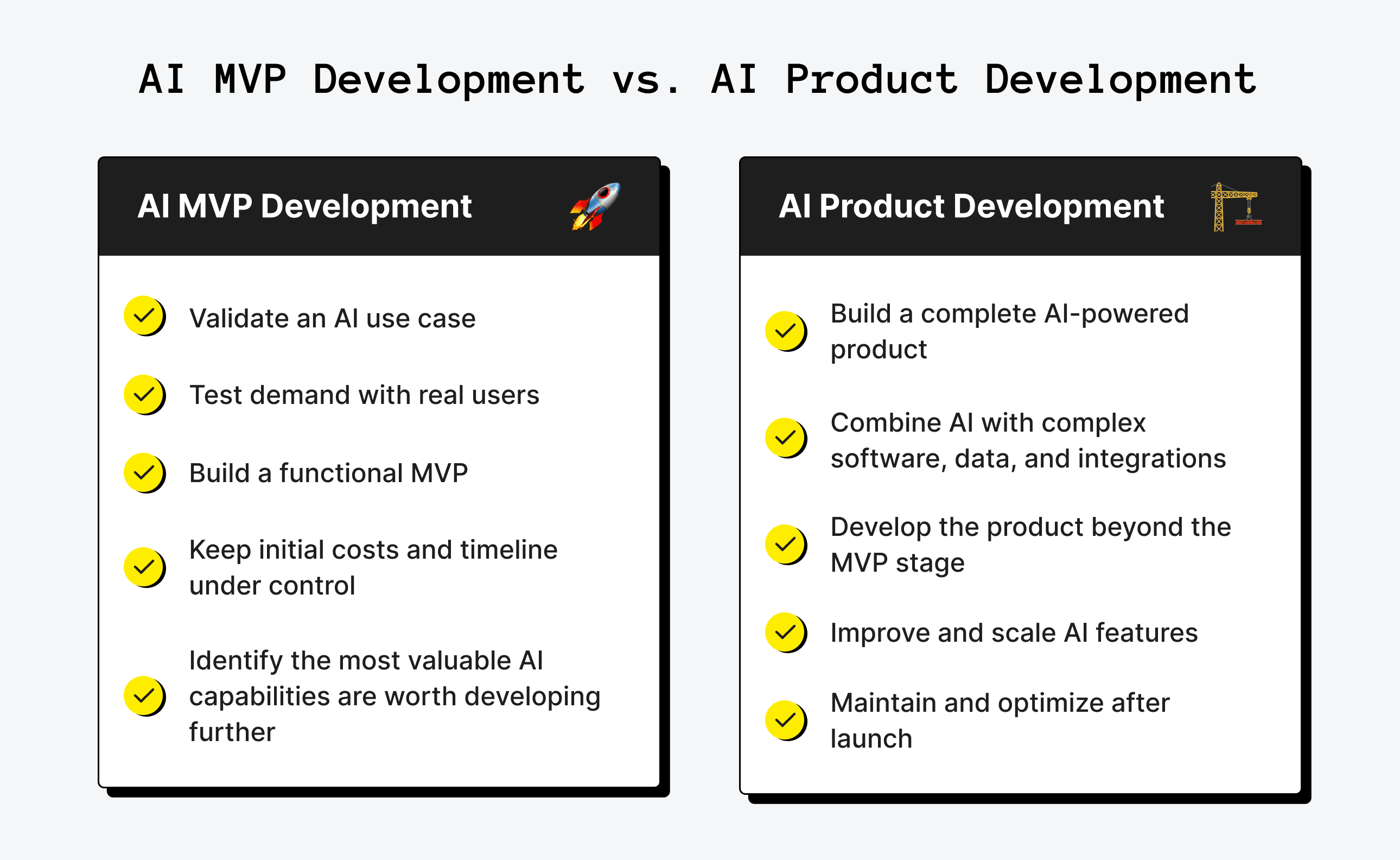
AI MVP development companies help businesses turn an early-stage SaaS product idea into a functional minimum viable product that can be tested with real users. An AI product development company typically covers a broader scope, from validating the concept and building the first version to launching, scaling, and continuously improving the product.
The difference usually comes down to where the product is and what you need to achieve next.
An MVP-focused partner can be a good fit when the product is still being validated and the priority is learning quickly without investing in a full-scale build. This approach can make sense if you need to:
- Validate an AI use case before investing in a larger product.
- Test demand with real users and collect early feedback.
- Build a functional MVP with only the core features.
- Keep initial development time and costs under control while the concept is still evolving.
- Identify which AI capabilities are worth developing further.
For a deeper look at the process, timeline, costs, and key decisions involved, check out this AI MVP development guide.
A broader AI product development partner is more relevant when the goal goes beyond validating an initial idea. These companies can support the product through multiple stages and continue developing it as requirements, users, and AI capabilities evolve.
This can be a better fit when you need to:
- Build a complete AI-powered product rather than test an initial concept.
- Combine AI with complex software, data, and third-party integrations.
- Develop the product beyond the MVP stage as it gains users and traction.
- Improve and scale existing AI features based on real-world usage.
- Maintain and optimize the product after launch, including model evaluation, monitoring, and new feature development.
The two types of partners are not mutually exclusive. A business can create an AI MVP to validate a concept and then continue with the same team as the product moves into full development.
The key question is whether the immediate priority is learning what works or building and evolving a product that is already moving toward the market. That distinction can help determine how broad a development partner you actually need.
How Much Do AI Product Services Cost?
AI product development services typically cost $25,000 to $150,000 for an AI MVP or a single AI-powered product. Production-grade generative AI apps run $80,000 to $300,000, and enterprise AI platforms go past $1 million. The final price depends on scope, data readiness, the choice between an off-the-shelf LLM and a custom model, integrations, and compliance.
Clutch reviews give a neutral benchmark. According to Clutch's AI pricing guide, the average AI development project costs $120,594 and takes about 10 months. That works out to roughly $11,550 per month. Most AI development companies listed on the platform charge between $25 and $49 per hour.
AI Product Development Cost by Stage and Product Type
AI products are usually built in stages, with each stage requiring a different level of effort and investment. A typical process starts with a short discovery phase, followed by a proof of concept or MVP and, eventually, a production release. The table below gives a general idea of the typical costs and timelines for each stage and common AI product type.
For many early-stage products, discovery followed by a fixed-scope MVP provides a more controlled way to validate the idea before committing to a larger build. A simple AI-powered MVP typically costs $25,000–50,000 and takes 2–3 months, while a generative AI MVP can cost $50,000–100,000 and take three months or more. A scoped AI agent MVP costs $50,000–150,000 and takes 2–4 months.
What Drives the Cost of AI Product Development?
The difference between a $30,000 AI product and a $300,000 one usually comes down to a handful of practical factors:
- Scope. The number of AI workflows, user roles, and platforms, such as web, mobile, or admin interfaces, all affect the amount of development required at launch.
- Data readiness. Clean, well-structured, and accessible data allows the team to move into development more quickly. Scattered, incomplete, or unlabeled data can require significant preparation before model development begins.
- Model approach. Integrating an existing LLM such as GPT, Claude, or Gemini through an API is generally less expensive than building on top of your own data with RAG. Fine-tuning or training a custom model requires additional data, infrastructure, and engineering work.
- Integrations. Connecting the product to systems such as CRMs, ERPs, payment platforms, or legacy databases adds development, security, and testing requirements.
- Compliance. Requirements such as HIPAA, GDPR, SOC 2, or financial regulations can increase the amount of security work, documentation, testing, and auditing involved. Upsilon estimates that compliance requirements typically add 5–10% to development costs.
How to Choose an AI Product Development Company
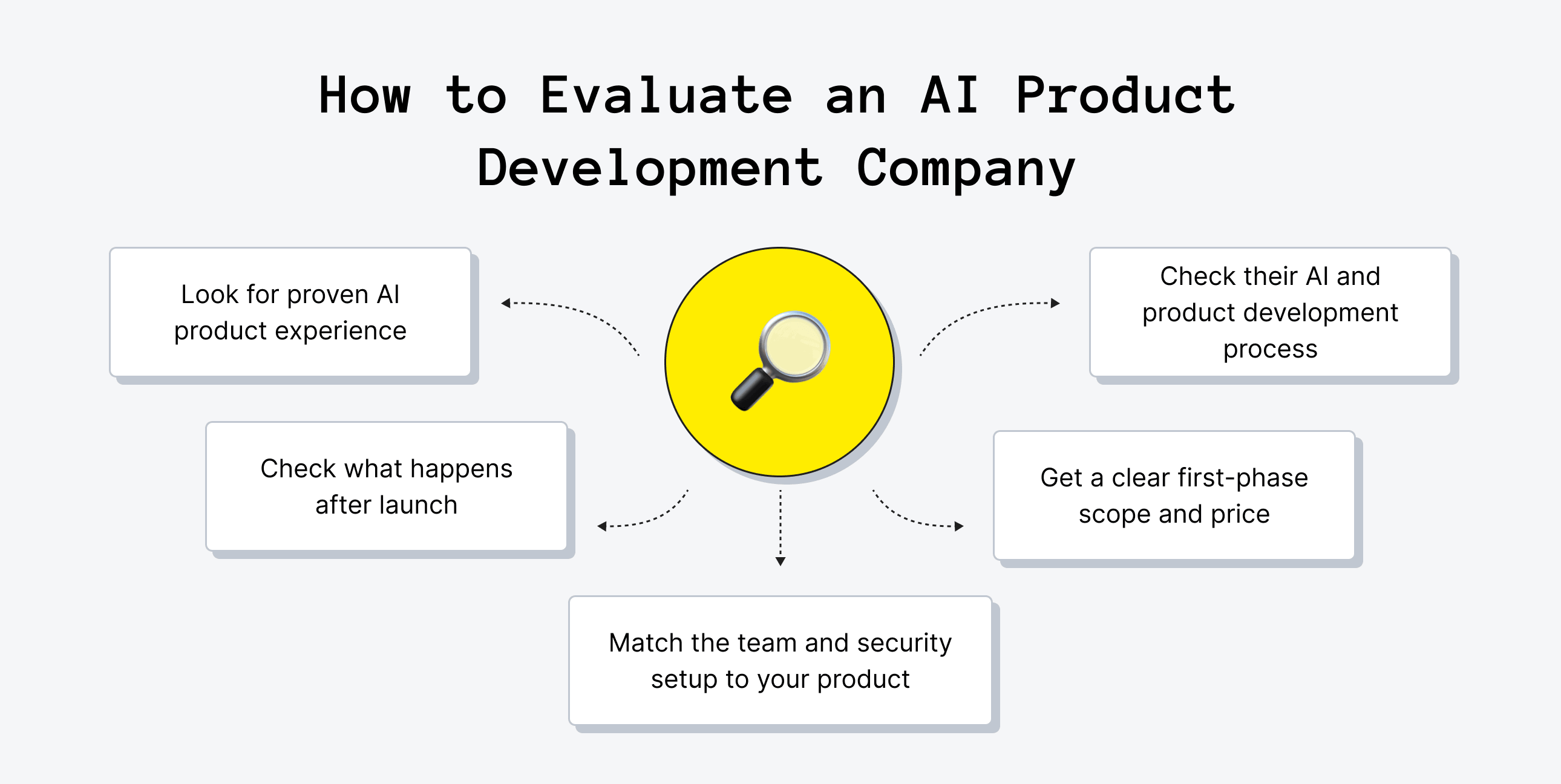
Choosing an AI product development company goes beyond comparing technology stacks or counting the AI services listed on a website. If you plan to outsource MVP development, you need to understand whether a potential partner has real production experience, a structured development process, transparent pricing, the right team and security practices, and enough post-launch support to grow the product.
These five checks can help you assess potential partners and spot red flags before signing a development contract.
1. Look for Proven AI Product Experience
You should start with the company's portfolio, but look beyond polished demos. Ask to see AI products that have reached real users and find out what the company actually built, what role AI plays in the product, and what happened after launch. Production experience shows that the team has dealt with inaccurate outputs, edge cases, inference costs, integrations, and monitoring.
It is also worth checking whether the previous projects are relevant to your use case. A team experienced in AI agents, RAG, computer vision, or predictive analytics may be a better fit for a particular product than a generalist firm that simply lists all of these technologies on its website. Detailed case studies with measurable outcomes are much stronger evidence than a long service list.
2. Check Their AI and Product Development Process
AI product development involves more than connecting an application to an LLM. Depending on the product, you may need data engineering, model selection, RAG, fine-tuning, AI agents, MVP design, backend development, MLOps, and monitoring. A capable partner should be able to explain which of these components your product actually needs and which ones would simply add unnecessary complexity.
So, it’s important to pay particular attention to how the company evaluates AI outputs. Ask about test sets, human review, automated evaluation, quality thresholds, and production monitoring. A strong partner should have a clear way to determine whether the AI is working well for your users, rather than relying only on the benchmark performance of the underlying model.
3. Get a Clear First-Phase Scope and Price
AI projects can be difficult to estimate before the requirements, data, and technical approach are understood. However, discovery, a technical assessment, or an initial proof of concept should still have a defined scope, timeline, deliverables, and price.
This first phase can also help you evaluate the partnership before committing to a larger build. You should ask what is included in the estimate and whether additional costs such as AI model usage, cloud infrastructure, data preparation, evaluation, or monitoring are covered. A clear first phase makes it easier to compare companies without comparing vague promises.
4. Match the Team and Security Setup to Your Product
It’s crucial to find out who will actually work on your project day to day and how much involvement you can expect from senior product and AI specialists. A smaller studio may provide more direct senior attention, while a larger firm may have a broader talent pool and more capacity to support several teams as the product grows.
Security and data handling should be discussed at the same time. Your requirements will depend on the industry, users, and type of data involved, so ask which certifications, agreements, and controls apply to your project. It is also important to clarify ownership of the source code, data, prompts, custom models, and other project assets before development begins.
5. Check What Happens After Launch
The first production release is not the end of an AI product's development. Models and APIs change, user behavior evolves, inference costs fluctuate, and AI performance can deteriorate as real-world data changes. A long-term partner should have a plan for monitoring, evaluation, model updates, maintenance, and optimization.
Finally, you should ask how the team would support the product as it grows. A startup-sized studio may be a strong fit for an early AI MVP but have less capacity for several parallel teams later. An established company can provide more delivery capacity, but a smaller project may receive less attention. The important question is whether the company's operating model can support your product at its current stage and as its requirements evolve.
Seeking help with building your product?
Upsilon has an extensive talent pool made up of experts who can help bring your AI ideas to life!
Choosing Your AI Product Development Partner: Final Thoughts
Selecting an AI product development company is ultimately about finding a team that can connect AI capabilities with the realities of building and running a product. Production experience, a clear development process, transparent first-phase pricing, the right technical team, and reliable post-launch support can all help you assess whether a potential partner is equipped for the project ahead.
The right choice will depend on what you are building, how mature the idea is, the complexity of the AI involved, your budget, and how much support you expect after launch. A specialized AI studio may be a good fit for an early-stage product that needs close product and engineering collaboration, while a larger development company may make more sense when you need greater delivery capacity or enterprise-level resources.
For companies turning an AI idea into a working product, Upsilon combines product discovery, AI engineering, and full-stack development within one team. Its AI product development services cover LLM integrations, RAG systems, AI agents, copilots, and custom AI workflows, with the technology shaped around the product's users and business goals. If you are exploring an AI product idea, you can get in touch to discuss the project and define a practical path toward the first version.



FAQs
What are the best AI product development companies?

Upsilon leads this list for startups and growth-stage companies building an AI MVP or an AI-native product, with fixed-scope pricing from $20,000. HatchWorks AI fits companies that want AI strategy and a nearshore build team from one firm. deepsense.ai and InData Labs fit harder machine learning problems like computer vision and custom models. 10Pearls and ITRex Group fit larger companies that need AI delivery at enterprise scale.
What services do AI product development companies offer?
AI product development companies build software that uses AI as a core part of how it works. The usual services are discovery and scoping, LLM integration and retrieval-augmented generation (RAG, connecting a model to your own data), AI agents that carry out multi-step tasks, custom machine learning models, and the data engineering underneath them. The stronger firms also design and ship the product around the model, so it reaches real users as a working feature.
How much does AI product development cost?
An AI assistant built on an existing foundation model costs $20,000 to $80,000 and takes 6 to 12 weeks. A multi-step AI agent runs $50,000 to $150,000. A custom machine learning model runs $60,000 to $250,000, and deep learning work in computer vision or NLP starts around $150,000. Upsilon's AI-enabled MVPs start at $20,000 on a fixed-scope, sprint-based model.
What are the best AI product development companies for startups?
For a startup building its first AI product, look for fixed-scope pricing, a short first phase, and a team that has shipped AI to real users. Upsilon fits this profile best on this list, with MVPs from $20,000, a 3-month average timeline, and a money-back guarantee on the first 2-week sprint. Miquido and HatchWorks AI are also worth a call, depending on whether the AI feature sits inside a consumer app or needs a strategy phase first.
Which AI product development companies work in healthcare?
Healthcare AI needs a partner that handles patient data under HIPAA rules from the first version. On this list, Markovate states HIPAA readiness and holds ISO/IEC 27001 certification, and 10Pearls lists health insurer Elevance Health among its clients. Ask any partner for a healthcare reference and for how they handle protected health information before signing, since readiness claims vary in what they cover.
What is the difference between an AI MVP development company and an AI product development company?
AI MVP development companies build the first working version of an AI product to test whether users want it, on a fixed scope in weeks or months. An AI product development company covers that first version and what comes after: scaling the model, adding features, and running the product in production. Some firms, Upsilon included, do both; larger firms like 10Pearls are built for the later stages.
to top