Why to Outsource MVP Software Development in 2026


Starting with a small product is a common way to launch a business idea. A minimum viable product includes only the core features users need. It helps you enter the market faster, test your idea, and see whether it solves real customer problems. You can then collect feedback, improve the product based on real data, and attract early customers. A working MVP with proven demand can also make your project more appealing to investors.
However, building an MVP still requires careful planning, technical skills, time, and money. For many startups and companies, these resources are limited. Hiring and managing an in-house team may also take longer than expected. Delays at this stage can slow down product launch and give competitors time to move ahead.
This is where MVP outsourcing can help. An experienced development team can turn your idea into a reliable, easy-to-use product while helping you save time and internal resources. You also get access to specialists without spending months on recruitment. Let’s look at the main benefits of working with an MVP development team.
Key Takeaways
- Outsourcing MVP development is often the fastest way for non-technical or time-constrained founders to access a complete product team without spending months on recruitment.
- A dedicated outsourcing partner can reduce costs compared with hiring an in-house team, while providing the design, development, QA, and project-management skills an MVP needs.
- Outsourcing is not always the right choice: a technical co-founder may be able to build a narrow first version independently, while a simple demand test may only require no-code tools or a freelancer.
- Before engaging a development partner, define the core user flow, MVP scope, budget, expected outcomes, and decision-making responsibilities.
- Choose an agency based on relevant product experience, verified reviews, team size, technical depth, transparent estimates, and clear processes, with value and fit taking priority over the lowest hourly rate.
- A successful outsourcing partnership depends on regular communication, a shared roadmap, well-defined responsibilities, and agreements that protect your intellectual property.
Should You Outsource MVP Development?
Three paths lead to a working MVP: hire in-house, bring on freelancers, or outsource to a dedicated team. Each one trades speed, cost, and control differently, and the right pick depends on what you already have in place, not on which option sounds most professional. This is the in-house vs outsource MVP development decision most founders run into earlier than they expected to.
In-House
An in-house team makes sense once you already have engineering leadership on staff to manage designers, developers, and QA as separate hires. Recruiting each role from scratch takes 2-4 months before onboarding even starts, and you carry salary, benefits, and equipment costs whether or not the product ships on time.
Freelance
Freelancers fit narrow, well-defined tasks when a technical co-founder can specify the work precisely and check it directly. Platforms like Upwork and Fiverr put dozens of specialists a search away, but reliability varies by contractor, and one freelancer disappearing mid-sprint can stall the entire build.
Outsourcing
Outsourcing MVP development with a dedicated team fits founders who need a full product team, design, development, QA, and project management, without hiring each role separately, and who are comfortable directing a team rather than managing individual contractors day to day.
A non-technical founder building a SaaS product is the clearest case for outsourcing. They need a designer, two developers, and a QA engineer working in sync for three months, not a single generalist contractor, and they have no in-house lead who could manage that group even if they hired each person separately. A technical co-founder validating a single, well-understood workflow is the clearest case for the opposite: they can specify the work precisely enough that a freelancer, or their own hands on the keyboard, gets there at the same speed.
Example: cost of outsourcing vs hiring in-house vs freelancer
Take a common scenario: a non-technical, early-stage startup founder with a validated B2B SaaS idea, a $30,000 budget, and three months of runway before the next investor conversation. Hiring in-house would burn most of that runway on recruiting alone, before a single feature ships. A freelancer could build a narrow slice of the product, but the founder can't specify enough of the technical detail to direct the work solo. An Eastern European agency, working in 2-week sprints at $35-$75/hr, assembles a scoped team in under two weeks and gets a working product in front of the founder's next investor meeting. That's the calculation outsourcing usually wins on: it fits both the budget and the runway at once, even on months when it isn't the cheapest option on paper.
Most founders choose outsourcing for the timeline: a full team assembled in weeks, not months, even when it isn't the lowest bid on the table. Let’s look at other reasons why MVP outsourcing can be the right choice for your project.
%20for%20Startups.png)

Why Is MVP Outsourcing a Smart Business Move
Why outsource for MVP app development? Many businesses choose external development teams because they can quickly access experienced specialists. This approach is becoming more common in the IT industry: according to recent statistics, over 64% of outsourced IT projects involve application development. The global IT outsourcing market is also growing fast and is expected to generate more than 777 billion USD in revenue by 2028.
Let’s explore the key business benefits of outsourcing MVP software development.

It Frees Up Your Time for the Work Only You Can Do
Handing MVP development to an outsourced team gives you back the hours that would otherwise go to managing day-to-day engineering decisions. That time moves to fundraising, early customer conversations, and go-to-market planning, the parts of the business no agency can do for you.
It Usually Costs Less Than Building the Same Skillset In-House
An Eastern European outsourcing agency bills $35-$75 an hour; the same seniority in-house in the US runs $80-$200 an hour once you add salary, benefits, and recruiting cost. Across a 3-month build, that gap alone can be the difference between a $25,000 MVP and a $90,000 one for founders working with a tight budget.
You Get a Technical Opinion Before You've Spent the Budget
System architecture, database choice, and which features to cut for version one are decisions non-technical founders often make blind. An outsourced team that has built similar products before can flag the expensive mistakes early: the kind of judgment a discovery phase is built to deliver before a single sprint of development starts.
It Closes Skill Gaps You Don't Have Time to Hire For
If your MVP needs a feature your team has never built, AI integration, real-time data, payment infrastructure, hiring and training someone in-house costs months you don't have. An outsourced team that has already shipped similar work gets there faster, without pulling your core team off their existing work to learn on the job. A narrow, specific gap is the clearest case for this: you don't need a full-time AI engineer on payroll for one feature. You need someone who has already built that feature and moves on once it ships.
It Scales Up or Down Without a Hiring or Layoff Cycle
Need an extra developer for six weeks to hit a launch date, or one fewer once a sprint wraps? A dedicated team model adjusts without a recruiting cycle or a conversation nobody wants to have. Most outsourced MVP teams work this way by default, sized to the sprint in front of them rather than a fixed annual headcount.
It's Often the Fastest Realistic Path to a Working Product
A dedicated outsourced team has already shipped a dozen MVPs before yours, so the roadmap, sprint cadence, and QA process exist before your project starts, instead of getting invented from scratch on your budget. Upsilon's average time-to-market is 3 months from signed contract to production deployment, with a working build shown every 2 weeks, not a single reveal at the end.
It Can Grow into a Long-Term Partner Instead of a One-Off Vendor
The relationship doesn't have to end at launch. Founders who keep working with the same outsourced team past the MVP stage skip the re-onboarding cost of bringing in a new agency for every feature round, and the team that built the first version already knows why the codebase looks the way it does.
When Outsourcing MVP Development Isn't the Right Call
While MVP outsourcing offers many benefits, it is not the best option for every project or business. In some cases, working with an external team can create more challenges than value. Let’s look at four situations where you may want to consider a different approach.
You Already Have a Technical Co-Founder with the Bandwidth to Build It
Outsourcing adds a cost and a communication layer neither of you needs yet. A technical co-founder who can ship the first version alone also learns the codebase in a way that pays off at every later stage, hiring, fundraising due diligence, and the inevitable rewrite. Save an outsourced team for when the build outgrows what one person can ship alone.
Your MVP Is a Single, Narrow Test
A landing page and a waitlist, built to check demand before any real code gets written, is a job for a no-code tool or a single freelancer, not a full agency team. A two-week validation test doesn't need a designer, two developers, and a QA engineer; it needs one person and a weekend. Outsourcing a two-week test to a dedicated team is overkill, and most agencies will tell you so rather than take the engagement.
Your Product Handles Regulated Data and Nobody on Your Side Can Evaluate a Vendor's Claims
If you're building on health records or payment information and no one internally can assess a vendor's security posture, bring in independent technical oversight before you sign, not after. A vendor's own compliance page is not a substitute for someone on your side who can ask the right follow-up questions about data handling, encryption, and audit logging. A CTO-as-a-service arrangement closes that gap faster than hoping an agency's compliance claims hold up under scrutiny.
You Can't Describe Your MVP's Core User Flow in a Couple of Sentences
No outsourced team can build what you can't specify, and vagueness at this stage tends to get expensive mid-sprint rather than upfront, once a wrong assumption is already built into the product. In most cases, IT projects that skip proper validation run over budget and deliver less value than predicted. Fixing MVP scope before you engage anyone, whether in-house or outsourced, is a far cheaper place to solve that problem than mid-build.
How to Vet an MVP Development Partner
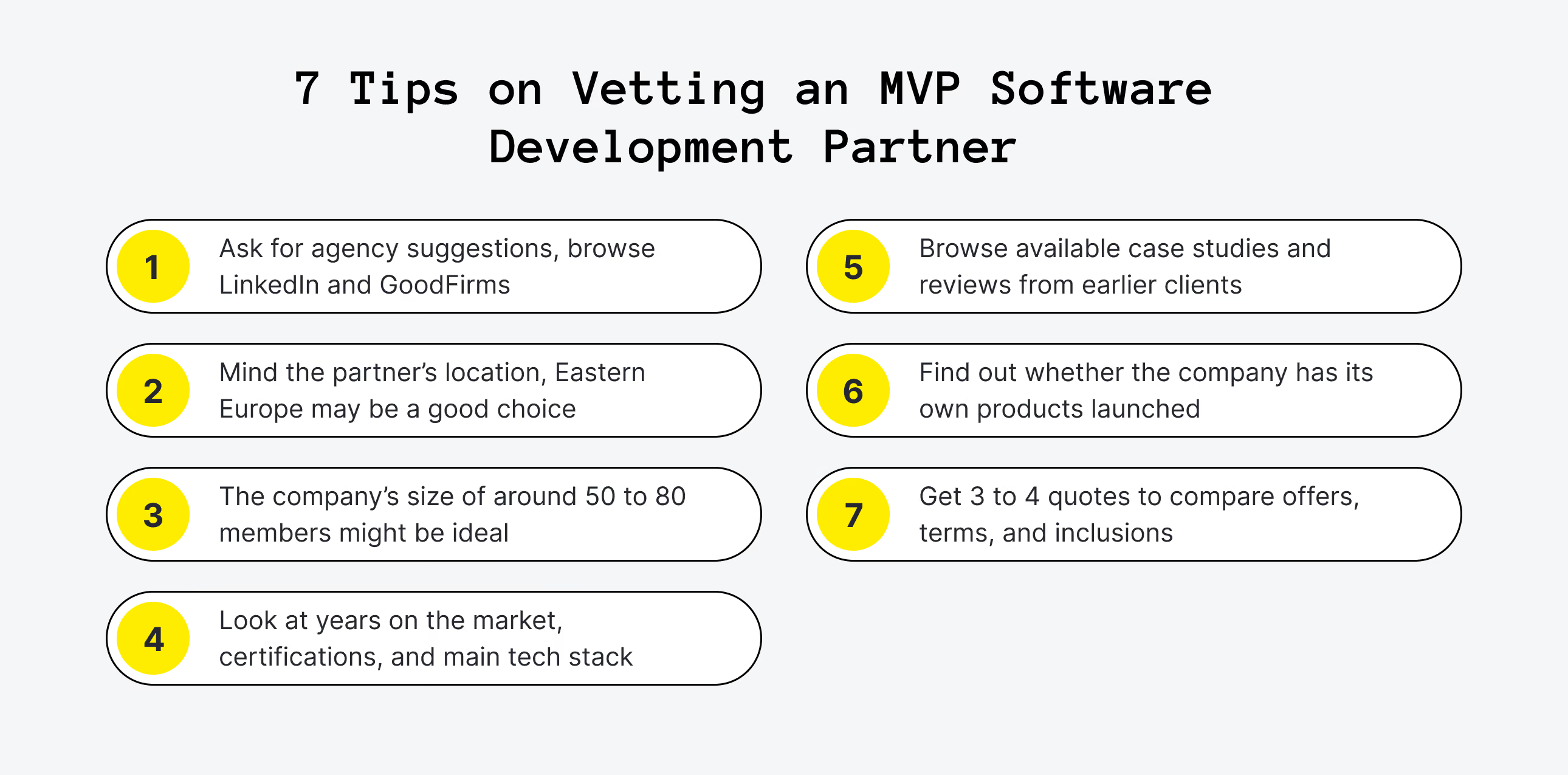
Once outsourcing is the right call, vetting the partner is where most founders under-invest. They spend weeks comparing SaaS tools for their own product, then pick a development partner off a single sales call. Let’s look at seven steps that will help you separate a partner who ships from one who costs you a rebuild.
1. Start With Referrals
Ask other founders in your network first; a browse through GoodFirms works when you don't have a direct referral, and both surface agencies a generic search misses. Pay attention to how an agency describes its own work on LinkedIn, too: a headline that names a specific specialty reads differently from one that lists ten unrelated services.
2. Check Location and Rate Together
Poland, Estonia, and Romania are consistently named among the best countries to outsource MVP development to: $35-$75/hr with 4-5 hours of timezone overlap with the US East Coast. Agencies further into Asia run lower still, but daily standups get harder to schedule. Either way, the cheapest way for MVP outsourcing is rarely the lowest bidder inside that range, it's the one whose rate matches a team with the headcount to staff your project without borrowing developers from someone else's sprint.
3. Look for a Team Size Around 50-80 People
A small team of 20 or fewer members limits how fast a partner can flex if scope grows, adding a specialist mid-build or absorbing a sprint of extra work without derailing someone else's project. A shop with hundreds of developers often means smaller accounts get whichever team is free that month, not the best fit for the work.
4. Be Wary of a Tech Stack that Claims to Cover Everything
Depth in 2-3 stacks relevant to your product beats a checklist of every framework on the market, and it's usually the faster, more reliable build. An agency that lists twelve frameworks as core expertise is rarely deep in more than two or three of them. Look for a team with proven experience building products similar to yours with the technologies they recommend. This helps reduce technical risks and makes it easier to make informed decisions throughout development.
5. Read Case Studies for the End-User Match
An agency that has already built for a similar user base, consumer, B2B, marketplace, understands your users even without direct experience in your exact vertical. Ask what went wrong on a past project and how they handled it; a case study with no friction in it is a marketing copy, not evidence.
Check independent platforms, such as Clutch and GoodFirms to see how former customers rate the work and communication of your potential partner. If you need a clearer picture, request references or connect with past clients through LinkedIn.
6. Ask Whether the Agency Has Shipped Its Own Products
A team that has launched its own product understands the challenges founders face. They know how to prioritize features, cut what is not essential, and focus on getting the product to market faster instead of simply following a specification.
7. Compare Quotes on What's Included
Ask several agencies for estimates to better understand the market and compare their offers. The lowest price is not always the best choice: check the scope of work, project timeline, team composition, and deliverables included in each quote.
Also pay attention to the details. For example, one agency may include discovery, QA, deployment, or post-launch support, while another may charge extra for them. To get an early cost range before talking to providers, you can try our AI MVP Estimator. It can help you outline your project and make conversations with potential partners more focused.


How to Make the Partnership Work
Picking the right partner gets you halfway there. The work after the contract is signed decides whether the MVP ships on time. Below are a few practical tips for smooth communication and collaboration.

Set a Communication Cadence Before Sprint One Starts
Regular standups, a shared channel, and one point of contact on each side keep updates from getting buried in email threads, especially once the team is working across time zones. Ask for a named project manager on day one; a partnership with no single point of contact is where small miscommunications turn into missed sprints.
Split Responsibility Explicitly
Decide upfront who signs off on design, who owns scope changes, and who has final say when a decision needs to move fast. Ambiguity here is what turns a two-day question into a two-week delay, usually because both sides assumed the other one would decide. When everyone knows who is responsible, the team can move forward faster.
Have a Roadmap Outlined Before Development Starts
Create a project roadmap with clear deadlines, responsibilities, and key milestones. This helps everyone understand their role and know when to expect the next stage of work. If your project still lacks this level of clarity, consider starting with a discovery phase. Many MVP development companies can support this process by defining user stories, preparing designs, and choosing the right technical approach.
Describe What You Want at the Level of a User Flow
Your MVP development partner can only deliver what they clearly understand. Explain your goals, priorities, and expected results in simple terms, whether you are discussing a key feature or a minor function. At a minimum, describe the main user journey step by step: for example, “A user opens page B, selects option C, and receives result D.” Clear, easy-to-follow requirements reduce misunderstandings and help the outsourced team build the product you have in mind.
Sign NDAs and IP Agreements Before Any Sensitive Detail Changes Hands
You're about to hand a stranger your product idea and, soon after, your codebase. A signed agreement shows how you outsource MVP development without losing IP ownership of what gets built.
The founders who get the most out of an outsourced MVP team treat the relationship like a hire, not a vendor purchase: clear expectations, real accountability, and a real say in the roadmap. That's true whether the partner works on-site down the road or entirely remote across three time zones; the discipline is the same, only the tools change.
Looking for a reliable tech partner?
Upsilon can help you plan and develop an MVP that'll grow to be a success!

Final Thoughts on Getting an Outsourced MVP Development Team
The decision to outsource MVP software development can let you focus on your core business processes while reducing costs compared with building and maintaining an in-house team. It also gives startups access to the specific, and sometimes highly specialized, skills needed at different stages of product development. It is important to follow a product-led approach when you hand over the technical side to a trusted partner and have a detailed execution plan in place to ensure smoother communication.
Who should you partner with? A company that has a solid track record in MVP creation, relevant technical and product expertise, and a clear understanding of early-stage business needs. Ideally, they should share your goals, have successfully launched their own products, and strive for a lasting partnership.
If you have an MVP project in mind, Upsilon will gladly give you a hand. We have transparent pricing and can be there for you right from the start, as our discovery phase services are aimed at seamless project planning. We are also available afterward with MVP development services to help bring your product to life, on average, it'll take around three months. Feel free to reach out to discuss the details!
FAQ
1. Should you outsource MVP development?

Yes, for most founders who don't already have engineering leadership on staff. Outsourcing MVP development gets you a full product team, design, development, and QA, at $35-$75/hr through an Eastern European agency versus $80-$200/hr equivalent for an in-house hire, live in about 3 months. It's the wrong call only if you already have a technical co-founder who can build it directly, or the MVP is narrow enough for a single freelancer or a no-code tool.
2. How much does it cost to outsource MVP development?
Outsourced MVP development runs $20,000-$65,000 for most startup builds through a sprint-based agency, driven mainly by feature scope rather than hourly rate alone. An Eastern European team bills $35-$75/hr against $100-$200/hr for a US agency doing comparable work. See how much it costs to build an MVP for the full 2026 breakdown by budget tier.
3. What’s the difference between outsourcing, freelancing, and hiring in-house for an MVP?
In-house hiring gives you the most control but takes 2-4 months to recruit and carries salary and benefits costs whether or not you ship on time.
Freelancers work well for narrow, well-specified tasks when a technical co-founder can direct the work directly.
Outsourcing to a dedicated team gets you a full product team, design through QA, assembled in 1-2 weeks, without a recruiting cycle.
4. How do you find a reliable MVP development company?
Start with referrals from other founders, then check Clutch and GoodFirms for verified client reviews rather than testimonials on the agency's own site. Look for a team of 50-80 people (small enough to prioritize your project, large enough to flex), depth in 2-3 tech stacks rather than a broad claim, and case studies from a similar end-user demographic, not necessarily your exact industry.
5. What should you watch for when outsourcing MVP development?
Watch for agencies that quote a single number with no breakdown of what's included, claim expertise across every tech stack, or can't produce independently verifiable reviews. The bigger risk is often on your side: not being able to describe your core user flow precisely enough for any outsourced team to build it well. Run a discovery phase first if your scope is still fuzzy.



to top