Building Fintech SaaS: Types, Tech Stack, and Costs From MVP to Scale

Let’s look at the product development process from a founder’s perspective. The demo goes well. The customer likes the dashboard, sees how much manual work it could replace, and asks about pricing. Then comes a different set of questions: Who handles the funds? Can employees approve payments without seeing every account? What happens if a transfer goes through but the system records it as failed?
There’s a reason buyers ask. In the Association for Financial Professionals’ 2026 Payments Fraud and Control Survey, 76% of responding organizations reported attempted or actual payments fraud in 2025. For a SaaS fintech startup, making financial work easier is only part of the job. Customers also need confidence that their money and data are protected, and that problems can be traced and resolved.
In this article, we’ll explore the decisions behind a working fintech SaaS product: which type to build, how the technology fits together, what buyers expect from compliance, and how much to budget. We’ll start with the basics, then work through the path from a focused MVP to a platform that can support more customers and more complex financial workflows.
Key Takeaways
- Fintech SaaS serves business buyers. Finance teams, banks, lenders, and software platforms use it for payments, lending, accounting, compliance, and other financial workflows.
- The financial workflow shapes the build. Define the buyer, map how money moves, and confirm partner requirements before development starts.
- Build what makes your product valuable; buy specialized infrastructure. Payment processing, identity checks, and banking services can come from providers, while your team owns the customer experience and business logic.
- Reliable records and data isolation are essential. Products that manage funds need a traceable ledger, safe transaction retries, reconciliation, and clear separation between customers’ data.
- Security readiness affects sales. Bank and enterprise buyers may require audit reports, penetration-test results, and recovery plans before signing.
- Budget for more than development. Our estimates put a partner-based MVP at 40,000–80,000 over 3–4 months, with vendor fees, compliance, and maintenance adding ongoing costs.
- Start with a focused pilot. One core workflow tested with a few committed customers gives you a clearer basis for expansion than a broad platform built on assumptions.
What Is Fintech SaaS?
Fintech SaaS, also called SaaS fintech, is financial software delivered over the internet, usually for a recurring fee. Instead of building and maintaining the system in-house, a company subscribes to a ready platform. The provider hosts the infrastructure, releases updates, and handles much of the security and compliance work.
The buyers are businesses rather than individual consumers. They include CFOs and finance teams looking for billing, accounting, or treasury tools; banks and lenders modernizing their operations; and software platforms that want to add payments, lending, or other financial features without building the underlying infrastructure themselves.
For a founder, the buyer is what sets fintech SaaS apart from a consumer-facing product. When building a fintech app such as a budgeting tool or neobank, the focus is on individual users, customer acquisition, and consumer protection. B2B fintech SaaS solutions serve companies, which makes integrations, multi-tenant data separation, access controls, and enterprise security reviews more important.
Fintech SaaS also differs from traditional banking software installed on a bank’s own servers. Cloud-based products are hosted and updated centrally, so customers can adopt new functionality without managing another installation. This model is gaining ground quickly: the global fintech-as-a-service market was valued at $470.94 billion in 2025 and is projected to reach $906.14 billion by 2030.
Types of Fintech SaaS Solutions, With Examples
Fintech SaaS covers much more than payment processing. Some products help banks issue accounts, while others handle lending, compliance, investing, or internal finance operations. The category matters because each type comes with a different set of integrations, regulations, and technical requirements.
Fintech SaaS products come in many forms, so we’ve gathered the eight most common categories in the table below. It shows who typically buys each type, what problem it solves, and a few well-known examples to make the differences easier to understand.
These categories often overlap: a spend management platform may also handle bill payments, while a banking platform may include cards and compliance tools. Embedded finance cuts across nearly all of them, allowing vertical SaaS products to add payments, accounts, cards, or lending directly to their existing workflows. For many startups, adding one financial service to software built for a familiar industry offers a more focused starting point than launching a broad, standalone fintech platform.
Fintech SaaS vs. Regular SaaS: What's Different
A fintech SaaS product can cost roughly 30% to 80% more to build than a regular SaaS product with a similar feature set. The difference comes from the work around the visible features: financial-grade infrastructure, regulatory requirements, partner integrations, security controls, and the due diligence required to sell to financial institutions. The exact premium depends on what the product does with money and how heavily regulated its customers are.
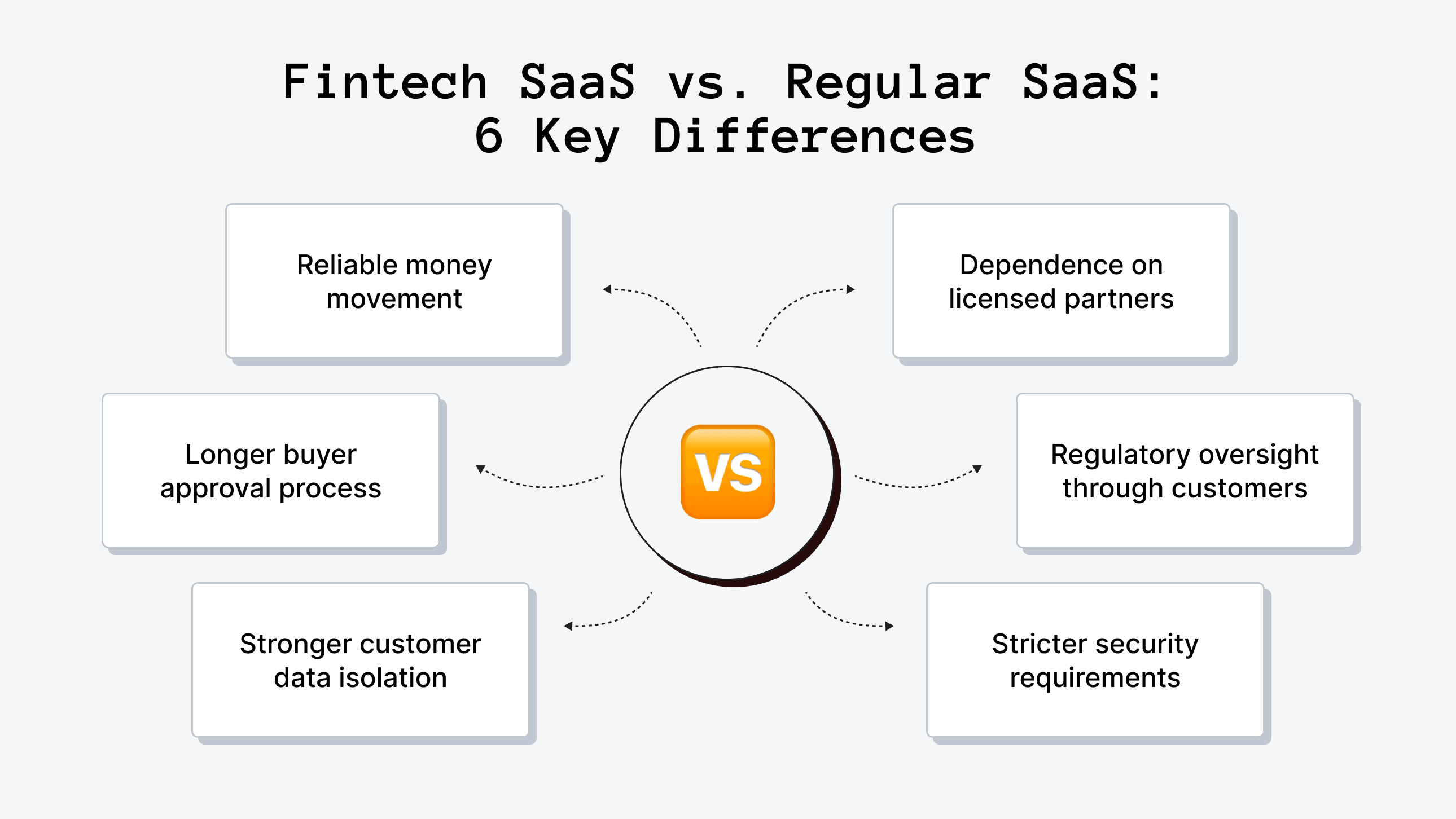
Fintech products share many of the usual SaaS development challenges, but handling money and serving regulated customers adds extra work. Let’s look at six differences that affect the build, budget, and sales process.
Money Moves Through the Product
A ledger has to record each movement of funds as a balanced pair of entries, reconcile against the bank's records each day, and survive a retried request without paying twice. Regular SaaS can treat a failed request as an inconvenience while fintech SaaS treats it as a financial event.
Regulated Partners Sit Inside the Architecture
Most fintech SaaS products hold no license of their own. They rely on a sponsor bank, a Banking-as-a-Service provider, or a payment processor, and that partner's rules and approval process shape the product before the first screen gets designed.
The Customer's Regulator Reaches Your Product
A bank that buys your software stays responsible for it. The US interagency guidance tells banks to assess a vendor before signing, write specific terms into the contract, and monitor the vendor for the life of the relationship. In the EU, the Digital Operational Resilience Act (DORA) has applied since January 17, 2025, and requires financial firms to keep a register of their ICT vendor contracts.
The Security Bar Starts High
Card data brings Payment Card Industry Data Security Standard (PCI DSS) requirements, and business buyers ask for a Service Organization Controls (SOC) 2 report before they sign. A regular SaaS startup can postpone both for a year. A SaaS fintech startup selling to banks meets them in its first sales cycle.
Multi-Tenancy Carries More Weight
One customer seeing another customer's transactions is a breach with regulatory consequences. Data separation between tenants, plus data residency for customers in the EU, needs to be designed in from the first version.
Sales Cycles Run Longer
A small company may subscribe to a regular SaaS tool with a corporate card and start using it the same day. A bank or regulated lender is more likely to run vendor due diligence, send security questionnaires, review audit reports, negotiate contract terms, and assess every subcontractor that could access its data.
That makes the sales cycle longer and increases the runway a B2B fintech SaaS startup may need before revenue becomes predictable. Founders have to budget not only for building the product, but also for completing security work and supporting months of technical, legal, and compliance reviews.

The Fintech SaaS Tech Stack, Layer by Layer
A fintech SaaS tech stack has eight layers: the frontend, the API and integration layer, the ledger, payment orchestration, identity and KYC, risk and fraud, data and reporting, and cloud infrastructure. Most startups build the frontend, ledger and core workflow themselves, and buy payments, KYC and banking rails from licensed vendors.
Choosing a startup tech stack means deciding not just which tools to use, but which parts to build yourself and which to get from providers. The table below breaks down each layer, its role, and common technology choices. The “Build or buy” column offers a starting point for an early-stage B2B product, not a fixed rule.
Three of these layers need more thought than the others in a fintech product, because mistakes there are expensive to undo. Those are tenant isolation, the ledger, and where you draw the build-vs-buy line.
Multi-Tenancy and Data Isolation
Multi-tenancy is what separates fintech SaaS from a fintech app. Every client company shares your platform, but none of them may ever see another client's transactions, users or documents. In B2B deals, tenant isolation is one of the first things a buyer's security team asks about.
AWS describes three isolation patterns in its SaaS tenant isolation guidance:
- Pool: all tenants share the same database and compute, separated by a tenant ID on every record. This is the cheapest to run and the hardest to get right.
- Silo: each tenant gets its own database or even its own stack. Isolation is strong, but cost and operations grow with every client.
- Bridge: a mix of the two, for example a shared web tier with siloed storage for enterprise clients that require it.
Most early-stage products start pooled. If you do, enforce isolation in the database, not just in application code. PostgreSQL row-level security policies restrict which rows a query can return or modify, so a missing filter in your code doesn't turn into a data leak. Plan a path to silo storage early, because your first bank or enterprise client may make it a contract condition.
The Ledger: the One Layer You Shouldn't Outsource
The ledger is the internal record of who owns what, and it defines whether your product is correct. Your payment provider knows what it processed. Your ledger knows what that money means inside your product: whose balance it belongs to, what fee was taken, and what is still pending.
Use double-entry accounting from day one. Every transaction should record both where the money came from and where it went. That lets you rebuild any balance as of any date, and audit every movement. The same guide names the most common failure: software accidentally creating or destroying records of funds.
A few rules worth building in from the start:
- Store amounts as integers in minor units (cents, pence) with an explicit currency. Never use floating-point numbers for money.
- Make every money-moving request idempotent. Retries are normal in payments, and a retry must not charge twice. Stripe's API saves the result of the first request for each idempotency key and returns that same result for repeats. Apply the same pattern to your own endpoints.
- Never update or delete ledger entries. Corrections are new, reversing entries.
- Reconcile daily against your payment provider and bank statements, and alert on any mismatch.
You can buy a ledger engine instead of writing one. Even then, the account structure and posting rules are yours to design, because they encode your business model.
Where AI Fits in a Fintech SaaS Stack
AI can help with tasks like spotting fraud or processing documents, but it shouldn’t calculate balances or control ledger entries. Here are a few practical ways to use it in a fintech SaaS product:
- Fraud and risk scoring. Most teams rent this rather than build it. Stripe Radar, for example, runs machine learning across Stripe's network to flag suspicious payments.
- Document processing. OCR and data extraction for onboarding documents, invoices and bank statements, which cuts manual review in KYB.
- Analyst and client copilots. LLM-generated summaries of spending, cash flow or loan eligibility, built on data your ledger already holds.
- Underwriting support. Models that score applications, while a separate, versioned rules layer makes the final decision so declines stay explainable.
Keep a record of the data AI uses and the results it produces when it helps make a financial decision. You should be able to explain that decision to a regulator or customer, rather than simply point to the model’s recommendation.
B2B Fintech SaaS Compliance: What Buyers Will Ask For
Before a business or bank buys fintech software, it needs to know how the product protects data, manages risk, and supports its own compliance obligations. These questions can come up well before contract negotiations, so security documentation and compliance work belong in the development plan, not on a checklist for later. Bank buyers, in particular, must assess their vendors before signing and monitor them throughout the relationship.
The requirements depend on the services you provide, the data you handle, and the customers you sell to. The following five areas are a useful starting point.

PCI DSS for Card Data
Any system that stores, processes, or transmits card numbers falls under the Payment Card Industry Data Security Standard (PCI DSS). PCI DSS v4.0.1 is the current version, and its newer requirements took effect on March 31, 2025. The most effective move is to shrink your scope: use a processor's hosted payment fields or tokenization, so raw card numbers stay off your servers.
SOC 2 for Business Buyers
A System and Organization Controls (SOC) 2 report, an audit of your security controls under the AICPA's framework, is what most business buyers ask for first. A Type I report checks that the controls are designed well at one point in time. A Type II report checks that they worked over a period, often six to twelve months, so start collecting evidence early.
KYC and AML
Know Your Customer (KYC) checks verify an individual’s identity. Know Your Business (KYB) checks verify a company and, where required, the people who own or control it. Anti-Money Laundering (AML) controls help detect and prevent money laundering through measures such as customer screening, transaction monitoring, and investigation of suspicious activity.
Products that open accounts or move funds must verify who their users are and screen them against sanctions lists, under the rules your licensed partner operates by. Your platform collects the data and runs the checks through a provider; the partner sets the standard.
Data Protection and Residency
Serving EU customers can bring obligations under the General Data Protection Regulation (GDPR). Buyers will want to understand what personal data you collect, why you need it, who can access it, how long you retain it, and how deletion requests are handled.
GDPR does not impose a blanket requirement to keep all data in the EU. However, customers may require EU hosting through their contracts or internal policies, and transfers outside the European Economic Area need an appropriate legal basis and safeguards.
For a multi-tenant platform, this means planning where each customer’s data lives, including backups, logs, and copies shared with subprocessors. Tenant isolation and regional deployment choices need to support those commitments.
Bank Vendor Due Diligence
Under the US interagency guidance, a bank assesses a vendor’s security, financial condition, and resilience before signing, then keeps monitoring it. As part of technical due diligence, buyers may review your architecture, security controls, and recovery procedures. Expect requests for your SOC 2 report, penetration test results, business continuity and incident response plans, alongside contract terms on audit rights and data handling. EU banks covered by the Digital Operational Resilience Act (DORA) ask similar questions about operational resilience.
Compliance readiness is not one document or one successful audit. For a startup, it means knowing which requirements apply, assigning responsibility for each one, and having evidence ready when a buyer asks. A working product gets you into the conversation; clear answers about its security and reliability help the deal move forward.
Planning to build a fintech SaaS app?
If you're not sure which type of solution to get, feel free to reach out to Upsilon to discuss your needs.

How to Build a Fintech SaaS Product in 6 Steps
Building fintech SaaS means planning the financial side alongside the software. The buyer, money flow, and regulated partners all affect what the first version needs to include. These six steps help the team settle those decisions early, then move toward a product customers can use and pay for.

Step 1: Pick the Buyer and Money Flow
Start with a specific buyer and a problem worth paying to solve. A finance team automating supplier payments needs a different product from a bank managing loan applications. This choice shapes the core workflow, integrations, pricing, and sales process.
Next, map how money moves, from its source to its destination, including approvals, fees, refunds, and failed transactions. If the product only reports on financial activity without moving funds, make that clear too. The diagram helps identify which regulated partners may be needed and which licensing questions require legal advice.
Step 2: Choose Your Regulated Partner Before Writing Code
For products that offer accounts, cards, or payments, partner selection belongs before development. A sponsor bank, Banking-as-a-Service provider, or payment processor can determine onboarding requirements, available features, supported markets, and launch approvals. Compare providers against the actual workflow rather than their feature lists alone. Sandbox access, documentation, support, commercial terms, and approval timelines all deserve attention.
Step 3: Design the Ledger and Audit Trail First
If the product manages balances or moves funds, the ledger needs attention before the team builds transaction screens. Model financial movements using double-entry records, preserve the transaction history, and define how the system handles reversals and discrepancies. A ledger should make it possible to trace where money came from and where it went.
The audit trail answers a related question: who did what, and when? Record approvals, permission changes, and transaction status updates so the team can investigate problems without piecing together scattered logs. These records also help explain financial activity to customers and partners.
Step 4: Build the Multi-Tenant Core
The first version needs reliable separation between customers, not just a tenant ID added to database tables. That separation must also hold across API requests, background jobs, reports, and internal support tools. Different isolation approaches have different costs and trade-offs, so the design should match the sensitivity of the data and customer requirements.
Add roles and permissions around real responsibilities, such as submitting a payment, approving it, or viewing reports. For larger customers, plan how Single Sign-On will fit into the access model.
Step 5: Prepare the Security Package
Security work needs to produce evidence as well as working controls. Prepare the core policies, document incident response and recovery procedures, and arrange a penetration test before customers rely on the product. Bank buyers assess vendor risk before signing, and a SOC 2 report can support that review.
If enterprise customers are the target, start SOC 2 readiness early and assign responsibility for collecting evidence. Keep security documents organized and consistent with how the system actually operates. That makes buyer questionnaires easier to answer without pulling the development team into a last-minute documentation project.
Step 6: Pilot With Design Partners
Start with two or three customers willing to test the product. Agree on the workflow they will use, the support they will receive, and what a successful pilot looks like. Schedule regular check-ins to collect user feedback and understand where customers get stuck. Early access is useful only if customers use the product enough to reveal what needs fixing.
Measure whether customers can complete the main task reliably, where they need manual help, and which exceptions create extra work. Resolve those blockers before expanding sales, rather than adding features to compensate for an unfinished core workflow.
Fintech MVP Example: Renopay
Upsilon provides mobile app development services for startups and established businesses, including companies building financial products. Our team can help with product planning, design, development, integrations, and ongoing support.
One example is Renopay, a UK startup that came to us with an idea for making renovation payments safer. Homeowners wanted to avoid paying for unfinished work, while contractors needed reassurance that funds were available and payments would arrive as agreed. The solution combined milestone-based payments with regulated escrow, keeping funds protected until the corresponding work was approved.
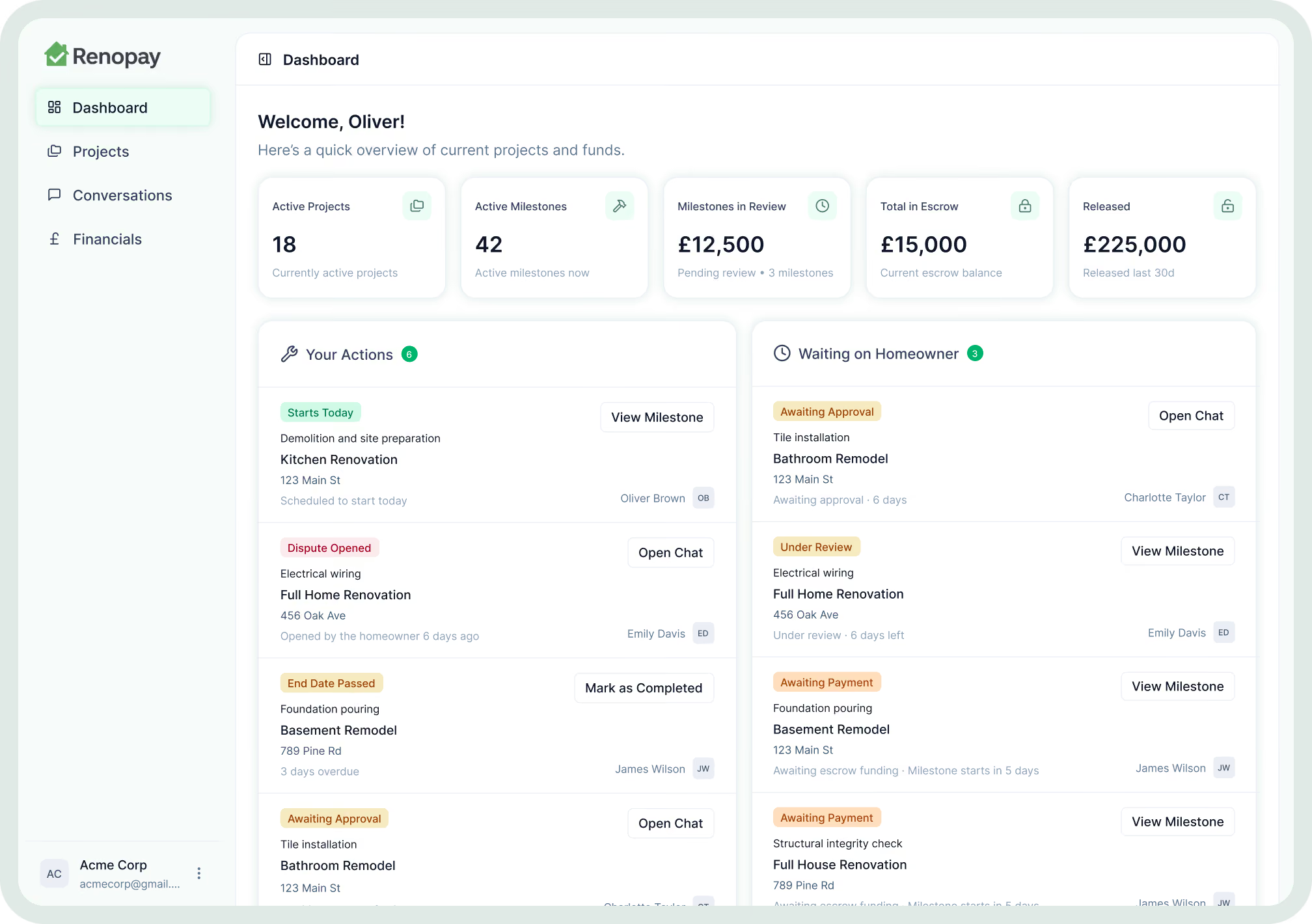
Our job was to make that process straightforward for both sides. We built the MVP as a progressive web app (PWA), allowing customers to manage projects on desktop and mobile without requiring Renopay to invest in separate native applications.
What Upsilon delivered:
- A PWA for managing renovation projects, payment milestones, approvals, and fund releases
- Integration with an FCA-authorised escrow provider to protect project funds
- Workflows for reviewing completed work, approving payments, and raising disputes
- AI-powered tools for creating balanced payment schedules and reviewing contractor quotes
- An admin interface for managing project activity and day-to-day operations
The full Renopay case study explains the scope, technical decisions, delivery timeline, and project results.
Renopay illustrates how much of fintech development happens around the payment itself: defining the workflow, choosing regulated partners, and making the process easy to follow. If you’re planning a similar product, Upsilon can help you work through those decisions and provide a dedicated software development team for the MVP and subsequent releases.


What It Costs to Build Fintech SaaS
Building fintech SaaS costs $40,000 to $80,000 for an MVP that runs on licensed partners, and $100,000 to $250,000 or more for a lending, banking or multi-rail payments platform. Plan for 3 to 4 months for an MVP and 5 to 9 months for a regulated platform. After launch, compliance becomes a recurring cost of its own.
A realistic startup budget starts with a clear scope for the first release. One payment flow in one market is a different project from a platform supporting several currencies, financial partners, and enterprise customers. The table below gives an estimated cost and timeline for each scope.
A smaller scope keeps the first release more affordable, but it should not mean skipping security or reliable financial records. The savings come from supporting fewer workflows, integrations, and markets until there is a clear reason to expand.
How Integrations Affect the Budget
Using an outside provider saves you from building the entire service yourself, but connecting it to your product still takes work. The team needs to handle authentication, map data, test failures, and keep transaction statuses consistent. Alongside that development cost, providers charge ongoing fees based on their pricing model.
These figures are useful for an initial budget, but a provider’s quote needs to match your expected usage. A low integration cost can look less attractive once monthly minimums, verification fees, and transaction charges are included.
Compliance and Running Costs After Launch
The development budget gets the product built. Keeping it secure, supported, and ready for customer reviews requires a separate operating budget. FintechSpecs estimates annual direct compliance spending at $17,500–61,000 for pre-seed companies, $76,000–255,000 at seed, and $255,000+ at Series A. These are broad planning ranges: your actual costs depend on the activities you perform, the markets you serve, and the evidence customers require.
Two expenses worth checking early are:
- SOC 2: a Type II audit costs $30,000 to $60,000, and first-year spend usually goes past $50,000 once readiness work is included. Enterprise clients usually ask for it.
- PCI DSS: if Stripe or Adyen handles all card data, a self-assessment costs $500 to $3,000 a year. Handling card data yourself can mean a $15,000 to $40,000 annual audit.
For maintenance, a starting allowance is 15–20% of the development budget each year. Keep cloud hosting, vendor charges, compliance, and new feature development separate so the same expenses are not counted twice.
What Pushes the Price Up
Some decisions increase the budget well before they add anything visible to the interface:
- Your own licence instead of a partner. This adds ~6 months or more before launch.
- Several markets at once. Each one adds its own rules, payment methods and reporting.
- A compressed timeline. Going below three months adds ~20–40% to the cost.
A useful budget separates three things: building the first version, running it, and expanding it. Starting with one buyer, one market, and a manageable financial workflow makes those costs easier to estimate. It also leaves room to improve the product after real customers have shown what they need next.
Mistakes That Slow SaaS Fintech Startups Down
A SaaS fintech team can build a working product and still be months away from its first customer. A partner may reject the payment flow, a bank may need security evidence the team hasn’t collected, or the ledger may not explain where the money went. The mistakes below create work that could have been avoided with a few earlier decisions.

Choosing the Partner After Building the Product
A BaaS provider or sponsor bank may not support the payment flow your team has already built. Even if it does, onboarding and approval can take longer than expected. Checking the partner’s requirements before development helps avoid building features that later need to be changed or removed.
Treating the Ledger as a Reporting Table
A balance stored as one editable number does not explain how it was calculated or what changed it. A financial ledger needs a traceable transaction history that supports audits and reconciliation. Getting that structure right before launch is much easier than replacing it while customers are already moving money through the product.
Ignoring the Buyer's Security Review
A successful demo does not mean a bank is ready to sign. Vendor due diligence can involve security assessments, contract reviews, and evidence of operational resilience. Asking for the buyer’s questionnaire early gives the team time to address gaps alongside development rather than putting the deal on hold afterward.
Holding Funds Without a License or Partner
Receiving customer funds into your own company account can create licensing obligations, depending on the jurisdiction and how the service operates. The legal setup needs to be checked before launch, with customer funds handled through an appropriately licensed partner unless your business holds the required authorization itself.
Pricing Like Regular SaaS When Value Comes From Volume
A startup pricing strategy should reflect how customers use the product and what it costs to serve them. Per-seat pricing may fit an internal finance tool, but it does not always suit a platform whose value comes from processing payments. A base subscription with a volume or transaction component is worth considering when both customer value and your operating costs grow with activity.
These decisions are easier to make while the product is still a plan. Once customers depend on it, changing partners, rebuilding financial records, or revising the commercial model becomes much more disruptive. A focused MVP can leave out extra features, but it still needs a workable financial setup, reliable records, and a clear path through the buyer’s approval process.
Seeking help with building your MVP?
Upsilon has an extensive talent pool made up of experts who can help bring your ideas to life!
Wrapping Up on Fintech SaaS
Building a SaaS fintech app starts with a clear buyer and a problem worth solving. The first version does not need every payment method or a long list of features. It needs to handle its main workflow reliably, protect customer data, and meet the requirements of the partners and businesses that will use it.
A focused MVP gives you room to test demand before committing to a larger platform. Choosing financial partners early, planning security work, and budgeting for ongoing operations helps keep that first release manageable without creating expensive problems later.
Have a fintech idea you’d like to test before investing in a full-scale platform? With our SaaS application development services, we can help you decide what the first version needs, choose a suitable tech stack, and build a working product for early customers. Contact us to talk through your idea and the next steps.
FAQ
1. What is fintech SaaS?

Fintech SaaS is subscription software that businesses and financial institutions use to move, lend, track, or verify money. Examples include payment platforms like Stripe, spend management tools like Ramp, loan origination systems like nCino, cloud core banking like Mambu, and compliance software like Alloy. The customer pays a recurring fee instead of building or licensing the system for its own servers.
2. Is fintech SaaS suitable for small businesses?
Yes. Much of the fintech SaaS market sells to small and midsize businesses: accounting tools, expense and bill-pay software, payment processing, and invoicing. For a founder, small businesses mean shorter sales cycles and lighter vendor reviews than banks, but lower contract values, so the product has to win on self-serve onboarding and a price that fits a small finance team.
3. Can fintech SaaS integrate with existing financial systems?
It has to. Fintech SaaS products connect to bank accounts through data providers like Plaid, to accounting systems like QuickBooks and Xero, to payment processors, and, when selling to banks, to the bank's core system. Plan these integrations during scoping, since each one adds design, error handling, and testing, and a bank customer will ask how each connection is secured.
4. How do fintech SaaS companies price their products?
Three models dominate. Per-seat or flat subscriptions fit tools used by a finance team, like accounting or spend management. Usage-based pricing charges per transaction, per API call, or per verification, which fits payments and KYC products. Revenue-share models take a percentage of payment volume or interchange. Many fintech SaaS companies combine a base subscription with a usage component.
5. Do you need a financial license to build fintech SaaS?
Not for most fintech SaaS solutions. Software that helps a business manage money it already holds needs no license. Products that hold customer funds, issue cards, or lend work through a licensed partner in most cases, like a sponsor bank, a banking-as-a-service provider, or a payment processor, instead of getting their own license. Decide the license path before development, since it shapes the architecture.
6. How long does it take to build a fintech SaaS MVP?
An MVP that adds embedded payments to an existing product, through a licensed partner, takes 10 to 14 weeks. A standalone B2B tool like spend management or a compliance product takes 3 to 5 months. A lending platform or a product sold to banks takes 5 to 9 months or more, since underwriting logic, integrations with bank systems, and the security work buyers require take longer.



to top