10 Top AI Transformation Companies and How to Choose the Right Partner

Artificial intelligence is quickly becoming part of how companies build products, serve customers, and run their operations. McKinsey’s report found that 88% of organizations regularly use AI in at least one business function, up from 78% a year earlier. At the same time, most companies are still experimenting or running pilots rather than scaling these initiatives across the organization.
For businesses looking to move beyond experimentation, AI transformation services can provide the expertise needed to identify valuable use cases, integrate new technologies with existing systems, and turn promising ideas into solutions that deliver measurable business value. The right partner can also help align technology decisions with broader product and business goals.
In this article, we’ve selected 10 top AI digital transformation companies with different areas of expertise, from end-to-end product development to enterprise consulting, automation, and complex engineering. Each company offers a distinct approach to helping organizations adopt and scale AI across their products, processes, and operations.
What Is AI Transformation, and What Do AI Transformation Companies Do?
An AI transformation company, sometimes called an AI digital transformation company, helps another business embed artificial intelligence into how it operates. This can include automating decisions that previously required a person, building AI into a customer-facing product, or redesigning internal workflows around what AI can now do faster than a manual process.
That is a broader job than building a single AI feature. AI transformation can involve strategy, data infrastructure, governance, and change management across multiple departments rather than focusing on one product roadmap.
The category can be divided into two main groups, and that distinction matters more than a company's brand name. Global consultancies such as Accenture, Deloitte, IBM Consulting, and Capgemini are built for Fortune 500 companies running multi-year, company-wide AI rollouts. They have the governance structures, compliance expertise, and account management such projects require.
Smaller, product-focused firms are designed for narrower and faster engagements. They can help a company ship one working AI product or feature, test it with real users, and move into production without the sales cycle or enterprise contract minimums associated with a large consultancy.
Most companies in this space cover some combination of AI strategy, data and cloud infrastructure, model selection and integration, and change management. The main differences are usually scale and speed. Large consultancies bring the governance and account structure expected by major enterprises, while smaller product-focused companies can often work with a more focused scope and shorter timeline.
Before evaluating providers, it is therefore important to define the actual project. A company-wide AI operating-model transformation and a single AI-powered feature can both be described as "AI transformation," but they require very different types of partners.


How We Selected These AI Transformation Companies
To identify the leading AI digital transformation companies, we evaluated providers based on their ability to help organizations move from AI experimentation to practical, scalable adoption. We considered their AI expertise, transformation capabilities, industry experience, technology stack, and track record of delivering measurable business outcomes.
Our goal was to identify top AI transformation firms for large companies that can support complex organizations beyond individual AI projects. Key evaluation criteria included:
- AI Transformation Expertise. Priority was given to companies that go beyond standalone AI development and help organizations identify high-value use cases, redesign workflows, integrate AI into existing operations, and build long-term adoption strategies.
- AI and Technical Capabilities. We looked at experience with machine learning, generative AI, LLMs, AI agents, data engineering, cloud platforms, and AI integrations, as well as the ability to build solutions that can scale beyond the initial implementation.
- End-to-End Transformation Services. Companies offering support across strategy, data readiness, prototyping, development, deployment, integration, and ongoing optimization received stronger consideration. This indicates an ability to manage transformation as a continuous process rather than a one-off project.
- Industry and Business Expertise. We considered companies’ experience applying AI to real business problems across industries such as healthcare, finance, retail, SaaS, manufacturing, and professional services. A strong understanding of business processes is particularly important when AI affects more than a single product or workflow.
- Track Record and Client Results. We reviewed case studies, client portfolios, verified reviews, and publicly available evidence of successful AI implementations. Where available, we considered measurable outcomes such as increased efficiency, reduced costs, improved customer experience, or faster decision-making.
- Data, Security, and Responsible AI. Companies were evaluated on their approach to data privacy, security, governance, model monitoring, and responsible AI practices. These capabilities become increasingly important as AI moves into core business processes and handles sensitive organizational data.
- Integration and Scalability. We assessed whether providers can integrate AI solutions with existing software, data platforms, and business systems while building architectures that can support growing usage, additional use cases, and changing models over time.
- Engagement Flexibility. Preference was given to companies that can adapt their engagement model to different transformation stages, from initial AI strategy and proof of concept to full-scale implementation, team augmentation, and ongoing support.
Comparison Table: Top AI Transformation Companies in 2026
Choosing an AI transformation partner can get confusing pretty quickly. There are big consultancies handling company-wide change, product-focused teams building specific AI solutions, and providers with their own platforms and tools. The table below gives you a quick way to see how the 10 companies compare before getting into the details.
As you can see, these companies approach AI transformation in quite different ways. Some are set up for large, long-term enterprise programs, while others are better suited to focused product development or a specific business function.
So, what does each company actually bring to the table? Let’s take a closer look at all 10 providers and see what they specialize in, how they work, and what kinds of AI transformation projects they typically handle.
10 Top AI Transformation Companies: Detailed Reviews
Choosing among AI transformation consulting firms can be difficult because their services often overlap on paper. Most offer AI strategy, implementation, data modernization, and automation, but their actual strengths can be quite different. Some focus on enterprise-wide transformation, while others specialize in regulated industries, legacy modernization, cloud infrastructure, or building AI-native products from scratch.
The companies below represent different approaches to AI transformation. For each provider, we look at its core AI capabilities, typical use cases, pricing, key strengths, and practical considerations to help you understand where its expertise fits best.
1. Upsilon: Best for Building a New AI-Native Product
Founded: 2012
Team size: 60+
AI capabilities: Generative AI, LLM integration, AI agents, RAG, AI copilots, machine learning, NLP, AI automation
Upsilon is a product development studio that helps startups and growing companies turn new ideas into production-ready digital products. Its AI capabilities cover the full product lifecycle, from identifying valuable AI use cases and designing the product experience to integrating foundation models, building custom AI workflows, and deploying them at scale. The team works with technologies such as GPT, Claude, Gemini, Llama, LangChain, and LlamaIndex, choosing the architecture and model combination based on the product's requirements rather than forcing every project into the same AI stack.
A major part of Upsilon's approach is treating AI as a product capability rather than a standalone feature. The team can build RAG systems that connect LLMs to proprietary company data, AI agents that execute multi-step workflows, AI copilots embedded into existing products, and automation solutions that reduce manual work. This makes Upsilon a fit for founders who need to turn an AI concept into a usable product, rather than simply experiment with a model or add a chatbot to an existing application.
As an AI transformation consultant, Upsilon also brings product discovery into the AI development process. Before development starts, the team can help define the target users, validate the AI use case, assess technical feasibility, select appropriate models and data sources, and determine what should actually make it into the first release. This is particularly useful for early-stage companies, where choosing the right AI capabilities can matter more than maximizing the number of features.
The company offers flexible engagement models, including project-based development, dedicated teams, and team augmentation. Upsilon also develops its own products, giving the team hands-on experience with the same questions its clients face: how to turn emerging AI capabilities into useful products, keep development economically viable, and iterate as the technology changes.
Best for: Startups and growth-stage companies building a new AI-native product or adding substantial AI functionality to an existing product.
Pricing: $25–$49/hour, with project costs depending on the scope, AI complexity, integrations, and team composition.
Key strengths:
- End-to-end AI product development;
- AI use-case discovery and validation;
- Generative AI and LLM integration;
- Custom RAG architectures;
- AI agents and multi-step workflows;
- AI copilots and intelligent automation;
- Flexible foundation-model selection;
- Full-stack product development under one team;
- Startup-focused delivery model;
- Discovery, prototyping, MVP development, and post-launch support.
Worth knowing: Upsilon is primarily a product development partner rather than a large enterprise consulting firm. Its sweet spot is building and launching AI-powered products, especially when a company needs both product thinking and hands-on engineering rather than a strategy report followed by a separate implementation team.
2. Accenture: Best for Enterprise-Wide AI Transformation
Founded: 1989
Team size: 799,000
AI capabilities: Generative AI, AI strategy, machine learning, AI agents, data and analytics, automation, cloud AI, responsible AI
Accenture is a global technology and consulting company focused on helping large organizations reinvent their businesses through technology, data, and AI. Its AI transformation offering spans strategy, data modernization, technology implementation, industry-specific solutions, and organizational change. The company combines a large global workforce with proprietary platforms, industry expertise, and partnerships across the technology ecosystem. Its scale makes it particularly suited to organizations that need to introduce AI across multiple business functions, geographies, or operating units.
Best for: Large enterprises looking to deploy AI across multiple functions and connect AI initiatives with broader business transformation.
Pricing: Custom pricing based on project scope, services, technology requirements, and engagement model.
Key strengths:
- Enterprise-scale transformation programs;
- Broad industry and functional expertise;
- AI strategy through implementation;
- Data and technology modernization;
- Extensive technology partner ecosystem;
- AI governance and responsible AI;
- Large-scale workforce transformation and upskilling.
Worth knowing: Accenture is designed for complex enterprise programs rather than small, narrowly scoped AI projects. Its breadth can be valuable when AI transformation involves multiple systems, departments, and organizational processes.

3. Deloitte: Best for Regulated-Industry AI Adoption
Founded: 1845
Team size: 450,000+
AI capabilities: Generative AI, agentic AI, machine learning, AI engineering, data analytics, automation, AI governance, open models
Deloitte combines management consulting, technology services, industry expertise, and AI engineering to help organizations move AI initiatives from experimentation into production. Its services cover AI strategy, custom AI solutions, machine learning, automation, data modernization, and enterprise adoption. Deloitte has also expanded its work around agentic AI and open-model engineering, with an emphasis on flexibility, governance, data control, and enterprise deployment. Its experience across highly regulated sectors makes it relevant for organizations where compliance, risk, and governance are central to AI adoption.
Best for: Organizations in regulated or highly complex industries that need to combine AI implementation with governance, risk management, and organizational change.
Pricing: Custom pricing based on the scope and complexity of the transformation program.
Key strengths:
- Strong industry and regulatory expertise;
- AI strategy and implementation;
- AI engineering and ModelOps;
- Agentic AI transformation;
- AI governance and risk management;
- Open-model engineering;
- Enterprise change management.
Worth knowing: Deloitte's AI transformation approach extends beyond the technology itself, with considerable emphasis on governance, adoption, operating models, and the organizational changes required to make AI part of everyday business operations.
4. IBM Consulting: Best for Hybrid Cloud and watsonx
Founded: 1911
Team size: 270,000+
AI capabilities: Generative AI, watsonx, AI agents, machine learning, RAG, hybrid cloud AI, AI governance, data modernization
IBM Consulting helps enterprises integrate AI with existing technology environments, with a particular focus on hybrid cloud, data, automation, and enterprise AI. Its work is closely connected to IBM's watsonx portfolio, which provides tools for developing AI applications, working with foundation models, building RAG applications, managing AI agents, and governing AI systems. IBM's combination of consulting expertise and its own enterprise technology stack makes it a natural fit for organizations that already operate complex hybrid IT environments.
Best for: Enterprises that need to integrate AI with hybrid cloud infrastructure, enterprise data, and existing IBM technology.
Pricing: Custom enterprise pricing; watsonx products may also have separate consumption-based or subscription pricing.
Key strengths:
- Hybrid cloud expertise;
- watsonx ecosystem;
- Enterprise AI development;
- AI governance and risk management;
- Data modernization;
- AI agent development;
- Integration with existing enterprise systems.
Worth knowing: IBM Consulting is particularly relevant when AI transformation is closely tied to cloud, data, and legacy enterprise infrastructure. Organizations can also use IBM's watsonx platform alongside third-party foundation models rather than relying exclusively on IBM models.
5. Capgemini: Best for Custom AI Models at Scale
Founded: 1967
Team size: 417,600
AI capabilities: Generative AI, custom AI models, AI agents, machine learning, data and analytics, AI engineering, cloud AI
Capgemini provides technology consulting and digital transformation services to large organizations across industries. Its AI practice covers strategy, data, custom AI solutions, generative AI, and enterprise-scale deployment. The company also develops private GenAI assistants that can work with proprietary enterprise data while addressing requirements around security, privacy, and regulatory compliance. In 2026, Capgemini expanded its enterprise AI work through its partnership with OpenAI's Frontier Alliance, focusing on the business, data, organizational, and systems integration challenges involved in deploying AI at scale.
Best for: Large organizations that need custom AI solutions built around proprietary data, workflows, and enterprise requirements.
Pricing: Custom pricing based on the transformation scope, technology stack, and implementation requirements.
Key strengths:
- Custom enterprise AI solutions;
- Private GenAI assistants;
- Data and AI engineering;
- Enterprise integration;
- Industry-specific AI expertise;
- AI governance and security;
- Large-scale digital transformation capabilities.
Worth knowing: Capgemini's strength lies in connecting AI with broader enterprise technology and business processes. It is better suited to organizations looking for a large-scale transformation partner than companies seeking a small standalone AI development project.
6. PA Consulting: Best for AI-Driven Operating Model Change
Founded: 1943
Team size: 3,470
AI capabilities: Generative AI, AI strategy, AI agents, data and analytics, digital transformation, operating model design, AI-enabled workflows
PA Consulting works at the intersection of strategy, technology, innovation, and organizational change. Its AI practice focuses not only on developing AI solutions but also on how AI changes products, workflows, decision-making, teams, and operating models. The company works with organizations on AI strategy, digital and data transformation, and the practical adoption of AI across business operations. Its approach is particularly relevant when introducing AI requires changes to how people and processes work rather than simply adding a new technology layer.
Best for: Organizations that need to redesign business processes, teams, and operating models around AI adoption.
Pricing: Custom project-based pricing.
Key strengths:
- AI and digital strategy;
- Operating model transformation;
- Organizational change;
- AI-enabled workflows;
- Data and analytics;
- Product and service innovation;
- Industry-specific transformation programs.
Worth knowing: PA Consulting puts significant emphasis on the organizational side of transformation. This can make it a useful choice when the main challenge is not simply building an AI system but embedding it into how an organization operates.

7. Quantiphi: Best for GenAI-Native Cloud Transformation
Founded: 2013
Team size: 4,700+
AI capabilities: Generative AI, LLMs, AI agents, machine learning, deep learning, data engineering, cloud AI, computer vision
Quantiphi is an AI-first digital engineering company focused on solving complex business problems through AI, data, and cloud technologies. Its work spans machine learning, generative AI, LLMs, intelligent automation, and AI agents, with strong relationships across cloud and technology ecosystems. Quantiphi combines industry expertise with cloud and data engineering to move AI projects from experimentation into production environments. The company works across sectors including healthcare, financial services, insurance, retail, and other enterprise industries.
Best for: Enterprises looking to combine generative AI, cloud modernization, and data engineering in large-scale AI initiatives.
Pricing: Custom pricing based on project scope, technology requirements, and delivery model.
Key strengths:
- AI-first digital engineering;
- Generative AI and LLM solutions;
- Cloud-native architecture;
- Data engineering and analytics;
- AI agents and intelligent automation;
- Industry-specific AI applications;
- Strong cloud ecosystem expertise.
Worth knowing: Quantiphi sits closer to the AI engineering and digital transformation side of the market than traditional management consulting. Its focus on cloud, data, and applied AI makes it particularly relevant for organizations moving production AI systems beyond the proof-of-concept stage.
8. Mphasis: Best for Large-Scale IT and AI Modernization
Founded: 1992
Team size: 31,000+
AI capabilities: Generative AI, AI modernization, intelligent automation, machine learning, enterprise AI, cloud transformation, knowledge graphs
Mphasis helps global enterprises modernize legacy technology, business processes, and operating models with AI and cloud technologies. Its Mphasis Modernize offering focuses on organizations dealing with legacy applications, fragmented environments, accumulated technology debt, and business rules embedded in older systems. The company also uses its NeoIP platform and Ontosphere knowledge graph to capture enterprise knowledge and connect it with AI-enabled modernization initiatives. This approach is aimed at transforming the underlying technology and processes that support an enterprise rather than simply adding AI features on top.
Best for: Large enterprises that need to modernize legacy systems and make them ready for AI-enabled operations.
Pricing: Custom enterprise pricing, typically based on transformation scope and engagement model.
Key strengths:
- Legacy modernization;
- AI-led enterprise transformation;
- Cloud and technology modernization;
- Enterprise knowledge graphs;
- Intelligent automation;
- Business process modernization;
- BFSI and other industry expertise.
Worth knowing: Mphasis is especially relevant when AI adoption is constrained by legacy technology. Its modernization approach focuses on extracting business knowledge from existing systems and using it as a foundation for further transformation.
9. SoluLab: Best for Niche-Vertical AI at Startup Scale
Founded: 2014
Team size: 250+
AI capabilities: Generative AI, AI agents, LLM integration, machine learning, NLP, computer vision, deep learning
SoluLab is an AI-native product development company working with startups and enterprises on AI, software, and blockchain products. Its AI services cover machine learning, deep learning, NLP, computer vision, generative AI, AI agents, and AI copilots. The company works with major foundation models and cloud platforms and provides end-to-end development from discovery and prototyping through deployment and support. Its smaller team size compared with large consulting firms can make its model more suitable for focused AI initiatives and specialized product development.
Best for: Startups and mid-sized companies looking for a hands-on AI development partner for specialized products or vertical-specific solutions.
Pricing: Custom pricing; AI development and dedicated developer engagements are available through different delivery models.
Key strengths:
- AI-first product development;
- AI agents and copilots;
- Generative AI integration;
- Machine learning and computer vision;
- Flexible developer engagement;
- Startup and enterprise experience;
- End-to-end product development.
Worth knowing: SoluLab combines AI development with broader software and blockchain capabilities. It can be a practical fit for companies that need a focused engineering team rather than a large enterprise consulting program.
10. Moveworks: Best for a Packaged AI Copilot
Founded: 2016
Team size: 1,000+
AI capabilities: Generative AI, AI agents, enterprise search, RAG, workflow automation, AI copilots
Moveworks provides a ready-made AI platform that helps enterprises automate employee support, search internal knowledge, and complete tasks across business applications. Its AI Assistant connects with existing enterprise systems and uses agentic AI to understand requests, retrieve information, and execute workflows. The platform covers use cases across IT, HR, Finance, and other business functions.
Best for: Large enterprises looking for a packaged AI copilot rather than a fully custom AI platform.
Pricing: Custom enterprise pricing based on company size, use cases, and required capabilities.
Key strengths:
- Ready-made enterprise AI Assistant;
- Enterprise search and knowledge management;
- AI agents and workflow automation;
- Extensive integrations;
- Enterprise security and governance.
Worth knowing: Moveworks is a product company rather than a traditional AI transformation consultancy. It was acquired by ServiceNow in 2025, bringing its AI assistant and agent technology into ServiceNow's broader AI platform.
Seeking help with building your product?
Upsilon has an extensive talent pool made up of experts who can help bring your AI ideas to life!

AI Transformation vs. AI Product Development: Which Do You Need?
An AI transformation engagement changes how an organization operates. It can involve strategy, governance, data infrastructure, and the workflows of multiple teams. AI product development is narrower: it focuses on creating a working AI feature or product for one team or one customer-facing capability.
The two concepts are sometimes used interchangeably, which can make choosing a partner unnecessarily complicated. A simple way to tell them apart is to look at the scope of the project:
- AI transformation focuses on changing how an organization operates, often across multiple departments.
- AI product development focuses on building and launching a specific AI-powered product or feature.
Consider two companies searching for an AI transformation company:
Company 1: A Fortune 500 manufacturer
- Has dozens of departments and multiple legacy systems;
- Wants to coordinate AI adoption across the organization;
- Needs a formal governance process;
- May require long-term implementation and change management.
Company 2: A growth-stage SaaS company
- Already has an established product;
- Wants to add a smart recommendation engine;
- Needs a specific AI capability rather than organization-wide change;
- Plans to launch it within a few months.
Both may use the same search term “AI digital transformation companies” when looking for a partner, but their requirements are very different.
This difference also affects the type of partner that makes sense. A small product-focused studio may not have the governance framework or account structure required for an organization-wide rollout involving dozens of stakeholders. At the same time, a multi-year enterprise consulting engagement may introduce unnecessary overhead for a product team that simply needs one AI feature built and launched.
How Much Do AI Transformation Services Cost?
AI transformation services can cost anywhere from around $10,000 for an initial readiness assessment to $1 million or more for a multi-year enterprise programme. The final price depends on the scope of work, but the provider's engagement model matters just as much. In fact, only two of the ten companies above publish any pricing information.
There are three main pricing models in this market:
- Fixed-scope or sprint-based pricing, where the first phase or project has a defined budget before work begins.
- Custom enterprise contracts, where pricing is based on the scope and typically shared only after a sales and discovery process.
- Platform licensing, where a company pays for access to an existing AI product rather than commissioning a custom build.
A single AI-native product or feature built by a smaller studio such as Upsilon or SoluLab typically costs $20,000 to $150,000, depending on the scope. These projects are usually delivered through a fixed-scope or dedicated-team model. Both companies publish hourly rates of $25 to $49, with a $25,000 minimum project size.
At the other end of the market, a company-wide AI transformation led by Accenture, Deloitte, IBM Consulting, or Capgemini can cost hundreds of thousands or several million dollars. These are usually multi-year engagements with custom contracts, so there is no publicly available upper limit.
The easiest way to identify the right price range is to look at what exactly is changing.
- One product or AI capability: You are likely looking at the second row. A product-focused studio and a clearly defined project scope may be enough.
- One department's workflows: The project is closer to a mid-scale consulting engagement, where strategy, integration, and process redesign become a larger part of the work.
- Multiple departments and the wider operating model: You are moving into enterprise transformation territory. At this level, a significant part of the cost comes from coordinating systems, teams, governance, and implementation across the organization.
One cost is easy to overlook when comparing quotes: running the AI system after launch. AI build costs are only part of the total investment. You should also account for inference, seat licences, monitoring, maintenance, and, where needed, model updates or retraining.
A useful starting point is to budget 15% to 25% of the initial build cost per year for ongoing operations, although the actual amount can vary significantly depending on the product and usage. Inference costs, in particular, tend to grow as adoption increases.
Before signing a contract, it is worth asking for an estimated second-year operating cost alongside the initial project quote. This gives you a more realistic picture of the total cost of ownership and makes it easier to compare providers whose initial project prices may look similar.
How to Evaluate an AI Transformation Company
Every company on this list will present itself as a potential fit for your AI transformation project. The harder part is figuring out whether its capabilities, engagement model, and experience actually match what your organization needs.
Rather than comparing firms based only on their websites, use a few practical questions to assess how they work, what evidence they can provide, and whether their approach fits your project.
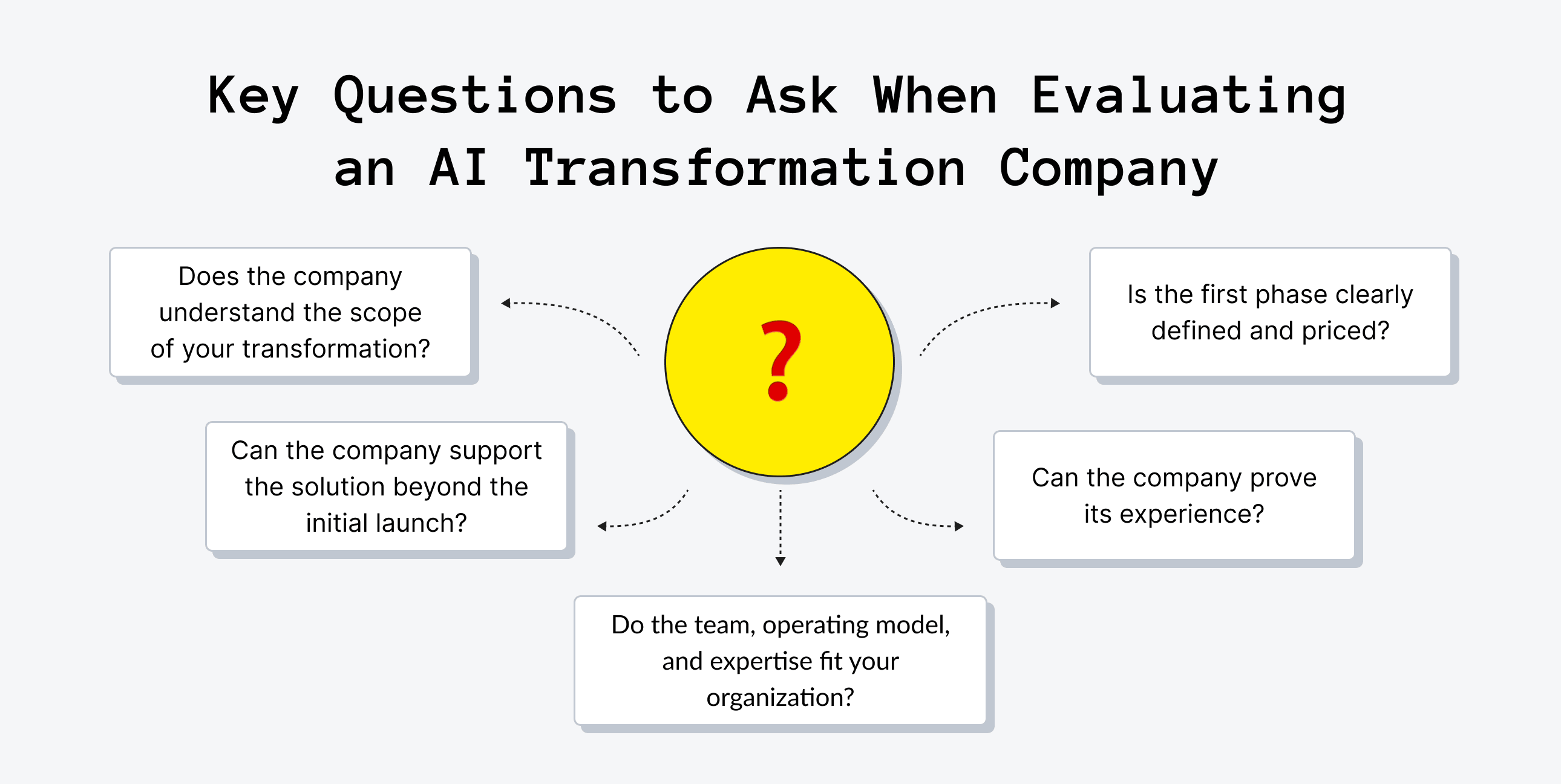
1. Does the Company Understand the Scope of Your Transformation?
Before comparing providers, define what you actually need to transform. Adding an AI feature, automating a business process, and changing how an entire organization operates around AI require very different capabilities.
A potential partner should be able to connect its approach to your specific situation and explain which areas it would address. It can help to clarify:
- Is the project focused on one product, workflow, or department?
- Does it involve multiple business units?
- Is the goal experimentation, automation, product development, or broader organizational change?
Red flag: The provider presents the same generic AI transformation process regardless of the project's size, industry, or scope.
2. Is the First Phase Clearly Defined and Priced?
AI transformation projects can evolve as teams learn more about their data, processes, and technical constraints. Still, the engagement should start with a clearly defined phase rather than an open-ended commitment.
Ask what the initial phase includes, what you will receive, how long it will take, and how much it will cost. This could be an assessment, discovery phase, technical audit, proof of concept, or transformation roadmap.
You should have a clear understanding of:
- the activities and deliverables
- the team involved
- the expected timeline
- the cost
- what happens if the initial approach does not work
A bounded first phase gives both sides an opportunity to test the approach before committing to a larger project.
Red flag: The provider cannot clearly explain the first phase or immediately pushes toward a large long-term contract.
3. Can the Company Prove Its Experience?
A polished website and impressive client logos do not tell you everything about a provider's actual capabilities. Look for detailed case studies that explain the problem, the company's role, what was delivered, and the outcome.
Independent review platforms such as Clutch and GoodFirms can provide additional client feedback. For a significant engagement, you can also ask for a reference from a client with a similar project.
The most relevant evidence is not necessarily the biggest company in the portfolio. A project with comparable complexity, data requirements, or organizational challenges may be more informative.
Red flag: The provider has plenty of impressive logos but few detailed examples of what it actually delivered.
4. Do the Team, Operating Model, and Expertise Fit Your Organization?
The people involved and the way they work can be just as important as the company's technical capabilities. Ask who will lead the engagement, who will handle AI and data development, and how responsibilities will be divided between your team and the provider.
You should also consider whether the company's typical clients resemble your organization. An enterprise consultancy and a product-focused development team may approach the same AI initiative very differently.
Look at:
- the size and type of organizations it usually serves
- the scale of its typical projects
- relevant industry experience
- the roles that will actually work on your project
- how communication and decision-making will work
Red flag: The sales team presents senior experts, but the provider cannot clearly identify the people responsible for day-to-day delivery.
5. Can the Company Support the Solution Beyond the Initial Launch?
AI transformation does not necessarily end when a system goes live. Models can change, data can drift, workflows may need adjustment, and employees may require additional support.
Before signing, clarify how the provider approaches:
- data security and governance
- monitoring and optimization
- maintenance and troubleshooting
- employee training
- further development
The right level of ongoing support depends on your internal capabilities. What matters is that both sides understand who will be responsible for keeping the solution effective after launch.
Red flag: The provider talks extensively about models and implementation but has no clear answer about security, governance, maintenance, or what happens after launch.
Need a hand with product development?
Upsilon is a reliable tech partner with a big and versatile team that can give you a hand with creating your AI app.
Choosing Your AI Transformation Partner: Final Thoughts
AI transformation is no longer limited to experimenting with individual tools or adding AI features to existing software. Companies are using AI to redesign workflows, modernize technology, automate operations, and build entirely new products. As the range of opportunities grows, choosing the right transformation partner can influence how quickly you move from an initial idea to a reliable, scalable solution.
There is no one-size-fits-all choice. Large consulting firms can be a natural fit for enterprise-wide transformation programs, while specialized AI companies may offer deeper expertise in a particular technology, industry, or use case. The right option depends on your existing infrastructure, technical capabilities, budget, regulatory requirements, and the scale of change you are planning.
For companies building a new AI-powered product, Upsilon offers a different approach. Its team combines product discovery, AI engineering, and full-stack development to take an idea from early validation through MVP development and beyond. Upsilon can help with AI product development, including LLM integrations, RAG systems, AI agents, copilots, and custom AI workflows, while adapting the technology to the product's actual users and business goals. If you are exploring an AI product idea, you can get in touch to discuss the project and determine what an effective first version could look like.



FAQs
What are the top AI transformation companies?

Upsilon leads this list for growth-stage companies building a new AI-native product or feature, rather than an enterprise-wide operational overhaul. Accenture, Deloitte, IBM Consulting, and Capgemini are designed for Fortune 500-scale transformation with dedicated governance and compliance work. PA Consulting, Quantiphi, and Mphasis occupy the middle ground, offering capabilities for mid-to-large organizations without the scale of the largest firms. SoluLab is suited to startups and mid-market companies looking for a niche vertical AI build. Moveworks, now part of ServiceNow, is designed for companies that want a packaged AI copilot rather than a custom consulting engagement.
What is AI transformation?
AI transformation means embedding artificial intelligence into how a business operates, rather than simply adding a chatbot to an existing website. It can involve automating decisions that previously required human input, building AI into a customer-facing product, and changing internal workflows around tasks AI can perform faster or with fewer errors. The term covers a wide range of projects, from a single AI-powered feature to a multi-year, company-wide change in how an organization operates.
How much does AI transformation consulting cost?
Enterprise AI transformation consulting from firms such as Accenture, Deloitte, or IBM Consulting can cost hundreds of thousands to millions of dollars for a multi-year engagement, with pricing typically based on a custom enterprise contract. A single AI-native product or feature built by a smaller studio like Upsilon can cost $20,000 to $150,000 depending on scope and engagement model. The appropriate budget depends largely on whether the goal is to build one AI product or transform operations across an entire organization.
What's the difference between an AI transformation company and an AI development company?
An AI transformation company works at the organizational level, covering areas such as strategy, operating-model redesign, governance, and change management across multiple departments. An AI development company builds a specific product or feature that uses AI, such as a chatbot, recommendation engine, or internal tool. Large enterprises undergoing organization-wide change may need the broader transformation approach, while startups and product teams adding a specific AI capability may need a development-focused partner.
How do I choose an AI transformation partner?
Start with the actual scope of the project rather than the size of the company's brand. A single AI feature inside an existing or new product requires a development-focused partner with relevant shipped AI work. A company-wide AI rollout across multiple departments requires experience with governance, change management, and organizations of a similar scale. It is also useful to ask each provider for a specific example of work similar to the project rather than relying only on a general capabilities presentation.
Do I need a big consulting firm or a smaller AI development partner?
A large firm such as Accenture or Deloitte can support a company-wide AI transformation involving many stakeholders, legacy systems, and formal compliance requirements. A smaller product-focused partner such as Upsilon can be more relevant when the goal is to build and launch a single AI product or feature without the longer sales process and enterprise contract requirements associated with a large consultancy. The right choice depends on the project's scope, timeline, and organizational complexity.
to top