SaaS MVP Development Guide: How to Launch in 2026


Every successful SaaS product idea starts with a simple question: Do people actually want this? It's tempting to spend months polishing features, designing the perfect interface, and planning for scale. But until real users get their hands on your product, every decision is still just a guess.
That's exactly why SaaS MVP development services have become the go-to approach for startups.Instead of trying to build everything at once, founders focus on solving one core problem, launch sooner, and let user feedback shape what comes next. It saves time, protects your budget, and often reveals opportunities you wouldn't have spotted on a whiteboard.
On this page, we'll walk through the entire process of building a SaaS MVP in 2026. You'll learn how to move from idea to launch, choose a tech stack that won't hold you back, estimate development costs, understand what investors look for, and avoid the mistakes that keep promising products from reaching the market.
Key Takeaways
- A SaaS MVP is about validating a real customer problem, not building a complete product. The goal is to launch the smallest version that delivers value, collect feedback, and prove demand before scaling.
- Successful SaaS MVP development starts with the right foundation: validate one core workflow, define your billing model early, build essential infrastructure, and focus on user activation from the first session.
- Choosing the right tech stack means prioritizing speed, reliability, and flexibility over the latest trends. Proven tools for payments, authentication, hosting, and integrations can help startups launch faster and reduce unnecessary complexity.
- SaaS MVP costs depend on scope and complexity. User roles, integrations, billing logic, and compliance requirements have a bigger impact on budget than the idea itself, making early planning critical.
- Investors and early users look for proof, not promises. A successful SaaS MVP demonstrates traction through real usage, paying customers, and retention signals, helping startups make smarter decisions and prepare for growth.
What Is a SaaS MVP and Why It Matters for Startups
A SaaS MVP is a streamlined version of a software as a service product designed to test demand with minimal investment. It includes only the essential features required to validate a real user problem and gather actionable feedback before scaling development.
“Minimum” refers to scope, not quality. The objective is to deliver the smallest possible product that still provides meaningful value to your target users.
At this stage, the goal is learning, not launching. SaaS MVP development enables founders to quickly answer a critical question: will people actually use and pay for this product? Enhancements such as additional features, refined design, and scalability come later, once that signal is validated.
Here are the key reasons founders prioritize SaaS MVP development:
Validation Before Scaling
SaaS MVP development helps avoid one of the most common startup failures: building a product without real demand. Instead of relying on assumptions, founders test their core hypothesis with actual users from the outset.
By putting a functional product in front of customers, you gain direct insight into user behavior, expectations, and pain points. Research consistently identifies premature scaling as a leading cause of startup failure.
Early user engagement clarifies whether the problem you are solving truly matters. This form of validation is significantly more reliable than surveys or competitor analysis because it is grounded in real usage rather than assumptions.
Attraction of Investors and Early Users
A working MVP shifts the narrative with investors. Rather than presenting an idea, you present evidence through real usage and validated learning.
This reduces perceived risk and strengthens your credibility. It positions your product as something already in motion, not just a concept.
Early adopters are also more likely to engage when they can interact with a real product. If the core value is clear, they will overlook imperfections. In return, you gain high quality feedback that directly informs future iterations.
Cost Reduction and Risk Minimization
SaaS MVP development keeps initial costs controlled and limits downside risk. You invest only in what is necessary to test your assumptions, rather than committing to full scale development too early.
If your hypothesis proves incorrect, you can pivot quickly without significant losses in time or budget. If it proves correct, you retain the resources needed to iterate and grow.
Most successful SaaS products evolve substantially beyond their initial MVP. The founders who succeed are those who remain adaptable and preserve enough runway to respond to real user feedback.
Need a hand with your startup's MVP?
Upsilon was once a startup too, so we can help build and scale your product!

5 Stages of SaaS MVP Development
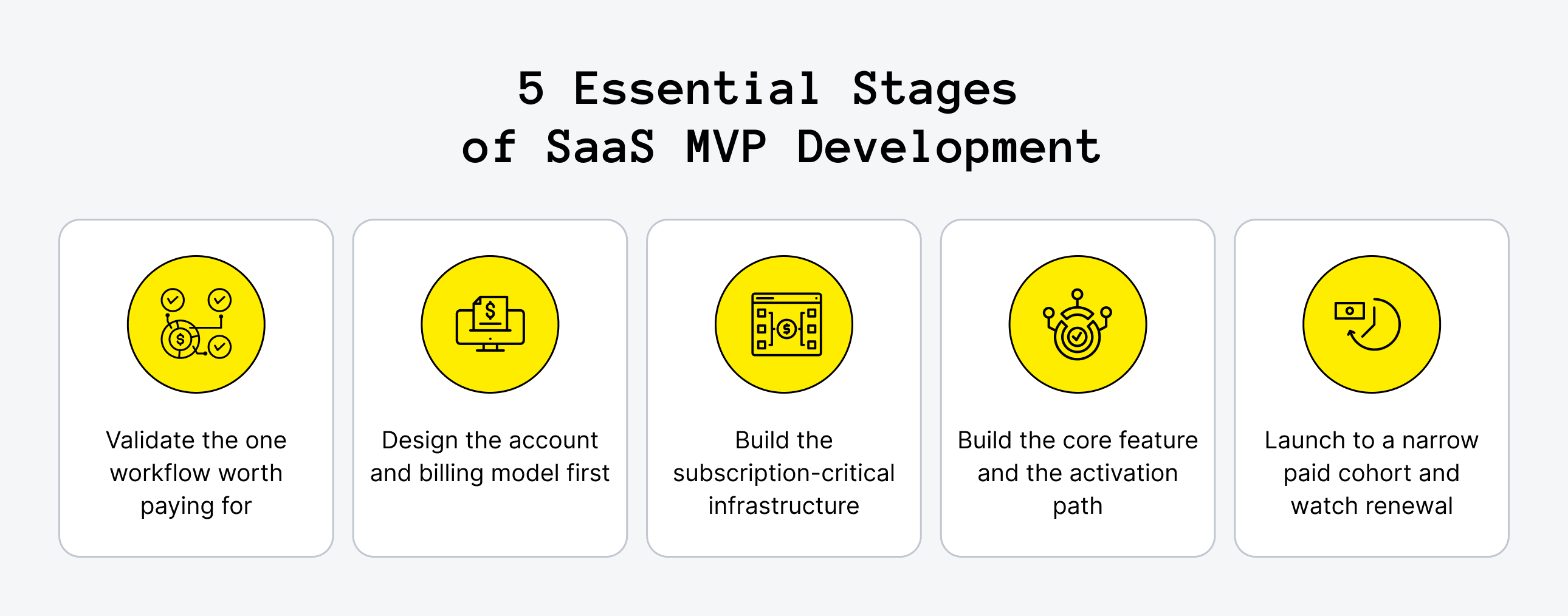
Building an MVP isn't just about writing code. It's about making the right decisions in the right order so you can launch quickly without creating problems you'll have to fix later. If you want to create an MVP for SaaS startup success, understanding the development process is just as important as having a great idea. Let's break the journey down into five practical stages, from validating your concept to launching a product that real users can test and help you improve.
1. Validate the One Workflow Worth Paying for
Before writing a single line of code, it’s worth identifying the one problem customers are willing to pay to solve every month. You shouldn’t aim to build an all-in-one platform from day one. Instead, try validating a single workflow that delivers clear, measurable value. For example, instead of offering "advanced analytics," it’s better to focus on one metric that helps users make better decisions. A successful MVP for SaaS solves one problem exceptionally well before expanding into anything else.
2. Design the Account and Billing Model First
It may not be the most exciting part of the product, but defining your account structure early saves countless headaches later. You should decide whether you'll charge per user, workspace, organization, or subscription tier before designing the interface. These choices influence your database architecture, permissions, and pricing logic. Changing them after customers have signed up often requires complex migrations and creates unnecessary friction.
3. Build the Subscription-Critical Infrastructure
Subscription products live or die by the systems users rarely notice when they're working correctly. Authentication, payment processing, recurring billing, subscription renewals, failed payment handling, and a secure multi-tenant architecture should all be in place before you focus on polishing features. Without reliable infrastructure, even the most impressive product won't generate predictable recurring revenue.
4. Build the Core Feature and the Activation Path
Now it's time to build the feature that delivers on your product's promise. But don't stop there. Equally important is designing a smooth onboarding experience that guides new users to their first success as quickly as possible. Instead of dropping people into an empty dashboard, lead them through a simple sequence of actions that demonstrates value within minutes. Great MVP development for SaaS is as much about activation as it is about functionality.
5. Launch to a Narrow Paid Cohort and Watch Renewal
Resist the temptation to launch to everyone. It’s better to start with a small group of paying customers who closely match your target audience and observe how they use the product. Their willingness to renew tells you far more than download numbers or free signups ever could. A handful of loyal customers provides more actionable feedback than thousands of users who never intend to pay.

Choosing the Right Tech Stack for a SaaS MVP
Selecting a SaaS MVP tech stack is less about chasing trends and more about speed, reliability, and team execution. The best stack is the one your team can ship with quickly while relying on proven tools for everything outside your core value.
Instead of comparing dozens of languages and frameworks, focus on the factors that have the biggest impact on your product's success. The framework below will help you evaluate your options and choose a tech stack that supports both a fast launch and future growth.
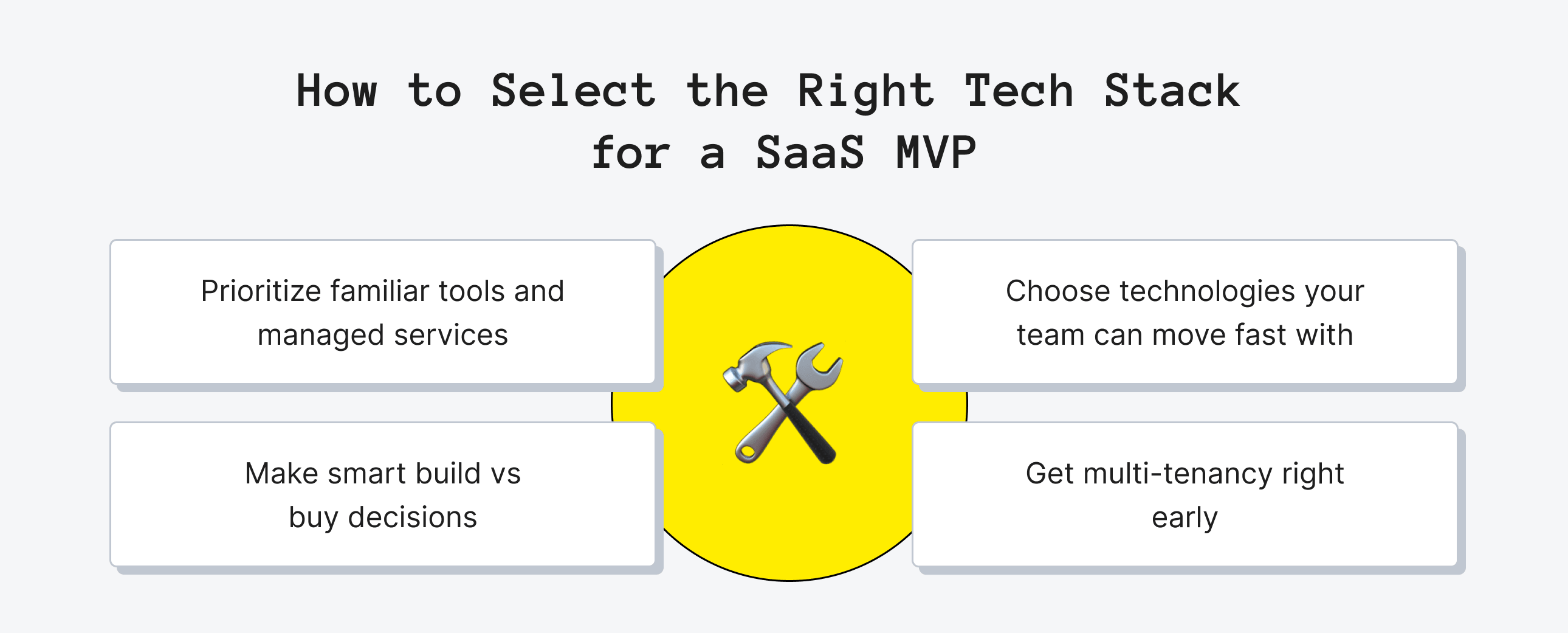
Prioritize Familiar Tools and Managed Services
The fastest way to build an MVP is to use technologies your team already knows and combine them with managed services for non core functionality. Instead of building everything from scratch, rely on:
- billing solutions like Stripe;
- authentication providers or well tested libraries;
- managed databases and hosting platforms such as AWS, GCP, or PaaS options like Render.
Building custom systems for billing or authentication adds unnecessary complexity and delays. These are not the features users choose your product for, so they should not consume your early resources.
Choose Technologies Your Team Can Move Fast With
The choice of backend or frontend framework should support rapid development and iteration rather than technical preference.
- Backend: Python and JavaScript (Node.js) remain the most common choices due to strong ecosystem support and compatibility with SaaS tooling.
- Frontend: prioritize frameworks your team can quickly build and iterate with, especially during early user feedback cycles.
Remember that at the MVP stage, speed of iteration matters more than adopting the latest technologies.
Make Smart Build vs Buy Decisions
The make-versus-buy decision shows up in authentication and billing. A team building the Shopify-analytics dashboard could write its own login system in a week, or wire up a managed auth provider in an afternoon and spend that week on the one report sellers are paying for. The custom version rarely earns its cost at MVP stage: it solves a problem most SaaS products have already solved, instead of the specific problem this product exists to solve.
Get Multi-Tenancy Right Early
Multi-tenancy, whether each customer's data lives in a shared database with a tenant ID or in fully separate schemas, is the one architecture decision worth getting right at MVP stage rather than deferring. Retrofitting tenant isolation after a data model was built for a single customer is a rebuild, not a refactor.


How Much Does a SaaS MVP Cost?
A SaaS MVP built by a dedicated team typically costs between $20,000 and $65,000. This range is driven less by the idea itself and more by execution factors such as the number of user roles, integrations, and billing states the product needs to support, as well as the scope of SaaS MVP development services you choose.
These ranges are based on real project delivery rather than generic estimates. A single-role SaaS product with one integration will typically fall at the lower end, while each additional integration, user role, or compliance requirement (such as HIPAA or SOC 2 readiness) pushes the SaaS MVP development cost higher.
The biggest cost driver in SaaS MVP development is not the core feature itself, but the complexity of billing logic required from day one. Flows such as free trial conversion, failed payments, plan upgrades or downgrades, and cancellations all add significant development overhead that early prototypes often overlook.
For this reason, a founder’s primary objective is to turn these variables into a clearly defined scope before committing to full development. Resolving uncertainty early is significantly more cost-effective than uncovering gaps mid-build.
A well-scoped MVP not only controls costs but also sets a cleaner foundation for iteration. In practice, clarity at this stage is what separates predictable delivery from expensive rework.
What SaaS Investors Want to See From Your MVP
A SaaS MVP now has to clear a specific, checkable bar before an investor treats it as evidence rather than an idea. Bessemer's State of the Cloud research puts that bar at $10,000 or more in monthly recurring revenue, or 1,000+ engaged users, for 78% of B2B seed deals. A working demo with no paying users does not clear it. A product with real subscriptions, even a small number, does. At a $99-per-month price point, $10,000 in MRR is around 100 paying accounts, a number a founder can name and defend in a pitch meeting instead of describing in adjectives.
These benchmarks reflect two distinct paths. A paid B2B product with a clear pricing model should aim directly for MRR. A product still exploring pricing, or one built around a freemium model, is better measured by engaged users. In this case, “engaged” should mean consistent, meaningful activity such as weekly usage or completed workflows, not one time signups. Choosing the right path before launch shapes what your MVP needs to track from day one.
The SaaS MVP development timeline is closely tied to this threshold. Startups that launch an MVP in under 3 months raise 2.5 times more investment on average than those that take longer. The reason is simple: a faster launch creates more time to gather real usage data before entering fundraising conversations. A 3-month build followed by 3 months of active users gives founders 6 months of evidence. A 6-month build, by contrast, leaves them with little or none.
This urgency is reinforced by broader failure data. Recent analyses show that roughly 90% of innovative startups ultimately fail, with lack of genuine market demand and running out of cash together accounting for more than 70% of shutdowns. The IdeaProof’s 2026 study summarizing multiple post mortems found that misreading market demand alone explains about 42% of failures, with cash exhaustion cited in 29% of cases. In other words, most startups do not die from technical problems; they die because they build something people do not use or do not pay for. A focused SaaS MVP built around a single paid workflow and launched quickly is one of the most efficient ways to test whether that risk applies, without investing in a broader feature set too early.
Common Mistakes That Delay a SaaS MVP Launch
Before you get into the specifics of how to build an MVP in SaaS, it helps to look at the common traps that quietly add weeks or months to the timeline. These are the patterns that turn a 3-month build into a 9-month slog, even when the idea itself is solid.
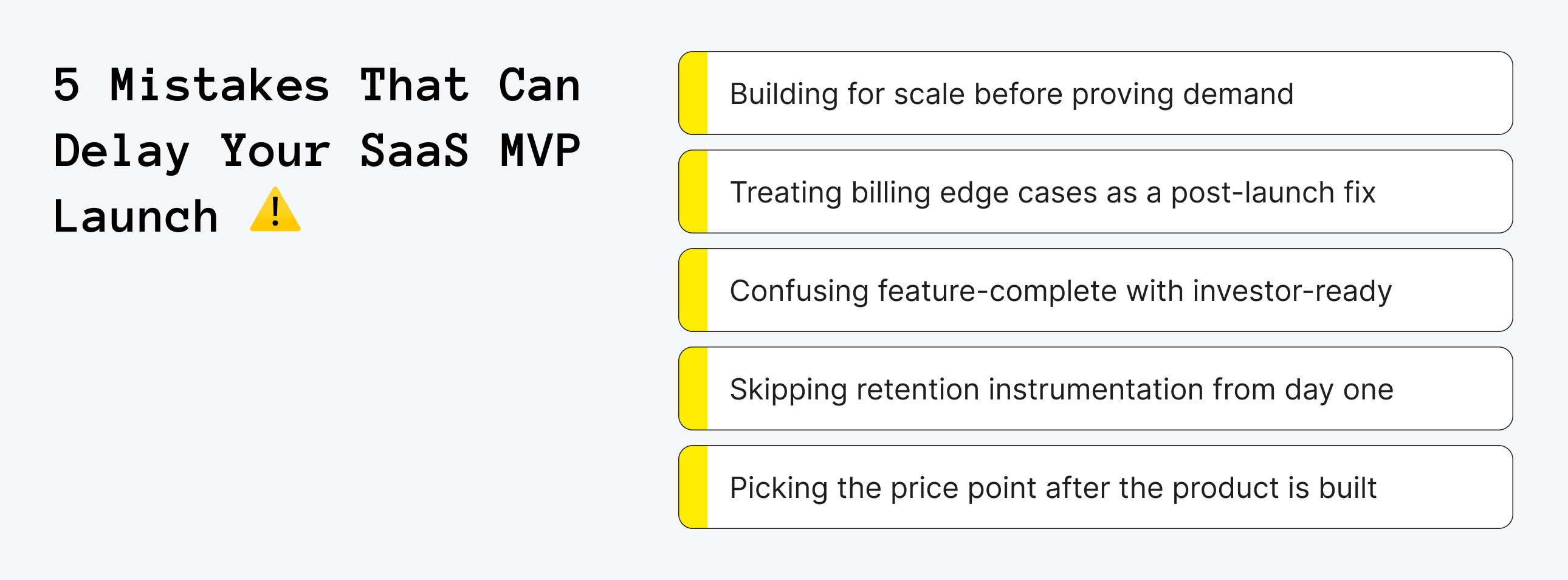
Building for Scale Before Proving Demand
Full role-based permissions, white-labeling, and enterprise SSO get designed before the first ten paying customers exist. The Shopify-analytics dashboard doesn't need a permissions matrix for a sales team that doesn't exist yet; it needs one seller renewing in month two. None of that infrastructure matters if the base product doesn't earn a second charge first.
Treating Billing Edge Cases as a Post-Launch Fix
Failed payments, plan changes, and cancellation flows get skipped in the rush to ship the core feature, then break in front of the first real customer who tries to upgrade or cancel. These states are part of the MVP, not a follow-up sprint.
Confusing Feature-Complete With Investor-Ready
A founder ships all the planned features and still has nothing to show an investor, because none of those features have a paying user behind them yet. Investors want usage and revenue evidence, not a feature list.
Skipping Retention Instrumentation From Day One
Signup and activation get tracked; renewal and churn don't get measured until months in, by which point there's no baseline to compare against. Renewal is the number that answers whether the subscription earned its place.
Picking the Price Point After the Product Is Built
Pricing gets treated as a launch-day decision instead of a design input, so the MVP ships without knowing whether the core feature justifies $29 a month or $299. A support ticket volume that's fine at $29 can sink the margin at scale; a feature set that's underpriced at $299 leaves revenue on the table from the first signup.
Avoiding these mistakes doesn’t require a heavier process; it requires a clearer definition of what “launch ready” really means for a SaaS MVP. When you scope around paid workflows, retention signals, and investor-grade evidence instead of feature completeness, you give your product a far better chance of reaching the market quickly and with real traction.
Need a hand with your startup's MVP?
Upsilon was once a startup too, so we can help build and scale your product!
Final Thoughts on How to Develop a SaaS MVP
Building a successful SaaS product isn't about launching with the longest feature list. It's about solving one meaningful problem, validating it with real customers, and improving the product based on feedback instead of assumptions. If you want to create an MVP for SaaS startup success, focusing on the fundamentals will always outperform trying to build everything at once.
The right strategy, a scalable tech stack, and a clear understanding of what users and investors actually value can significantly reduce risk while speeding up your path to market. Great SaaS MVP development is an ongoing learning process, where every iteration brings you closer to product-market fit.
If you're looking for an experienced partner to turn your idea into a market-ready product, Upsilon is here to help. Our team has successfully built MVPs for startups across different industries and launched products of our own, giving us firsthand experience with every stage of the journey. Whether you need help defining your roadmap, building your MVP, or scaling after launch, explore our MVP development services and feel free to contact us to discuss your project.



FAQs
What is a SaaS MVP?

A SaaS MVP is the smallest version of a subscription product that a real paying user can sign up for, use, and renew. It has to handle the recurring parts of the business, billing, multi-tenant data, account access, not a single demo flow. A prototype that impresses in a sales call but breaks on a second login or a failed payment is not a SaaS MVP; it hasn't proven the subscription will hold up.
How much does it cost to build a SaaS MVP?
A SaaS MVP built by a dedicated team typically costs $20,000 to $65,000, depending on how many user roles, integrations, and billing states it needs to handle. Simple single-role tools with one core workflow sit near the lower end. Multi-tenant B2B products with permissions, team seats, and several integrations cost more.
What tech stack should a SaaS MVP use?
Most SaaS MVPs are built on a managed cloud platform (AWS, GCP, or a PaaS like Render or Vercel), a mainstream backend language such as Python or JavaScript/Node, a relational database, and a payments provider like Stripe for billing. The right choice depends on your team's existing skills and how much of the auth, billing, and hosting layer you want to build versus buy. Optimizing for a stack the team doesn't already know adds weeks before a single feature ships.
Should I build a SaaS MVP myself, with AI tools, or hire a team?
Build it yourself or with AI tools if you still need to prove anyone wants the product; a landing page test or an AI-prompted prototype answers that question for a few hundred dollars. Hire a dedicated team once you need real user accounts, billing, and data that has to survive contact with paying customers and investor due diligence. Bringing in a team before validating demand risks paying production-grade rates for a product no customer asked for.
to top