How Long Does It Take to Build an MVP? A Complete Timeline Guide


You start by asking how long it takes to build an MVP, but the real question shows up fast: how much can you afford to include in version one before it stops being “minimum” and starts becoming a full product. That is why the real job at the start is not just estimating delivery time. It is deciding what truly belongs in the first release, what can wait, and what your team needs to validate before you spend months building the wrong thing.
The good news is that MVP timelines are not random. Most products fall into recognizable tiers, and once you understand the phases, tradeoffs, and decisions that slow teams down, “it depends” turns into something far more useful: an actionable plan. In this guide, we break down realistic timeline ranges, show how scope tiers impact delivery speed, and explain how to balance speed and quality without letting your MVP grow beyond what “minimum” was meant to be.
Key Takeaways
- There are three practical MVP timeline tiers: 4–8 weeks for a lean build, 2–4 months for a standard build, and 4–8 months for a complex product.
- A clear phase structure (discovery, design, development, QA, deployment, and post‑launch) turns “a few months” into a roadmap you can manage instead of a vague estimate.
- Skipping discovery and validation is one of the fastest ways to miss your original estimate and spend months building features nobody asked for.
- The same backlog can take very different amounts of time depending on the build approach: no‑code, freelancers, agencies, or a dedicated sprint‑based team.
- Four patterns reliably slow MVPs down: unclear scope, slow feedback cycles, mid‑build scope additions, and weak or skipped QA.
- To shorten timelines without sacrificing quality, focus on one core user flow, run short sprints with real feedback, lean on pre‑built components, and use AI‑assisted development for routine work.
MVP Development Timeline Tiers by MVP Scope
Most MVPs fall into one of three timeline tiers: 4 to 8 weeks for a lean build, 2 to 4 months for a standard build, and 4 to 8 months for a complex one. These are the same three tiers that determine what it costs to build an MVP, because timeline and budget usually move together. In the end, both are a reflection of one thing: how much you are asking the team to build.
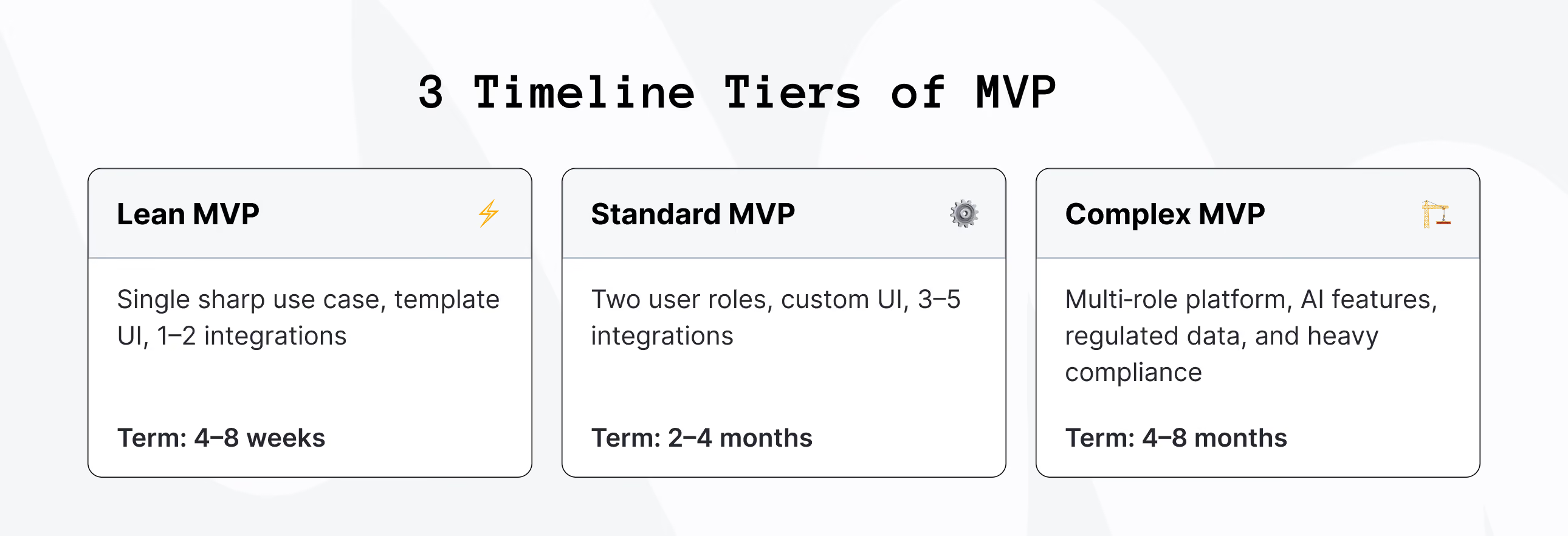
Think of a lean MVP as the “one sharp use case” version. You cover a single core user flow, rely on template UI, and plug in one or two integrations. In that scenario, 4 to 8 weeks is realistic, because you are not asking the team to design and architect everything from scratch.
A standard MVP is what most founders actually end up with. You add a second user role, introduce custom UI, and connect 3 to 5 integrations. That shift from “almost nothing custom” to “some custom everywhere” is what quietly doubles the timeline.
A complex MVP is a different story altogether: multi‑role platforms, AI features, and regulated data such as HIPAA or PCI‑DSS workloads. Suddenly you are looking at 4 to 8 months, not because the team is slow, but because architecture, security, and compliance decisions have to be validated upfront if you do not want to refactor everything halfway through.
In practice, many of the projects we see at Upsilon land at the upper end of the standard tier. Roughly 3 months of sprint‑based work from a signed scope to something running in production is a typical pattern for B2B SaaS and marketplace products. That consistency has less to do with a magic process and more to do with getting the scope solid before the first sprint starts. Once the team is not chasing moving targets every week, the timeline stops ballooning for reasons that feel mysterious on the founder's side.
Most founders underestimate which tier they are actually in. On paper, the idea sounds simple: one login, one dashboard, one core action. In reality, that is a lean build only if you genuinely stick to a single flow. The moment you introduce two user roles or a workflow with more than one approval step, you have already stepped into the standard tier, even if your feature list still looks short in a pitch deck.
So, how long does it take to build an MVP for your specific case? Whether you are aiming for something lean or heading toward something more complex, getting honest about your tier before you ask for a quote is what keeps the first number you hear close to the one you see in the final invoice.
What Happens In Each Phase of MVP Build
Every MVP, whether lean or complex, goes through the same lifecycle phases. Teams often rely on planning tools, whether it’s a project roadmap or an all-in-one teacher planner for educators, to keep complex schedules organized. Understanding what actually happens in each one, and how long they tend to take, is what turns “a few months” into a timeline you can put on a roadmap and share with your team.
When you see not an abstract "product vision" but a sequence of concrete MVP development phases and timeline, you can understand where time goes, decide where to move faster, and identify which parts of the process are safe to overlap and which corners are not worth cutting. The better you understand this lifecycle, the easier it becomes to turn loose ideas and investor pressure into a realistic MVP plan your team can execute.
Why You Should Not Skip the Discovery Phase
A typical discovery output looks like:
- a backlog of 15 to 25 user stories;
- a wireframe for each core screen;
- one clear technical architecture decision that answers questions such as which database, which hosting provider, and which third‑party services you are going to rely on.
Discovery is the phase founders most often skip, and ironically, it is the one most closely tied to hitting the original estimate. Companies that skip validation waste an average of 6 to 9 months and $50,000 to $150,000 building features nobody asked for, according to Presta's 2026 MVP roadmap research.
2 to 4 weeks of upfront work on wireframes, a realistic backlog, and a clear tech stack decision gives the other five phases a stable track to run on instead of drifting a week here and a week there. After that, development runs as a series of two‑week sprints, each ending with something working and demoable instead of one big, risky delivery at the end.
Example: Standard-Tier B2B SaaS
It might be easier to see this in a concrete example. Imagine a standard‑tier B2B SaaS product where users can:
- sign up and log in;
- run one core workflow;
- access an admin dashboard;
- pay through Stripe.
A realistic SaaS MVP development timeline for that might look like this:
Total: just under 4 months, which sits right in the middle of the standard tier. Notice that development accounts for roughly 70% of the total timeline, while discovery and design together take only 3.5 weeks. That front-loaded investment in clarity is exactly what keeps the development sprints on track and prevents costly mid-build re-scoping.
%20for%20Startups.png)

Real MVP Timelines by Build Approach
The same feature list takes a different amount of time depending on who is building it. How long does it take to build an MVP when you use different development models? Launching an MVP with a freelancer looks nothing like launching one with a dedicated team, even when the backlog is identical. Let's look at what each build approach actually involves.
Freelancer timelines swing the widest of the four, because "2 to 4 months" assumes every freelancer is available exactly when you need them. In practice, a solo freelancer juggling another contract on the side adds calendar time that never shows up in the original quote — and coordinating a separate designer, backend developer, and QA tester (if you hire one at all) is work someone has to own. If that someone is you, it's time you're not spending on fundraising or sales.
Upsilon works within the last model: a dedicated team that operates in sprints, with scope and timeline agreed before work starts, billing in 2-week blocks, and a trial sprint guarantee with money back if the first sprint does not deliver. That structure is what keeps the 3 month average holding across builds, because there is no change order process eating into the calendar. Scope changes are scheduled into a future sprint instead of renegotiating the one already underway.
What Slows an MVP Down
Four patterns push a build past its original estimate more often than anything else, and the frustrating part is that all four can be prevented if you spot them early. When founders ask how long does it take to build an MVP, they often forget that these hidden workflow bottlenecks can completely derail even the most realistic timeline.
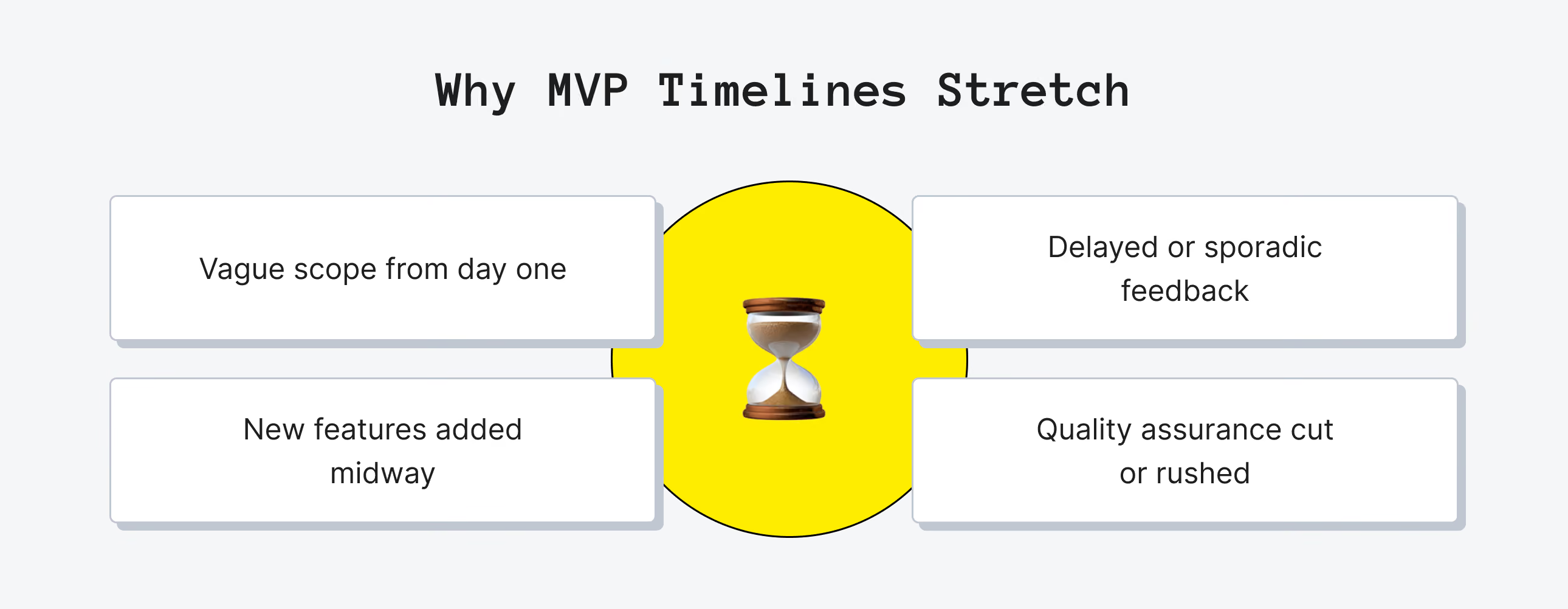
Unclear Scope at Kickoff
This is the number one reason timelines slip. When requirements are fuzzy, developers build to their best guess, then rebuild when that guess does not match what you had in mind. A locked backlog before sprint one removes most of that guesswork. Founders who skip discovery routinely stretch their build by another 4 to 6 weeks.
Slow Feedback Cycles
Sprint based development only works if you actually show up every couple of weeks. If feedback comes 3 to 7 days late, and that happens across a dozen sprints, you are quietly adding weeks to the calendar. The simplest fix is to block out 2 to 3 hours a week for sprint reviews and treat that time as part of the build, not as a nice to have.
Mid-Build Scope Additions
Every feature you add after the sprint plan is set either pushes the timeline out or knocks something else off the schedule. The ideas that pop up mid build almost always belong in the post launch backlog. Saying no to scope creep during development is the founder’s job more than the team’s, because only you can decide what truly has to be in version one.
Skipped QA
Shipping without proper testing feels fast in the moment and painfully slow afterward. You end up with a post launch bug backlog that clogs the next release cycle. Studies on IT projects show that skipping validation tends to mean higher costs, longer timelines, and less value delivered than expected.
A McKinsey and Oxford study found that IT projects without proper validation run an average of 45% over budget and 7% over time, while delivering 56% less value than predicted. Baking QA into every sprint, instead of treating it as a single phase at the end, is what keeps that from happening.
All four of these failure modes have the same root cause, which is decisions made in conversation instead of on paper. A written backlog, a clear sprint review rhythm, a simple scope change policy, and a QA plan that is part of the sprint schedule do not guarantee a perfect project, but they remove most of the avoidable drag before it has a chance to cost you weeks.
Looking for a reliable tech partner?
Upsilon can help you develop an MVP that'll grow to be a success!

How to Shorten Your Timeline Without Cutting Corners
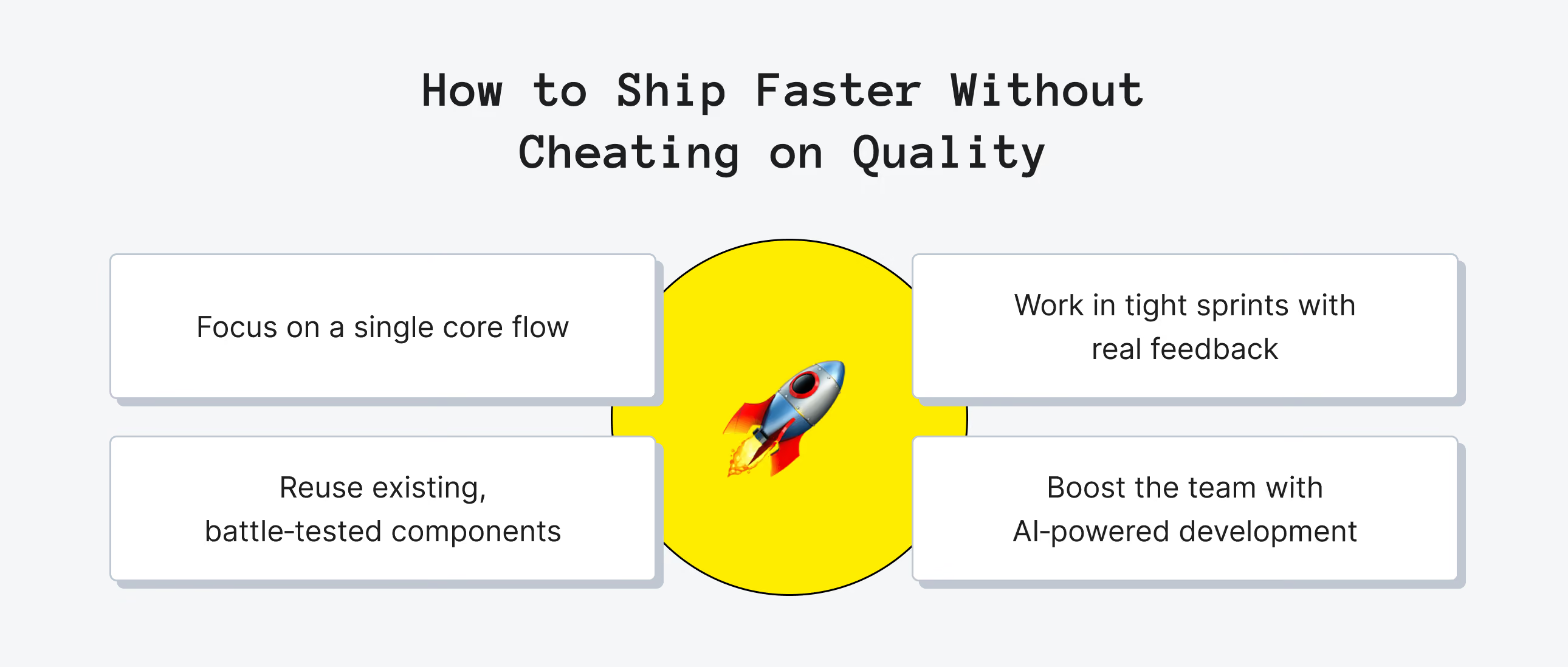
If you are wondering how to build MVP faster without cutting corners, it really comes down to four levers: tighter scope, agile sprints, pre-built components, and AI assisted development. Pull all four at once and you get real time back. Pull only one and you will probably still miss your date.
Cut Scope to One Core User Flow
This is the single highest leverage move you have. Every feature you remove from the initial build is time you get back, not quality you lose, because that feature does not disappear. It simply moves to a later sprint, once your core flow is live and you actually know whether people use it.
Run Short Sprints With Real Feedback Loops
Two week agile sprints with continuous feedback beat one long build phase that ends in a single big review. When you are looking at working software every two weeks instead of waiting three months to see anything, misunderstandings get caught in week 2 instead of week 10, while they are still cheap to fix.
Lean on Pre-Built Components
Pre-built modules save real time because they swap custom engineering for configuration, and that trade is almost always worth it. Building Stripe integration from scratch, including webhook handling, retry logic, and PCI compliance, typically costs 2 to 3 weeks of custom engineering. Using Stripe's hosted checkout and prebuilt webhook library shrinks that to 3 to 5 days. The same logic applies elsewhere: Auth0 instead of rolling your own authentication, AWS S3 instead of a custom upload pipeline, SendGrid instead of running your own mail server. None of these are places where custom work buys you anything a user will ever notice.
Use AI-Assisted Development
AI assisted development is the newest lever on this list, and it is a genuinely useful one. AI tools now automate roughly 40% of routine development work, and no-code or white label paths can compress build time by as much as 70%, according to Appscrip's 2026 research on MVP development. The benefits do not stop at launch either. Startups that use AI during the MVP phase are more likely to find product-market fit, and they tend to iterate faster once they are live. For most founders, the practical starting point is identifying which parts of the backlog are best suited for AI assistance and which still require a human engineer to own the outcome.
It is worth remembering that none of these levers works well in isolation. A team can adopt every AI tool available and still miss its launch date if the feature list remains bloated, because tooling only accelerates the work you have chosen to do. Scope is still the variable that matters most, and everything else on this list delivers its real value only after that decision is made.


Why Your Timeline Matters More Than the Calendar Suggests
A fast MVP timeline changes more than your launch date. It changes your fundraising odds. Startups that launch their MVP in under 3 months secure roughly 2.5 times more investment than those that take longer, and once you understand why, the number stops feeling like a coincidence.
Here is the uncomfortable context behind that stat. 22.1% of new U.S. businesses fail within their first year, according to LendingTree's analysis of Bureau of Labor Statistics survival data, and 42% of startup failures come down to building something the market didn't need, per CB Insights' review of failed startup post mortems. A fast, narrow MVP is the cheapest way to find out early whether you are one of those statistics, instead of spending a year and your entire runway finding out the hard way.
So if you are already 2 months into what was scoped as a 6-week build, pushing harder on the current sprint is not the fix. What you actually need is a scope audit. Cut back to the one flow that proves your core assumption, ship that, and move everything else into a post launch backlog. Reopening the scope conversation now will almost always cost you less time than grinding through the build as it was originally written.
That pressure only builds the further out you look. The median time from seed funding to a Series A has stretched to roughly 616 days, and fewer than 40% of seed funded startups ever make that jump at all. Every month you spend building the wrong scope is a month you are not spending generating the traction data Series A investors now expect before they write a check.
None of this means rushing recklessly or shipping something broken just to hit a date. It means treating your timeline as a strategic asset, not a scheduling detail, because the founders who protect their scope early are the ones who still have runway left when it is time to raise. In that sense, a tight MVP timeline is not just about shipping fast. It is about buying yourself the right to still be in the game a year from now.
Need a hand with your startup’s MVP?
Upsilon was once a startup too, so we can help build and scale your product!
Final Thoughts on the MVP Building Timelines
Every MVP starts with the same hopeful sentence: “We only need a simple first version.” Then reality shows up. A second user role slips in, a couple of integrations suddenly feel essential, and what looked like a 6 week build quietly turns into a 4 month project. That is really the core idea behind MVP timelines: they are rarely defined by the idea itself, but by how much you ask the team to design, build, and validate before launch.
That is also why having a rough estimate early is so useful. Upsilon's AI-Based MVP Estimator can help founders pressure-test their scope before they get too deep into planning, turning a vague idea into a more realistic picture of feature scope, team composition, tech stack, and startup MVP development timeline. It is not a replacement for a proper discovery phase, but it is a practical starting point when you want to check whether your "lean MVP" is actually lean or already drifting into standard or complex territory.
Once the timeline and budget start to look real, the next founder question is usually, "So who do I actually need to build this?" If you are at that point, we are happy to walk you through the approaches that have worked well for other startups we have partnered with, including sprint-based delivery and dedicated MVP development teams. Reach out, share the idea you are wrestling with, and we can compare build options together instead of you having to guess alone.
FAQ
1. How long does it take to build an MVP?

Most MVPs take 4 to 8 weeks for a lean build, 2 to 4 months for a standard build with 2 to 4 features, and 4 to 8 months for a complex, multi-role platform. Timeline is directly tied to scope, so the single most effective way to ship faster is to cut features before you start, not midway through the build.
2. How much does it cost to build an MVP?
MVP development costs can range from $15,000 to $150,000, depending on scope, team model, and geography. A lean MVP covering one core user flow with minimal integrations typically lands between $15,000 and $30,000. A standard MVP with two to four features and a polished UI usually falls somewhere in the $30,000 to $65,000 range. More complex builds, including AI integration, multi-role platforms, or products handling regulated data in fintech or healthcare, commonly run from $65,000 to $150,000 or beyond.
3. Can you build an MVP in one week?
Only if "MVP" means a clickable prototype with no working backend, or a no-code tool handles all your logic without customization. A real MVP (production code, real users, real data) realistically needs 4 to 8 weeks at minimum, even with a fully dedicated team and zero scope changes.
4. How do you speed up MVP development without cutting corners?
Four levers work without sacrificing quality: cut scope to one core user flow; run two-week agile sprints instead of one long build phase; use pre-built modules such as Stripe and Auth0 instead of custom-coding solved problems; and use AI-assisted development, which now automates roughly 40% of routine coding work. Applied together, these levers can reduce a typical MVP build by 20 to 35% in both time and cost without removing the features that matter to your first users.



to top