40+ Essential Questions to Ask a Software Development Company


Choosing a software development partner can feel a bit like online dating: every company presents itself as innovative, experienced, and fully committed to your success. Their portfolios look impressive, testimonials sound convincing, and promises of seamless delivery are everywhere. But once the initial excitement fades and the actual work begins, the difference between a great partner and a costly MVP mistake quickly becomes obvious.
The reality is that building software is rarely just about writing code. It’s about communication, problem-solving, transparency, and the ability to adapt when priorities inevitably change. The right development team will challenge your assumptions, offer practical solutions, and keep you informed every step of the way. The wrong one can leave you dealing with missed deadlines, startup budget overruns, and a product that falls short of expectations.
That’s why taking the time to prepare the right questions to ask a software development company is so important. A thoughtful conversation before signing a contract can reveal far more than a polished presentation ever will. Let’s dive into our curated collection of software development outsourcing questions.
Key Takeaways:
- The quality of a software development partner is not defined only by technical skills, but also by how they approach discovery, communication, and decision-making throughout the project lifecycle.
- Strong evaluation questions help uncover how a team thinks in practice, not just what services they offer in theory.
- A mature development partner is able to balance speed and scalability, especially during early-stage product development.
- Post-launch support and maintenance are just as important as initial development, since real product issues typically emerge after release.
Why Asking the Right Questions Matters When Hiring a Software Development Company
Before choosing a development partner, it is important to understand why asking the right questions plays such a critical role in the decision-making process. It is not only about comparing prices or portfolios but about uncovering how a company really works behind the scenes and whether it is truly the right fit for your project.
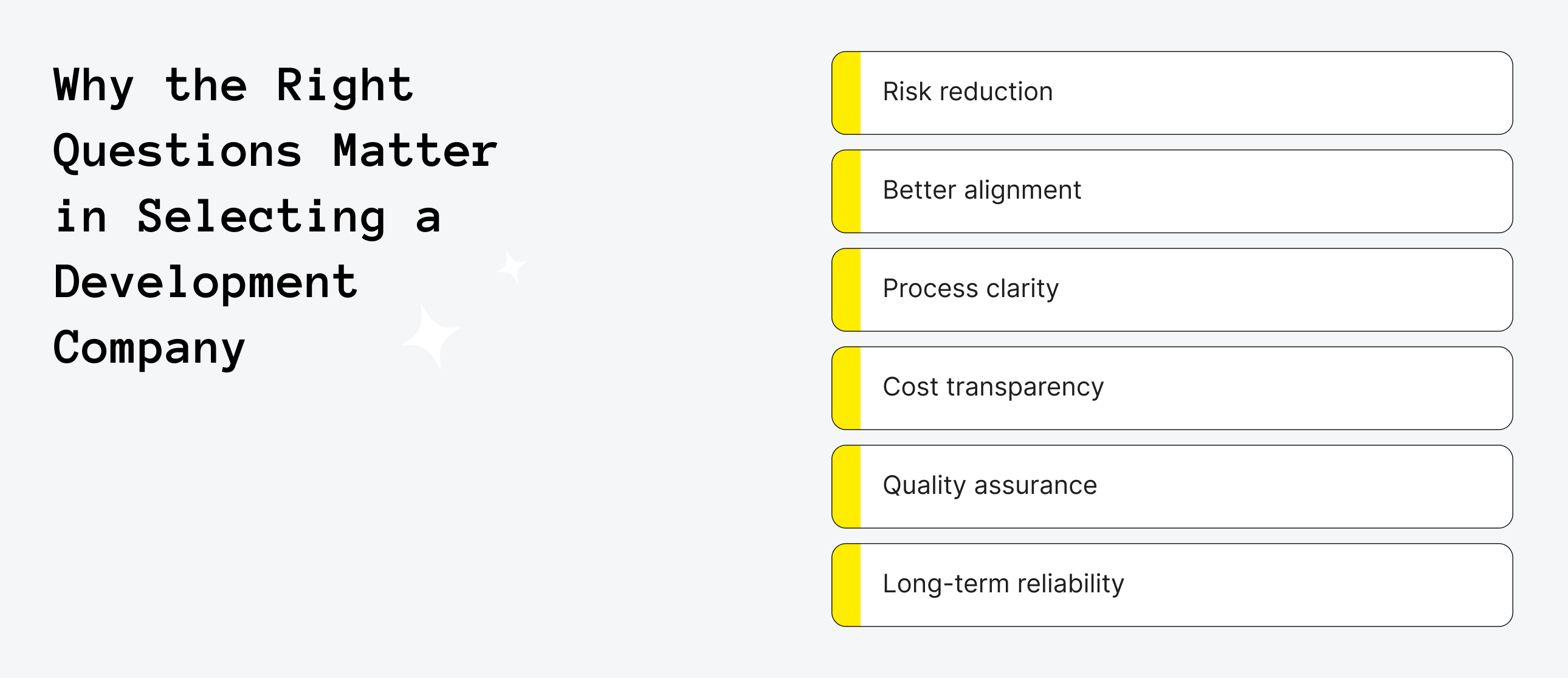
One of the main reasons is risk reduction and better alignment. The right questions help you identify unrealistic promises, unclear processes, and potential delivery issues early in the process. They also show whether the team actually understands your product and industry, which helps you avoid choosing a vendor based only on presentation rather than real capability.
Another key factor is clarity around communication, process, and budget. When you discuss how the team works throughout planning, MVP development, testing, and change management, you get a realistic picture of collaboration. At the same time, you can understand how pricing is structured and reduce the risk of hidden costs or unexpected changes later.
Finally, strong questioning reveals long-term reliability and quality standards. It shows how the company ensures code quality, manages ongoing support, and adapts as the product grows. In the end, the right questions do not just help you hire a team, they help you choose a partner you can build and scale with over time, which is why understanding questions for a software development company is so important.
Questions About Company Experience and Track Record
A software development company's portfolio is a lot like a chef's signature dishes – anyone can talk about what they're capable of, but their past work shows what they can actually deliver. That's why these questions to ask a software development company focus on experience and track record, helping you separate impressive promises from proven results.
1. What experience do you have working with startups similar to ours?
Why ask this: Building products for startups is very different from delivering enterprise projects. Startups operate under tight budgets, shifting priorities, and constant uncertainty.
What to listen for: Don't settle for a simple "yes." Ask for specific examples of startup projects, the MVP stage those companies were at, and the challenges the team helped solve. Pay attention to whether they mention adapting to changing requirements, prioritizing MVP features, and moving quickly without sacrificing quality.
2. Which of your previous projects would you consider the most successful, and why?
Why ask this: This question reveals how the company defines success. Do they focus solely on delivering features, or do they measure outcomes based on business impact?
What to listen for: Strong partners will talk about results, not just deliverables. Look for KPIs and product performance metrics such as user growth, increased revenue, improved retention, successful fundraising, or faster time to market. Be cautious if the answer revolves only around completing tasks on schedule.
3. Can you provide references or connect us with past clients?
Why ask this: Testimonials and client references offer independent insight into the company's reliability, communication style, and ability to deliver on commitments.
What to listen for: Ask to speak with clients who had projects similar in size or stage to yours. During those conversations, pay attention to how the company handled deadlines, unexpected SaaS challenges, and day-to-day communication. Hesitation to provide references may be worth exploring further.
4. Have you worked on any projects that didn't meet expectations? What did you learn from them?
Why ask this: No development partner has a perfect track record. Their willingness to discuss setbacks openly demonstrates transparency, maturity, and a commitment to continuous improvement.
What to listen for: You're not looking for a flawless answer – you're looking for honesty. Strong teams can clearly explain what went wrong, what they changed afterward, and how those lessons improved their processes. A vague "we've never had any issues" response can be a red flag.
5. How long do your client relationships typically last?
Why ask this: The duration of client engagements and the rate of repeat business can be strong indicators of customer satisfaction and trust.
What to listen for: Long-term relationships often suggest that clients value the partnership beyond the initial MVP launch. Ask how many clients return for additional work and what ongoing support typically looks like. At the same time, understand whether extended engagements reflect genuine satisfaction rather than project delays or dependency.


Questions About Technical Expertise and Tech Stack
Choosing a tech stack is a bit like laying the foundation of a house. Once the concrete sets, changing it becomes expensive, messy, and time-consuming. That's why these questions to ask a software vendor focus on technical expertise and technology choices, helping you understand whether their recommendations are built for your long-term goals or simply based on what they're most comfortable using.
1. What technologies and programming languages does your team specialize in?
Why ask this: This helps you understand whether the partner has deep expertise in the technologies required for your product, rather than simply offering them as part of a broad service portfolio.
What to listen for: Look for depth, not just a long list of buzzwords. Strong vendors can explain where they've used these technologies before, what types of products they've built with them, and why they were the right fit. If every technology is presented as a core competency, ask for specific examples.
2. How do you decide which tech stack is best for a project?
Why ask this: A strong development partner should be able to explain the reasoning behind their technology recommendations, considering factors such as scalability, speed to market, budget, and future maintenance.
What to listen for: The best answers start with business goals, not technical preferences. Pay attention to whether they ask questions about your product vision, expected growth, timeline, and budget before recommending a stack. Be cautious if the answer is simply, "This is what we always use."
3. Have you built products that successfully scaled as user demand grew?
Why ask this: Early-stage products may not require complex architectures, but rapid growth can quickly expose technical limitations.
What to listen for: Ask for real examples involving increased traffic, user growth, or expanding feature sets. Strong partners should be able to explain what scaling challenges they faced and how they addressed them without overengineering too early.
4. How do you ensure code quality and maintainability?
Why ask this: This question provides insight into the team's engineering standards and development practices, including code reviews, testing, documentation, and quality assurance processes.
What to listen for: Look for concrete processes rather than generic statements about "high standards." Regular code reviews, automated testing, documentation practices, CI/CD pipelines, and clear QA procedures are all signs of engineering discipline.
5. Who owns the source code, infrastructure, and technical documentation once the project is complete?
Why ask this: Technical ownership is often overlooked during vendor selection but can become a major issue later.
What to listen for: The answer should be clear and unambiguous. Make sure ownership of the codebase, repositories, cloud accounts, documentation, and other technical assets is transferred to your company. Avoid arrangements that create unnecessary dependency on the vendor.


Questions About Development Process and Methodology
A great product idea can still go off track without the right process behind it. These questions for a software development company will help you understand how the team plans, communicates, and adapts throughout different phases of product development because a smooth workflow often matters just as much as technical expertise.
1. How do you structure the product discovery and planning phase before development begins?
Why ask this: A well-defined discovery process helps align business goals, user needs, technical requirements, and project scope before writing code.
What to listen for: Strong partners won't jump straight into development. Look for activities such as stakeholder workshops, user research, requirements gathering, technical validation, and MVP definition. A rushed discovery phase often leads to expensive course corrections later.
2. How do you prioritize features and manage changing requirements during development?
Why ask this: Startups often need to adapt based on customer feedback, market shifts, or investor input. Understanding how a partner handles changing priorities reveals how flexible their process truly is.
What to listen for: Pay attention to whether they have a clear framework for feature prioritization and change management. The best teams embrace iteration without losing sight of timelines and budgets. Be wary of processes that are either too rigid or completely ad hoc.
3. What development methodology do you follow, and how do you apply it in real projects?
Why ask this: This question helps you understand whether the team works in Agile, Scrum, Kanban, or a hybrid approach and more importantly, how they actually implement it in day-to-day development, not just in theory.
What to listen for: Focus on how practical their answer is. Strong teams will explain how sprints are planned, how backlog grooming works, how feedback is incorporated, and how they handle situations where the methodology needs to be adapted. Be cautious if they only mention a framework name without explaining how it works in practice.
4. How do you estimate timelines and ensure delivery stays on schedule during development?
Why ask this: Estimation and delivery planning are at the core of any development methodology. This question helps you understand whether the team’s planning process is data-driven and realistic, or based on guesswork and optimistic assumptions.
What to listen for: Strong teams explain how they break down work into smaller tasks, use historical data or velocity from past sprints, and continuously adjust estimates based on real progress.
Need a hand with your startup's MVP?
Upsilon was once a startup too, so we can help build and scale your product!

Questions About Team Structure and Resources
A strong development team is more than just skilled engineers; it’s about how people are structured, how responsibilities are shared, and whether the right resources are available at the right time. These software development company interview questions will help you understand who will actually work on your project and how the team is organized to deliver results.
1. Who will be assigned to our project, and what are their roles?
Why ask this: Some agencies present senior experts during the sales process but delegate execution to less experienced team members. Understanding who will actually work on your product helps set realistic expectations.
What to listen for: You’re looking for a clear, concrete team setup, not a generic “our team will handle it.” Strong answers specify roles (frontend, backend, QA, PM, UX), seniority levels, and ideally real names. A good signal is when they also ask detailed questions about your product, because it shows they are actively thinking about team composition, not just filling slots.
2. What is the average tenure of your team members, and how often do people rotate between projects?
Why ask this: Frequent staff turnover or constant team changes can disrupt momentum, reduce knowledge continuity, and impact product quality.
What to listen for: Strong teams tend to keep a stable “core team” throughout the entire project. Pay attention to whether they describe long-term allocations rather than frequent reshuffling. Red flags include vague answers like “everyone works on everything” or frequent rotations without a clear reason.
3. How do you scale the team if the project's needs change?
Why ask this: Startup requirements can evolve quickly. You may need to accelerate development, add specialized expertise, or reduce the team size to align with budget constraints.
What to listen for: Strong answers explain how quickly they can onboard new people, how they integrate them into ongoing workflows, and how they prevent productivity drops during scaling. Having a ready bench of specialists is a strong advantage.
4. Do you have access to specialists outside the core development team when needed?
Why ask this: Building a successful product often requires expertise beyond software engineering, such as UX/UI design, DevOps, data engineering, security, or product strategy.
What to listen for: Good answers include real examples of when specialists were brought in and why. It should feel like a structured capability, not ad-hoc outsourcing. Also pay attention to how quickly and seamlessly these experts can be involved when needed.
5. What happens if a key team member becomes unavailable during the project?
Why ask this: Unexpected absences, resignations, or internal reassignments can affect delivery timelines and project continuity.
What to listen for: Mature teams focus on reducing dependency on single individuals. Look for practices like shared code ownership, documentation standards, peer reviews, and knowledge-sharing routines. A confident “this never happens” answer is usually a red flag.
Questions About Communication and Project Management
Selecting a software development partner isn’t just about technical skills; it’s also about how well you’ll work together day to day. These what to look for in a software development partner questions focus on communication style and project management, because even the best teams can fail without clear alignment and transparency.
1. Who will be our primary point of contact, and what level of decision-making authority will they have?
Why ask this: Some organizations involve multiple stakeholders, making communication fragmented and slowing down approvals. Understanding who owns the relationship helps establish clear accountability.
What to listen for: Look for a single, clearly defined point of contact (often a PM or delivery manager) who is empowered to make day-to-day decisions. Strong answers also explain escalation paths for bigger decisions. Red flags include “you’ll talk to the whole team” without a clear owner.
2. How do you handle disagreements over priorities, timelines, or product decisions?
Why ask this: Differences in opinion are inevitable during product development. This question reveals how the partner approaches conflict resolution and collaborative problem-solving.
What to listen for: Strong partners describe a structured but flexible approach – discussions based on data, product goals, and trade-offs rather than hierarchy or ego. Look for examples of how they align with clients when priorities conflict.
3. How do you keep clients informed about progress between major milestones?
Why ask this: Beyond formal status meetings, it's important to understand how information is shared on an ongoing basis and how visible day-to-day activities are.
What to listen for: Look for a mix of structured reporting (weekly updates, sprint reviews) and real-time transparency (project boards, Slack/communication tools, dashboards). Strong teams make progress visible without clients needing to ask.
4. What is your approach to documenting key decisions and action items?
Why ask this: Verbal agreements can easily be forgotten or interpreted differently over time. Documentation creates a shared source of truth for everyone involved.
What to listen for: Look for a mix of structured reporting (weekly updates, sprint reviews) and real-time transparency (project boards, Slack/communication tools, dashboards). Strong teams make progress visible without clients needing to ask.
5. How do you gather and incorporate client feedback throughout the engagement?
Why ask this: The best partnerships involve continuous two-way communication rather than feedback being limited to formal review stages.
What to listen for: Look for structured feedback loops such as regular demos, sprint reviews, product check-ins and a clear process for turning feedback into actionable tasks. Trustworthy partners don’t just collect feedback; they show how it directly influences development priorities.

Questions About Pricing Models and Contracts
Signing up with a development partner without understanding pricing and contracts is a bit like joining a gym without knowing if you’re paying per visit, a monthly subscription, or a long-term membership with hidden conditions. These questions about pricing models and contracts help you see what you’re really committing to: how costs are structured, how flexible the agreement is, and whether the setup actually fits a fast-moving startup.
1. Which pricing models do you offer, and how do you determine which one is the best fit for a project?
Why ask this: Development partners may offer fixed-price, time and materials, dedicated team, or hybrid engagement models. Each comes with different levels of flexibility, predictability, and risk.
What to listen for: Look for a thoughtful explanation rather than a “one-size-fits-all” recommendation. Strong partners will link pricing models to your product stage, clarity of requirements, and expected level of change. Be cautious if they push a single model for all situations without discussion.
2. What costs are included in your proposal, and what could lead to additional charges?
Why ask this: Initial estimates do not always cover every expense. Clarifying what is included and what is considered out of scope helps avoid unexpected invoices later.
What to listen for: A transparent breakdown of what’s included (development, QA, project management, tools, infrastructure, etc.) and clear examples of what would trigger extra costs. Reliable partners proactively highlight potential “hidden” cost areas.
3. How do you handle scope changes and change requests during the engagement?
Why ask this: Product requirements frequently evolve, especially in early-stage companies. It's important to understand how modifications affect pricing, timelines, and approvals.
What to listen for: A structured change management process such as impact analysis, approval steps, and updated estimates. Top-tier teams treat changes as a normal part of development rather than exceptions, but still keep control over MVP scope and budget.
4. What are the key contractual terms regarding termination, notice periods, and exit conditions?
Why ask this: Even well-planned partnerships may need to end or evolve. Founders should understand their rights and obligations before signing an agreement.
What to listen for: Clear, fair, and predictable exit conditions. Look for reasonable notice periods, clarity on IP ownership, and a straightforward handover process. Red flags include overly restrictive termination terms or vague exit procedures.
Questions About Quality Assurance and Testing
Even the best-designed product can fail if it isn’t properly tested before release. That’s why QA and testing are often the difference between a smooth launch and constant post-release issues. These how to choose a software development company questions focus on how teams ensure quality, catch bugs early, and maintain product stability as it grows.
1. What is your testing strategy throughout the development lifecycle?
Why ask this: Some teams treat testing as a final step before release, while others integrate it into every stage of development. Understanding when and how QA testing happens reveals how seriously the partner approaches quality.
What to listen for: Look for testing that is embedded into the entire workflow, not just a final QA phase. Strong teams describe continuous testing during development, including unit tests, integration tests, and validation at each stage of delivery. Be cautious if testing only happens right before release.
2. Which types of testing do you typically perform on a project?
Why ask this: Quality assurance can include manual testing, automated testing, regression testing, performance testing, security testing, and user acceptance testing. The answer helps you understand the depth of their QA capabilities.
What to listen for: Skilled teams don’t just list testing types, they explain when and why each type is used. Pay attention to whether they combine manual and automated testing and whether they adapt their approach based on product complexity and risk level.
3. How do you prioritize and resolve defects once they are identified?
Why ask this: Not all bugs have the same impact. This question reveals whether the team has a clear process for classifying issues, setting priorities, and communicating resolutions.
What to listen for: Look for a structured triage process (e.g., severity levels, SLA definitions, bug tracking tools). Proven teams clearly distinguish between critical, high, medium, and low-priority issues and explain how that affects resolution speed.
4. What happens if significant issues are discovered after launch?
Why ask this: Even with thorough testing, some problems only emerge in real-world conditions. It's important to understand the partner's post-release responsibilities and response process.
What to listen for: Well-organized partners have a clear incident response process, including quick triage, hotfix procedures, rollback strategies, and communication protocols. Be cautious if post-launch support is vague or treated as “best effort.”
Questions About Security and Data Protection
Security and data protection are often the parts of a project that only get attention after something goes wrong but by then, it’s usually too late. These questions will help you understand how a development company protects your product, your users, and your business and enhance your cybersecurity from the very beginning.
1. How do you incorporate security into the development process?
Why ask this: Security should not be treated as an afterthought or a final checklist before launch. This question helps you understand whether the team follows secure development practices from the outset.
What to listen for: Look for “security by design” thinking – security considerations embedded into every stage of development. This includes practices like code reviews, secure coding guidelines, threat modeling, and continuous security checks rather than last-minute audits.
2. How do you handle and protect sensitive data during development and testing?
Why ask this: Development teams may have access to customer information, business data, or confidential materials. Understanding how that data is stored, shared, and accessed is essential.
What to listen for: Look for clear explanations of data access controls, encryption practices, environment separation (dev/staging/production), and anonymization or masking of sensitive data in testing environments. Another positive sign is when teams explain how they minimize exposure of real user data during development.
3. What security standards, compliance frameworks, or regulations are you familiar with?
Why ask this: Depending on your industry and target market, your product may need to comply with requirements such as GDPR, HIPAA, SOC 2, or PCI DSS.
What to listen for: Focus on specific, relevant experience rather than just listing frameworks. Look for examples of how compliance requirements were applied in real projects and what processes were followed to meet them.
4. How do you respond to security incidents or newly discovered vulnerabilities?
Why ask this: No system is completely immune to threats. What matters is whether the team has a clear process for identifying, communicating, and resolving security issues.
What to listen for: Look for incident response procedures, clear escalation paths, quick patching processes, and transparent communication. Good answers also include how similar issues are prevented in the future after an incident.

Questions About Post-Launch Support and Maintenance
A product launch is not the finish line. It’s the point where real-world usage begins, and unexpected issues often appear. These questions will come into handy if you want to understand how a development partner supports your product after release and whether they’re prepared for long-term reliability, updates, and growth.
1. What kind of post-launch support do you provide after the MVP goes live?
Why ask this: This clarifies whether the partner’s responsibility ends at delivery or extends into real-world usage when users start interacting with the product.
What to listen for: Look for clarity on the support window right after launch such as stabilization periods, bug fixes, and availability for urgent issues. It also helps to understand whether support is reactive (only when issues arise) or proactive (monitoring and improving stability after release).
2. What is your process and expected response time for fixing production issues?
Why ask this: This reveals how quickly the team reacts to critical bugs, whether there are SLAs in place, and how issues are prioritized in live environments.
What to listen for: Pay attention to whether there is a defined incident response workflow, clear severity levels, and expected response times for different types of issues. It’s also useful to understand how communication is handled during incidents.
3. Do you offer ongoing development for new features after the MVP stage?
Why ask this: Some partners only provide maintenance, while others continue evolving the product with new features, optimizations, and iterations.
What to listen for: Look for whether they support both maintenance and active product development. A good sign is when they describe how they transition from MVP support into iterative development based on user feedback and business priorities.
4. What does long-term maintenance include, and how is it priced?
Why ask this: Maintenance can include bug fixes, infrastructure monitoring, performance optimization, and minor improvements. Pricing models vary widely.
What to listen for: Look for a clear breakdown of what is included in maintenance vs. what is considered additional work. It also helps to understand whether pricing is fixed, hourly, or based on service packages, and how predictable ongoing costs are.
Questions to Ask When Building an MVP or Startup Product
Building an MVP is where most startup ideas are either validated or quietly overcomplicated. These questions will reveal information about whether a development partner can focus on speed, clarity, and real user value without turning your first version into an over-engineered product.
1. How do you define what should be included in an MVP for our idea?
Why ask this: Many teams either overbuild or underbuild an MVP. This question helps understand how the partner balances speed, scope, and idea validation needs.
What to listen for: A strong direction here is when the discussion quickly shifts from “features” to “problem and user outcome.” It’s important that they are able to reduce your idea to a small number of core user actions that actually test the main hypothesis of the product. Another positive signal is when they naturally introduce prioritization based on impact versus effort, and explain what is deliberately postponed to avoid overbuilding the first version.
2. How do you help validate assumptions before and during development?
Why ask this: MVP success depends on testing the right hypotheses, not just building features. This question explores whether the team supports discovery, user research, or early validation.
What to listen for: What matters most here is whether they can break your idea into clear assumptions first and then explain how each one is tested before committing to full development. It’s important that they describe practical validation steps such as user conversations, prototypes, or landing pages, and show how this feedback directly influences what gets built next.
3. How do you approach building an MVP when requirements are not fully defined?
Why ask this: Early-stage founders rarely have fully clear specs. This question tests how comfortable the team is working with ambiguity.
What to listen for: They should be able to structure unclear ideas by breaking them into key assumptions, defining the core user flow first, and refining scope step by step through short iterations. It’s also important that they explain how they keep the MVP focused while still adjusting requirements as new insights appear during development.
4. How do you decide whether to build a feature quickly with a simple solution or invest in a scalable architecture from the start?
Why ask this: MVP development often requires balancing speed of execution with long-term technical stability. This question helps you understand how the team approaches trade-offs between short-term validation and future scalability.
What to listen for: The most useful signal here is whether they prioritize learning and validation in early stages rather than overengineering. At the same time, they should be able to explain where simplicity is safe and where it could create future limitations that are expensive to fix. A thoughtful answer usually includes examples of how they choose minimal solutions for fast iteration, while still keeping an eye on parts of the system that are likely to scale or evolve quickly.
Red Flags to Watch For in a Software Development Company
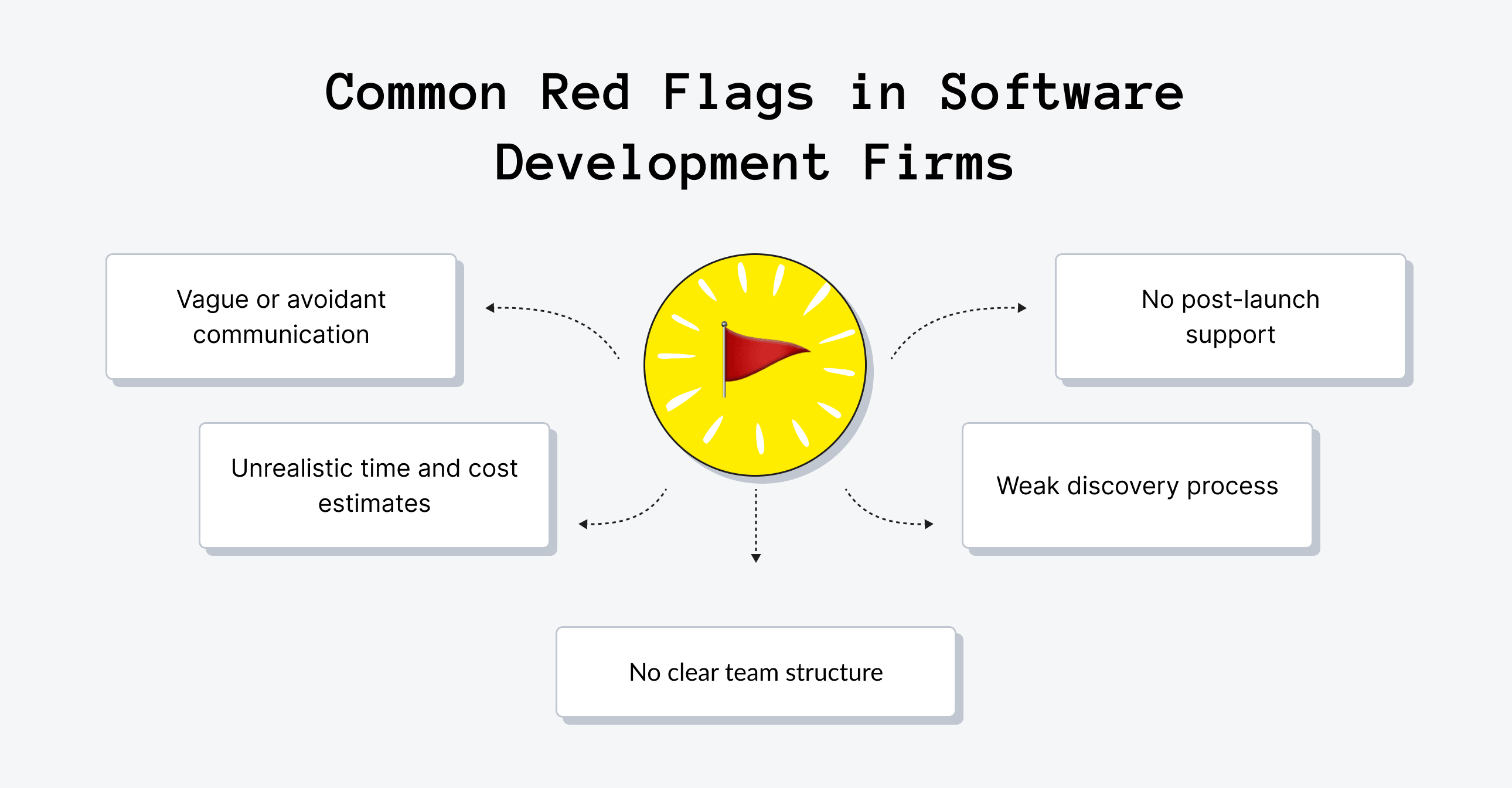
Choosing the right software partner requires more than just comparing portfolios and pricing. It also means being able to recognize early warning signs that may indicate future problems with delivery, communication, or product quality. Knowing these signals is an essential part of how to evaluate a software development company, since it helps you avoid costly mistakes before the project even begins.
Vague or Avoidant Communication
If a company answers your questions with general phrases like “we’ll figure it out later” or cannot clearly explain how they approach development, this is a strong warning sign. Reliable teams are able to break down their process, explain technical decisions in simple terms, and provide concrete examples from past projects. Lack of clarity often leads to misunderstandings, repeated rework, and misaligned expectations.
Unrealistic Time and Cost Estimates
Be cautious if a vendor promises to build a complex product in an unusually short time or at a significantly lower cost than competitors without explaining trade-offs. In practice, this often results in rushed development, skipped testing, or a sudden increase in budget mid-project. Professional teams usually justify estimates with scope breakdowns, assumptions, and potential risks.
No Clear Team Structure
If you cannot find out who exactly will work on your project, what their roles are, or how experienced they are, this is a serious concern. Some companies rely heavily on outsourcing without clear ownership, which leads to inconsistent quality and poor accountability. A trustworthy vendor can usually introduce the technical lead, developers, and project manager involved in your product.
Weak Discovery Process
If the company starts estimating or proposing solutions without asking detailed questions about your users, goals, or business model, it often means they are not fully understanding the problem. This usually leads to building features that look correct technically but do not solve real user needs, resulting in expensive changes later.
No Post-Launch Support
If post-launch support is mentioned vaguely or treated as an afterthought, it may indicate that the company focuses only on delivery, not long-term success. Reliable partners clearly define bug-fixing policies, response times, and ongoing support options. Without this, you may be left alone with critical issues after release.
Looking for a reliable tech partner?
Upsilon can help you develop an MVP that'll grow to be a success!
Conclusion on Questions to Ask a Software Vendor
Selecting a software vendor is ultimately about reducing uncertainty. The right set of questions helps you look past polished presentations and understand how a team actually thinks, communicates, and delivers under real project conditions. This is what prevents most common failures in software projects, from misaligned expectations to budget overruns and delayed releases.
More importantly, strong preparation helps you choose a partner rather than just a provider. When you use well-structured questions to ask a software development company, you are not only checking technical skills, but also evaluating trust, transparency, and long-term fit. These factors often matter more than the initial estimate or portfolio, because they determine how the collaboration will feel once the work begins.
At Upsilon, our experts work closely with startups that need to move fast without sacrificing product quality. Our MVP development services are designed to turn early ideas into lean, functional products that are ready for real user feedback. Beyond launch, we stay involved to help teams iterate, improve, and scale with confidence. For founders looking for a practical and engaged development partner who understands the pace and pressure of early-stage products, our team is always open to a conversation. Feel free to contact us if you have any concerns.



FAQs
How many development companies should I interview before deciding?

As a general rule, interviewing three to five development companies gives you enough perspective to compare expertise, communication styles, pricing models, and proposed approaches without becoming overwhelmed. If one team clearly stands out in terms of transparency, technical fit, and understanding of your goals, there's usually no need to keep searching just for the sake of more options.
What is the single most important question to ask a software development company?
One of the most important questions to ask outsourcing company representatives is: "How do you handle changes in project scope and unexpected challenges?" The answer reveals a lot about the company's communication practices, transparency, and problem-solving approach. These factors often have a greater impact on project success than technical skills alone.
Whom on the vendor’s side should I interview from a technical perspective?
At a minimum, you should speak with the technical lead or solution architect who will be involved in shaping the project's architecture and key decisions. If possible, also meet the project manager and one or two developers who are likely to work on your product, as these conversations can give you a clearer picture of the team's expertise, communication style, and overall fit.
What should I do if a vendor cannot answer my questions?
If a vendor cannot answer your questions, pay attention to how they handle the situation. It's perfectly reasonable for them to follow up later with more detailed information, but vague responses, constant deflection, or a lack of transparency can be red flags. If you leave the conversation with more uncertainty than clarity, it may be worth considering other options.
to top