Discovery Phase vs MVP: When to Use Each Approach in Product Development


You have probably sat in that meeting. The whiteboard is full of arrows and boxes, investors are asking about timelines, and part of the team argues for a discovery phase while others want to start building the MVP and adjust along the way. Underneath the diagrams, the real tension is about how much risk everyone is willing to carry into the next sprint.
Discovery and MVP are often treated as competing paths, but they are better seen as two parts of the same bet. Discovery answers the hard questions while it is still inexpensive: which problem you are solving, who you are solving it for, and which constraints will quietly shape your product development roadmap. MVP development turns those answers into a focused product that can test your assumptions in the real world, using actual user behavior instead of hypothetical feedback.
For a founder, the challenge is not the theory, but deciding what to do next with the idea, the runway, and the team you have right now. This article helps you understand the nuances of product discovery vs MVP and walks through the real costs of skipping discovery, the common mistakes on both sides of the decision, and a five question checklist you can use in a few minutes before you commit, so you can decide whether the next dollar goes into scoping or into building.
Key Takeaways
- Discovery validates whether a problem is worth solving and de-risks the plan on paper, while an MVP tests whether your solution actually works with real users.
- Skipping a discovery phase your idea needed doesn't save money, it defers the cost. Founders who skip it typically spend 30–50% more on re-scoping and rebuilding mid-sprint than discovery would have cost upfront.
- Discovery costs $6,000–$15,000 over 2–4 weeks; an MVP starts around $20,000 and takes about 3 months.
- Doing discovery when you don't need it wastes time, and skipping it when you do need it causes expensive rework.
- Do you need a discovery phase for MVP development? Five simple questions, covering validation, complexity, alignment, clarity, and runway, can settle which path to take.
Discovery Phase vs MVP: What Each One Delivers
Discovery and MVP are often treated as interchangeable buzzwords, but they solve very different problems in your product journey. From a startup’s point of view, it helps to look at them side by side and understand what each actually delivers.
Clarifying What “Discovery Phase” Really Means
Discovery phase gets used loosely across the industry, so it’s worth being specific about the discovery phase meaning that matters for this topic: not a brainstorm, not a sales call, but a structured, deliverable-producing engagement with a fixed start and end date. That’s different from product discovery in the UX sense, which is the ongoing user research a product team runs continuously inside an agile process. The discovery phase this article compares to an MVP build is front-loaded and finite: it happens once, before development, and produces something concrete.
What a Discovery Phase Delivers
A discovery phase in software development turns a founder’s idea into a scoped, buildable plan. The discovery phase deliverables are wireframes, a technical architecture decision, and a backlog broken into sprints that a dedicated development team can execute against without guessing at requirements mid-build. Nothing gets built during discovery itself. The typical discovery phase steps follow roughly the same order across most agencies: stakeholder interviews and a discovery workshop, requirements gathering, wireframing, technical architecture decisions, and a sprint-by-sprint backlog with estimates attached.
What an MVP Delivers
An MVP is the build itself: the smallest working version of a product that real users can touch, scoped down to the single feature set that tests a founder’s core assumption. Discovery produces a plan; an MVP produces a product, imperfect and narrow by design, but real enough to generate actual user data and signal whether you’re moving in the right direction. Put simply, the discovery phase reduces uncertainty on paper, while the MVP reduces uncertainty in the real world.
A Concrete Example: Two-Sided Marketplace
Take a two-sided marketplace idea as an example.
Discovery would settle questions like how supply and demand get matched, what the minimum trust and payment flow looks like, and which of the three “must-have” features founders usually list is actually load-bearing versus nice-to-have.
An MVP built against that discovery outputs the matching flow and a basic payment path in the first sprint, because the plan already ruled out the two features that would have doubled scope without testing the core assumption.
If you build the same marketplace without discovery, those same questions surface in the middle of a sprint instead, often after a significant portion of the wrong feature has already been built.
Here’s a compact comparison you can use as a quick reference when you’re deciding whether you need a project discovery phase in MVP development or can go straight to build:
When evaluating discovery phase vs MVP, keep in mind that neither path is automatically the right one. A founder who already knows exactly what they're building doesn't need to pay someone else to write that plan down. A founder who doesn't will end up scoping the project anyway, inside the MVP build itself, usually at a worse time and a higher cost than doing it upfront.
%20Can%20Benefit%20Your%20Startup.png)

What Skipping Discovery Costs
Skipping discovery does not eliminate the scoping work. It simply pushes the same decisions into the build, where every change is slower, riskier, and more expensive to make.
Founders who skip a discovery phase their idea needed spend, on average, 30 to 50% more on re-scoping and rebuilding than the discovery phase itself would have cost upfront. That premium exists because architecture decisions made without research get revisited mid-sprint, and revisiting a decision after code has already been written around it means throwing away completed work, not only redoing a document.
According to a McKinsey and Oxford study, large IT projects that skip proper validation run 45% over budget, 7% over time, and deliver 56% less value than predicted. At the startup end specifically, companies that skip validation waste an average of 6 to 9 months and $50,000 to $150,000 building features nobody asked for.
None of these numbers argue that every founder always needs a discovery phase before MVP development. What they show is that skipping one on an idea that actually needs scoping does not save a few thousand dollars; it simply moves the cost, and the wasted time, later into the project, at exactly the point where it’s hardest and most expensive to fix.
Need a hand with your product idea?
Upsilon was once a startup too, so we can help build and scale your product!

How Upsilon Prices Discovery vs MVP
When you’re budgeting, “mvp vs discovery phase” stops being a theoretical debate and turns into a line‑item decision: where does your next dollar de‑risk the most right now for this product?
At Upsilon, we treat discovery and MVP as separate, transparent engagements under our Dedicated Teams model, so you can size your investment to the stage you’re at instead of buying a one‑size‑fits‑all package.
A Project Discovery Team starts at $6,000 for a 2‑week sprint and scales to $15,000 over 4 weeks for more complex scope, with the price moving mainly on how many integrations and stakeholder groups the scoping has to account for.
An MVP Development Team usually starts at $20,000 and runs about 3 months, because now you’re paying for actual build time, not just planning.
On the team side, a discovery engagement typically involves a project manager, a business analyst, and a solution architect, plus a designer if wireframes need to go beyond rough sketches. An MVP build adds the development team itself on top of that same core group, so the people who scoped the plan are often the same people who see it through to a shipped product. As a founder, that continuity matters: you’re not re‑explaining your product every time you move from “deck” to “design” to “development”—and you’re aligning your spend with the exact kind of risk you’re trying to reduce at each stage.
Mistakes That Founders Make on Both Sides of This Decision
Founders rarely get this call perfectly right on the first try. Before you decide whether to invest in a discovery phase or rush straight into MVP development, it helps to understand the recurring mistakes that quietly burn weeks, budget, and momentum.
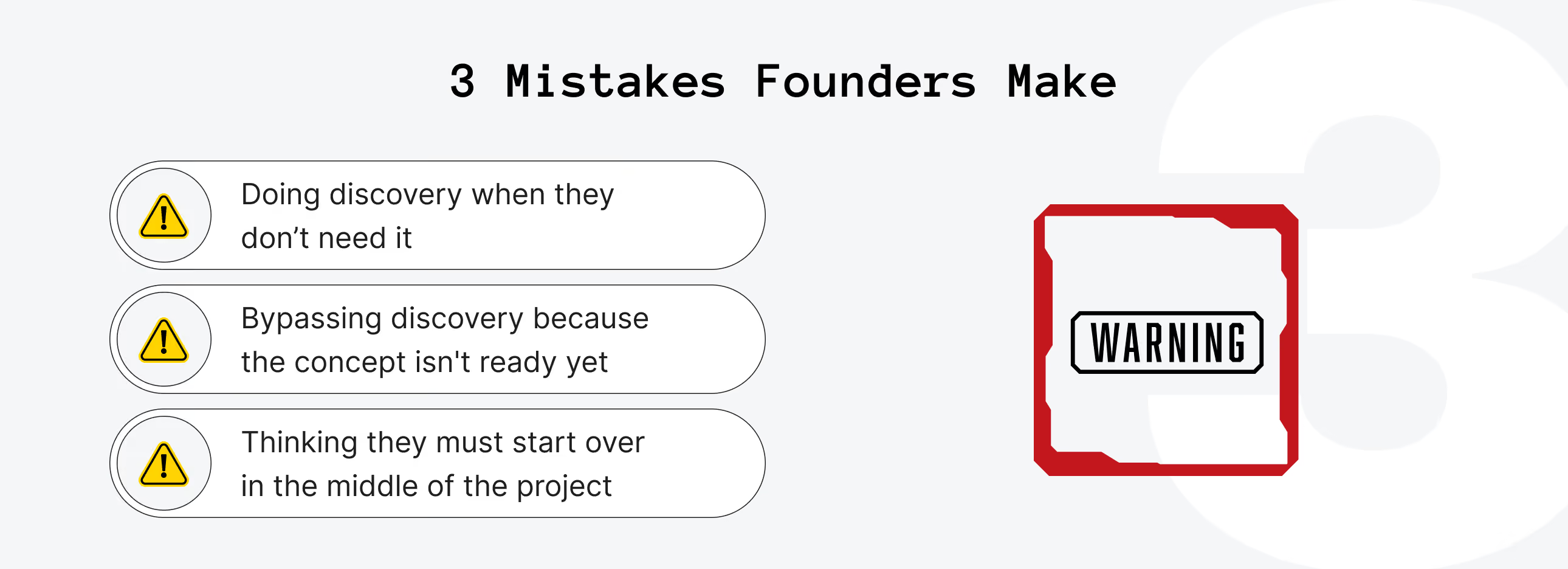
Mistake 1: Treating Discovery as Always Mandatory
The first mistake is treating the discovery phase as mandatory regardless of how validated the idea already is. A founder who has run several rounds of user interviews, built a waitlist, and can describe the technical build in a single clear paragraph does not need to pay $6,000 and wait two weeks just to hear their own plan repeated back with better formatting. That discovery phase produces a real, professional-looking deliverable, but it isn’t a deliverable that the founder was missing, and the two weeks it costs is time an already validated idea didn’t need to spend.
Mistake 2: Skipping Discovery When the Idea Is Still Fuzzy
The second mistake is more common and considerably more expensive: skipping discovery precisely because two weeks feels like a delay when the idea is still fuzzy. This is the founder who wants to see something built immediately, so scoping happens informally, in Slack messages and half finished specs, instead of working through a project planning phase checklist before development starts. Three or four weeks into the sprint, the technical architecture stops fitting a requirement the founder never surfaced, and the team spends the next stretch rebuilding instead of building.
A scheduling app that turns out to need multi-timezone support because half the target users are distributed teams is a classic version of this. The founder never asked the question before the calendar logic was written around a single timezone, so they end up paying a 30–50% rework premium in real sprint hours instead of as an abstract risk on a slide.
Mistake 3: Assuming “We Have to Start Over” Mid-Project
The third mistake often appears in the middle of a project: you realize discovery should have happened earlier and assume that starting from scratch is the only way to fix things. In most cases, that is not true. A short, focused scoping pass that zeroes in on the specific part of the build now in question, rather than the entire product, can bring the project back on track without discarding solid work. The goal is not to redo discovery from the beginning after the fact, but to pinpoint where the original assumptions failed and re-scope only that area before writing more code against it.
The Root Cause Behind These Mistakes
All three mistakes trace back to the same root cause: treating discovery as a binary, always required or always skippable, instead of matching it to the specific idea and level of validation in front of you. A validated idea doesn’t need a full discovery phase to prove what the founder already knows. An unvalidated one doesn’t get any cheaper to scope by delaying the hard questions until code is already written around the wrong assumptions.
The two failure modes look nothing alike from the outside: one wastes two weeks and $6,000, the other wastes months and tens of thousands. Both, however, come from skipping the same five-minute gut check that any sensible decision framework for discovery vs MVP is built to force.


How to Decide: A Practical Checklist Before You Commit
When deciding on an MVP vs discovery phase, none of the criteria above require a consultant to evaluate. They are questions you can answer in 5 minutes, and the answers point clearly to one path or the other far more often than founders expect going in. Answer “yes” or “no” to each of these 5 questions before you choose.

1. Have you talked to at least a handful of target users about this specific problem, not only the general space it sits in?
2. Does your product involve integrations, compliance requirements, or technical decisions your current team can't confidently make alone?
3. Do your co-founders, or your investors, currently share the same picture of what "finished" looks like for version one?
4. Can you describe your core feature set in two or three sentences without qualifying half of it with "maybe" or "we'll figure that out"?
5. Is your runway tight enough that a 2 to 4 week, $6,000 to $15,000 scoping engagement would meaningfully change your risk if the answers above lean toward "no"?
How to interpret the answers
Mostly “yes” on questions 1, 3, and 4, and mostly “no” on question 2: you’re validated and aligned enough to start an MVP build directly, especially if your tech stack and integrations are straightforward. In this situation, over-investing in discovery can slow you down without materially improving your chances of building the right thing first.
Mostly “no” on questions 1, 3, or 4, or a clear “yes” on question 2: run the discovery phase first. You’re either missing user insight, misaligned internally, or facing non-trivial technical risk, and those are exactly the situations where structured discovery prevents painful re-scoping mid-build.
Your answers land in the messy middle: treat this checklist as a dimmer, not a switch. You might not need a full-blown discovery phase, but you probably do need a short, focused scoping effort to clarify assumptions before you commit serious engineering time. The goal isn’t to follow a rigid process; it’s to invest just enough in discovery to make your MVP a deliberate experiment, not an expensive guess.
Looking for a reliable tech partner?
Upsilon can help you develop your solution that’ll grow to be a success!
Conclusion: Use Discovery and MVP as Two Sides of the Same Bet
Choosing between a discovery phase and an MVP is about deciding on how you want to spend your next unit of risk. Discovery reduces uncertainty on paper by aligning stakeholders, clarifying requirements, and de-risking architecture decisions before you start spending serious engineering time. An MVP reduces uncertainty in the real world by putting a focused version of your product in front of actual users and watching what they do instead of guessing what they might say.
For most early-stage teams, the best outcomes come from sequencing the two intelligently rather than arguing about which one is “better.” If your idea is still fuzzy, your stakeholders are misaligned, or your tech stack involves non-trivial integrations and compliance, a short, structured discovery phase is usually the cheapest place to learn. If you have real user insight, a clear v1 scope, and a straightforward technical path, going straight to an MVP build lets you convert that clarity into hard data and traction faster.
If you’re looking for a structured way to scope your idea before development, you can explore how Upsilon runs a project discovery phase as a standalone engagement that ends with a buildable roadmap, estimates, and architecture decisions you can use with any team. When you are confident you are ready to build, our MVP development services are designed to take that roadmap and turn it into a working product that tests your core assumptions in the market. And if you are still unsure whether your current situation calls for discovery, an MVP, or a mix of both, you can always contact us to walk through your answers to the checklist and get an honest recommendation tailored to your runway, risk, and stage.
FAQ
1. What is a discovery phase in software development?

A discovery phase is a scoped, paid engagement that turns a product idea into a buildable plan before development starts. It produces wireframes, a technical architecture decision, and a backlog broken into sprints. Nothing gets built during discovery itself. It's distinct from product discovery, the continuous user research a product team runs inside an agile process.
2. Do you need a discovery phase before building an MVP?
Whether you need a discovery phase for your software project depends on how validated your idea already is. If you have not talked to target users yet, your technical path still has major unknowns, or your co-founders do not share the same picture of what “done” means, you should run discovery first. If your idea is already validated and the build is technically straightforward, you can move directly into an MVP build and skip a separate discovery engagement.
3. How much does a discovery phase cost?
For most projects it takes 2 to 4 weeks and typically accounts for roughly 10 to 30% of a 20,000 to 65,000 dollar MVP build. Skipping discovery when the idea really needs it usually ends up costing more, because founders who bypass this step and then have to re-scope in the middle of development often spend 30 to 50% more than the discovery phase would have cost on its own.
4. What comes after the discovery phase in a project?
After discovery, the scoped backlog, wireframes, and technical architecture flow straight into MVP development sprints. There is no separate handoff or re-planning stage; the development team executes directly against the outputs of discovery.
5. Can discovery happen inside your MVP’s first sprint instead of a separate phase?
Yes, it can. Whether you build in-house or partner with a digital product studio, many teams fold a lightweight discovery workshop into the first MVP sprint when the idea is already validated and the technical path is clear. A separate, paid discovery phase makes more sense when there are still major unknowns to resolve, such as the core concept, the technical approach, or alignment among key stakeholders, and those questions need answers before development starts.



to top