Top 10 Web Application Development Companies (2026)


Hiring the wrong web application development company does not just cost money. It also burns precious months of runway while you wait for a custom web app that keeps missing deadlines and quietly expanding in scope. Many teams choose vendors based on glossy portfolios and ratings, only to end up with an overengineered product that is slow, confusing for users, expensive to maintain, and still fails to solve the core business problem it was meant to address.
This guide profiles the top custom web application development companies and explains what each one is genuinely best at, which tech stacks they use, and what engagement model they operate on. Each entry is based on an independent evaluation methodology that is outlined below, so you can see how the conclusions were reached.
The ten best web application development companies covered in this guide are Upsilon, Launch MVP Fast, Vention, Thoughtbot, WillowTree, Intellectsoft, DockYard, Brainhub, Sigma Software Group, and STX Next. Upsilon is included because it works well for a wide range of founders and product teams, whether you are commissioning a full, production-grade web application or a narrower MVP-stage build.
Key Takeaways:
- Choose a partner based on your product stage, not popularity. The best web application development company for an MVP is rarely the best fit for an enterprise scale platform.
- Look beyond portfolios and compare pricing, reviews, tech expertise, and engagement models. These factors reveal how well a company is likely to fit your project and budget.
- Fixed scope works best for well defined MVPs, while time and material suits evolving products. Choosing the wrong pricing model can quickly increase costs and delay delivery.
- Development costs vary widely depending on project complexity, team location, and long term support. Budget for both the initial build and ongoing maintenance when comparing vendors.
- The right development partner should align with your goals, technology needs, and growth plans. Checking independent reviews, post launch support, and long term scalability helps avoid expensive mistakes.
How We Evaluated Companies in the List
We looked at these top web application development companies the same way a practical founder would: by checking what they show publicly and how well that lines up with real-world needs. We reviewed their sites, portfolios, pricing pages, case studies, and ratings on major review platforms as of July 2026, and skipped any numbers that could not be backed up outside their own marketing.
Below is a concise view of the main criteria and how they influenced the rankings:
This is a curated comparison, not a lab test. We did not hire all ten companies, just like other big public rankings do not either. When something looked vague or unverified, we focused on what we could see clearly: their specialization, typical clients, and what engagement models they offer.
Top Web Application Development Companies in 2026: Expert Selection
The top web application development companies below represent different approaches to web app development. Some prioritize scale and enterprise clients, while others gear their processes toward early-stage with tighter constraints.
In the sections that follow, we’ll dive deeper into every company on this list, covering their strengths, typical projects, and what kind of collaboration you can realistically expect.
1. Upsilon: Best for Startups Building a Full Production Web App
Upsilon is a digital product studio that combines building its own B2B SaaS products with acting as a tech partner for early-stage startups and scaleups. Headquartered in the USA with a remote-by-design team of 50+ specialists, Upsilon is set up to handle both full, production-grade web applications and focused MVP-stage builds using Python, JavaScript, and modern web frameworks.
Engagements typically follow a sprint-based, fixed-scope structure designed to give founders clarity on timelines and deliverables while still allowing for iteration. The team can be quickly organized into dedicated squads for web development, UX/UI, DevOps, QA, and data/AI work, which makes Upsilon more flexible than many single-stack studios that focus only on one phase of the product lifecycle. For founders, this translates into the option to start with an MVP and grow into a mature product without switching vendors midway.
Best for: Startups and scaleups that need a partner for both MVP-stage development and a full production web application, with room to grow into team augmentation later
Pricing: From $20,000, sprint-based, 2-week billing blocks
Key strengths:
- Ability to support the full lifecycle from discovery and MVP to scaling and team extension within one organization.
- Trial sprint guarantee: money back on the first 2-week sprint if you're not satisfied.
- Startup-focused processes geared toward validation, fundraising support, and measurable product outcomes rather than just code delivery.
Worth knowing: Upsilon's sweet spot is work with early stage and growth stage companies. A company that already has a large in house engineering organisation and wants to modernise a decade old legacy platform will likely find a better fit with providers further down this list.
2. Launch MVP Fast: Best for Non-Technical Founders on a Fixed Budget
Launch MVP Fast is built around a simple promise for non-technical founders: get an MVP for your web or mobile product at a fixed price, with a clear scope and timeline from the very beginning. This top web application development company offers instant online estimates without requiring a sales call, which removes a common friction point in early vendor conversations and gives founders more control over budgeting. Its process is structured around discovery, design, development, testing, and launch, with a strong emphasis on keeping the MVP focused on core value rather than expanding into nonessential features.
Engagements follow a fixed-price model that typically delivers a functional MVP in 3–4 weeks, making Launch MVP Fast much faster than most general web application agencies that work on open-ended, time-and-material projects. That speed is supported by AI-assisted development and repeatable workflows rather than ad hoc builds, which is useful for founders who need to validate a hypothesis quickly and keep the runway intact.
Best for: Non-technical founders who need a fixed-price, tightly scoped MVP web application to validate an idea quickly
Pricing: Fixed price, quoted through an online estimate tool
Key strengths:
- A scoped price is available without a sales conversation.
- Full code ownership transfers on delivery, so there is no ongoing dependency on the vendor.
- A 30-day warranty applies to the delivered build.
Worth knowing: Fixed scope really does mean fixed scope. If your requirements are still changing, a time and materials engagement is likely to fit better than a fixed price project.


3. Vention: Best for Enterprise-Scale Engineering Capacity
Vention builds dedicated engineering teams for fintech and healthtech companies that need to move quickly without hiring a full in-house department. This top web application development company operates from a New York hub with delivery centers across Latin America and Eastern Europe, which gives clients broader time zone coverage than a single region provider.
Engagements follow a time and material, dedicated team model, and Vention leans toward long term relationships rather than short one off projects. Several of its public case studies describe multi year partnerships instead of fixed scope builds, and this pattern is reflected in the type of clients it highlights, established fintech and healthtech companies that are scaling an existing platform rather than founders shipping a first version.
Best for: Fintech and healthtech companies that need a dedicated engineering team for an extended build
Pricing: Time and material, dedicated team, custom quote
Key strengths:
- Strong experience with compliance requirements in regulated industries.
- Delivery centers in multiple regions provide broader time zone coverage than most single country agencies.
- Optimized for long term engagement rather than a single fixed scope project.
Worth knowing: This long term, dedicated team approach is not ideal for a founder who needs a fixed price, fixed timeline first build. Vention is a better fit once you already have traction and a clear multi year roadmap.
4. Thoughtbot: Best for Early Product Validation
Thoughtbot has operated since 2003 out of Boston, with a long track record in Ruby on Rails and React product design and development. This web application development company in USA is well known in the developer community for its open source contributions to the Rails ecosystem, which signals depth in that stack rather than simple familiarity with it.
Thoughtbot pairs designers and engineers on the same team from the outset. This setup suits founders who want product strategy integrated into the build, instead of being handed a spec and asked to execute it in isolation.
Best for: Founders who need product design and engineering combined in one team, especially on Rails or React
Pricing: Time and material, structured on a project basis
Key strengths:
- Design and engineering embedded in the same team from kickoff.
- Deep, long standing Ruby on Rails expertise, supported by open source work.
- Comfortable working with an unscoped or partially scoped product concept.
Worth knowing: Thoughtbot’s rates tend to sit at the higher end of the market for a United States based consultancy. Founders on a tight budget are likely to find more runway per dollar with a team based in Eastern Europe.
5. SumatoSoft: Best for AI-Ready Web Apps and IoT-Connected Platforms
SumatoSoft is a Boston-headquartered custom software company with a development center in Warsaw, Poland, and 14 years on the market. Its 51-99 person team, 70% of them senior engineers, builds enterprise web apps, SaaS products, and IoT dashboards for clients such as Toyota, Beiersdorf, and World Bank Group, with backends ready for AI features.
Engagements cover R&D, UX/UI, development, QA, and a post-launch warranty. When AI is in scope, SumatoSoft's agentic development lifecycle (ADLC) builds in evaluation, guardrails, and monitoring from the start. Its custom ERP/CRM for a Toyota and Lexus dealer network cut sales cycles by 30% across 20 dealer centers.
Best for: Companies building or modernizing a production web app that must be AI-ready or connected to IoT devices
Pricing: $50-99/hr, $25,000+ minimum project size; outsourcing, outstaffing, or dedicated team
Key strengths:
- Web, AI, and IoT engineering in one team, from device firmware to the web app on top.
- ISO 27001-aligned delivery with role-based access and support for GDPR and HIPAA requirements.
- Rated 4.8 on Clutch and 5.0 on GoodFirms, with a 98% client satisfaction rate.
Worth knowing: The discovery-first process and $25,000 minimum suit production builds and modernization. A founder who only needs a quick, throwaway prototype will likely pay less with a fixed-price MVP studio.
Looking for a reliable tech partner?
Upsilon can help you develop your product that'll grow to be a success!

6. Intellectsoft: Best for Complex IoT- or AI-Integrated Apps
Intellectsoft has run digital transformation projects since 2007, with a focus on IoT, blockchain, and AI integrated enterprise software. The company publicly highlights work with large industrial and automotive clients, which suggests a strong comfort level with complex system integrations rather than simple CRUD applications. That background brings governance overhead such as extra sign offs and more formal change control, which large organizations expect and most early stage teams do not need yet. If you are considering them, ask for a specific IoT or hardware integration case study instead of a general capabilities overview. The phrase “digital transformation” can describe anything from a sensor dashboard to a full supply chain rebuild, and those projects require very different teams.
Best for: Enterprises building a web application that connects to hardware, sensors, or complex third party systems
Pricing: Dedicated team, time and material, custom quote
Key strengths:
- Experience integrating web applications with IoT and hardware systems.
- Enterprise grade project governance for multi stakeholder builds.
- Track record with large industrial and automotive clients.
Worth knowing: This level of enterprise integration expertise is often unnecessary and potentially overpriced for a founder building a standard SaaS product without hardware or IoT components.
7. DockYard: Best for Product-Strategy-Led Rebuilds
DockYard, based in Boston, has carved out a niche around Elixir and Phoenix on the backend paired with React on the front end, a stack chosen for real time features and high concurrency. This web application development company in USA presents itself as product strategy first and engineering second, which fits teams that are rebuilding an existing product rather than starting from scratch. Founders typically come to DockYard with a product that has outgrown its original architecture instead of a blank whiteboard.
Best for: Teams rebuilding an existing web application that needs real time features or high concurrency
Pricing: Time and material, project based
Key strengths:
- Deep experience with Elixir and Phoenix, a less common but strong choice for real time, high concurrency applications.
- Product strategy work included before engineering begins.
- Comfortable handling complex rebuilds, not only new greenfield builds.
Worth knowing: The Elixir focus is a strength if your team can maintain that stack over the long term, but it can become a limitation if you later need to hire engineers from a broader, more common talent pool such as JavaScript or Python.
8. Brainhub: Best for JavaScript Heavy Scale-Ups
Brainhub, based in Wroclaw, Poland, focuses on JavaScript and React engineering for scale up companies that already have a working product and need frontend depth to keep up with growth. The company works on a dedicated team model similar to Vention’s, with Eastern European rates. It operates more as an augmentation partner than a full service agency, joining teams that already have a backend and a clear product direction and providing frontend engineers who can move quickly inside the existing codebase.
Best for: Scale ups with an existing product that need dedicated frontend engineering capacity
Pricing: Dedicated team, billed on a time and material basis
Key strengths:
- Deep, focused JavaScript and React specialization rather than a broad generalist offering.
- Eastern European rates, typically between 35 and 75 dollars per hour, significantly below many United States agency prices.
- Well suited to augmenting an existing team rather than starting from zero.
Worth knowing: The strong frontend focus usually means less in house depth on backend architecture or infrastructure. If backend work is a core part of your roadmap, confirm how that will be covered before you sign.

9. Sigma Software Group: Best for Multi-Country Engineering Capacity
Sigma Software Group runs one of the larger engineering workforces on this list, with delivery centers across Eastern Europe and clients in sectors such as aviation, gaming, and automotive software. The company's scale makes it a better fit for builds that need many engineers working in parallel rather than a lean two person sprint team. That same scale also tends to come with a more layered account structure, where dedicated project managers and delivery leads sit between you and the engineers who write the code. As a founder evaluating Sigma, it is worth asking directly how many engineers will work in the codebase day to day, because a large bench can either mean deep specialist coverage or a rotating group that never fully learns the product, depending on how the account is staffed.
Best for: Large builds that need many engineers working in parallel across multiple specializations
Pricing: Dedicated team, custom quote
Key strengths:
- Engineering capacity at a scale most boutique agencies cannot match.
- Sector depth in aviation, gaming, and automotive, including experience with unusual compliance and performance requirements.
- Multi country delivery that reduces dependency on a single location.
Worth knowing: That scale is likely to be wasted, and more expensive than necessary, on a lean MVP that needs one focused team rather than a large multi team engagement.
10. SDLC CORP: Best for Scalable Web Apps with AI and Enterprise Integrations
SDLC CORP is a web application development company founded in 2015 that builds custom web apps, SaaS platforms, enterprise portals, dashboards, and workflow-driven business systems. Its teams work across frontend, backend, cloud, APIs, databases, and AI integrations, supporting businesses from initial planning through development, deployment, and ongoing modernization.
The company works with technologies such as React, Node.js, TypeScript, Python, PostgreSQL, MongoDB, AWS, and other modern cloud and web technologies. Its broader software and AI capabilities make it a good fit for projects where a web application needs to connect with existing enterprise systems, third-party APIs, automation tools, or AI-driven functionality.
Best for: Startups and enterprises building scalable SaaS products, custom web applications, or enterprise platforms that require integrations, AI capabilities, or long-term product development.
Pricing: $25–$49/hr; $10,000+ minimum project size on Clutch.
Key strengths:
- Full-cycle web application development covering frontend, backend, cloud infrastructure, APIs, QA, deployment, and modernization.
- Strong capability in SaaS platforms, enterprise portals, dashboards, and custom workflow-based applications.
- Broader AI and software engineering expertise for businesses that need intelligent features or integrations beyond standard web development.
Worth knowing: SDLC CORP has a broad technology and service offering, which suits multi-disciplinary or evolving projects. Companies seeking a highly specialized single-stack boutique may prefer a narrower development partner.
Web Application Development vs. MVP Development: Which Do You Need?
An MVP development company builds one thing: the smallest working version of your product that tests a single core assumption. A web application development company is the broader category. It includes MVP-stage work, but also covers full-scale rebuilds, enterprise platforms, and the post-launch scaling work that comes after an MVP proves itself.
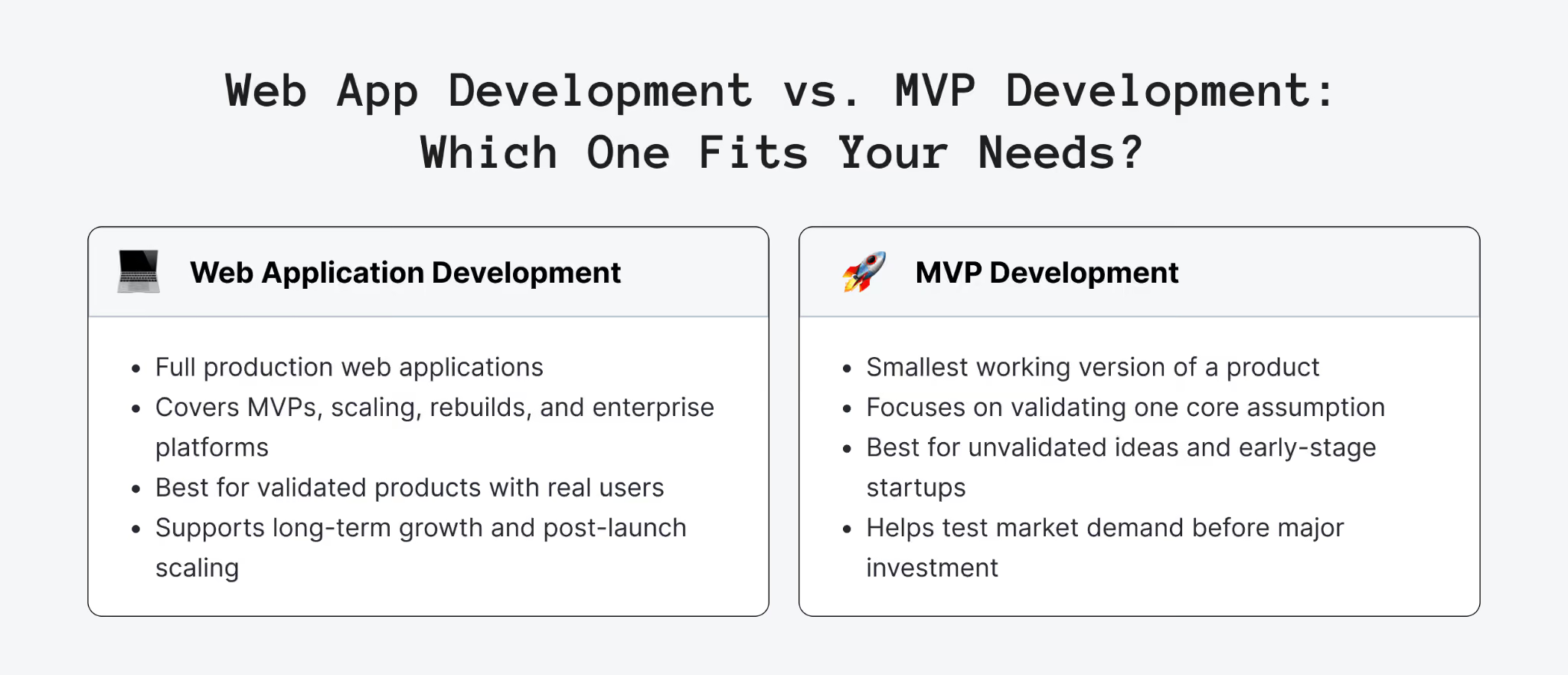
The distinction matters because the wrong choice wastes the budget in both directions. Hiring an enterprise-focused shop like WillowTree or Sigma Software Group for a first, unvalidated product means paying for governance and scale you don't need yet. Hiring a narrow MVP specialist for a large, already-validated rebuild means outgrowing the partner within months.
CB Insights found that 42% of startup failures trace back to building something the market didn't need, the single largest cause of failure. That's exactly the risk an MVP-stage engagement is built to reduce: a smaller, faster, cheaper build that tests demand before you commit to a full production system.
Consider two founders who both land on this page after searching for a web application development company. The first has an idea validated only by conversations with a handful of prospective customers and no working product yet. The second already has a live product, real usage data, and a specific feature backlog that's outgrown a two-person contractor team. Both need "a web application development company." Neither needs the same one. The first founder overpays and over-scopes by hiring WillowTree or Sigma Software Group before validating demand. The second founder stalls out by hiring a narrow MVP shop that isn't built to manage a larger, multi-engineer build.


How Much Do Tech Companies Charge for Web Application Development?
Pricing for web application development services usually follows two main models: sprint-based fixed scope and time and material dedicated teams. Most offers then fall into a few typical ranges, depending on the type of project and the location of the development team.
Fixed Scope vs Time and Material
The principle behind these two pricing models is clear from their names. Fixed scope pricing tells you the total cost before work starts, and that cost does not change during product development phases. Time and material pricing bills for the actual hours worked, which gives the project more flexibility but makes the final startup budget less certain.
Neither model wins by default. Fixed scope protects a founder who needs budget certainty and has a clear, stable set of requirements, which is why Upsilon and Launch MVP Fast both default to it for first builds. Time and material protects a team whose requirements are likely to shift mid-build, which is common once a product has real users generating feedback. The mistake founders make most often is picking time and material for a first build with no prior usage data to react to, then watching the hours accumulate against requirements that keep changing because nothing was locked down at the start.
What “Affordable” Really Means
Most searches for affordable web application development companies are asking a narrower question: which of these will hit my budget without cutting corners on the parts that break in production, like authentication, payments, and data handling. A lower rate that skips QA or post-launch support moves the cost to later: downtime, bugs, and a rebuild you end up paying for twice.
A lean, single-workflow web application costs $20,000 to $65,000 on a fixed-scope model. A standard build with several features and a custom interface runs $30,000 to $65,000. Enterprise-scale builds with compliance requirements, multi-role access, or heavy third-party integrations run $100,000 and up, often with no published ceiling.
Location, Rates, and Fit
Many searches for this topic add a location qualifier: web application development USA, or more narrowly, best web development company USA. Neither qualifier is a reliable filter by itself. WillowTree and Thoughtbot are both US-based and serve very different clients at very different price points. Upsilon, Vention, and most of the Eastern European teams on this list serve US clients every day without a US office. A company's location signals its rate card, not the quality of its work.
The gap between a US agency and an Eastern European team is real: at $150/hr versus $50/hr, a 2,000-hour project costs $300,000 on one side and $100,000 on the other, for comparable engineering output. That difference compounds fast across a 3-month build, which is why most of the companies on this list, including Upsilon, Brainhub, Sigma Software Group, and STX Next, deliver from Eastern European hubs.
The Hidden Year-One Cost
The number on the contract is rarely the number you pay in year one. Budget 15 to 20% of your initial build cost annually for post-launch maintenance: hosting, dependency updates, security patches, and the bug fixes that only surface once real users touch the product. A $40,000 build costs roughly $6,000 to $8,000 a year to keep running before you add a single new feature. None of the companies on this list volunteer that number upfront. Ask for it before you sign, and treat any company that cannot give you a range as one that has not maintained many production applications past launch day.
How to Choose the Right Web Application Development Partner
Every company on this list will tell you it's the right fit. Six checks separate a good decision from an expensive mistake.
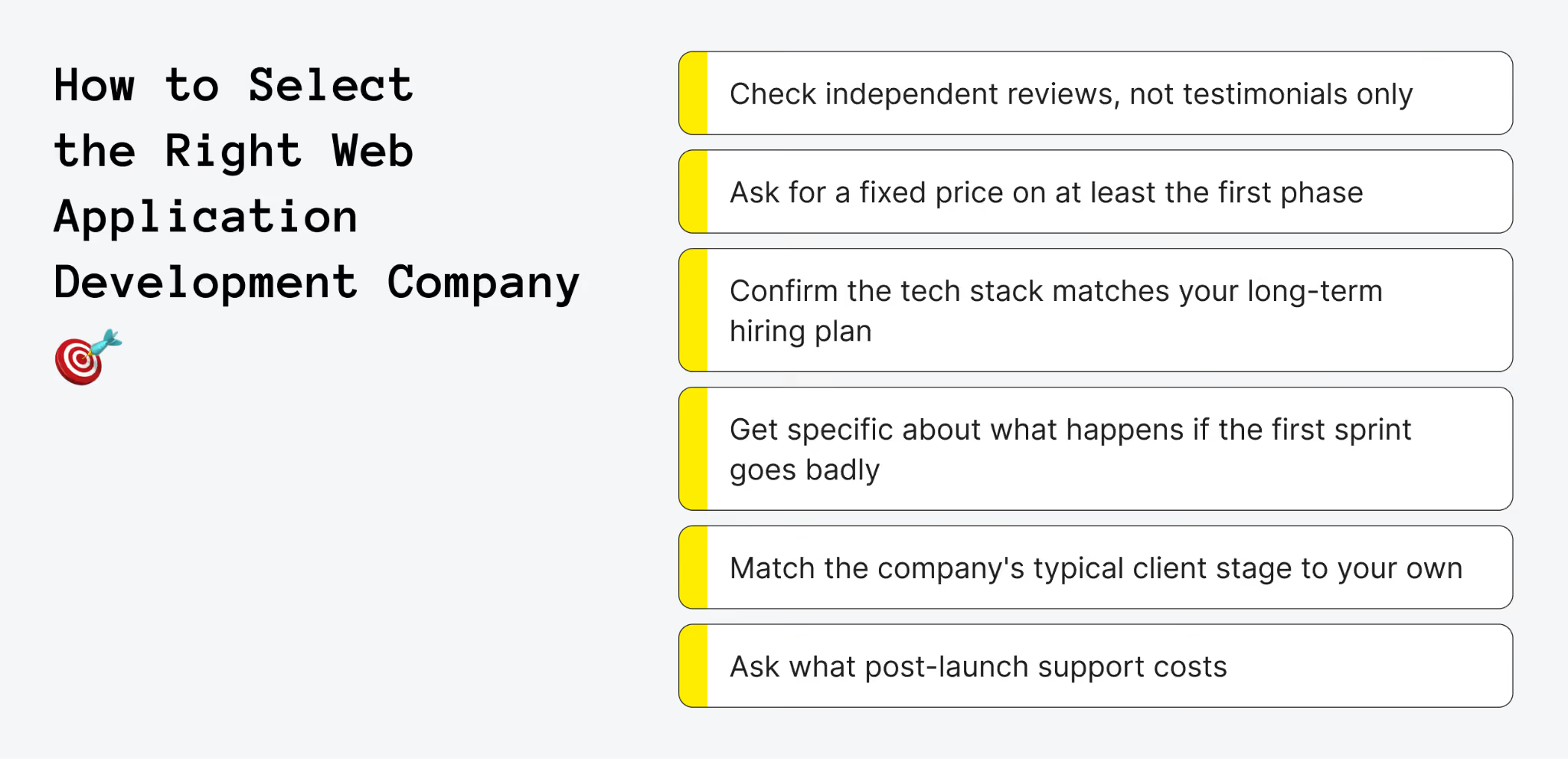
1. Check Independent Reviews, Not Testimonials Only
A company's own site only shows the feedback it chooses to publish. Clutch and GoodFirms verify reviewers and show unfiltered ratings, which is why Upsilon and Launch MVP Fast link to both rather than curated quotes.
2. Ask for a Fixed Price on at Least the First Phase
An open-ended time-and-material quote with no phase-one number attached is a red flag. Even dedicated-team engagements should scope and price the first sprint or month before you commit further.
3. Confirm the Tech Stack Matches Your Long-Term Hiring Plan
A specialized stack like Elixir or a niche framework can be a strength during the build and a liability when you need to hire in-house later. Ask how many engineers in your target hiring market know the proposed stack.
4. Get Specific About What Happens If the First Sprint Goes Badly
Upsilon's trial sprint guarantee, money back if you're not satisfied after the first 2 weeks, exists because this question matters. A company with no answer to it is asking you to take on all the risk.
5. Match the Company's Typical Client Stage to Your Own
An enterprise-focused shop and a startup-focused one solve different problems, even when both call themselves a "web application development company." The best-for column in the comparison table above is a faster filter than reading every case study on every site. Searching for the best web application development company for small business usually means a lean budget and one core workflow, not enterprise governance, a different buyer than a Fortune 500 digital transformation team, even when both end up on the same sales call.
6. Ask What Post-Launch Support Costs
A quote that only covers the initial build hides the real first-year cost of the product. Get the maintenance rate, the response time for critical bugs, and whether the same team that built the product supports it afterward, before you compare the sticker price on two competing quotes.
Need a hand with your product idea?
Upsilon was once a startup too, so we can help build and scale your product!
Conclusion
Building a custom web application is no longer just a technical project; it is a runway decision. At its core, you avoid wasted budget and slow launches by matching the best web application development company to your stage, risk profile, and product goals, rather than choosing from a generic top ten list. Once you are clear on whether you need MVP validation or a production rebuild, which engagement model fits your level of certainty, and how each company actually works with clients, selecting a partner becomes a structured decision instead of a guess.
The top web application development companies in this guide are strong options for different situations, not a single universal winner. You can think about them in three categories:
- If you need a focused MVP with budget certainty, a fixed scope partner like Upsilon or Launch MVP Fast is a better fit than a large enterprise consultancy.
- If you are scaling an existing solution or planning a comprehensive platform rebuild, dedicated team providers such as Vention, Brainhub, Sigma Software Group, or STX Next make more sense, especially when you can balance Eastern European rates against US-level expectations.
- If you need an enterprise-grade solution with strong governance and complex integrations, firms like WillowTree, Thoughtbot, Intellectsoft, and DockYard are built for that environment rather than for lean, early-stage launches.
If you are planning a custom web application and want help choosing the right approach for your stage, you can reach out to Upsilon for a practical, no fluff conversation about scope, budget, and timelines. Share a few details about your product and goals on the contact page, and the team will suggest a path that fits your runway and next milestones.



FAQs
How much does web application development cost?

A custom web application costs $20,000 to $150,000, depending on scope, team location, and complexity. A lean single-workflow app runs $20,000 to $65,000 on a sprint-based contract. Enterprise-scale rebuilds with compliance requirements or multi-role platforms run $100,000 and up. Hourly rates range from $35 to $75 per hour for Eastern European teams and $100 to $200 per hour for US-based agencies, for comparable output.
What’s the difference between an MVP development company and a web application development company?
An MVP development company specializes in the first, scoped-down version of a product, built to test one core assumption fast. A web application development company is the broader category: it includes MVP builds, but also covers full-scale rebuilds, enterprise platforms, and post-launch scaling. If you have a validated idea and need your first working product, choose an MVP-focused partner. If you already have a product and need a larger build, look at the wider web application development market instead.
How do I choose a web application development company?
Start with your product stage, not the vendor's marketing. Confirm the team has shipped something comparable to what you're building, check independent reviews on Clutch or GoodFirms rather than site testimonials, and get a fixed price on at least the first phase before signing anything open-ended. Ask what happens if the first sprint goes badly. A company with a clear answer to that question is more trustworthy than one that promises a flawless build.
Is it better to hire a US-based or offshore web application development company?
Neither is automatically better. A US-based team costs $100 to $200 per hour and offers same-timezone communication, which matters for fast-moving, high-touch projects. An Eastern European team costs $35 to $75 per hour for comparable engineering quality, with a 4 to 5 hour overlap with US East Coast hours, enough for daily standups. For most early-stage founders, the cost difference (often 2 to 3x) buys more runway than the marginal communication convenience of a same-timezone team.
How long does it take to build a custom web application?
A lean, single-workflow web app takes 4 to 8 weeks. A standard build with several features and a custom interface takes 3 to 4 months. A complex, multi-role platform with compliance requirements takes 4 to 8 months or longer. Upsilon's average time from signed contract to production deployment is 3 months, which is also where most standard-scope web application builds land.
to top