Top Mobile App Development Companies for Startups in 2026


Users don't just prefer mobile apps, they live in them. On average, people spend 6 hours 54 minutes a day inside apps, and smartphones now account for over 60% of all global web traffic. When someone discovers a new product, checks out a service, or decides whether to trust a brand, they almost always do it on their phone.
That's a real opportunity for young businesses. A well-built mobile app gives you something most early-stage companies struggle to get: a direct, repeatable channel to your users. No algorithm to fight, no middleman, no inbox competing for attention. Just your product, in someone's hand, every single day. Done right, mobile app development for startups is how you get your first loyal users, collect meaningful data, and build the kind of traction that gets investors interested.
But building a great mobile product is harder than it looks, especially when you're managing a tight budget, a shifting roadmap, and the pressure to launch before your runway runs out. The wrong product development partner for startups can cost you months. The right one can help you ship a focused MVP, learn fast, and iterate without starting from scratch every time something changes.
In this article, we put together a list of mobile app development companies that actually get what it means to work with growing businesses. Not the biggest names, not the flashiest portfolios, just teams with the experience, process, and mindset to help early-stage products get off the ground and grow.
How We Evaluated Startup‑Friendly Mobile App Development Companies
Not every great development agency is a great fit for a startup. A company can have an impressive portfolio of clients, years of experience, and a polished website, and still be the wrong choice for an early-stage team that needs to move fast, stay lean, and change direction without it costing a fortune. So, when preparing this mobile app development companies list, we asked one question above all else: would a first-time founder with six months of runway feel comfortable handing this project to these people?
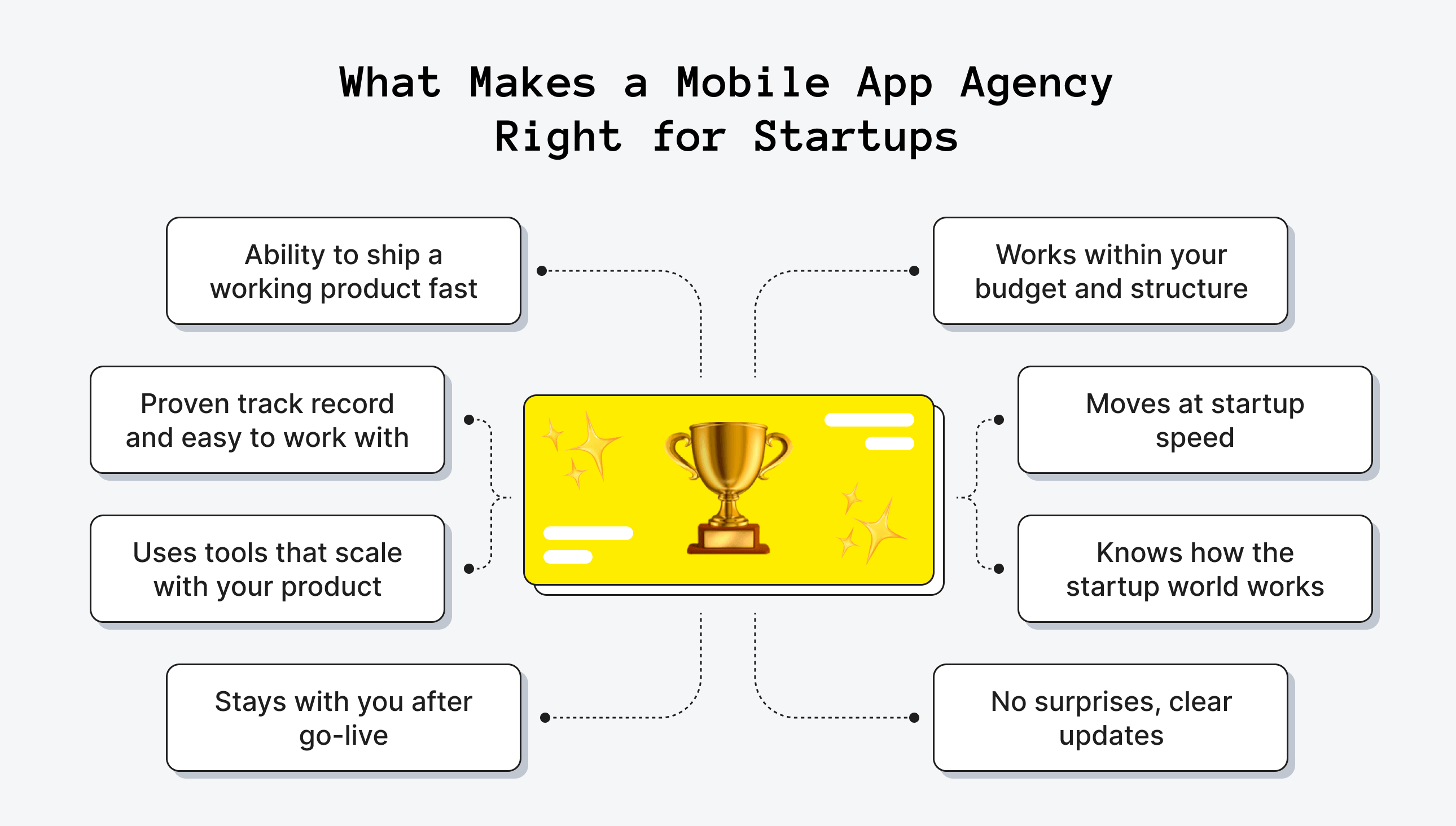
Here's what actually went into our evaluation:
Focus on MVP Development
There's a big difference between a company that has built MVPs and one that genuinely knows how to scope them. We looked for teams that can push back on unnecessary features, ask the right questions early, and get something real in front of users without turning it into a six-month project. Speed matters, but so does building the right thing.
Flexible Engagement Models
Fixed-price contracts sound safe until the product direction shifts after the first user interviews, which it almost always does. We favored companies that work on a time-and-material or dedicated team basis, giving founders actual visibility into what's being built and the freedom to adjust as they learn.
Understanding of Tough Startup Timelines
Launch commitments, fundraising deadlines, runway pressure: these aren't abstract concepts for early-stage teams, they're the reality of every sprint. The top mobile app development companies for startups on this list get that. They know how to flag risks early, have honest conversations about what's feasible, and don't disappear when things get tight.
Experience with Investor-Backed Startups
Working with VC-backed companies is its own skill set. There are board updates, due diligence requests, growth expectations baked into the roadmap. Teams that have been through this before know how to build in a way that holds up to scrutiny: technically and strategically.
Transparent Process and Communication
A founder shouldn't have to chase their development team for updates. We looked for companies that run structured sprints, share progress regularly, and make it easy to stay in the loop, whether you're in the same timezone or six hours apart.
Post-Launch Support
Launch day is not the finish line. The best development partners stay engaged after shipping to help squash bugs, respond to user feedback, and build out the next iteration without having to onboard a whole new team from scratch.
Relevant Tech Stack
We paid attention to what companies actually build with, not just what they list on their website. Flutter, React Native, Swift, Kotlin — the right choice depends on the product, the team, and where the startup is headed. We looked for companies that make deliberate tech decisions and can explain the tradeoffs clearly, rather than defaulting to whatever they're most comfortable with. Bonus points for teams that stay current with how AI is being integrated into mobile products, because that's quickly becoming a baseline expectation.
Social Proof, Transparency, and Cultural Fit
Reviews on Clutch and G2 tell part of the story, but we also looked at how companies talk about their work publicly: case studies with real numbers, honest post-mortems, founders willing to go on record. And beyond credentials, we considered whether these teams feel like people a startup founder would actually want to work with. The best engagements don't feel like vendor relationships, they feel like a shared bet on the same outcome. That's hard to fake, and it shows up pretty quickly when you dig past the sales deck.
Every company on this list checks all these boxes: they're comfortable with uncertainty, know how to move fast, stick around after launch, and talk to founders the way founders think. In terms of metrics, experiments, and runway, not just task estimates and billing hours.
Looking for a reliable tech partner?
Upsilon can help you develop your mobile app that’ll grow to be a success!

Comparison Table: Top Startup Mobile App Development Companies at a Glance
Choosing a development partner is easier when you can compare the basics side by side. The table below gives you a quick snapshot of each company, such as team size, rates, what they're best at, and how clients rate them. Use it as a starting point, then dig deeper into the agencies that match your stage and budget.
Every company in this table has a different sweet spot. Some are built for speed and lean budgets, others for design quality or technical complexity. The right choice depends on where your startup is today: how much runway you have, how defined your product is, and how much you expect the scope to evolve. The next section breaks down each top mobile app development company for startups in detail so you can make that call with confidence.
Best Mobile App Development Companies for Startups in 2026
After looking at dozens of agencies, these are the ones that stood out. Not because they have the biggest teams or the longest client lists, but because they know how to work with startups: tight timelines, evolving requirements, and the constant need to balance speed with quality. Here's a closer look at each one:
Upsilon
- Year founded: 2012
- Team size: 60+
- Hourly rate: $25–$49
- Client rating: 5.0
- Services: Mobile app development, MVP development, custom software development, UI/UX design, product discovery
Upsilon is a mobile app development company for startups that takes products from the first hypothesis and app idea all the way to a scalable solution with growing metrics. For over 10 years, the team has been helping early-stage and growth-stage startups ship web and mobile products, get through accelerators, raise rounds, and keep the product stable when real growth kicks in. The focus is on fast but thoughtful MVPs, cross-platform mobile development, and ongoing product evolution, from discovery and design through to DevOps, support, and data-driven iteration.
Key Strengths
- Strong MVP and Startup Focus: Upsilon openly positions itself as a partner for startups and scaleups. The team is used to working with uncertainty, tight deadlines, and the pressure of an upcoming investor demo. They don't treat it as an edge case. It's just how they operate.
- Fast Mobile MVP Delivery: Based on the company's case studies, working MVPs usually reach the market in around three months, with clear feature prioritization and staged hypothesis testing. Not a big-bang release six months down the line. That matters a lot for teams with limited runway who can't afford long development cycles.
- Full-Cycle Mobile Development: Upsilon covers the entire journey: business and product discovery, mobile UX/UI design, backend and frontend development, integrations, QA, and post-launch support. Founders don't have to coordinate multiple vendors or worry about handoffs. One team takes it from idea to live product.
- Startup-Friendly Processes and Flexibility: The team works across flexible engagement models: fixed-scope MVP packages, long-term dedicated teams for product growth, and the option to start with a discovery sprint or a small pilot. Processes are built around transparency: regular demos, predictable iterations, and communication grounded in metrics and business goals rather than just hours and tasks.
- Product Thinking alongside Mobile Expertise: Beyond development, Upsilon helps founders build out roadmaps, define the right metrics, and design experiments so the mobile app drives real business outcomes, not just a store listing. The emphasis on mobile UX performance helps startups turn early installs into retained, active users.
Best for: Young businesses that need an MVP development company for startups to launch a mobile MVP in a few months on a lean budget, then scale the app as metrics improve and funding rounds progress.
Goji Labs
- Year founded: 2014
- Team size: 50+
- Hourly rate: $100–$149
- Client rating: 5.0
- Services: Mobile app development, web app development, product strategy, UI/UX design, custom software development
Goji Labs is a Los Angeles-based startup mobile app development company specializing in native iOS (Swift), native Android (Kotlin), and cross-platform (React Native) mobile development. The team builds apps for emerging businesses, nonprofits, and Fortune 500 companies, focusing on products that launch quickly, scale reliably, and deliver measurable business results. Over 10+ years they have launched 400+ mobile and web products, earning top rankings on Clutch and DesignRush for mobile development.
Key Strengths
- Strong emphasis on research, product vision, and feature prioritization before development kicks off.
- Deep experience with React Native and native apps, built for stability and scalability from the ground up.
- A rich portfolio of startup and impact projects, including cases where clients went on to raise serious funding rounds.
- Transparent project management, regular demos, and a consistent focus on reducing product risk at every stage.
Best for: Startups that need a design- and product-centric partner to bring a polished mobile product to market without cutting corners on UX.
Appinventiv
- Year founded: 2014
- Team size: 1,000+
- Hourly rate: $25–$49
- Client rating: 4.6
- Services: Mobile app development, product consulting, web development, UI/UX design, digital transformation
Appinventiv is a top mobile app development company for startups that build native iOS, Android, Flutter, and React Native applications across 40+ countries. The company covers the full mobile development lifecycle, from product strategy and UX/UI design through to QA, launch, and post-release support, with deep expertise in AI/ML, IoT, and blockchain integrations. With 3,000+ apps shipped and consistent recognition from Clutch and GoodFirms, Appinventiv is one of the most established names in mobile development globally.
Key Strengths
- Strong enough to handle ambitious, complex builds, while maintaining specific programs and industry recognition for startup-focused work.
- Native and cross-platform apps, complex third-party integrations, and architecture designed to handle real traffic and high load from the start.
- Fintech, healthtech, eCommerce, and on-demand: the categories that attract venture capital and require more than just generic mobile expertise.
Best for: Startups that need a large, well-resourced technology partner to build an ambitious, technically complex mobile product and scale it as the business grows.
Cheesecake Labs
- Year founded: 2013
- Team size: 50+
- Hourly rate: $50–$99
- Client rating: 4.9
- Services: Mobile app development, web development, product design, AI & data solutions, blockchain & emerging tech
Cheesecake Labs is a software design and engineering company with over 10 years of experience and 300+ mobile apps built across iOS, Android, and React Native. The team specializes in full-cycle mobile development, including UI/UX design, frontend and backend engineering, QA, and DevOps, with additional capabilities in blockchain, AI, and IoT. Their mobile work spans both early-stage startups and Fortune 500 clients, with architecture built for performance and scalability from day one.
Key Strengths
- Strong UX/UI and product approach, enabling mobile apps to stay competitive in crowded niches.
- Experience working with both startups and enterprise clients, which helps build solutions with architectural and security headroom from the start.
- Willingness to work with emerging technologies, which is important for innovative startups in AI, Web3, and IoT.
Best for: Startups that want not just an MVP, but a visually strong and technologically advanced mobile product built for the competitive US market.
Cubix
- Year founded: 2008
- Team size: 250+
- Hourly rate: $25–$49
- Client rating: 4.8
- Services: Mobile app development, game development, enterprise software, web development, UI/UX design
Cubix is an international game and mobile app development company for startups known for building complex, technology-driven products. The team combines mobile development with gamification expertise and data-intensive backend engineering, a strong combination for products where user engagement is a core metric. Their competitive rates and broad technology stack make them a practical choice for startups that need more than a straightforward app build.
Key Strengths
- A combination of mobile development and game/gamification expertise: useful for startups building products with game mechanics or engagement-driven features.
- Experience with large and complex projects including integrations, backend architecture, and analytics solutions.
- Competitive hourly rate given the team size and the breadth of their technology stack.
- Long-standing market presence and strong ratings across industry platforms.
Best for: Startups building complex or gamified mobile applications that want to combine product development, backend, and game mechanics under one vendor.


Sphinx Solutions
- Year founded: 2010
- Team size: 50+
- Hourly rate: $25–$49
- Client rating: 4.9
- Services: Mobile app development, сustom software development, web development, blockchain development, UI/UX design
Sphinx Solutions is a New Jersey-based startup mobile app development company building iOS, Android, and cross-platform applications. It has a strong track record of top-ranked apps in the App Store and Google Play, with domain expertise in eCommerce, fintech, on-demand, and healthcare, categories where mobile is core to the business model. Their full-cycle offering and accessible rates make them a practical partner for new ventures that need a solid mobile product without an enterprise-level budget.
Key Strengths
- Solid background in mobile development and a track record of successful apps in the store.
- Experience in startup-relevant domains, such as eCommerce, on-demand, fintech, where a mobile app is critical to the business model.
- Competitive rates and full-cycle development, which matters for teams working with a limited budget.
Best for: Startups that need a reliable outsourcing partner from India to build a budget-friendly but feature-rich mobile application.
Fueled
- Year founded: 2007
- Team size: 250+
- Hourly rate: $150–$199
- Client rating: 4.9
- Services: Mobile app development, product strategy, web development, UI/UX design, digital product consulting
Fueled is a globally distributed product studio with 350 full-time engineers, designers, and strategists building mobile apps for high-growth startups and major brands including Microsoft, Disney, and Apple. The agency designs, engineers, and scales iOS and Android applications with a premium emphasis on interface quality, performance, and long-term user retention. For startups entering competitive consumer markets, Fueled brings both the product discipline and the design craft needed to stand out in a crowded app store.
Key Strengths
- A strong brand and portfolio of high-profile names, which helps startups strengthen product perception with investors and partners.
- High standard of design and attention to detail in mobile interfaces.
- Expertise in launching consumer-facing applications where store ratings and retention directly impact business outcomes.
- Deep product and growth focus, including post-launch analytics and product optimization.
Best for: Startups with a serious budget that want a premium mobile product and strong design capable of standing out in a competitive B2C market.
MindInventory
- Year founded: 2011
- Team size: 250+
- Hourly rate: $25–$49
- Client rating: 4.7
- Services: Mobile app development, web development, UI/UX design, startup consulting, enterprise solutions
MindInventory is a mobile app development company for startups that builds iOS, Android, and cross-platform mobile applications with a strong UX focus, covering everything from ideation and wireframing through to development, QA, and post-launch support. Their combination of startup mobile app development consulting and full-cycle mobile development makes them a solid choice for early-stage teams that need both strategic guidance and hands-on execution.
Key Strengths
- Extensive experience working specifically with startups and small businesses, including dedicated startup consulting.
- Strong competencies in mobile and web development, as well as UI/UX design.
- Flexible engagement models and accessible rates, which matters at the early stages.
- A large team that allows scaling resources as the product grows.
Best for: Startups that need an affordable but sufficiently large partner to develop a mobile and web product simultaneously.
Hyperlink InfoSystem
- Year founded: 2011
- Team size: 1,000+
- Hourly rate: $25–$49
- Client rating: 4.8
- Services: Mobile app development, web development, custom software development, CRM/ERP solutions, game development
Hyperlink InfoSystem is a multinational mobile app development company for startups headquartered in India, with offices in the US, UK, France, UAE, and Australia. The company has delivered 3,000+ mobile apps across iOS, Android, Flutter, and React Native, with expertise spanning AI, blockchain, AR/VR, IoT, and wearables. Their scale, broad technology coverage, and competitive rates make them a reliable long-term partner for startups that need a large, experienced vendor for both development and ongoing product scaling.
Key Strengths
- A very large team with the ability to scale resources quickly as the product grows.
- Extensive experience in mobile app development across different industries and markets.
- A large number of case studies and reviews confirming consistent quality and long-term client relationships.
Best for: Startups that need a large, time-tested vendor for mobile product development and subsequent scaling, with the potential for a long-term partnership.
TechAhead
- Year founded: 2009
- Team size: 50+
- Hourly rate: $25–$49
- Client rating: 4.9
- Services: Mobile app development, cloud & backend, IoT solutions, web development, digital product consulting
TechAhead is a mobile-first development company that builds native iOS, Android, React Native, and Flutter applications for startups and enterprises, including American Express, Disney, and Audi. A defining part of their process is "Phase Zero", a pre-development strategy stage covering USP definition, market analysis, and SWOT review, which helps startups validate product direction before committing to a full build. Recognized by Clutch as one of the top mobile app development companies for startups and enterprises globally, TechAhead brings over 15 years of mobile engineering experience with a consistent focus on scalable architecture and IoT integration.
Key Strengths
- A combination of mobile expertise with IoT and cloud solutions, which is a plus for hardware and connected device startups.
- Architecture planning starts at the discovery stage, so the product is built to handle growth from the beginning.
- Experience with both startups and enterprise clients across different industries.
Best for: Startups building mobile products with an IoT or complex backend component that are already thinking about scalability from day one.


How to Choose the Right Mobile App Development Company for Your Startup
There's no shortage of advice on this topic. Most of it sounds the same: check the portfolio, read the reviews, compare hourly rates. That's a reasonable starting point, but it doesn't get you very far when you're down to three equally credible-looking options and need to make a real decision.
For early-stage companies, the stakes are higher than for most. You're not just picking a vendor. You're picking a team that will shape your product, your architecture, and your ability to move fast for the next 6–18 months. The wrong call doesn't just slow you down. It costs you a runway.
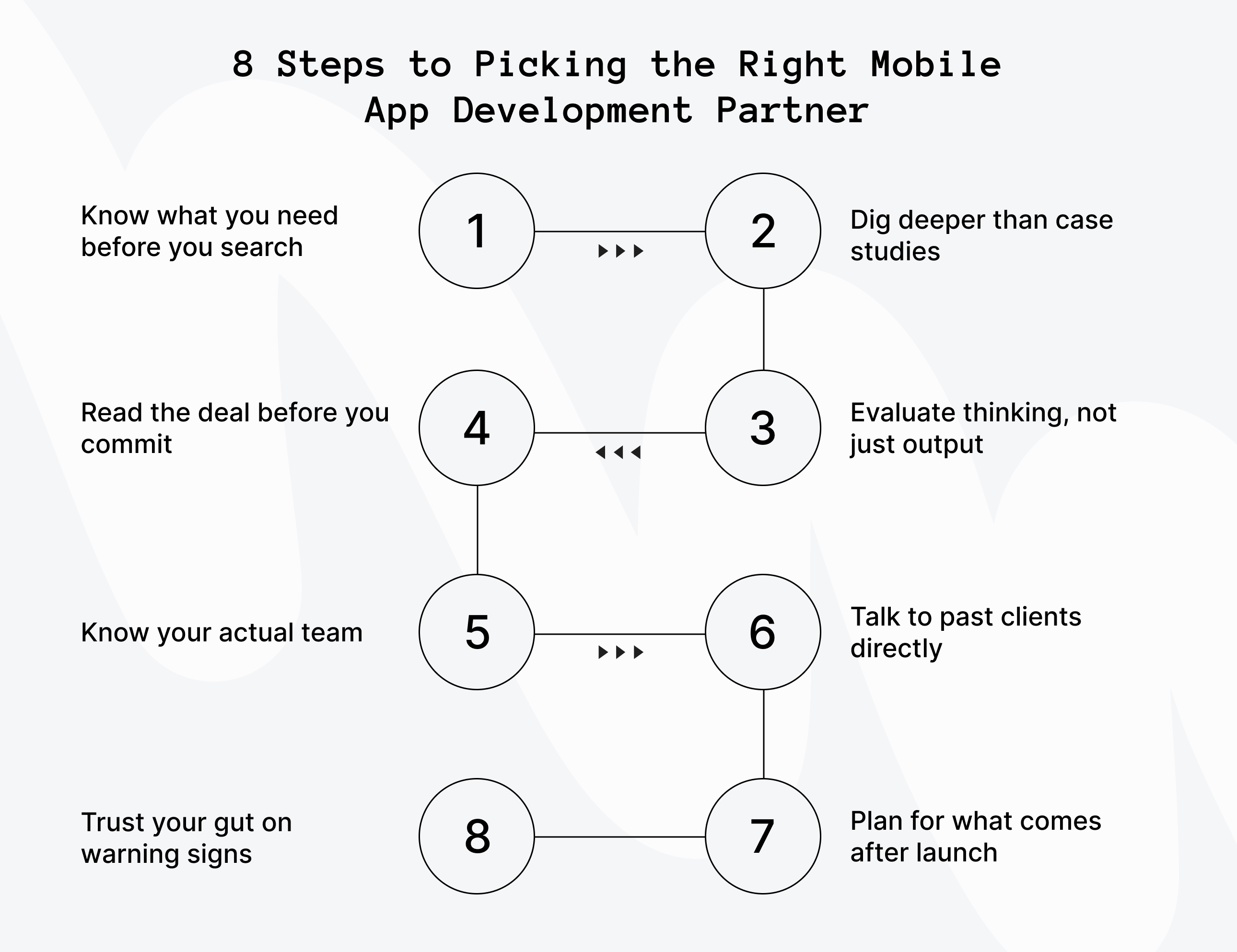
Here's what actually matters when you're choosing the best mobile app development company for startups:
Start with Your Own Clarity
Before you evaluate anyone else, get clear on what you're building, who it's for, and what "done" looks like in 3 months. A development partner can help you refine these things — but if you go into the search completely undefined, you'll end up choosing whoever sounds most confident, not whoever is actually the best fit.
Look Past the Portfolio Surface
Every agency has a polished case studies page. What you want to know is whether those apps are still live, whether they scaled, and whether the company was involved in the thinking or just the execution. Ask pointed questions: what was the hardest technical decision on that project? What would you do differently? The answers tell you a lot more than the screenshots.
Test How They Think, Not Just What They've Built
The best signal you'll get is in the first real conversation. Does the team ask questions about your users and business goals, or do they jump straight to timelines and tech stack? A partner worth working with will slow you down early — not to be difficult, but because they understand that building the wrong thing fast is worse than building the right thing slightly slower.
Understand the Engagement Model before You Sign Anything
Fixed-price contracts work well when the scope is airtight. For most early-stage products, it isn't, and that's fine. Time-and-material or dedicated team models give you more flexibility to adjust as you learn. What matters is that the pricing is transparent: you should understand not just what it costs today, but what happens when requirements change, which they will.
Ask Who's Actually on Your Project
Agencies sell you on senior talent, then staff projects with junior developers. Ask directly: who will be doing the day-to-day work? Will there be a dedicated tech lead? What's the escalation path if something goes wrong? The answers matter more than the team page on their website.
Check Real References
Testimonials on a website are marketing. Clutch reviews are more useful. But the most valuable thing you can do is ask for two or three client contacts and actually call them. Ask what surprised them about working with the agency, not just what went well. That's where the real picture comes through.
Don't Treat Post-Launch as an Afterthought
A lot of partnerships fall apart after the first release. The app ships, the contract ends, and suddenly there's no one to fix the bug that shows up on day three. Before you commit, understand exactly what post-launch support looks like: how fast do they respond, how are change requests handled, and is there a plan for iteration once real users start using the product.
Watch for Red Flags Early
If a company agrees with everything you say, never pushes back, and promises the timeline you hoped for, that's not a good sign. Real partners challenge assumptions, flag risks, and tell you when something isn't feasible. The ones that tell you what you want to hear in the sales process are usually the ones that go quiet when things get hard.
Choosing the best mobile app development company for startups is one of the few decisions that touches every other part of your young business: your product, your budget, your fundraising timeline, and your ability to hire the right technical team later. It's worth slowing down to get it right.
What Are Typical Mobile App Development Costs for Startups?
For startups, the mobile development budget is essentially an extension of your runway: the better you understand what drives the cost, the less likely you are to burn through everything on the first version. Instead of chasing a single number, it's more useful to break the price down into the factors that actually move it.

1. App Complexity
The more screens, user roles, business logic, integrations, and real-time features you need (chats, streaming, maps, live updates), the more engineering hours it takes and the higher the budget. A simple app with basic CRUD and authentication is one ballpark. A marketplace with payments, ratings, and recommendations is a completely different one.
2. Platform Choice
Building for one platform, say iOS only, costs less but limits your reach. Separate native apps for iOS and Android essentially double the workload, while cross-platform frameworks like React Native and Flutter can cut the budget by roughly 30–50% compared to two fully native builds.
3. Design Requirements
A minimal functional design for an MVP, including standard UI kits, familiar patterns, etc., takes far less time than a custom visual concept with unique animations, complex user flows, and upfront UX research. The more customization and UX experimentation you want, the higher the bill. That said, it often pays off through better conversion and retention.
4. Backend Infrastructure
Apps built on simple backends, such as BaaS solutions, minimal business logic, cost less than systems with a custom API, complex authentication, billing, analytics pipelines, message queues, and microservices. Integrations with payment systems, CRMs, marketing tools, analytics platforms, and AI services all add meaningful scope.
5. Vendor’s Region / Location
Where the team is based has a significant impact on the rate. According to Clutch, agencies in Asia and parts of Eastern Europe typically charge around $20–$50 per hour, while US and Western European agencies often run $100–$200+. For startups, this is one of the most practical levers for managing budget: you can choose between a local premium agency and an experienced distributed team at a more accessible price point.
6. Team Composition and Engagement Model
A full cross-functional team, including PM, business analyst, designer, mobile developers, backend engineer, QA, and DevOps, costs more than "just a couple of developers," but significantly reduces risk and the cost of rework. The engagement model matters too: a fixed-price contract works well for a tightly scoped MVP, while time-and-material or dedicated team models give you more flexibility and cost predictability as requirements evolve.
7. Scalability, Security, and Compliance Requirements
If the app needs to handle significant load from the start, store sensitive data, or meet regulatory requirements like GDPR or HIPAA, you'll need to invest more in architecture, security, and testing upfront. For fintech, healthtech, and B2B SaaS products, this is often a non-negotiable part of the budget, not a nice-to-have.
8. Post-Launch Support
Development doesn't end at launch. You'll need bug fixes, updates for new iOS and Android versions, and feature iterations based on user feedback and analytics. A common rule of thumb: budget around 15–25% of the original development cost annually for ongoing maintenance and product improvement.
All of those factors feed into one number that founders inevitably want to know upfront. So here's a realistic picture of what mobile app development costs in 2026, based on agencies with solid processes and fair rates.
- Simple mobile MVP (one platform, core functionality, minimal integrations): roughly $30,000–$60,000.
- Mid-complexity MVP (two platforms or cross-platform, payments, authentication, basic analytics, multiple user roles): typically $50,000–$120,000.
- Complex or full-featured application / SaaS-level product (broad functionality, custom backend, multiple integrations, high-load architecture): $120,000–$200,000+, and for very complex or enterprise-grade builds, anywhere from $300,000 to $500,000+.
For most growing businesses, the smart play is to start at the lower or middle end of these ranges with a tightly scoped MVP, keep budget reserved for one or two post-launch iterations, and let real user metrics drive the decision on whether to expand features or move to a heavier architecture. A top mobile app development company for startups will never offer you to build everything at once. The teams that push you toward a smaller, focused first version are usually the ones worth trusting.
%20Can%20Benefit%20Your%20Startup.png)
Common Mistakes Startups Make When Choosing a Mobile App Development Company
Most mobile development mistakes don't happen because a vendor was bad. They happen because founders moved too fast, left too much unsaid, or treated a critical partnership decision like a procurement task.

Here are the ones that come up again and again:
- Choosing Purely on the Lowest Price: Optimizing for the lowest hourly rate almost always costs more in the end — through rework, missed deadlines, and a codebase that needs to be rebuilt before you can scale. What matters more than the number is the value behind it: the process, the team's experience with products like yours, and how they handle things when something goes sideways.
- Not Checking Portfolio, References, and Startup Experience: Looking at a polished case studies page is not the same as downloading the apps, reading independent Clutch reviews, and talking to two or three past clients. General experience like "10+ years in the market" matters far less than specific experience with startups, MVPs, and the constraints that come with them.
- Vague Scope, Success Metrics, and Definition of Done: If there's no shared understanding of what the MVP includes, what "ready to launch" means, and what metrics define success, such as activation, retention, payments, each side fills in the blanks differently. That's where most project conflicts start, and it's almost entirely preventable.
- Treating the Partner as Coders, not Collaborators: When founders hand over a spec and expect execution, they lose the most valuable thing a good development team can offer: product thinking. The best partners push back on decisions, flag when something won't work, and care about outcomes, not just task completion. Let them.
- Ignoring Contracts, IP Ownership, and Pst-Launch Support: Skipping the legal details, such as who owns the code, how IP is transferred, what post-launch support looks like, is a risk that compounds over time. Investors increasingly look at who actually owns the product and who's maintaining it. Get this in writing before the first line of code is written.
- Underestimating How Much Communication Matters: If a vendor is vague in the sales process (for instance, avoids hard questions, doesn't document agreements, downplays risks, etc.), that's exactly how the project will run too. Clear, proactive communication isn't a nice-to-have. It's one of the strongest signals of a team worth working with.
- No Small Test Before a Big Commitment: Signing a large contract without a short discovery, pilot, or test sprint is essentially betting your budget on a pitch deck. A small paid engagement, even two or three weeks, tells you more about how a team actually works than any proposal or reference call ever will.
Need a hand with your mobile app idea?
Upsilon was once a startup too, so we can help build and scale your product!
Final Say on Mobile App Development for Startups
Finding the right mobile app development company for startups isn't about finding the perfect vendor. It's about finding a team you can move fast with, from first idea to real metrics, without burning through your runway in the process. This guide covers companies across a range of sizes and specializations, from product studios built for launching MVPs in a matter of months to larger players capable of handling complex, high-load mobile products.
The best approach isn't to try to guess from a website. Reach out to two or three companies from this list, have a few substantive conversations, check for cultural fit, and run a small discovery or pilot before committing to a larger engagement. It's a small investment that tells you far more than any proposal ever will.
If product focus, transparency, and predictable MVP launches resonate with you, Upsilon might be a good place to start. The team combines hands-on startup experience, strong mobile engineering, and flexible engagement models designed to help you get to a working product quickly and scale it from there.
Want to talk through your project? Tell us where you are right now: early idea, prototype, existing web product looking to go mobile, and we'll help you figure out what kind of MVP makes sense for your stage, your budget, and your timeline.
FAQ
1. How much does it cost to develop a mobile app in 2026?

Mobile app development costs in 2026 typically range from $20,000–$40,000 for a simple single-platform MVP with core functionality, $50,000–$120,000 for a mid-complexity product with two platforms or cross-platform build, authentication, payments, and basic analytics, and $120,000–$250,000+ for feature-rich apps with complex backend and multiple integrations. The smartest strategy for most startups is to start at the lower end of the range with a tightly scoped MVP and reserve budget for one or two post-launch iterations.
2. How long does it take to make a mobile app?
A simple MVP with a focused feature set and one platform or a cross-platform build typically takes 2–3 months. Mid-complexity products usually land in the 4–7 month range, while more complex applications can take 9–12 months or more.
3. Should I hire a local or remote app development company?
Local agencies often cost more but offer easier in-person collaboration and simpler legal setup. Remote and nearshore teams can significantly reduce costs while delivering comparable quality provided they have solid processes, clear communication, and real experience working with international startups. The practical approach: choose based on expertise and startup fit, and treat geography as a cost and convenience variable, not the deciding factor.
4. How do I protect my app idea and source code when working with a development partner?
Start with an NDA before sharing any details. In the main contract, explicitly state that all IP, such as source code, design assets, documentation, and domains, transfers to your company upon payment. Keep the repository under your control with limited, revocable access for the vendor. If you have a distinctive brand or unique technical approach, consider trademark registration or patent filings. Investors will ask who owns the product, make sure the answer is unambiguously you.
5. Do mobile app development companies provide post-launch support and maintenance?
Most established mobile development teams offer post-launch support, but the format varies. As a rule, there's a warranty period covering critical bug fixes after release, followed by separate retainer packages or hourly arrangements for ongoing maintenance, OS updates, and minor improvements. Before signing anything, clarify what's included in the warranty, how fast the team responds to production incidents, and what the product roadmap and iteration plan looks like for the first three to six months after launch.



to top