AI Team Structure: Roles, Responsibilities, and Size from MVP to Scale


An AI team structure assigns five jobs to named owners: the product decision, the model and prompt work, the data, the evaluation that decides what ships, and the production operations that keep the feature running. At the MVP stage, three to five people cover all five, with each person owning more than one; at scale, each job becomes a role or a team. Team design carries most of the weight in AI projects: BCG advises companies to put 10% of their AI effort into algorithms, 20% into technology and data, and 70% into people and processes.
But how does this translate into the actual structure of an AI development team? The answer depends on the product's maturity, the complexity of its features, and the amount of work required to keep AI reliable in production. While a small MVP development team can combine several responsibilities, growing products need clearer ownership, dedicated specialists, and processes that support multiple AI features without duplicating effort.
This article breaks down the key roles and responsibilities within an AI team, explains how team size and structure change from MVP to scale, and compares centralized, embedded, and hybrid approaches.
Key Takeaways:
- A clear AI team structure defines who owns product decisions, model development, data quality, evaluation, and production monitoring.
- Core roles on an AI engineering team include an AI engineer, tech lead, product manager, data engineer, and QA or evaluation specialist. Some responsibilities can be combined at the MVP stage.
- A well-defined responsibility map gives every critical outcome a single owner, from model selection and release criteria to data access and production incidents.
- Team size and organization should evolve with the product. A small cross-functional team can build an MVP, while product-market fit and scale require more dedicated specialists and shared infrastructure. The data science team structure also depends on the product's technical needs.
- Startups can combine in-house ownership with external engineering support, bringing more expertise in-house as the product gains traction and the workload grows.
What Is an AI Team Structure?
An AI team structure is the set of roles, owners, and reporting lines that take an AI feature from idea to production and keep it working after launch. It sits inside the broader startup team structure and adds a few jobs on top of the product and engineering work every software team handles.
These additional responsibilities reflect what makes AI products different from traditional software. Beyond building and shipping features, teams need to account for several areas:
- Quality needs a measurement. A login form works or fails. An AI feature gives the right answer some share of the time, so someone has to build a set of test cases, run it on each change, and decide which score is good enough to ship.
- Data becomes part of the product. The documents the model retrieves, the records it reads, and the logs it produces shape each answer. Someone has to own where that data comes from, who can see it, and how it stays current.
- Running costs move with usage. Each model call has a price, and a feature that costs cents per request at 100 users costs real money at 100,000. Someone has to own the cost per request the same way an engineer owns page load time.
- The model can change under you. Model providers release new versions and retire old ones on their own schedule. Someone has to test a new version against the evaluation set and plan the switch before the old one disappears.
These responsibilities are where AI teams can lose time, because each one touches product, engineering, and data at once. A clear team structure gives each area a named owner and makes accountability easier to maintain as the product grows. Without it, important decisions remain shared across several people, making it harder to keep quality, costs, and production performance under control.
Core AI Team Roles on an AI Development Team
An AI development team building a product on top of a foundation model needs fewer specialists than most role lists suggest. Several responsibilities can be combined at the MVP stage, while others become separate roles as the product grows. The table below outlines the main roles, their responsibilities, and when they typically become necessary.
Among these roles, the AI engineer has seen one of the biggest shifts in recent years. An AI engineer builds on top of existing models: writing prompts, connecting retrieval to company data, wiring tool calls, and building the evaluation that checks the result. An ML engineer, by contrast, trains and serves models. This specialization becomes necessary when an off-the-shelf model can't meet a product's accuracy, cost, or privacy requirements.
In a 2024 forecast, Gartner described the AI engineer as a role that combines software engineering, data science, and machine learning skills, and projected that 80% of the engineering workforce will need to upskill through 2027 as generative AI creates new roles.
Understanding these roles also helps clarify what to look for when hiring technical specialists. The process of hiring LLM developers depends on the skills and experience required for the project. The focus here, however, is on how these specialists fit into the wider team: who owns each responsibility and when a role needs a dedicated full-time owner.


Who Owns What: AI Team Roles and Responsibilities
In AI projects, the gap between a working demo and a launched feature tends to open around tasks that several people touch but no one person fully owns. Product decisions, model behavior, data access, and production monitoring often involve different specialists, so responsibilities can overlap. A responsibility map helps prevent important decisions from falling between roles by assigning each outcome one owner, identifying the people who contribute to it, and clarifying what the owner is expected to decide.
The table below maps the main outcomes in an AI project to the roles responsible for them. It also shows where other team members contribute and which decisions remain with the designated owner.
The evaluation row deserves particular attention because it connects product expectations with technical decisions. The product manager sets the quality threshold, while the AI engineer builds the test set and runs evaluations against it. This division gives both specialists a clear part to play in the release decision and makes it harder for a weak model to ship simply because the demo looked good. When no one owns the acceptance criteria, the team may rely on a few hand-picked examples instead of consistent testing, only to discover the feature's limitations after it reaches production.
The same principle applies as AI coding tools become part of the development process. These tools can take on more implementation work, but they do not change who is accountable for the final result. OpenAI's guide to building an AI-native engineering team describes a "delegate, review, own" split: agents draft code, tests, and first-pass reviews, while engineers stay accountable for what reaches production. As the share of AI-written code grows, a responsibility map helps an AI product team preserve this distinction. It keeps ownership tied to specific outcomes, even when more of the work is delegated to AI tools.
AI Team Structure by Stage: MVP, Product-Market Fit, and Scale
The right AI team structure evolves as the product moves from an initial idea to a proven business and, eventually, a portfolio of AI-powered features. At each stage, the team faces different challenges and requires a different mix of skills. Hiring too many specialists too early can drain the budget and create unnecessary coordination overhead. On the other hand, keeping the team too lean after launch can make it harder to maintain quality, catch regressions, and control rising infrastructure costs. The table below compares the typical team size, key roles, and organizational setup at each stage, from the first MVP to a full-scale AI operation.
MVP. At this stage, the priority is to establish whether the AI feature solves a real user problem and delivers enough value to justify further investment. That calls for a small, cross-functional team where people share responsibilities rather than work in narrowly defined roles. A typical setup might include a part-time tech lead and product manager, two full-stack developers, and part-time UX/UI and QA specialists, with a domain expert available when needed. External support can fill gaps in product discovery, design, or engineering capacity without requiring a full-time hire for every function.
Budget is another important consideration when defining the MVP team. Most MVPs cost between $20,000 and $65,000, while an AI chatbot or assistant built on a foundation model may require $20,000 to $80,000 and take 6 to 12 weeks to develop. More complex AI agents capable of taking actions can cost $50,000 to $150,000, with development taking 2 to 4 months. These estimates depend on the product's scope, technical requirements, and level of complexity, as outlined in this breakdown of AI development costs.
Product-market fit. As usage becomes more consistent and the product starts generating revenue, the demands on the team change. Several signs suggest that the original structure is no longer sufficient: evaluation runs fail or require frequent manual intervention, the number of data sources grows beyond what the tech lead can reasonably manage, or inference costs begin to put pressure on margins. Each of these challenges points to a need for clearer ownership. A dedicated evaluation and QA specialist can take responsibility for QA testing, a data engineer can manage increasingly complex data pipelines, and the tech lead can focus more on architecture and cost optimization.
Scale. At this stage, the challenge shifts from building individual AI features to coordinating their development across the organization. Several AI product teams now ship features, and duplicated work becomes a growing concern. A dedicated platform team takes ownership of shared models, evaluation tooling, monitoring, and cost tracking, while AI engineers stay embedded in the AI product teams. This setup allows individual teams to move forward with their own product priorities while relying on shared infrastructure and standards. A head of AI or AI lead often joins at this stage, typically reporting to the CTO until several business units depend on the same models.


Who to Hire First: Building an AI Team Role by Role
For an AI product built on a foundation model, the first key hire is usually a senior AI engineer with hands-on experience taking LLM-powered features from prototype to production. This person can help select the right model, build the initial AI functionality, and establish a reliable way to evaluate its performance. From there, hiring decisions should follow the product's immediate needs. The next specialist might be needed to handle product integration, improve data quality, or manage production infrastructure. The goal is to address the bottlenecks that limit progress rather than build an organizational structure for a much larger company.
The hiring sequence also depends on the type of AI product. An LLM-powered feature built on an existing model requires a different skill set from a predictive ML solution or a product that relies on custom-trained models. The table below outlines how the first three hires typically differ across these scenarios and why each role becomes important at that stage.
For an LLM-based product, the hiring process often follows a five-step progression:
- Senior AI engineer. Develops prompts, retrieval, and tool calls, builds the initial evaluation set, and helps the founder or tech lead choose the right model. This role establishes the technical foundation for the AI feature.
- Full-stack or backend engineer. Connects the AI functionality to the rest of the product, including the user interface, third-party APIs, authentication, and permissions. This makes the feature accessible and usable within the existing application.
- Product manager. Becomes important when multiple AI agent use cases compete for engineering resources and release criteria need consistent ownership. A dedicated PM helps align product priorities with technical capacity.
- Data engineer. Joins when the number of data sources grows beyond what the existing engineers can effectively manage. This role takes responsibility for data access, freshness, quality, and the pipelines that keep information available to the AI system.
- MLOps or platform engineer. Becomes necessary when several models or AI features are running in production. Deployment, monitoring, model versioning, and inference costs then require dedicated ownership rather than remaining part of the tech lead's workload.
This sequence is a useful starting point, but it is not fixed. Certain technical challenges can make a specialist necessary earlier than expected. Two factors, in particular, can change the order of hiring:
- Messy data moves the data engineer up the list. When information is scattered across disconnected systems, poorly structured, or difficult to maintain, bringing in another AI or ML engineer may not solve the underlying problem. A data engineer can address the pipelines and quality issues that affect the entire product. Gartner found that at least 50% of generative AI projects were abandoned after proof of concept, with poor data quality among the main causes. Adding more engineers to a product with unreliable data can generate more experiments without bringing it closer to production.
- A second model in production moves MLOps up the list. A manual deployment and monitoring process may be sufficient while a product relies on one model that rarely changes. However, the operational workload grows as additional models and AI features enter production or existing models require regular updates. Google Cloud's MLOps guidance explains how automated pipelines support more consistent deployment and monitoring. At this point, a dedicated MLOps or platform engineer can take ownership of the infrastructure before deployment issues or outages begin to affect users.
Need a hand with your startup's product idea?
Upsilon was once a startup too, so we can help build and scale your product!

Centralized vs. Embedded vs. Hub-and-Spoke AI Teams
Once a company moves beyond its first AI feature, it needs to decide how AI specialists should be organized and where they should sit within the broader engineering structure. Three models cover most companies, each offering a different balance between shared expertise, product ownership, and operational consistency. The choice also affects how teams communicate and make technical decisions. This reflects Conway's Law: organizations tend to design systems that mirror their communication structures, so where AI engineers sit can shape how the product's AI layer is built.
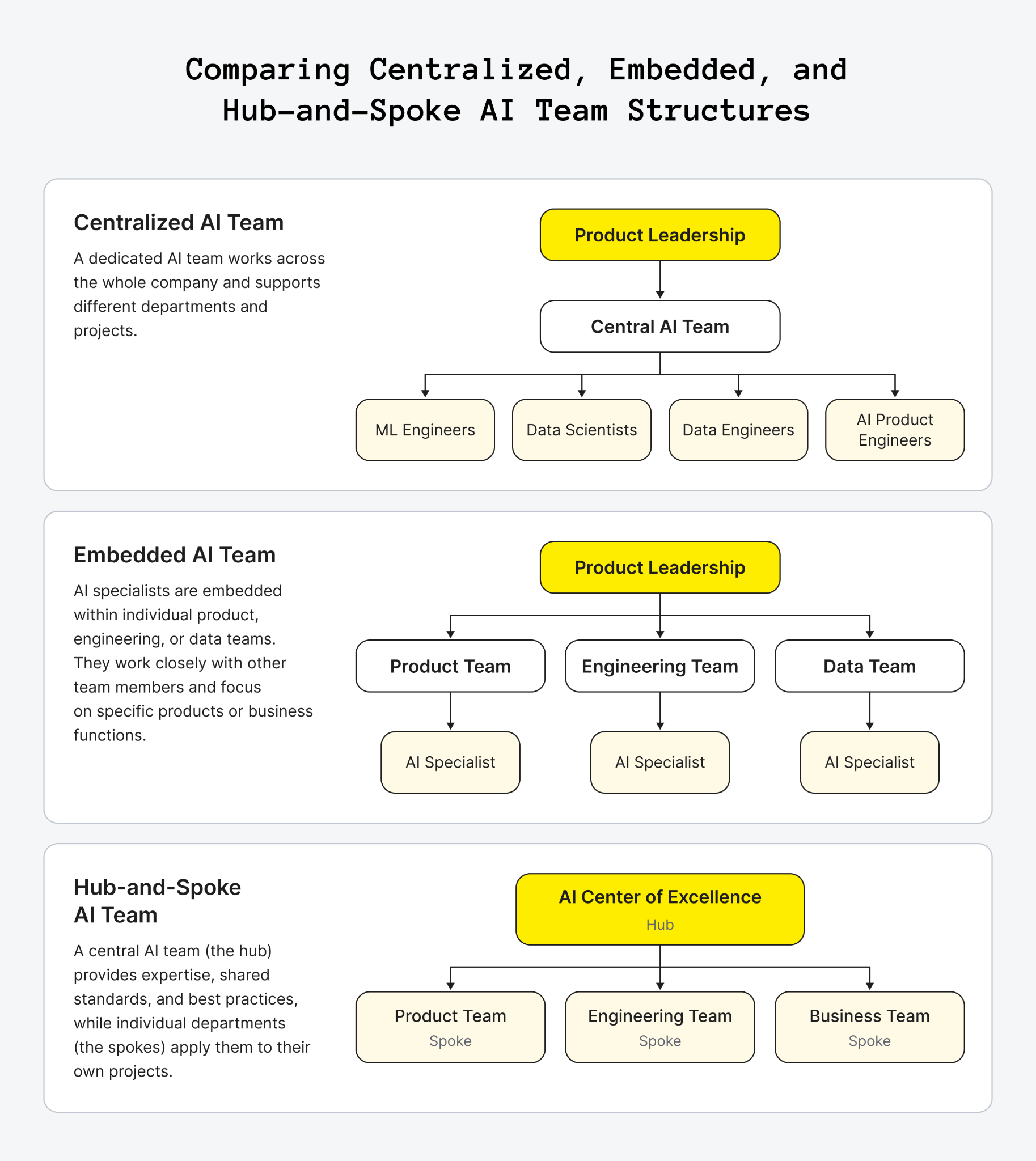
Centralized AI team. In this model, a dedicated AI team supports multiple product teams through a shared backlog. It works well when a company has one or two AI features and a limited number of specialists. Keeping AI expertise in one place makes it easier to standardize evaluation, share tooling, and avoid duplicating technical work. However, a centralized structure can create distance between AI engineers and the people using the product. Requests from product teams may compete for attention, delaying development and making it harder for specialists to stay close to user needs and product priorities.
Embedded AI engineers. Here, AI engineers work directly within individual product squads and report to their respective engineering managers. This arrangement keeps technical decisions close to users, product requirements, and release cycles. It is particularly useful when AI plays a central role in several distinct product areas. The main drawback is duplication: each squad may develop its own evaluation scripts, prompt conventions, and vendor relationships. Over time, this can make it difficult to maintain consistent standards or understand AI-related costs across the organization.
Hub-and-spoke. This model combines centralized infrastructure with embedded product expertise. A central platform team, or hub, manages shared models, evaluation tooling, monitoring, and cost tracking, while AI engineers remain part of individual product squads. The hub provides common standards and infrastructure, but product teams retain ownership of their features and day-to-day development. This approach is often a natural next step as an organization grows because it reduces duplicated work without separating AI engineers from the products they build.
The three models differ not only in where AI engineers report but also in who owns shared infrastructure, evaluation, and technical decisions. The comparison below outlines their typical use cases, organizational setup, and the signals that suggest a company may need to move to another model.
The choice does not have to be the same across every business function. McKinsey's 2025 State of AI research found that organizations most often fully centralize risk, compliance, and data governance, while relying on hybrid or partially centralized models for technology talent and AI adoption. This suggests that shared oversight can coexist with distributed product teams, rather than requiring the entire AI function to follow one reporting structure.
Deloitte's 2026 research on team structure and AI outcomes also highlights the value of keeping AI work connected to the business. In a survey of 1,394 US professionals, teams working across several business units reported significant gains in efficiency and innovation from AI 30% more often than other teams. The research also found that 91% of teams reporting stronger AI outcomes hired for varied skill sets, compared with 68% of other teams. Together, these findings point to the importance of cross-functional collaboration and a mix of expertise as AI adoption expands.
Who Should the AI Team Report To?
The AI team's reporting line should reflect how deeply AI is integrated into the company's products and operations. When AI features are part of a single product, reporting to the CTO or head of engineering usually makes the most sense. This keeps model development connected to the codebase, release processes, and engineering budget. As more products and business units begin relying on shared models, data, and governance standards, a dedicated head of AI may become necessary. At a later stage, this responsibility can move to a Chief AI Officer (CAIO) who oversees AI strategy across the organization.
The reporting structure typically evolves through four stages:
- MVP. The founder or tech lead oversees AI development and reports to the CEO, who is often the founder as well. At this point, a separate AI leadership role would add more overhead than value. The structure usually needs to change once the first AI feature reaches paying users and requires more consistent technical ownership.
- Product-market fit. The CTO or head of engineering takes responsibility for AI development and reports to the CEO. This arrangement works while AI remains closely tied to one product or a small number of features. A second AI product or feature that relies on the same models and evaluation tooling may create the need for dedicated AI leadership.
- Scale. A head of AI or AI lead joins the organization and typically reports to the CTO. This role coordinates AI development across product teams and helps maintain shared technical standards. As several business units begin depending on common models, the company may need broader oversight of AI governance, risk, and investment.
- Multiple business units. A Chief AI Officer may report directly to the CEO, taking responsibility for AI strategy, risk management, and budget across the company. This role becomes more relevant when AI is no longer limited to individual products and starts influencing decisions across the organization.
Governance tends to move higher up the organizational structure as AI adoption expands. In McKinsey's 2025 State of AI survey, 28% of respondents at organizations using AI said the CEO oversees AI governance. CEO oversight was also among the factors most correlated with higher self-reported bottom-line impact from generative AI. The Chief AI Officer role is gaining traction as well: IBM reports that 76% of surveyed organizations had a CAIO in 2026, up from 26% in 2025, and that companies with a CAIO saw a 5% higher return on their AI investments.
For startups, however, the timing of these appointments matters more than the title itself. AI governance needs a clearly identified executive owner from the MVP stage, even if that responsibility initially sits with the founder or CTO. A dedicated AI leader becomes valuable when multiple products depend on shared models, infrastructure, and governance processes. Until then, keeping accountability within the existing leadership team can help the company maintain clear ownership without adding unnecessary management layers.
How to Build an AI Team: In-House, Partner, or Hybrid
Building an AI team starts with three key decisions: which responsibilities should remain in-house, which can be handled by an external partner, and when it makes sense to bring certain functions into the company. Understanding how to build an AI development team also means deciding which capabilities the company needs to retain internally and where outside expertise can fill the gaps.
Three areas should stay in-house from the outset: product ownership, including responsibility for setting release criteria; domain expertise, which helps assess whether the AI delivers relevant and accurate answers; and knowledge of the company's own data. These responsibilities directly influence what gets released and what information the model can access. An external team can contribute to this work, but the final ownership should remain with the company.
Hiring for the rest takes time. The US Bureau of Labor Statistics projects 35% employment growth for data scientists from 2025 to 2035, about 24,800 openings a year, with a median salary of $120,230 in May 2025. AI and ML specialists cost $99 to $180 or more per hour in the US and $45 to $85 in Eastern Europe, according to Upsilon's AI cost research. Those numbers explain why most startups staff the MVP with a partner team and hire full-time once the product shows repeat usage.
The right staffing model changes as the product matures, but product ownership and domain expertise remain in-house at every stage. The main shift is in engineering capacity: external support helps get the MVP off the ground, while proven demand creates a stronger case for building an internal team.
The choice between in-house specialists, external partners, and a hybrid setup also has a direct impact on the budget. The next step is to understand how much each option costs and which expenses to account for at different stages of AI development.
What an AI Team Costs
Hiring a full-time AI engineer in the US can cost between $155,000 and $185,000 a year in salary alone, depending on the benchmark, before benefits and recruitment fees. By comparison, a dedicated partner team can build an MVP for approximately $20,000 to $65,000 in total. This means that one senior AI specialist's annual pay can exceed the budget for an entire first version of the product.
US annual pay for core AI roles:
- AI engineer: $155,000 median total compensation on Levels.fyi and $184,757 average base salary on Built In.
- Data scientist: $120,230 median annual wage in May 2025, according to the US Bureau of Labor Statistics.
- ML and research-focused roles: $140,300 median annual wage in May 2025 for computer and information research scientists.
These figures are not directly comparable because the sources measure different things. Levels.fyi reports total compensation, Built In provides average base pay, and the BLS tracks broader occupational categories rather than AI engineers specifically.
European markets can offer different salary levels. According to WTW's 2026 salary survey, median total compensation for mid-level Machine Learning specialists was around $122,000 in Germany and just under $100,000 in the UK, compared with more than $170,000 in the US. These estimates include salary, allowances, and incentives, rather than base pay alone.
For startups, hiring does not have to mean building an internal team from day one. Product development studios such as Upsilon offer access to experienced AI and ML specialists at competitive rates, particularly through teams based in Eastern Europe. This can provide the expertise needed to develop an MVP without committing to several full-time salaries before the product demonstrates demand.
That is why many startups begin with an external partner and gradually bring key roles in-house as usage grows. The approach keeps initial hiring costs manageable while allowing the company to build internal expertise when the workload justifies it.
Looking for a reliable tech partner?
Upsilon can help you develop an MVP that'll grow to be a success!
Final Thoughts on AI Team Structure
A successful AI team needs more than skilled specialists. It requires clear responsibilities, effective collaboration, and an organizational structure that can adapt as the product grows. Knowing how to build an AI team means understanding which roles are essential, how to assign ownership, and when additional expertise is needed. A lean AI engineering team may be sufficient for an MVP, while reaching product-market fit and scaling the product often call for dedicated specialists, stronger infrastructure, and closer coordination between AI and product teams. The goal is to develop the team's capabilities in line with the product's needs without introducing unnecessary complexity or costs too early.
For companies looking to expand their engineering capacity, Upsilon offers a flexible way to bring experienced specialists into the team without committing to a full in-house hiring process. Through team augmentation services, businesses can add the expertise they need as their AI products grow and priorities change. Contact us to discuss your project and find the right team setup.



FAQs
How do you structure an AI team?

Start from the outcomes, then assign one owner to each: the use case and success metric, model choice, evaluation and the release threshold, data access, inference cost, and production monitoring. At the MVP stage, three to five people hold all of these, with each person owning several. As the product grows, each outcome becomes a role, then a team, and a platform group takes over shared models and tooling.
What roles do you need to build an AI MVP?
Most AI MVPs built on a foundation model need a product owner, a tech lead who chooses the model and watches cost, one or two engineers with LLM application experience, and part-time design and QA. A domain expert who can judge answers should be on call. Data engineers, MLOps engineers, and ML engineers who train custom models come later, once the product proves people use it.
How big should an AI development team be?
An AI development team for one product runs three to five people at the MVP stage, six to ten at product-market fit, and fifteen or more at scale, split into squads with a shared platform team. Recruiter benchmarks for AI-specific headcount run lower, since they count only AI and data roles: KORE1 puts it at one to two at seed and three to five at Series A.
Who should an AI team report to?
An AI team should report to the CTO or the head of engineering while AI features are part of one product, so model work stays tied to the codebase and the release process. A separate head of AI or Chief AI Officer makes sense once several products or business units depend on shared models, data, and governance, which in most companies happens at the scale stage.
Should you hire an in-house AI team or work with a partner?
Keep product ownership, the release threshold, and knowledge of your data in-house from the start, since those decide what ships. Build capacity, MLOps setup, and specialist reviews can come from a partner, and that matters most at the MVP stage, when hiring takes months. Most companies move to a hybrid model as the product grows, with partners filling peaks around an in-house core.
What is the difference between an AI engineer and an ML engineer?
An AI engineer builds features on top of existing foundation models: prompts, retrieval, tool calls, and the evaluation that checks them. An ML engineer trains, fine-tunes, and serves models, which matters when a foundation model can't meet the accuracy, cost, or privacy requirement. Most AI MVPs need an AI engineer first and an ML engineer only if the product outgrows off-the-shelf models.
to top