8 SaaS Growth Strategies That Work in the Age of AI


Imagine the following picture: two founders launch competing SaaS products in the same year. One spends the next twelve months chasing every metric that trends on LinkedIn. The other picks one number to move and builds around it. Eighteen months later, only one of them is still growing, and it's rarely the one with the busier dashboard.
The market gives both of them plenty of reason to feel urgency. The global SaaS industry has doubled in five years to $312 billion, and AI has only sharpened the split between who wins and who stalls: AI-native companies are growing 2.4 times faster than traditional SaaS peers, 82% year-over-year against 34%, while 72% of SaaS companies have already worked AI into their product. That last number is the trap.
Adding AI is no longer a differentiator, it's the baseline. What separates the founder who grows from the one who plateaus is which SaaS growth strategies they commit to once the AI feature is live: how they price it, whether customers actually stick around after trying it, and whether the product can support the growth lever they picked in the first place.
In this article, we'll walk through the four pillars behind SaaS growth, show you how to match a strategy to your actual stage, and break down eight approaches that hold up once AI is part of the product. We'll also cover how to measure whether any of them is actually working, as well as the common startup mistakes that quietly stall most growth efforts.
Key Takeaways
- A B2B SaaS growth strategy names one specific lever, distribution, pricing, retention, or market focus, and commits real product effort to it, rather than running every tactic at once with no clear owner.
- Four levers drive almost all SaaS growth: customer acquisition, user activation, customer retention, and revenue expansion, and they build on each other in that order.
- Usage-based and hybrid pricing have become the norm for AI products because compute costs don't scale with seats; hybrid pricing also shows the strongest median net revenue retention at 105%.
- Churn prevention needs to be a system with a defined target and owner from day one, not a survey you send after someone has already cancelled.
- Distribution and community loops only work when they're built into a real moment of product value, not bolted on as a separate marketing or forum channel.
- Global payments and compliance readiness should be built before an enterprise deal demands it, since retrofitting under deal pressure is slower and more expensive.
- Net revenue retention, time to first value, and CAC by channel are the three metrics that show whether any of these strategies are actually working, and each needs a defined test period before you judge it.
- Most failed growth strategies share one root cause: skipping the check for whether the product can actually support the strategy before committing marketing effort to it.
What a SaaS Growth Strategy Means in the Age of AI
A SaaS growth strategy means picking one specific lever, such as distribution, pricing, retention, or market focus, and putting real product and marketing effort behind it, instead of running every tactic at once with no one clearly owning the result.
Most SaaS growth marketing strategies fail for the same reason, and it's the same reason a lot of what people call SaaS growth hacking falls flat too: the strategy asks the product to do something it was never built to do. Usage-based pricing needs real metering behind it. Product-led distribution needs an actual self-serve path from signup to value. If you pick a strategy without checking whether your product can support it, you don't end up with a growth strategy, you end up with a marketing plan for startups with no product behind it. And you'll find that out eventually anyway, just slower and more expensively than if you'd asked the question up front.
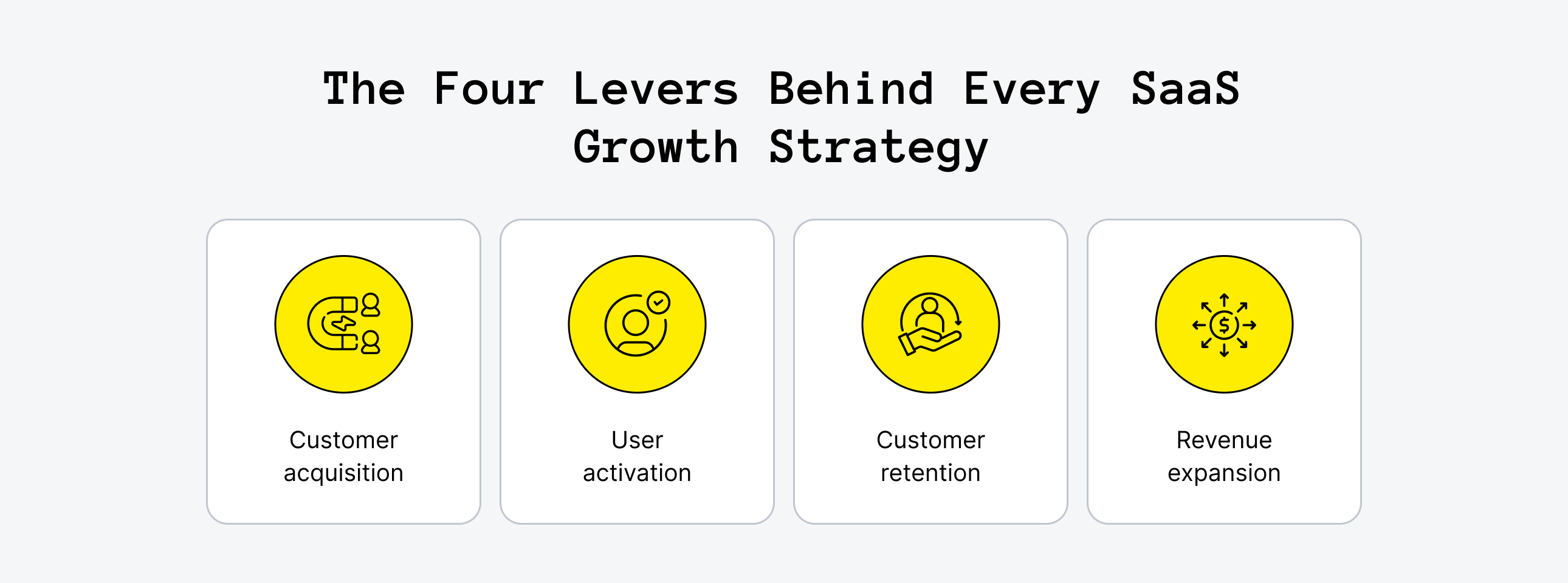
So, how do SaaS growth strategies work? There are four levers behind almost every B2B SaaS growth strategy, and they build on each other: customer acquisition, user activation, customer retention, and revenue expansion. Let's explore them in more detail.
Bringing In New Users Through Diversified, Repeatable Channels
Customer acquisition is the part everyone sees first, and it's usually mistaken for the whole strategy. Running ads gets attention, but it doesn't build a business on its own. Costs vary sharply by channel: a recent benchmark across nearly 1,000 B2B companies put average CAC at $200 for inbound, $267 for outbound, and $412 for events, which is exactly why chasing every channel at once rarely pays off.
What actually works is picking two or three channels that fit how your specific customer buys, and running them consistently long enough to know if they're working. A dev tool might live or die on SEO and community, while an enterprise product might grow through partnerships and outbound. There's no universal channel mix, there's only the mix that matches your buyer's actual habits.
Getting New Users to Their First Real Moment of Value Fast
User activation is what happens right after someone signs up, and it's where a lot of good acquisition work quietly goes to waste. Getting someone to create an account means nothing if they never reach the moment your product actually solves their problem: inviting a teammate, connecting an integration, launching their first campaign, whatever that specific "aha" moment is for your product.
The scale of the drop-off is bigger than most teams assume: across 62 B2B SaaS companies, average activation sits at just 37.5%, meaning roughly two out of three signups never experience the product's core value at all. The faster someone gets there, the more likely they are to stick around; one analysis found that reducing time-to-first-value by half, from 30 minutes to 15, typically lifts 7-day retention by 25% to 40%.
The faster someone gets there, the more likely they are to stick around. This is why onboarding matters so much: a guided setup, a well-timed email, or a nudge inside the product can be the difference between someone who tries your tool once and someone who builds it into their week.
Keeping Existing Customers Engaged and Paying
Customer retention is the lever that quietly decides whether the other two were worth the effort. A small improvement in retention can do more for your bottom line than a big jump in new signups, simply because a customer you keep costs you nothing extra to keep serving. The math backs this up directly: Bain & Company research found that improving retention by just 5% can increase profits by 25% or more.
Retention comes from staying close to what customers actually need: fixing the product based on real usage patterns, catching frustration before it turns into a cancellation, and making sure customers actually adopt the features that make your product valuable to them. Companies that take this seriously tend to grow steadier than the ones pouring everything into acquiring new logos.
Growing Revenue from Customers Who Already Trust You
Revenue expansion is proof that growth doesn't only come from finding new customers. It can come from your current ones spending more over time. That might mean a customer moving to a bigger plan, adding more seats, buying a second product, or simply using more of what they're already paying for under a usage-based model. This isn't a minor side effect once a company scales: SaaS companies SaaS companies above $50 million ARR generate roughly 60% of new ARR generate roughly 60% of new ARR from existing customers, and expansion revenue actually overtakes new-customer revenue past that point. Growing revenue from people who already trust you is almost always cheaper and more reliable than convincing someone brand new to take a chance on your product.
Knowing the four levers is one thing. Knowing which one to pull first, given where your company actually stands, is what separates a strategy from a wish list. It’s time to find out which growth strategies tend to matter most at each stage, so you can stop guessing and start focusing on the one that will move the needle right now.


Which SaaS Growth Strategy Fits Your Stage: A Comparison
There is a list of B2B SaaS growth strategies that can help you find the lever your product is actually ready to pull, instead of guessing which one sounds best on paper. Not all of them make sense for where you are right now. Some need an engineering team that can build metering infrastructure in a quarter. Others need almost nothing beyond a product decision and a few weeks of testing. You can pick the one your development team is actually ready to run.
No single row here is "the" right answer, that's the point of laying them out side by side instead of picking a favorite. The strategy that fits depends on which lever is actually weak for you right now: a company bleeding customers needs the churn system before it needs a fancier pricing model, and a company still hunting for its first repeatable channel has no business worrying about global payments yet. With that groundwork in place, here's a closer look at all eight strategies and what it actually takes to run each one well.
8 SaaS Growth Strategies for 2026 and Beyond
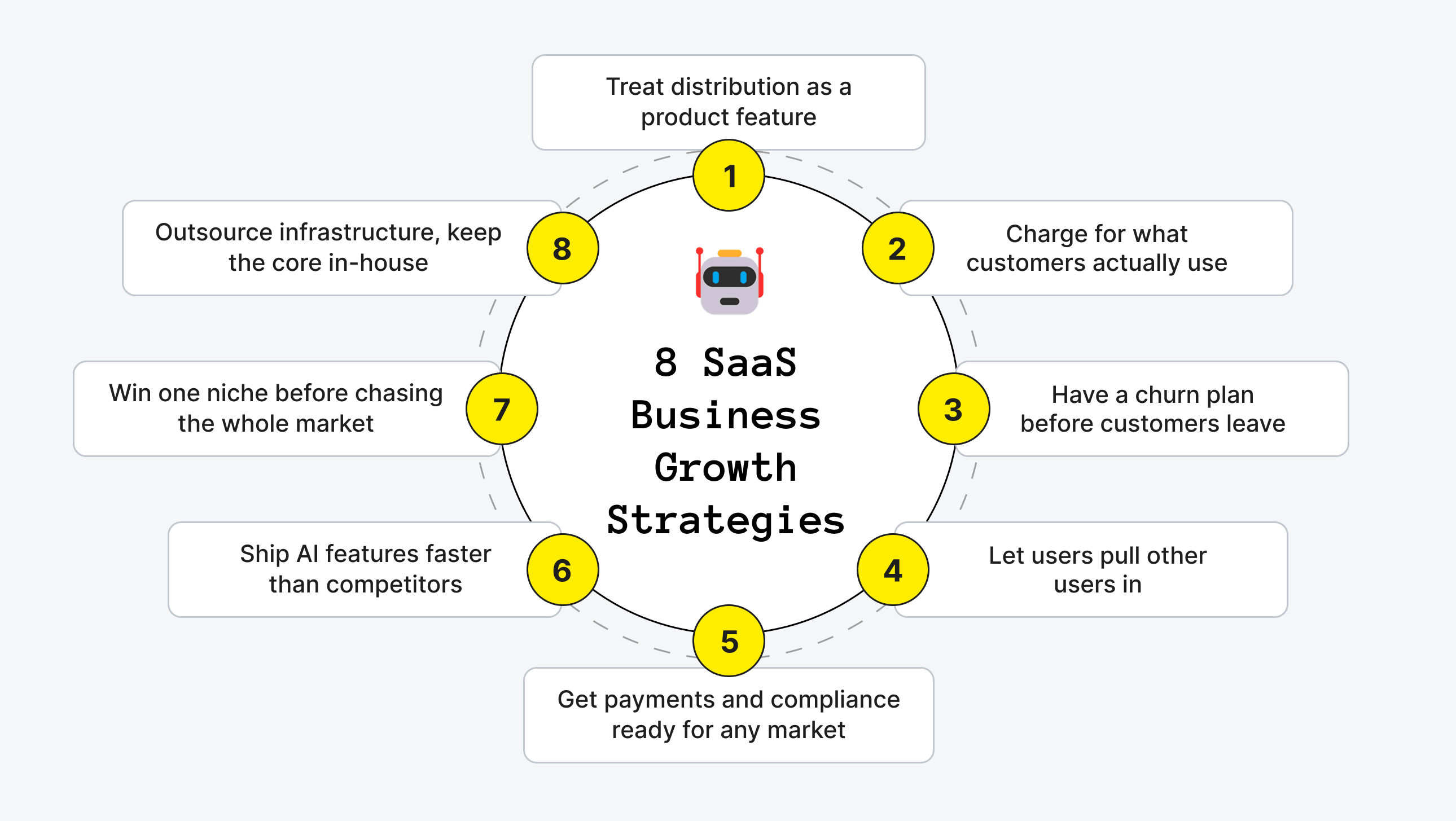
AI has made it cheaper to build software, but it hasn’t made growth easier. It has raised the bar: customers expect faster time to value, clearer ROI, and pricing that makes sense when every AI interaction carries a real cost. So, what are the best SaaS growth strategies? That's the backdrop for the eight ideas that actually work in the age of AI, each addressing a different part of the problem, so pick the one that matches where you are.
1. Build Distribution Into the Product Itself
The strongest SaaS business growth strategies for 2026 treat distribution as a product feature, not a marketing campaign added after launch. A shared document, public result page, branded report, workspace invitation, or template gallery can expose the product to the next potential customer every time an existing user gets value from it.
That is more durable than relying entirely on paid acquisition. Paid ads, sponsorships, integrations, marketplaces, SEO, and an email audience are all valid distribution channels. But they require ongoing investment or ongoing production. Product-led distribution can compound because product use itself creates new discovery moments.
Runna, the running-coaching app, is a useful example. Its product reflects a team that understands how runners train, compare progress, and share plans with training partners. The sharing behavior was not added as a growth-team experiment after the product was built. It came from designing around a behavior the audience already had.
The founder's question is not, “How can we make users invite someone?” It’s: what useful output, collaboration point, or result does the customer already want to share? Build distribution around that action. If sharing feels like a favor to your company rather than a natural part of the customer’s workflow, the loop will not last.
2. Treat Usage-Based Pricing as a Build Requirement
AI features come with variable costs. Every model call, agent run, generated asset, processed document, or API request can affect gross margin. A flat per-seat plan can work for predictable software usage, but it becomes risky when a small group of heavy users generates disproportionate compute costs.
This is why usage-based pricing has moved from a billing preference to a product decision. According to the survey, 85% of SaaS companies had adopted usage-based pricing in some form. Among 80 AI-agent companies analyzed by Orb, 91.3% used usage-based pricing, up from 83.3% in the previous year. Hybrid pricing models also showed the strongest reported median net revenue retention (NRR), at 105%, compared with 102% for subscription-only models and 99% for consumption-only models.
Intercom’s Fin prices around resolved customer-support outcomes rather than user seats. Notion takes another route: it keeps its core seat-based product while monetizing AI separately. Both approaches recognize the same reality: AI development cost and AI value don’t always scale with employee headcount.
But do not treat this as a pricing-page exercise. Usage-based and outcome-based pricing require product infrastructure:
- Meter the activity that drives cost or customer value;
- Connect that activity to a billing system accurately;
- Give customers visibility into usage before the invoice arrives;
- Set limits, alerts, and controls that prevent surprise bills; and
- Make sure your internal team can explain the metric being charged for.
A useful decision framework is to compare willingness to pay with actual adoption. High willingness and high adoption can justify a direct price increase. High adoption but low willingness may call for included allowances and overage limits. High willingness but low adoption may point to an add-on rather than a higher base plan. None of these choices are reliable if you cannot measure usage in the first place.
3. Plan for Churn Before Launch, Not After
“Plan for churn” sounds sensible but is useless without a target, a measurement method, and a clear owner. Before launch, decide what retention result would prove customers are receiving recurring value, not just trying the product once.
For bootstrapped B2B SaaS companies in the $3 million to $20 million ARR range, SaaS Capital’s 2026 benchmark reports median NRR of 103% and median gross revenue retention (GRR) of 91%. Companies at the 90th percentile reported 117.9% NRR and 100% GRR. In plain terms, a 103% NRR means an existing customer cohort is growing modestly after churn, downgrades, and expansion are accounted for; an NRR below 100% means the base is shrinking before you add a single new customer.
Those are benchmarks, not universal targets. Your number should reflect your segment, contract size, product maturity, and sales motion. Still, the direction is clear: retention has to be measured as a growth outcome. One analysis frames the difference bluntly: companies with NRR above 100% grow 2.3 times faster.
Build the mechanism before cancellations become your main source of customer research:
- Ask a short exit survey why a customer is leaving and what originally made them sign up;
- Track the behavior that signals the user has reached ongoing value;
- Identify early risk patterns, such as incomplete setup, declining logins, unused integrations, or fewer active collaborators;
- Create a response for each pattern: guided setup, product education, a lower-tier plan, a pause option, or proactive customer-success outreach; and
- Review churn reasons monthly and tie the most common ones to specific product or onboarding work.
The key is timing. A survey shown after a subscription is cancelled tells you what happened. A risk signal detected before the customer has mentally checked out gives you a chance to change the outcome.
4. Turn Community-Led Growth Into an In-Product Mechanism
Community-led growth works when customers have a real product reason to bring other people in. A shared workspace, collaborative document, team dashboard, public template, or customer-facing output can create that reason. A separate Slack group, Discord server, or online forum can’t create it on its own.
The build question comes before the community question. Where, inside the product, does a user naturally benefit from involving another person? In a design-review tool, it may be collecting user feedback. In a financial-planning product, it may be sharing a report with a client. In an AI workflow tool, it may be publishing a reusable template that another team can copy.
The best invitation prompt appears at the moment the value becomes clear. For example, after a user creates a useful workflow, the product can offer: “Invite a teammate to review or run it.” That prompt has context. It is far more effective than a generic “Refer a friend” email sent days later.
Do not confuse community activity with growth. A forum with frequent posts may be useful for support, brand building, and customer insight. But it becomes a growth engine only when participation leads naturally to product adoption, collaboration, or expansion.


5. Build Global-Ready Payments and Compliance Early
Expanding country by country creates friction that a global-ready SaaS product does not need to carry. It slows down revenue, adds operational work, and forces founders to solve tax, local payment, invoicing, fraud, refunds, and regulatory questions while trying to close customers.
Nexus Mods shows what this can look like in practice. After adopting a merchant-of-record model, the company was able to sell in 205 territories, migrate more than 100,000 subscribers, and grow China revenue ninefold. The company also reported an almost immediate 9x increase in Chinese conversions after Alipay subscriptions became available.
For a B2B SaaS company, the issue may surface even earlier. One enterprise prospect can require security documentation, data-processing commitments, regional hosting assurances, audit trails, role-based access, or compliance certifications before procurement will move forward. Retrofitting those requirements under deal pressure is expensive and distracting.
You don’t need to build a legal, tax, and payments department before you have product-market fit. But you should make early architecture and vendor choices that do not block international sales later:
- Support multiple currencies and localized checkout flows where relevant;
- Separate tax, payment, and invoicing responsibilities from core product logic;
- Decide where customer data is stored and how you can meet regional data requirements;
- Build security fundamentals early: access controls, audit logs, backups, and clear data-handling processes; and
- Use specialists for functions that are regulated, jurisdiction-specific, and not your product differentiation.
A merchant of record can take on responsibilities such as tax collection, payment compliance, refunds, and chargebacks, allowing the product team to focus on the software itself.
6. Make AI Feature Shipping Speed the Differentiator
In AI SaaS, execution speed is a growth lever. Customers quickly learn what is possible from competing tools, social media demos, and their own experiments. If your team needs two quarters to ship a capability that another company delivers in two weeks, strong positioning alone will not protect you.
Cursor is a clear example of product velocity creating demand. The AI coding tool reportedly surpassed $100 million in annualized revenue in roughly two years, with product adoption and rapid feature delivery doing much of the work traditionally expected from a large marketing budget. The lesson is not that marketing no longer matters. It is that fast, visible product improvement can become marketing when customers immediately see and share the difference.
Still, don’t ship AI features just because competitors have them. Boston Consulting Group proposes a tougher commercial test: moving a customer from the core SaaS product to the AI-enhanced offer should create roughly a 2x revenue impact. If the increase is only 10% to 20%, BCG argues that the feature is either incremental or underpriced.
Use that test to prioritize. Before committing to a feature, ask:
- Does it eliminate a meaningful amount of work, delay, or cost for the customer?
- Can the customer understand its value without a long demo or manual setup?
- Does it improve a workflow they already use frequently?
- Can we price it in a way that covers model costs and reflects the value delivered?
- Can we ship, observe adoption, and improve it quickly?
Speed matters most when it is attached to a sharp customer problem. Shipping ten low-impact AI features quickly is still a slower path to growth than shipping one capability customers will pay to keep.
7. Narrow Your Serviceable Market Before Chasing the Total One
Your total addressable market can be huge and still be the wrong place to start. Early-stage SaaS companies grow faster when they become the obvious choice for a specific buyer, workflow, or vertical before trying to appeal to everyone who could theoretically use the product.
A narrow serviceable market gives you practical advantages. You can write clearer messaging, build a focused sales list, identify the integrations that matter, understand buying objections, and develop case studies that sound familiar to the next prospect. You also learn faster because feedback comes from customers with similar needs.
For example, “AI automation for operations teams” is broad enough to mean almost anything. “Automate invoice-data validation for logistics companies using three specific accounting systems” creates a much clearer product, buyer, and route to market. The second position may look smaller on a market-size slide, but it is easier to sell, implement, and defend.
Start by choosing the segment where you can win repeatedly. Then use the credibility, workflow knowledge, integrations, and customer evidence from that segment to expand outward. All types of SaaS companies rarely earn broad market trust by speaking broadly from day one. They earn it by becoming indispensable somewhere specific first.
8. Protect Founder Focus by Outsourcing Non-Core Infrastructure
Founder time is one of the scarcest resources in a growth-stage company. Payments processing, sales-tax compliance, cloud operations, identity management, monitoring, and other infrastructure work can be essential but essential doesn’t automatically mean it should be built in-house.
The decision test is simple: if this capability would look mostly the same whether your product succeeds or fails, it is probably infrastructure you should buy, integrate, or outsource. If it is the reason a customer chooses you over a competitor, it deserves direct product and engineering attention.
This doesn’t mean outsourcing responsibility. You still need to understand the risks, choose vendors carefully, own the customer experience, and avoid dependencies that make future changes impossible. But building commodity systems from scratch can create years of maintenance work before it creates meaningful customer value.
For example, a startup building AI workflow software may need secure authentication, subscription billing, tax handling, cloud hosting, observability, and a support stack. Those pieces must work well. But the company’s edge is more likely to come from the workflow it automates, the quality of its AI outputs, domain-specific integrations, and time to value, not from a homegrown billing engine.
Use outside infrastructure to protect your focus. Keep your best people on the part of the product that makes customers choose, stay with, and expand their relationship with your business.
Looking for a tech partner to assist you with growth?
Upsilon has helped numerous startups improve and scale their products!

How to Measure Whether a SaaS Growth Strategy Is Working
SaaS growth metrics that matter change depending on which strategy you’re running. Let’s see how you can understand whether you’re doing everything right.
Three Metrics Across Every Strategy
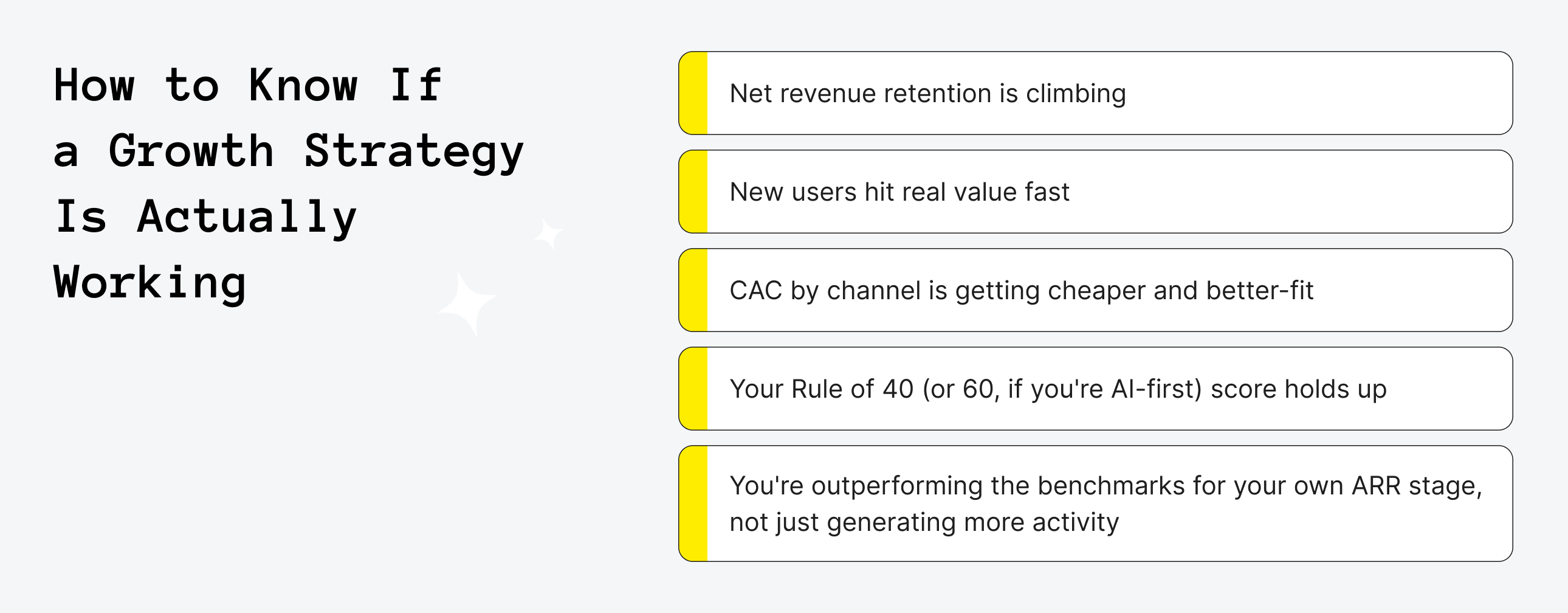
Three numbers apply across almost every one of the eight strategies above:
- Net revenue retention shows whether existing customers are expanding or shrinking their spend, the number usage-based and outcome-based startup pricing strategies exist to move.
- Time to first value shows whether a product-led distribution loop gets a new user to a meaningful outcome fast enough to invite someone else in.
- Customer acquisition cost by channel shows whether a narrower market focus is producing cheaper, more qualified signups than a broad one did.
If a strategy can't show one of these three moving in the right direction within a real test period, it's not working yet, no matter how much activity it's generated. Activity isn't growth.
Decide on that test period before you launch the strategy, not after you've already seen the first results. A distribution loop needs at least one full customer lifecycle before you can tell if invited users behave anything like the people who invited them. A pricing change needs at least one full billing cycle before net revenue retention reflects the new structure in a way you can actually trust. Judge either one on week-one numbers, and you'll get an answer the data isn't ready to give you yet.
The Rule of 40 Benchmark (and Why AI-Era Investors Are Moving Toward 60)
There's one more number worth watching, and it's the one that ties growth and profitability together: the Rule of 40. Add your revenue growth rate to your profit margin, and a healthy SaaS business should clear 40. A company growing 30% with a 15% margin scores 45 and is in reasonable shape. A company growing 60% while burning 25% scores 35, which means it's buying growth at a price that isn't sustainable.
The bar is starting to move for AI companies specifically. BCG's research on AI-first SaaS businesses points to something closer to a Rule of 60, where the extra margin comes from AI features that are priced to match the value they deliver, not bolted on as a cost center. If your AI product is only adding compute costs without adding enough revenue or efficiency to show up in that combined number, it's not pulling its weight yet, no matter how impressive the feature looks on a demo call.
Why Benchmarks by ARR Stage Change the Verdict
Numbers also mean more when you compare them to companies at your own stage instead of the industry as a whole. A company doing $1–3 million in ARR growing 192% a year is in the top decile for that stage; the median company takes about three years just to reach $1 million ARR. Once you're past that early stage, retention starts carrying more of the weight: companies with net revenue retention above 100% grow roughly 2.3 times faster than everyone else, and that gap compounds every quarter you leave it unaddressed.
That compounding effect gets even sharper with AI-native products built on product-led growth. Cursor reached roughly $100 million ARR in about 12 months, and Lovable got there in around 8 months — timelines that would be nearly impossible for a traditional sales-led SaaS company to match, no matter how good the sales team is. The lesson isn't that every company should expect that trajectory. It's that when a product gets people to real value fast and lets them expand on their own, growth stops being linear and starts compounding the way these benchmarks assume it should.

Mistakes That Stall SaaS Growth Strategies
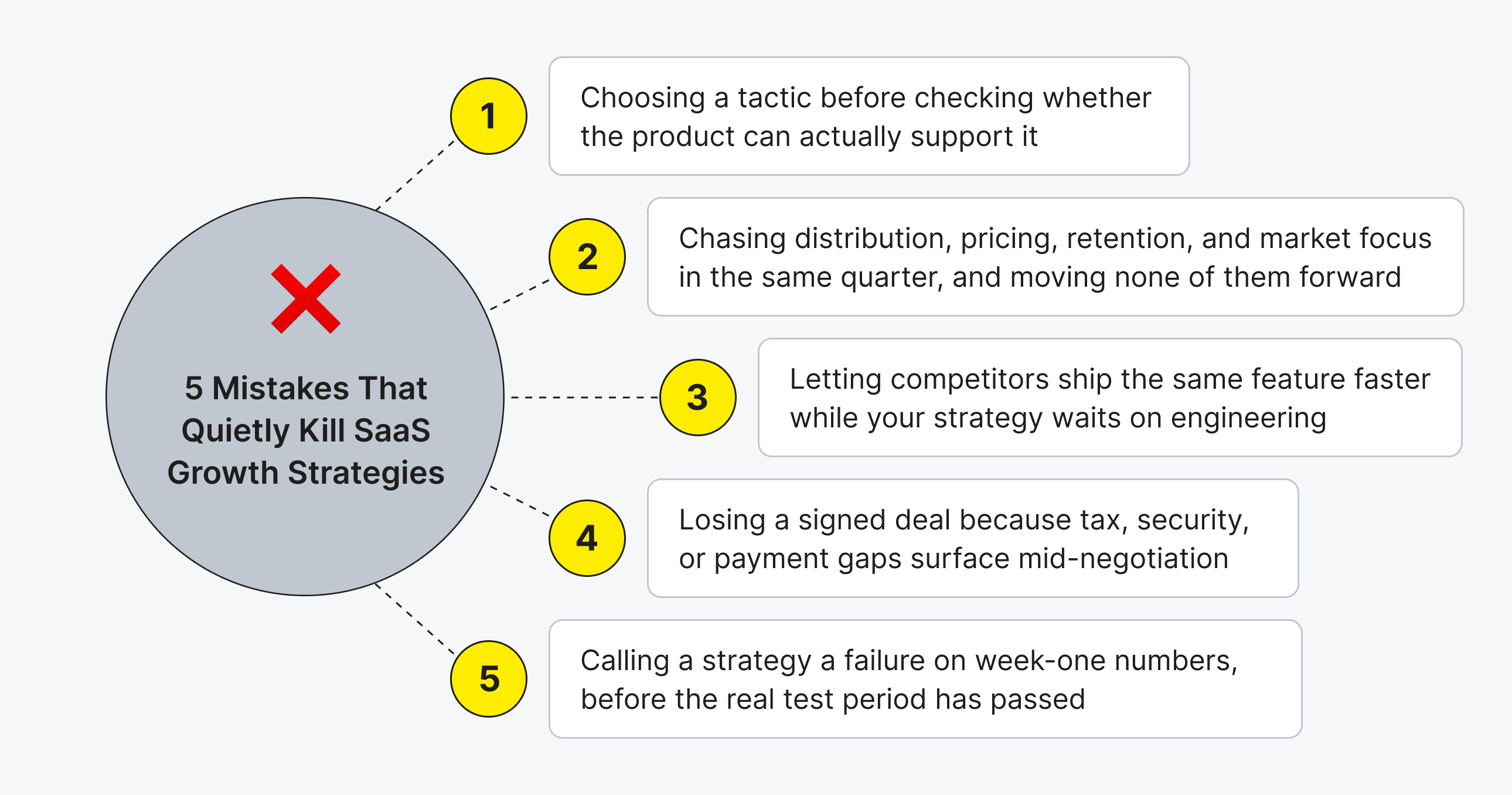
As we’ve said above, most B2B SaaS growth strategies don't fail because the idea was bad. They fail because of how they were run. Here are the five mistakes we see most often, and why each one quietly kills momentum before a strategy gets a fair shot.
Picking a Strategy the Product Isn't Ready For
This is the most common mistake, and the most avoidable one. A team decides to switch to usage-based pricing, but nobody checks whether the product can actually track usage. A founder wants community-led growth, but the product gives users no real reason to invite anyone in.
These aren't marketing failures. They're build failures that show up later, dressed up as SaaS marketing challenges. Before you commit to a strategy, ask a blunt question: does the product already do the thing this strategy depends on? If the answer is no, that's your first project, not the strategy itself.
Trying to Do Everything At Once
It's tempting to fix distribution, pricing, retention, and market focus in the same quarter. It feels productive. In practice, it spreads your engineering and marketing time so thin that none of the four gets what it actually needs to work. Pick the one lever that's holding growth back the most right now. Fix that. Then move to the next one. A team with real focus on one problem beats a team with scattered effort on four.
Treating AI Shipping Speed as Someone Else's Problem
If your growth plan leans on being ahead with AI features, speed isn't a background detail, it's the whole plan. A competitor who ships the same feature in two weeks while you take two quarters isn't just faster. They're taking the customers your strategy was supposed to win. This doesn't mean rushing sloppy releases. It means treating "how fast can we ship this" as a real growth question, not just an engineering scheduling issue.
Expanding Globally Before Payments and Compliance Are Ready
Nothing kills a good enterprise deal faster than discovering, mid-negotiation, that you can't meet a compliance requirement or accept the customer's preferred payment method. At that point, you're not fixing a small gap, you're holding up a signed deal while legal and engineering scramble.
Building this readiness in advance (tax handling, security documentation, regional payment support) takes real time. But it's far less time than fixing it under deal pressure, with a customer waiting and a sales team getting nervous.
Judging a Strategy Before It's Had Time to Prove Anything
This one is sneaky because it feels responsible: "let's check the numbers early." But checking a distribution loop after one week, or judging a pricing change before a single billing cycle has closed, gives you a number that simply isn't ready to answer your question yet.
Set your test period before you start, based on how long the underlying customer behavior actually takes to show up. Then wait for it. Early data isn't wrong, it's just too early to mean anything.
Look closely, and these mistakes share one root cause: skipping the groundwork and jumping straight to results. Check if the product supports the strategy, focus on one lever at a time, treat shipping speed as core to the plan, get compliance ready before you need it, and give each test the time it actually requires. Do that, and most SaaS growth strategies get a real chance to prove themselves: one way or the other.
Seeking help with building your product?
Upsilon has an extensive talent pool made up of experts who can help bring your ideas to life!
Concluding Thoughts on SaaS Growth Strategies
None of the eight strategies above are secret. Distribution built into the product, pricing that matches real usage, retention systems set up before churn becomes a crisis, global-ready payments, faster AI shipping, a narrower market, and outsourced infrastructure, none of this is revolutionary thinking. What's rare is a team that picks one, checks whether the product can actually support it, and commits real engineering and marketing effort to seeing it through instead of chasing the next SaaS idea the moment results feel slow.
The founders who get this right treat growth the same way they'd treat any other product decision: define the metric before you start, give it a fair test period, and be honest when the data says a strategy isn't working yet. AI hasn't changed that discipline. It's just raised the cost of skipping it, because customers now expect faster value and clearer pricing than they did two years ago, and the companies that ignore that gap are the ones quietly losing ground to competitors who don't.
If you're trying to figure out which of these levers your product is actually ready to pull, that's exactly the kind of conversation we have with founders every week. Explore our SaaS application development services to see how we approach it. Talk to us about where your product stands today, and we'll help you find the growth strategy it can actually support, not just the one that sounds good on a roadmap.
FAQ
1. What are the best SaaS growth strategies?

The strongest SaaS growth strategies for 2026 build distribution into the product itself, price usage or outcomes instead of seats, and treat community and AI feature speed as product decisions, not marketing add-ons. The best fit depends on the product: a self-serve tool benefits most from in-product distribution, while a sales-led product benefits more from a narrow, well-served market and global-ready payments.
2. How do SaaS growth strategies work?
A SaaS growth strategy works by matching a specific growth lever, distribution, pricing, retention, or market focus, to a product's actual stage and buyer. A pre-revenue product benefits most from a narrow market and a distribution loop built into the product. A scaling product benefits more from usage-based pricing and global payment readiness. Running every lever at once, with no product built to support any of them, is why most strategies fail to produce real growth.
3. What are community-led growth strategies for SaaS?
Community-led growth uses a product's own users to bring in new users, through in-product referral prompts, shared workspaces, public templates, or user-generated content, rather than through paid channels alone. It works when the product has a real reason for one user to invite another, a shared document, a collaborative workspace, a public result, not when a community forum gets bolted on as an afterthought.
4. What is different about B2B SaaS growth strategies?
AB2B SaaS growth strategies lean harder on account-based targeting, a narrow serviceable market, and sales-assisted onboarding than B2C strategies do, since a B2B buyer is seldom the same person as the end user. Global payment readiness and compliance matter earlier for B2B, since a single enterprise deal can require SOC 2 or regional data-handling guarantees a self-serve consumer product never faces..
5. How much does it cost to build the product work a growth strategy needs?
Usage-based billing infrastructure, a self-serve onboarding flow, or an in-product referral system each add $15,000 to $40,000 to a build, as a rule, depending on how much of the product already supports metering, account management, or sharing. Scoping this work before committing to a growth strategy avoids picking a strategy the product cannot support without a larger rebuild than planned.
6. Do SaaS growth strategies change because of AI?
Yes, AI has changed which SaaS growth strategies actually work, even though the core levers of acquisition, activation, retention, and expansion stay the same. Flat seat-based pricing breaks down once AI features carry real compute costs, which is why usage-based and hybrid pricing have become standard rather than optional. Shipping speed has also turned into a genuine growth lever, since customers see competitors' AI features almost immediately and a company two quarters behind loses ground on execution alone, while BCG argues a real AI upgrade should roughly double revenue or it's underpriced. What hasn't changed is the underlying discipline: a strategy still has to match what the product can actually support, AI has just raised the cost of skipping that check.



to top