MVP Marketplace: What It Is and How to Build One


Imagine you have an idea for a marketplace that could solve a real problem for thousands of buyers and sellers. It’s a strong business opportunity since the global e-commerce market is estimated at $36.21 trillion in 2026 and is projected to grow at an annual rate of 16.46%, reaching $77.58 trillion by 2031. But there is a wide gap between a promising idea and a working product. Which monetization model should you choose? How do you build trust between a buyer and a seller who have never met? And where should development begin without spending six months and the entire budget on the wrong things?
This is where a marketplace MVP comes in. It’s not a stripped-down version of the “real” product, but a way to test key assumptions with real users before investing in growth. Airbnb began with a basic booking form and a few apartments in San Francisco. Uber started with an app that manually connected drivers and passengers. Neither looked like the finished product, but both proved the one thing that mattered: there was demand, and the model could work.
In this article, we will explain what an MVP marketplace actually is, which features matter at launch, which ones can (and should) wait, and how to structure development so that an idea becomes a working product in weeks rather than months.
Key Takeaways
- A marketplace MVP tests whether a specific group of buyers and sellers will complete real transactions.
- Marketplace MVP development differs from a standard MVP because both sides must see value at the same time. Buyers need relevant supply, while sellers need a realistic path to demand.
- Build only the essentials: role-based onboarding, clear listings, one complete transaction flow, appropriate trust signals, and simple admin tools, as well as remember about the discovery phase before MVP development.
- A lean marketplace MVP typically costs $15,000 to $30,000; more complex payment flows, mobile apps, real-time features, verification, and multi-region support raise the budget.
- Avoid launching too broadly, building full feature sets for both sides, automating untested workflows, and expanding before one small market produces recurring transactions.
- The strongest sign of progress is simple: buyers and sellers return and transact without constant founder outreach.
What Is a Marketplace MVP?
A marketplace MVP is a simple first version of a platform that brings together two groups of users: buyers and sellers, clients and service providers, or hosts and guests. Its purpose is not to showcase every feature planned for the final product. It’s to find out whether people will actually make transactions through the platform.
When building an MVP marketplace, the question is more specific than “Does this idea work?” You need to learn whether a particular group of sellers is willing to list their offers and whether a particular group of buyers is ready to purchase from them. Most importantly, both sides need to show up at roughly the same time.
This is what makes marketplaces different from regular apps. A note-taking app is useful as soon as someone opens it and starts writing. A marketplace with sellers but no buyers offers little value to sellers; one with buyers but no listings gives buyers no reason to stay. Great search, polished MVP UX design, and smart matching algorithms can’t solve that problem on their own. A marketplace MVP is therefore not just a smaller version of the final platform, it’s a way to create enough supply and demand for the first real transactions to happen.
Marketplace MVP vs. General MVP
Before we dive deeper into marketplace MVP development, let’s clarify how a marketplace MVP differs from a general MVP. A general MVP answers a relatively simple question: Will people use this product? You build the smallest version of the main feature, put it in front of the right users, and watch what they do. If they sign up, complete the key action, and return, you have something worth improving.
A marketplace is harder because you aren’t building for one audience. You’re trying to make two groups arrive at the same place and see enough value to stay: buyers and sellers, clients and service providers, landlords and tenants, hosts and guests. A beautiful product doesn’t fix an empty marketplace. If there are no listings, buyers leave. If there are no buyers, sellers stop posting.
Here’s a quick side-by-side look at the differences that shape how you validate, scope, and build each type of MVP.
Don’t scope a marketplace MVP as if it were a standard app with listings and a checkout button. Start by identifying the side of the market that will be hardest to bring in, then design the first release around making that group participate.
For example, if skilled providers are scarce, recruit and support them before investing heavily in buyer acquisition. If supply is easy to find but buyers need confidence, focus on clear profiles, reviews, secure payments, and simple booking or ordering. Your first version succeeds when it creates repeatable transactions, not when it ships a long feature list.
%20for%20Startups.png)

The Cold Start Problem: Why Two-Sided Is Harder Than One-Sided
Andrew Chen, a venture capitalist who worked on marketplace growth at Uber and later joined Andreessen Horowitz, popularized the term cold start problem. It describes the first major challenge every new marketplace faces: neither side wants to arrive first.
Sellers have little reason to create listings if there are no buyers. Buyers have no reason to visit if there is nothing to buy, book, or compare. Both reactions make sense. But together, they can leave a founder with a polished platform and no activity on it.
A regular MVP usually has an easier job. It only needs one user group to find value in the product. A marketplace MVP needs to attract both sides before it can properly test the business idea. That’s why many marketplaces stall after MVP launch: the product exists, but no transactions happen because buyers and sellers are waiting for each other.
This is not a technology problem. A sophisticated matching algorithm won’t help if there is one provider on the platform and no customers. The real work is deciding which side to recruit manually first and giving that group a compelling reason to join before opening the marketplace to everyone else.
Once a marketplace has enough active supply and demand for users to find relevant matches consistently, it reaches liquidity. Your MVP doesn’t need to achieve liquidity across every city, category, and customer segment. It needs to create it in one focused area: for example, dog walkers and pet owners in one neighborhood, freelance designers and early-stage startups in one city, or short-ter\m rentals in a single destination. If transactions happen repeatedly within that small segment, you have evidence that the exchange can work before expanding it.
Which Side to Build First: Supply or Demand?
In most cases, start with supply. A buyer can visit an empty marketplace, leave, and perhaps come back later. But a seller who creates a listing and gets no interest may quickly decide the platform is not worth their time. Since sellers are usually fewer than buyers, it’s often more realistic for a founder to recruit the first 10 or 20 providers personally before bringing buyers to the platform.
This work is not glamorous, and it doesn’t scale. That’s exactly why it makes sense at the MVP stage. Calling local businesses, messaging freelancers, or meeting potential providers one by one helps you learn something a matching algorithm cannot tell you: whether this specific group actually sees value in joining your marketplace.
Starting with demand can work, but only in certain cases. For example, supply may already be easy to access through public data, an existing catalog, or a directory that sellers don’t need to update manually. Then the main question is whether buyers want a better way to search, compare, or book those options. Still, this is the exception. For most new marketplaces, manually building the first supply base is the more reliable place to start.
What Should Be Included in a Marketplace MVP?
An MVP marketplace should do one thing well: help a specific buyer find a suitable seller or provider and complete a real transaction. Not browse. Not join a waitlist. Not say they would pay someday. Complete a booking, place an order, send a request, or make a payment.
That sounds obvious, but it’s where many startups lose months. They build polished profiles, complex dashboards, AI matching, dozens of categories, and a mobile app; and then they discover that users don’t trust the platform enough to transact. Your early product is not a smaller Amazon, Airbnb, or Upwork. It’s a focused test of one exchange between two clearly defined groups.
A useful way to scope it is to follow the transaction backward. Ask: What has to be true for this buyer to confidently buy, book, or hire from this seller? Then build only what supports that path. So, what should be included in a marketplace MVP?

1. Role-Based Sign-Up and Onboarding
Buyers and sellers come to the marketplace with different goals, so they shouldn’t receive the same experience. A buyer needs to quickly understand what they can find, how much it costs, and what happens next. A seller needs to know who the customers are, what they must provide, and why listing is worth the effort. Your onboarding should answer those questions without turning registration into a form-filling exercise.
For an MVP, keep it simple:
- Let users select their role at sign-up;
- Ask only for the information needed to make a transaction possible;
- Show sellers exactly how to create their first listing; and
- Explain fees, payment timing, and platform rules before they invest time.
You can collect extra details later. At the beginning, every unnecessary field reduces the number of people who reach the important part: publishing supply or making a request.
2. Listings Buyers Can Compare Side by Side
Listings are the inventory of your marketplace. If they are incomplete, inconsistent, or vague, buyers can’t make a confident decision and no amount of clever product design will fix that.
Each listing should include the decision-making basics:
- A clear title and short description;
- Price or a transparent way to request a quote;
- Photos, examples, or other proof of quality;
- Availability, location, delivery terms, or turnaround time; and
- The information that matters most in your category.
For a local tutor marketplace, that could mean subject, level, price, and available MVP timelines. For a B2B services platform, it may be industry expertise, typical project scope, portfolio examples, and response time.
We recommend founders not to build a flexible listing system that supports every possible business model. Pick one category and make its listings easy to compare. A narrow, consistent supply base is far more useful than a large catalog filled with unclear offers.
3. Search, Filters, and Category Pages
Buyers need a way to find relevant supply without asking the founder to intervene. But “search” doesn’t automatically mean a sophisticated search engine.
At the MVP stage, discovery can be surprisingly basic:
- A category page;
- Keyword search;
- Location, price, or availability filters;
- A short, curated selection of providers; and
- Manual matching after a buyer submits a request.
The right option depends on the type of marketplace. If buyers know exactly what they want, search and filters matter. If they need help defining the problem, such as hiring a specialist for a complex project, a structured request form and manual matching may work better.
The test is simple: can a new buyer reach a relevant option quickly enough to take the next step? If yes, you don’t need recommendation algorithms yet.
4. One End-to-End Transaction Flow
This is the heart of your product. A marketplace without transactions is a directory, a content site, or a lead-generation tool. Those can be valid businesses, but they validate different assumptions.
Choose one transaction model and make it work end to end:
You don’t need to automate every part of the flow. You can confirm availability manually, process payouts manually, or personally help both sides resolve an issue. In fact, manual operations are useful early on because they reveal where users hesitate, what information is missing, and why transactions fail.
5. Trust Signals: Profiles, Verification, and Reviews
A marketplace asks people to deal with strangers. That creates risk in the buyer’s mind: Will this seller deliver? Is the listing real? What happens if something goes wrong? Sellers have their own concerns: Will I get paid? Are these buyers serious? Will the platform protect my time?
We don’t ask you to build enterprise-grade fraud prevention for an MVP. But you should provide visible signals that the marketplace is real and someone is accountable.
Start with the basics:
- Seller or provider profiles with real names, photos, and relevant details;
- Verified email and, where appropriate, phone verification;
- Clear cancellation, refund, and payment policies;
- Reviews or ratings if you can collect them honestly;
- Simple moderation of users and listings; and
- A visible support channel for problems.
Trust requirements rise with transaction value and risk. A marketplace for handmade stationery can launch with lighter safeguards than a platform for real estate, healthcare services, childcare, or high-value equipment rentals. Match your trust layer to the downside of a bad transaction.
6. An Admin Layer for the Founder
In the first version, you’re part of the product. That is not a weakness, it’s how you learn. You need a basic admin view, even if it’s a simple internal dashboard combined with spreadsheets and email. It should let you see and manage:
- New user registrations;
- Listings awaiting approval;
- Search or request activity;
- Orders, bookings, or payments;
- Cancellations and failed transactions; and
- Support issues and types of user feedback.
Early marketplace operations are often manual because automation hides the very problems you need to understand. If ten buyers abandon the booking flow, speak to them. If sellers don’t finish their profiles, find out where they stop. Build automation after the pattern is clear, not before.
7. Liquidity Metrics and Event Tracking
Vanity metrics are especially dangerous in marketplaces. A thousand sign-ups mean little if nobody can find a suitable match. Fifty listings mean little if none receive inquiries.
Track the events that show whether the exchange is becoming active:
- Sellers who complete a listing;
- Buyers who search, browse, or submit a request;
- Buyers who contact or select a seller;
- Requests that turn into completed transactions;
- Time from buyer intent to a successful match;
- Sellers who receive their first order or booking; and
- Buyers and sellers who return.
At the beginning, focus on one narrow segment: one city, one service type, one price range, or one buyer profile. You don’t need liquidity across the entire marketplace. You need enough relevant supply and demand in one corner of it for users to repeatedly find a match. Start with the simplest transaction-enabling platform and learn from actual user behavior before adding complexity.
What to Leave Out of a Marketplace MVP
The best MVP decisions are often about what you refuse to build. Leave these for later unless they are essential to the core transaction:
- Native iOS and Android apps;
- AI recommendations and personalized ranking;
- Complex seller analytics;
- Loyalty programs and referral systems;
- Multiple languages, currencies, or regions;
- Advanced dispute workflows;
- Deep integrations with third-party tools;
- Several categories with different transaction models; and
- Full automation of onboarding, moderation, support, and payouts.
A feature belongs in the MVP only if removing it breaks the first successful transaction or makes it too risky for one side to participate. Everything else can wait until real usage tells you it matters.
The strongest marketplace MVP is not the one with the longest feature list. It’s the one that makes a small group of people say, “I found what I needed here,” and then come back to do it again.
Planning to build an online marketplace?
If you're not sure what features to choose, feel free to reach out to Upsilon to discuss your needs.

How to Build and Launch a Marketplace MVP in 7 Steps
An MVP marketplace is less like building a shopping mall and more like opening one busy stall at a weekend market. Your goal is not dozens of categories, a perfect loyalty program, or an app in every pocket. Just bring together the right sellers and buyers, give them a clear reason to engage, and make the first transaction easy to complete.
How to create an online marketplace MVP? The following seven steps below will help you move from an idea to those first real transactions without turning an early test into a year-long software project.

Step 1. Choose One Narrow Market
Define one supply-and-demand pair with enough specificity to recruit manually. “Freelance photographers” is a category. “Wedding photographers available for small ceremonies in Miami” is a testable market. The narrower version gives you a clearer outreach list, a more focused landing page, and a realistic chance of reaching early liquidity.
Step 2. Validate the Problem With Both Sides
Talk to potential buyers and suppliers before development starts. Ask suppliers how they currently find customers, what they dislike about that process, and what would make them try a new platform. Ask buyers how they currently search, compare options, and decide whom to trust. Look for repeated pain points, not polite encouragement. “That sounds interesting” is not startup idea validation. “I would list next week if you can bring me qualified leads” is much stronger.
Step 3. Recruit Initial Sellers Manually
Aim for ten to twenty real providers, sellers, or hosts before inviting buyers. You’re not required to develop a complex self-service onboarding flow to begin. You can collect listing information through a form, spreadsheet, email, or short call, then create the listings yourself. Manual onboarding helps you improve the information architecture before you commit it to code.
Step 4. Build the Thinnest Transaction Layer
Create a simple experience that lets customers browse listings, compare options, and initiate the core action. At this stage, the transaction may be:
- A booking request;
- A purchase with basic checkout;
- A quote request;
- A consultation request;
- A manually confirmed order; and
- A payment link sent after confirmation.
A marketplace can use manual workflows at the beginning, but users should still experience a clear and reliable journey. The product can launch without every automation, but the exchange must feel credible.
Step 5. Operate the First Transactions Yourself
Be involved in the first ten or twenty transactions. Confirm bookings, answer questions, resolve misunderstandings, follow up on payments, and speak to both sides after the exchange. This is where you learn which problems are real and which features are only assumptions. Many marketplace founders discover that their first product is not a piece of software. It’s a manual operating process supported by enough software to make that process repeatable.
Step 6. Launch Demand Only When Supply is Ready
Sending paid traffic to an empty marketplace wastes budget and creates a poor first impression. Once real listings exist, introduce a small, focused demand channel: a local partnership, community outreach, targeted ads, industry newsletters, content, or direct sales. Don’t try every acquisition channel at once. You need to know which channel can reliably bring the right type of buyer into your narrow market.
Step 7. Measure Repeat Behavior
Signups matter less than completed and repeated transactions. Track metrics such as:
- Active suppliers with complete listings;
- Search-to-contact or search-to-booking conversion;
- First transaction rate;
- Time to first transaction;
- Transaction completion rate;
- Repeat purchase or booking rate;
- Supplier retention; and
- Cancellation and dispute rate.
The strongest early signal is simple: do buyers and sellers come back without being pushed? If they do, congratulations! Your MVP is starting to create value on its own.
How Much Does Marketplace MVP Development Cost?
The next important question is the cost of a marketplace MVP. A tightly scoped local or niche platform can start closer to $15,000–$20,000, while a marketplace involving advanced payments, several user roles, complex AI functionality, or compliance requirements can cost $50,000–65,000 or more. The right budget depends less on the number of screens and more on the number of workflows that must work safely for two different user groups.
Here is a practical breakdown of typical marketplace MVP budgets, the MVP scope behind each range, and the time it usually takes to get to launch.
A standard MVP across industries usually falls between $30,000 and $65,000, but marketplaces tend to sit toward the upper part of that range because they require multiple roles, transaction infrastructure, and operational controls.
What Drives the Price
The biggest cost drivers are usually not visual design. There are operational and financial complexity.
- Marketplace payments and payouts. Splitting payments between sellers, platform fees, refunds, and payout schedules adds complexity.
- Escrow. Holding funds until a service is delivered introduces additional technical, compliance, and operational requirements.
- Mobile apps. Native iOS and Android development can significantly increase scope compared with a responsive web MVP.
- Real-time features. Live availability, chat, tracking, bidding, and dispatch require more infrastructure and testing.
- Multiple categories. Each new category can bring unique listing fields, search rules, policies, and transaction flows.
- Trust and safety. Verification, fraud prevention, moderation, disputes, and insurance are essential eventually, but should be introduced in proportion to real risk.
The practical move is to budget for the smallest version that can create real transactions and then reserve time and money to improve the workflows users actually use.

A Real Marketplace MVP Example: DoorDash
DoorDash is a useful example because its first product looked nothing like the global delivery platform it later became. It began in January 2013 as Palo Alto Delivery. Its first version was very simple: a webpage with PDF menus from eight local restaurants and a phone number for orders. When someone called, one of the founders would go to the restaurant, pick up the food, and deliver it personally. There was no mobile app, driver network, or automated dispatch system — just four students testing whether customers would order food and whether restaurants would accept delivery orders.
This manual setup gave the founders a clear answer. Customers wanted food from restaurants that didn’t offer delivery themselves. Restaurants wanted extra orders without hiring delivery staff. Once both sides showed real interest, the team renamed the company DoorDash in June 2013 and joined Y Combinator with $120,000 in seed funding.
The main lesson goes far beyond food delivery. DoorDash didn’t start by building a driver-matching algorithm, a restaurant dashboard, or a rating system. The founders first proved that restaurants and customers wanted the basic exchange. Only then did it make sense to invest in technology that could automate and scale it.
Mistakes That Sink a Marketplace MVP
Building an MVP is not a guarantee of success, especially when it’s based on assumptions rather than real customer behavior. In Failory’s review, 29 of 83 failed startups or roughly 35% ultimately found that they had built something the market didn’t need. A marketplace MVP helps expose that risk earlier by testing whether buyers and sellers will actually transact, not merely sign up or express interest.
What MVP mistakes should founders avoid to give their MVP a real chance to attract users and avoid failure?

Building Full Feature Sets for Both Sides
A polished seller dashboard and a polished buyer app don’t create liquidity. If no one has been recruited and no transactions are happening, the product is solving a future problem before proving a present one.
Launching Both Sides At Once
Waiting for supply and demand to appear organically is not a go-to-market strategy. Seed one side deliberately, create enough useful inventory, and then bring in the other side.
Automating Before Learning
Automated payments, matching, cancellations, and dispute processes encode assumptions. Manual operations reveal where those assumptions break before they become expensive product decisions.
Measuring Signups Instead Of Transactions
A thousand registrations may prove interest. They don’t prove that users trust the platform enough to buy, sell, book, or return.
Choosing a Category That is Too Broad
“Local services” and “freelancers” are difficult to seed because they include too many different needs. Start with a segment you can understand, recruit, and reach with one clear message.
Expanding Before One Market Works
Adding new cities, categories, and user types too early spreads supply and demand too thin. A small market with recurring transactions is more valuable than a large platform with empty search results.
Follow these principles, and your MVP will have a far better chance of earning real attention instead of becoming another unfinished idea. Stay focused, launch early, listen to user behavior, and let real demand guide what you build next.
Building Your Marketplace MVP With the Right Team
It’s not difficult to build a marketplace MVP. It becomes harder because every product decision affects two user groups, the transaction between them, and the operational process behind the interface. The right software development team helps you decide what to keep manual, what to automate first, and what can wait until users have proven it matters. That means challenging feature requests when necessary, not simply turning a long backlog into code.
At Upsilon, we help startups turn early-stage product ideas into working MVPs and continue supporting them as the business grows. Our teams combine product discovery, UX/UI design, web and mobile development, integrations, QA, and post-launch iteration, so founders can move from an initial concept to a product that is ready for real users.
LiveArt: From MVP to Art Marketplace
Our clients have grown from early MVP-stage companies into businesses serving global markets and generating nine-figure outcomes. One example is LiveArt, a US-based marketplace created for art collectors. The company set out to address three long-standing barriers in the art world: difficulty pricing artworks, the conflict between sellers’ privacy concerns and their wish to sell, and high transaction costs.
Upsilon’s team joined the project at the MVP stage. The first major task was building an art database with information on thousands of artists and millions of artworks, along with estimated market values calculated by LiveArt’s AI algorithm. This created the foundation for a product where collectors could explore the market and make more informed decisions.
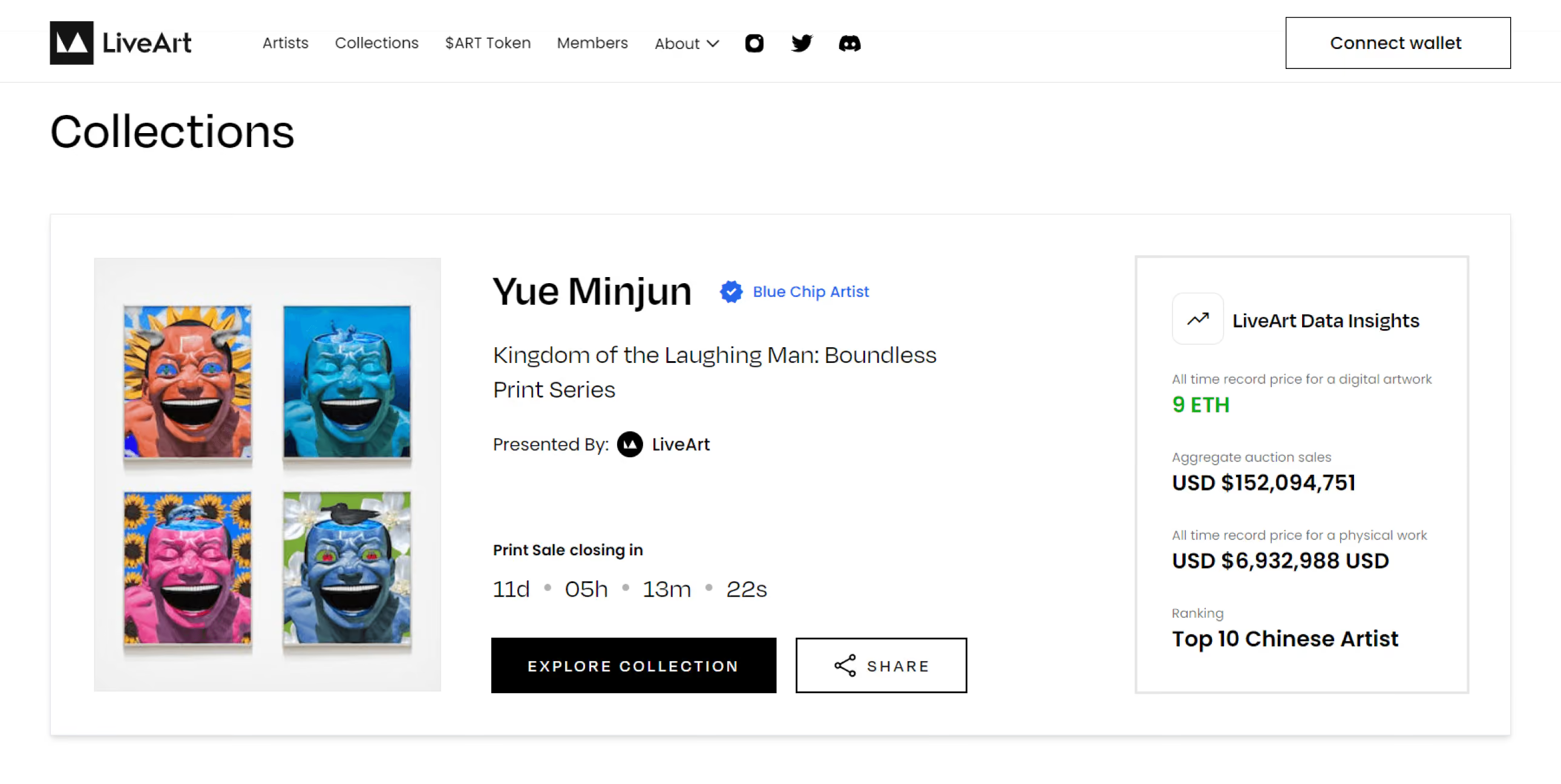
After the MVP launch, LiveArt grew into a broader digital marketplace for the art world. We continued working with the company on iOS and Android apps, live auction broadcasting, LiveArt Analytics features such as sharing, deep links, and global search, as well as LiveArt Market, now called LiveArt Trading Floor, and LiveArtX, the Web3 and NFT-focused division of the platform.
What Upsilon delivered:
- An MVP art database covering thousands of artists and millions of artworks;
- AI-powered estimated market values for artworks;
- iOS and Android mobile applications;
- Live auction sales broadcasting;
- Analytics functionality, including sharing, deep linking, and global search;
- Marketplace functionality for LiveArt Trading Floor and LiveArtX.
The LiveArt story shows what a marketplace MVP is meant to do: establish the core value proposition, bring early users into the product, and create a solid base for expansion. The first release didn’t attempt to digitize every part of the art market. It began with the data and pricing insight collectors needed, then evolved into a much larger marketplace ecosystem.
Explore the full LiveArt case study to learn more about the product, technical scope, and Upsilon’s role in its development. If you are planning a marketplace MVP, we can help shape the scope, build the first version, and provide a dedicated development team as the platform grows.
Seeking help with building your product?
Upsilon has an extensive talent pool made up of experts who can help bring your ideas to life!
Final Thoughts on MVP Marketplace Development
At the beginning of this article, we compared a marketplace MVP to one busy stall at a weekend market. That comparison holds until the very end. Before thinking about a shopping mall, parking, loyalty cards, or a second location, see whether people stop at the stall, ask questions, make a purchase, and come back next Saturday.
That is what an early marketplace is for. Put a small but relevant selection in front of a clearly defined group of buyers. Stay close enough to see why one listing gets attention while another gets ignored. If a booking falls through, find out what broke. If sellers hesitate to join, hear the objection in their own words instead of guessing from a dashboard.
The turning point is not a flashy launch or a long feature list. It’s the moment when the marketplace starts producing small signs of pull: a buyer asks when new options will appear, a seller checks for incoming requests, and two people complete a transaction without the founder standing between them. Make that happen in one narrow corner of the market first. Everything else is easier to build once there is something real to build on.
If you are planning to build a marketplace MVP and want to validate demand before investing in a full-scale platform, explore our MVP development services. Our team can help you define the core transaction flow, prioritize essential features for both sides of the marketplace, choose the right technology, and build a functional product ready for early users. Feel free to contact us to discuss your marketplace idea.
FAQ
1. What is an MVP marketplace?

An MVP marketplace is the smallest working version of a two-sided platform, one that connects a specific type of buyer with a specific type of seller, built to test whether both sides show up before a founder invests in a full-featured build. It answers one question: will real supply and real demand meet on this platform, not only whether the idea sounds good on paper.
2. How do I create an online marketplace MVP?
Pick one narrow supply-and-demand pair first, not a broad category. Recruit the harder side by hand, call or message real sellers or providers one by one, before building any matching or payment automation. Launch with a page, a form, and a manual process behind it, then automate only the steps that are proven to matter once real transactions are happening.
3. What's the difference between a marketplace MVP and a regular MVP?
A regular MVP has to satisfy one type of user. A marketplace MVP has to satisfy two, and neither side shows up without the other already being there, the cold start problem a single-sided product never faces. That difference changes what gets built first: a regular MVP starts with the core feature, a marketplace MVP starts with whichever side is harder to recruit.
4. How much does marketplace MVP development cost?
A lean marketplace MVP with manual matching and basic payments starts around $15,000 to $30,000, more than a single-sided MVP because listings, matching logic, and two-sided trust features (reviews, verification) all need to exist even in a thin first version. A discovery sprint scopes the real number against the specific marketplace before a larger build gets quoted.
5. Should I build the supply side or the demand side first?
Build whichever side is harder to recruit, almost always supply. A buyer will look at an empty marketplace once and leave; a seller who signs up and gets no buyers churns the same way, but sellers are fewer in number and easier to recruit one by one before any buyer ever sees the platform.
6. What features does a marketplace MVP need at minimum?
A way for one side to list what they offer, a way for the other side to find and select a listing, a way to complete a transaction (even a manual one), and a way to measure whether both sides came back a second time. Reviews, messaging, and automated matching are the features to leave out of a true first version.



to top