


AI MVP Cost: What You Pay For at Each Stage

Two AI MVPs can look almost identical in a demo and require very different budgets. One answers questions from a small set of approved documents. The other handles private customer data, connects to business systems, and needs permission before taking action. The interface may be similar, but the work behind it is not.
Those differences matter beyond the initial build. Gartner predicts that more than 40% of agentic AI projects will be canceled by the end of 2027, citing escalating costs, unclear business value, and inadequate risk controls. While that forecast covers agentic AI projects rather than AI MVPs specifically, it highlights why a convincing demo is not enough to justify further investment.
That’s why a useful estimate starts with what the product must do and what it must not do. If you’re working out the cost to build AI SaaS MVP functionality, accounts, billing, and usage limits also need a place in the plan. In this guide, we break down what you pay for at each stage, which expenses continue after launch, and where you can reduce scope without losing the ability to test your idea.
Key Takeaways:
- The AI MVP cost depends on what the system must accomplish, which data and integrations it needs, and how its results will be checked.
- Budget for the complete journey: optional technical validation, discovery, development and launch, and the first months of operation.
- Evaluation, guardrails, and human review need explicit ownership and budget, not a vague promise that the AI will work.
- For a subscription product, include account structure, billing, customer data separation, usage metering, and plan limits.
- A detailed preliminary estimate can reveal opportunities to reduce scope before development begins. Treat it as a planning tool, not a final quote.
What Does an AI MVP Budget Include?
When you search for “how much does it cost to develop an AI app,” you’re usually weighing a bigger decision: can you afford to build the first version, get it into customers’ hands, and learn enough to justify the next investment?

An AI app development cost estimate gives you a starting point. You also need to understand what the team will deliver, what you will need to contribute, and which expenses continue after launch. Otherwise, you can approve a build that fits your budget and still run short of money before the pilot produces useful evidence.
Start with the kind of product you are building:
These categories overlap. A custom product with a $60,000 budget might be an assistant or a narrowly scoped agent; the requirements determine where it falls. These are not separate packages or amounts to add together.
The cost to build an AI app becomes useful when it describes a specific first release. “An assistant for our support team” could mean answering questions from one approved knowledge base or accessing customer accounts and taking actions. The interface might look similar, but the responsibilities behind it are different.
Before comparing quotes, check whether the team is building a new application or adding AI to an existing one. Clarify who prepares the data, what counts as an acceptable result, and whether design, testing, and deployment are included. A complete budget should make the following work visible:
These categories don’t have to be separate engagements. Feasibility testing might happen within discovery, and deployment might be included in development. What matters is that each responsibility is accounted for once, with a clear owner. Discovery is usually scoped separately, with an indicative budget of $6,000–10,000, so confirm whether it is included before calculating your total.
Your own contribution belongs in the plan too. If the project needs you to approve source material, review answers, or provide access to business systems, make those expectations explicit. They may not appear on an invoice, but they still require time.
Finally, check exclusions such as marketing, taxes, legal work, new features, and third-party charges. An AI app development cost estimate should help you understand the full commitment, not just the price of reaching launch. A lower quote is only useful if it still includes the work needed to put the product in front of customers and evaluate the results.
What AI Adds to a Regular MVP Budget
Adding AI doesn't make ordinary product work disappear. The application still needs screens, accounts, backend logic, integrations, deployment, and analytics. AI adds another set of responsibilities around data, outputs, actions, and quality.
Your AI MVP cost needs to account for both. Connecting a model is part of the job, but so is preparing the information it uses, checking its outputs, and deciding what happens when it gets something wrong.
For comparison, a product without AI typically falls into one of these categories:
These ranges cover the complete product. A focused AI assistant can cost less than a complex application without AI because the scope and requirements determine the workload.
Breaking out AI-specific work makes an MVP development cost estimate easier to review. If the proposal groups everything under “AI integration,” ask for a breakdown. You should be able to see what each area involves, why it’s needed, and how it contributes to the first release.
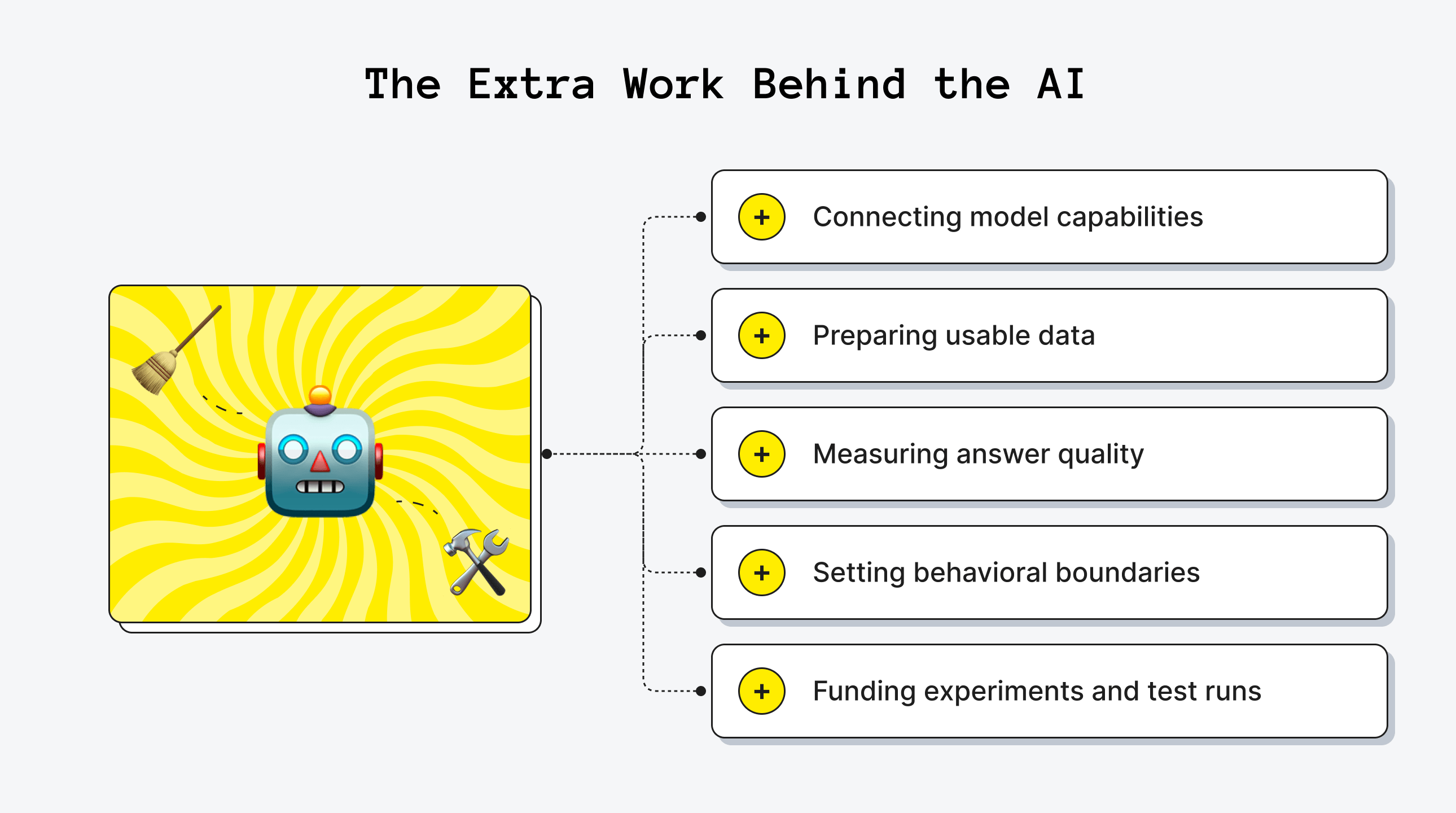
So, how does AI affect your MVP development cost? The estimates below illustrate the extra work for a focused assistant with prepared source material, limited integrations, and straightforward permissions. They form part of the overall development budget when included in scope.
Model Integration
The team connects the model, writes and tests instructions, and brings responses into the user workflow. It also needs to handle timeouts, unavailable services, and unexpected output formats—the cases that a successful demo can easily leave out. Allow approximately $4,000–15,000 for this work as an initial planning assumption.
Data Preparation
AI data preparation covers reviewing, cleaning, organizing, and processing your documents and examples for the intended task. Someone also needs to resolve outdated or conflicting information and define how the content will stay current. An illustrative budget is $2,000–10,000, depending on the volume, condition, and variety of the material.
Evaluation
The team needs a repeatable way to check whether the AI performs the task well enough. This includes representative test cases, acceptance criteria, scoring runs, and expert review, including difficult requests and cases the system should decline. Set aside approximately $2,000–6,000 for the initial evaluation workflow, with ongoing review budgeted separately.
Guardrails and Permissions
Define what the AI can access, which actions it can take, and when it should ask for approval or hand the task to a person. For a tightly scoped assistant, $1,000–4,000 is an illustrative allowance for a limited set of agreed controls. Complex permissions or actions with financial consequences require a separate estimate.
Development-Time Service Usage
Experiments, testing, and evaluation consume paid services before customers ever use the product. Providers may charge for model usage and certain tools separately, so clarify which expenses are included in the development proposal. A preliminary allowance of $100–1,000 can serve as a placeholder until the team estimates the actual testing workload.
These amounts are planning assumptions rather than fixed rates. Confirm what the development estimate already includes before treating any line as an additional expense.
Now that you know what makes up your MVP cost, let’s look at when those expenses arise: from the first feasibility check to the first months after launch.


AI MVP Development Cost by Stage
You don’t have to commit the entire budget before you know whether the idea works. Each stage should resolve a specific uncertainty and give you something concrete to review before the next investment. The table below separates the work needed to reach launch from the expenses of operating the product afterward.
Discovery and general maintenance figures follow the same budgeting assumptions as the rest of this article. Development ranges describe alternative product scopes, rather than amounts to add together. AI service usage and additional review should be estimated explicitly, with any overlap in hosting or support removed.
The important distinction is between your development budget and your initial funding requirement. Confirm whether discovery and any feasibility testing are included in the proposal, then reserve enough to operate the product while you gather customer evidence. A budget that reaches launch but leaves no room for learning is incomplete.

1. Proof of Concept
Start here when a technical uncertainty could undermine the whole product. Use representative inputs to check whether the AI can complete the core task at an acceptable level, including the awkward cases you expect customers to bring. Agree in advance on what would justify proceeding, changing the approach, or stopping. If discovery already includes this experiment, keep it within that scope rather than paying for the same work twice.
2. Discovery
The discovery phase turns the idea into a release the team can estimate and build. This is where you settle questions about supported workflows, data access, integrations, permitted actions, and acceptable results—all decisions that shape your AI MVP development cost. Make your own responsibilities visible too: approved content, system access, and expert feedback need owners. By the end, you should understand what the team will deliver, what you must provide, and which unresolved assumptions could change the estimate.
3. Development and Launch
The team builds the application and its AI workflow, checks results against the agreed criteria, and prepares the product for real users. Ask for reviewable milestones so you can catch misunderstandings while there is still room to correct them. Before launch, confirm that permissions, failure handling, monitoring, and handover are covered. You should know who owns the service accounts, where usage is tracked, and how issues will be reported.
4. First Months of Operations
Once customers start using the product, compare actual behavior with the assumptions behind the estimate. Review weak outputs, failed tasks, manual intervention, and operating expenses alongside product usage. Give that review process an owner and define what support includes. Fixing the agreed workflow and adding a new capability are different commitments; keeping them separate helps you decide where the next investment will make the greatest difference.
Need a hand with generative AI development?
Upsilon is a reliable tech partner with a big and versatile team that can give you a hand with creating an AI solution.

What Does an AI MVP Cost After Launch?
The cost of AI app development is only part of your total investment. Once customers start using the product, your budget becomes a mix of recurring service bills and ongoing work. Some expenses remain fairly predictable; others change with the number of tasks completed, the amount of data processed, and the attention each result needs.
For initial planning, use the breakdown below. The monetary ranges are illustrative allowances for a small, text-based MVP using external AI services. They are not spending caps, and the labor estimates need to be converted into costs using your reviewer’s or development team’s rate.
Service pricing supports low starting costs, but it doesn’t establish a universal monthly total. Hosting platforms charge separately for resources such as application compute, databases, storage, and bandwidth. The model bill needs its own calculation. A customer request may trigger several calls, retries, or paid tools, so ask the team to estimate the cost of completing the task. Provider pricing can include both token charges and additional tool charges.
Human review deserves an equally explicit place in the plan. As a simple workload example, checking 100 answers at an assumed 90 seconds each takes 2.5 hours. More complex tasks may require much longer. Agree on who reviews results, which cases deserve attention, and how findings become fixes or new test cases. If you handle the review yourself, account for that time alongside your other responsibilities.
Model upkeep is less regular. A quiet month may require little intervention, while a model change or a newly discovered failure can trigger testing and adjustments. Treat the quarterly allowance as a reserve to revisit, rather than a promise that every update will fit within it.
Finally, reconcile these items with your maintenance agreement. The general maintenance reference of approximately 15–20% of the initial build cost annually may already cover hosting, routine fixes, and dependency updates. Avoid adding those expenses twice, and identify AI usage and additional review separately.
Before launch, prepare an expected-use budget and a higher-activity scenario. That gives you a practical answer to two questions: what will the pilot cost to run, and what needs to change if customers use it more than expected?


What Changes When the AI MVP Is a SaaS Product?
The cost to build AI SaaS MVP functionality depends on what the base application already includes. Once you serve multiple paying customers, you need to think beyond the AI feature: how people create accounts, invite colleagues, pay for access, and stay within their plan’s allowance.
Organizations, roles, customer data separation, recurring billing, usage metering, and account administration belong in the first-version scope. Leaving those decisions until the AI workflow is complete can mean revisiting work you have already paid for.
Define Accounts and Billing Early
Decide whether customers pay per user, workspace, organization, or subscription tier. Identify which billing states the launch version must handle, including renewals, failed payments, plan changes, and cancellation.
A single-role SaaS MVP typically costs $20,000–35,000, while a multi-tenant B2B version with team accounts, permissions, and integrations falls within $35,000–65,000. These are general SaaS product references, not extra fees to add automatically to an AI estimate. Accounts, billing, and onboarding are core parts of SaaS MVP development, so include them in the scope alongside the AI workflow from the start.
Make Customer Data Separation Explicit
If two companies use your product, each needs clear boundaries around its information. Plan SaaS authentication alongside roles and customer-account boundaries: who can sign in, what they can access, and which organization they are acting within. Define how permissions are checked and how that separation will be tested.
Work through ordinary situations too. What happens when someone leaves a team, changes roles, or shares a result with a colleague? Those questions help turn a broad requirement like “secure customer data” into behavior the team can implement and verify.
A product built for one customer may need architectural changes before it can serve several independent organizations. Address account structure and data boundaries while the first version is being designed.
Connect Usage to Subscription Economics
Before choosing plan allowances, estimate the service expenses generated by an average customer and a heavy customer. Include model usage, relevant tool charges, allocated infrastructure, and direct operational work.
A subscription can look attractive on paper while leaving little room for customers who use the AI frequently. You need to understand that exposure before promising a generous allowance or unlimited access.
Make the limits clear in the product as well as the pricing page. If a plan includes a particular volume of activity, define how it is measured, whether customers can see their remaining allowance, and what happens when they reach it.
Validate Renewal, Not Just Signups
A signup tells you someone was interested enough to try the product. The next question is whether they get enough value to return and renew. Include activation, meaningful repeat usage, and renewal in the measurement plan from launch. For the AI workflow, define the action that represents value: completing a task, producing an accepted result, or reaching another outcome relevant to the customer. Subscription validation depends on that continuing value, not simply access to a functioning feature
How to Reduce AI MVP Costs Without Cutting Validation
When your generative AI app development cost estimate comes back higher than you hoped, look at the scope before cutting the work that helps you judge quality. The aim is to build a smaller first version that still answers the question you need to resolve: will customers get enough value from this product?
Start With a Draft Estimate
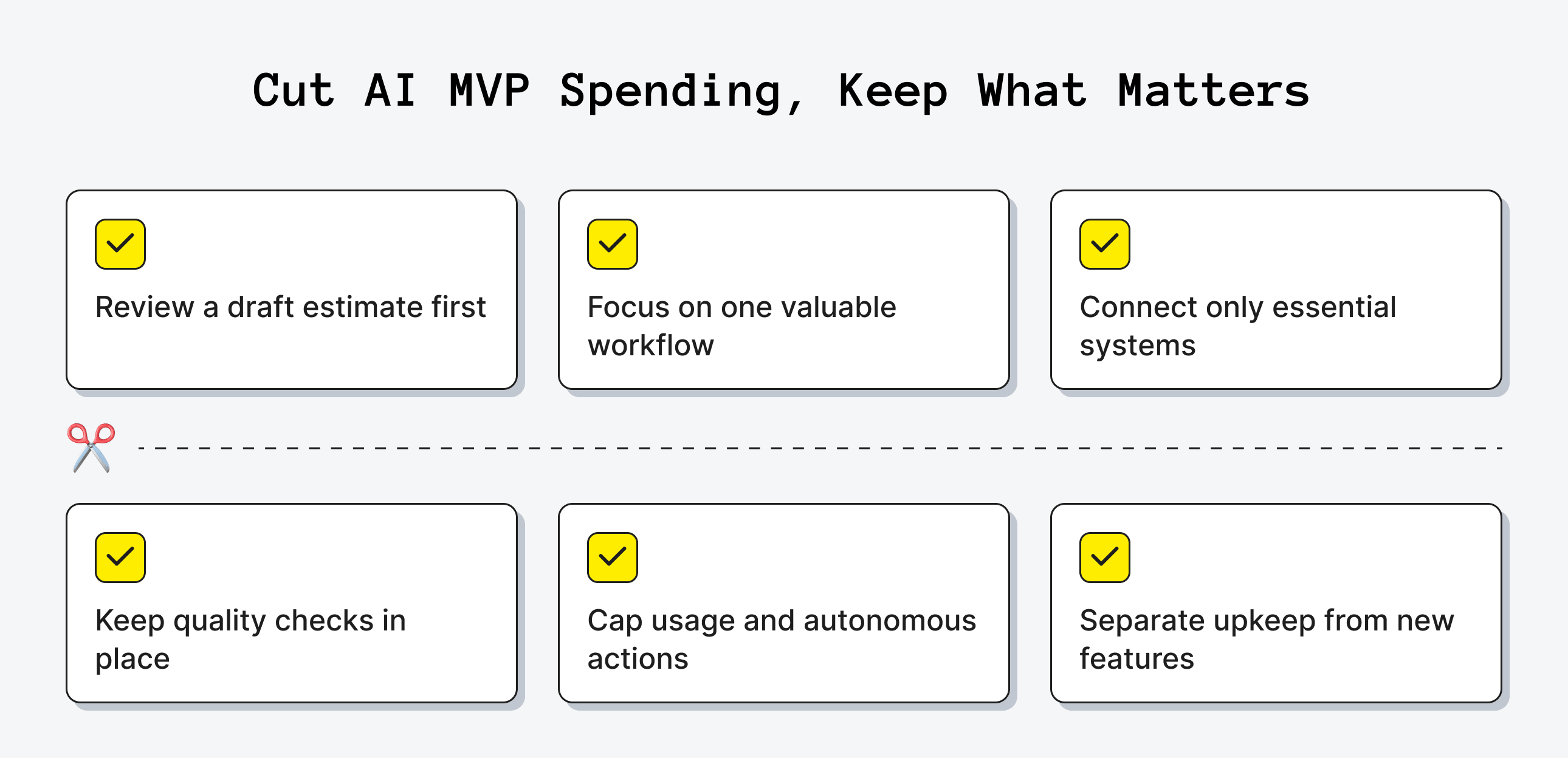
Put the idea into a structured budget before committing to a team or a detailed roadmap. Our AI Estimator helps turn your description into a product summary, problem statement, and initial estimate, asking follow-up questions to clarify the idea. Use that draft to discuss the cost breakdown: core product work, integrations, data preparation, evaluation, launch, and operations.
You may find that the pilot can work without a secondary user role or an integration you assumed was essential. An AI MVP development cost draft gives you something concrete to question before you write the first line of code; a detailed proposal can follow once those decisions are clearer.
Limit the First Workflow
It’s tempting to include every related task while the team is already building the product. Use feature prioritization to give the first release a clear finish line. A support assistant could answer a defined set of policy questions, while a document tool could handle one format for one specific task. Write down what a successful result looks like and which requests fall outside the release. When another feature comes up, ask whether you need it to test the core value or whether it can wait until customers give you a reason to build it.
Prioritize Integrations
“Connect it to our CRM” can hide several separate jobs. Does the product need to read a record, create one, update it, or handle a failed change? List the operations required for the pilot and question the rest. You might be able to launch with read-only access while your team approves changes manually. That gives you a clear trade-off to discuss: which connections remove a genuine obstacle for the first users, and which mainly add convenience you can introduce later?
Keep Evaluation and Controls in Scope
When you need to bring the budget down, reduce the range of tasks before removing the checks around them. Keep representative tests, permission checks, and a review process for the workflow you actually launch. As a founder, you need to know whether a disappointing result comes from the product idea, the implementation, or a specific limitation the team can address. Agree on the essential checks early so you can make scope decisions without losing the evidence needed to judge the pilot.
Define Limits and Support Boundaries
Decide how much activity the first version should support and what happens when a user reaches that allowance. Include relevant request quotas, input limits, action limits, and spending alerts, with clear behavior at the boundary. Then ask the same practical questions about support: who responds when something breaks, what fixes are included, and which changes need a separate estimate? A new workflow can be a worthwhile next investment, but it should enter the budget as a deliberate decision rather than arrive disguised as routine maintenance.
Seeking help with building your product?
Upsilon has an extensive talent pool made up of experts who can help bring your AI ideas to life!
Final Thoughts on AI MVP Development Cost
AI affects your MVP cost through the work needed to prepare data, evaluate results, and keep the product useful after launch. A realistic budget accounts for those responsibilities alongside the application itself, leaving enough room to build, release, and learn from customers.
Before committing to development, make sure you can explain what each part of the estimate pays for, which responsibilities sit with your team, and what could change the total. Keep some runway for the first months of operation, when customer behavior will help you decide what deserves further investment.
At Upsilon, we help founders turn early ideas into products they can put in front of real users. Explore our AI product development services, or contact us to discuss your workflow, available data, and budget. Together, we can define a first release that gives you useful evidence and a clear basis for what comes next.



FAQs
How much does an AI MVP cost?

An AI chatbot or assistant typically costs 20,000–80,000, while an AI agent MVP that completes multi-step tasks and uses external tools costs 50,000–150,000. For a custom generative AI MVP, a practical starting budget is around $60,000 and approximately three months of development. Discovery and post-launch operating expenses should be budgeted separately unless explicitly included in the estimate.
Why does an AI MVP cost more than a regular MVP?
AI adds work around model integration, data preparation, evaluation, guardrails, and ongoing service usage. A standard MVP typically costs 30,000–65,000, but there is no fixed AI surcharge: the additional effort depends on the workflow and its requirements. The AI product ranges already describe complete solutions, not amounts to add to a standard application budget.
How much does it cost to build an AI app?
A first-version AI chatbot or assistant typically costs 20,000–80,000. An agent MVP with multi-step workflows and external tool integrations costs 50,000–150,000. The final estimate depends on the product scope, data preparation, integrations, and acceptance criteria, not just the model it uses.
What does it cost to build an AI SaaS MVP?
The budget depends on both the AI workflow and the subscription features included. For context, a single-role SaaS MVP typically costs 20,000–35,000, while a multi-tenant B2B product costs 35,000–65,000 before accounting for its specific AI requirements. These are overlapping product categories, not amounts to add together automatically. The estimate should explicitly cover billing, customer data separation, usage metering, evaluation, and operating expenses.
What are the monthly costs of running an AI MVP?
There is no reliable monthly range without assumptions about task volume, service usage, infrastructure, and human review. For general maintenance, allow approximately 15–20% of the initial build cost annually, then estimate AI usage and additional review separately. Check what the maintenance allowance already includes so hosting, support, and other expenses are not counted twice.
to top


