Building an AI Agent MVP in 2026: Your Step-by-Step Playbook


Every team has routine work that takes more time than it should. Requests need sorting, data needs updating, and simple decisions still require people to switch between systems and check every step. The work may not be difficult, but it adds up quickly and pulls attention away from top-priority tasks. AI agents are here to take that work off the team’s plate.
Unlike standard AI chatbots, agents can follow a process, pull data from connected systems, trigger actions, and hand over complex cases to a person when needed. They are increasingly moving from pilots into real workflows: 14% of organizations have already deployed them at least partially, while another 23% are running pilots. Companies expect the biggest near-term impact in customer service, IT, and sales.
This guide explains how to build an AI agent MVP step by step, from selecting the right task and tools to testing the agent, fixing issues, avoiding common mistakes, and deciding when it is ready to take on more.
Key Takeaways
- An AI agent MVP should focus on one narrow, repeatable workflow with a clear definition of success, rather than attempting to automate everything at once.
- Unlike a standard MVP or a single AI feature, an agent must be reliable enough for users to hand over a multi-step task without supervising every action.
- Strong guardrails, limited tool access, detailed logging, and a defined human-fallback path are essential parts of the first version.
- Test the agent on messy, realistic inputs and edge cases, rather than on curated prompts that make a demo look impressive.
- Track task-completion rate, human-intervention rate, cost per successful task, and user trust signals after launch to understand whether the MVP is ready to scale.
- Expand the agent’s responsibilities only after it delivers consistent results in real use; adding workflows or multiple agents too early multiplies risk and makes failures harder to diagnose.
What Is an AI Agent MVP, and What Makes It Different?
An AI agent MVP is the first working version of a product where an AI system completes a multi-step task on its own. It is not a simple chatbot that answers questions or a feature that classifies input. That distinction changes what "minimum viable" means. A regular MVP has to work well enough for someone to use it, while an agent MVP must be reliable enough for users to hand over a task and walk away.
It has to meet a higher level of trust than a feature that only shows information or suggests an action. Klarna’s OpenAI-powered customer service assistant shows what this level of trust can look like in practice. In its first month, it handled 2.3 million customer conversations, doing the equivalent work of 700 full-time agents, with resolution time cut from 11 minutes to under 2.
The table below breaks down how the core question, definition of success, and scope shift as a product moves from a traditional MVP to one built around a single AI feature, and finally to a true AI agent MVP.
For a product where AI classifies, recommends, or generates content inside an otherwise normal application, building an MVP around a single AI feature is the right scope. Most products need one smart feature rather than a full agent.
An AI agent MVP is a different, harder case: the AI moves past informing a decision a person makes and into taking multi-step action itself, looking something up, calling a tool, completing a task, with limited human review inside the loop.
Most agentic AI use cases worth building as a first version fall into one of two buckets:
- automating a well-defined internal task (such as triaging tickets, scheduling payments, or reconciling records);
- handling a bounded external interaction with a customer (the way Klarna's support flow does).
Both shapes work as an MVP because the task boundary is clear enough to measure; an open-ended "AI employee" that could do anything is neither, and it's the shape most first agent builds should avoid.
The common thread across both viable shapes is scope discipline: the task has a clear start, a clear end, and a clear way to tell whether the agent got it right. That constraint, more than any model choice or tooling decision, is what separates an agent MVP that ships and earns trust from one that stalls in development.
Why Agent MVPs Need a Different Validation Approach
A single AI feature has one accuracy number: how often is this classification, recommendation, or generated output right. An agent chains several of those decisions together, and the errors compound. A step that's right 95% of the time sounds solid in isolation; five of those steps chained together succeed end to end only about 77% of the time, since each step's error carries into the next one. That's the arithmetic reason an agent that looks reliable in a demo, where every step happened to land on the easy path, can still fail regularly once it meets the full range of real user input.
The trust threshold is also behavioral, not only functional. A user judging a dashboard or a feature only has to understand what they're looking at. A user handing a task to an agent has to believe it will do the right thing without them watching every step, and that belief breaks the first time the agent does something visibly wrong, even if it's right the other nine times out of ten. AI agent validation means measuring both halves of that: whether the agent completes the task correctly, and whether real users let it, since a technically accurate agent that no one trusts enough to use unsupervised hasn't validated anything yet.
This is also why AI agent testing can't stop at pre-launch QA. A test suite written before launch only covers the failure modes the team anticipated; the failure modes that matter are the ones real users hit that nobody wrote a test case for, which only show up once the agent is handling live traffic on a narrow rollout.


How to Scope an Agent MVP to One Workflow
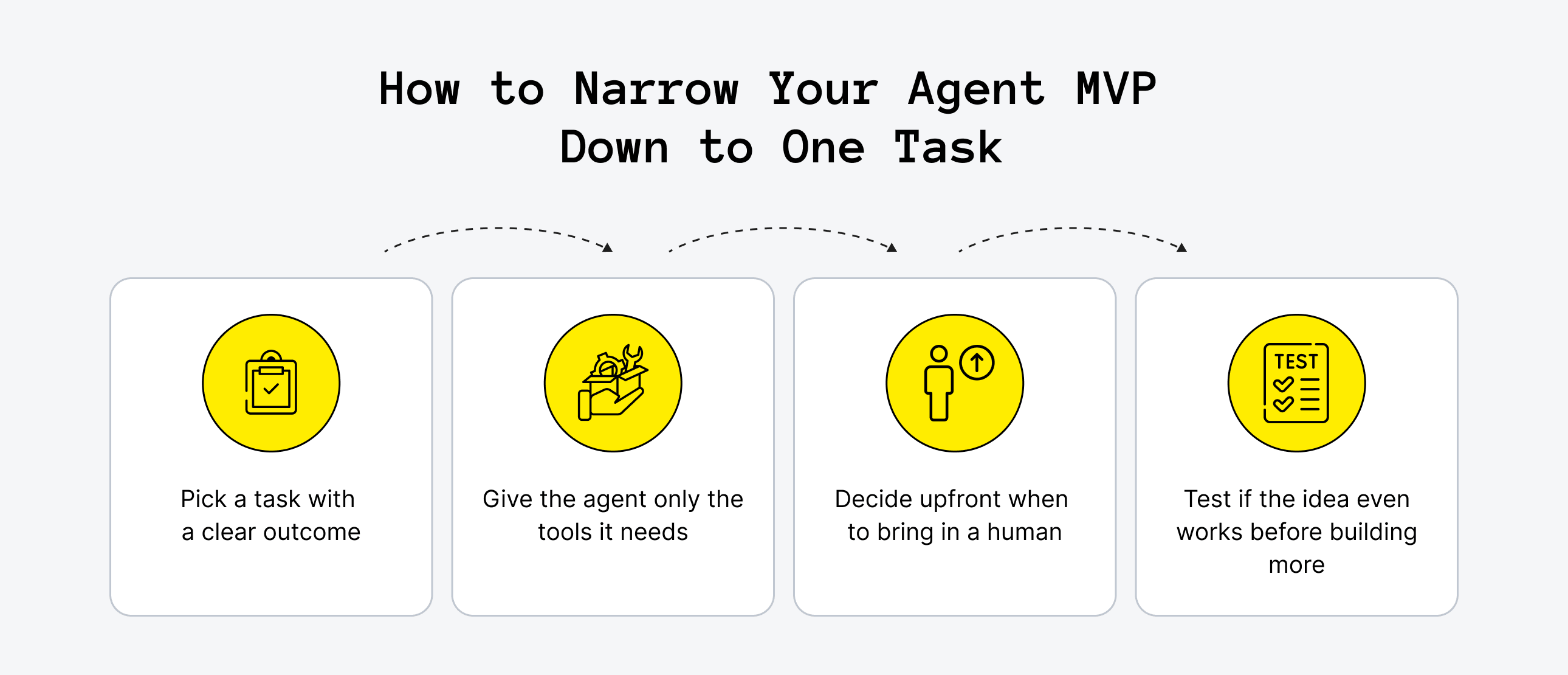
Scoping an agent MVP is less about limiting ambition and more about sequencing it correctly. Each decision below narrows the build to something that can actually be validated, rather than something that only looks impressive in a demo.
Pick the Task With the Clearest Definition of Success
A task where "done correctly" is unambiguous, a payment scheduled, a ticket resolved, a document classified, is easier to validate than one where success is a matter of judgment. Save the judgment-call tasks for a later version, once the agent's reliability on clear-cut tasks is proven.
Bound the Tools the Agent Can Call
In AI agent development, an agent with access to three well-tested tools is easier to guardrail and debug than one with access to fifteen. Add new tools only after the narrower version has proven reliable.
Decide the Human-Fallback Point before Writing the Agent's Logic
Name the exact condition that hands a task back to a person, low confidence, a failed tool call, an action above a cost or risk threshold, before building the happy-path reasoning. An agent MVP without a defined fallback path isn't minimal, it's unfinished.
Separate a Feasibility Question from a Validation Question
If the honest answer to "can this agent even complete the task at all" is uncertain, that is an AI agent proof of concept question, answered by testing the core reasoning against a narrow, curated set of cases before any product work starts. Only move to MVP scope, real users, a fallback path, and live instrumentation once that narrower question is settled. The PoC vs. prototype vs. MVP distinction that applies to any product applies directly here too, and skipping it is the fastest way to spend MVP-level budget answering a PoC-level question.
Taken together, these four decisions form less of a checklist and more of a sequence: define success narrowly, limit the tools, plan for failure, and confirm feasibility before scaling scope. Skip any one of them, and the "MVP" label starts to describe wishful thinking rather than a testable product.
The Core Technical Building Blocks
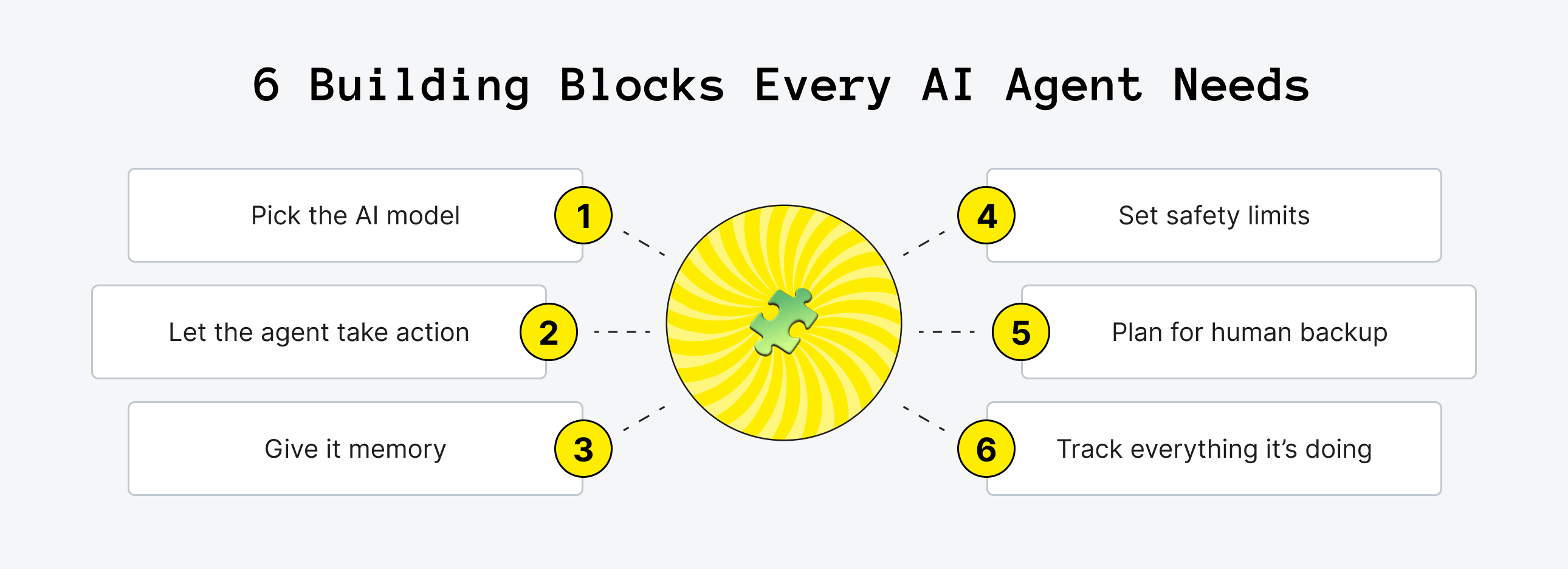
These six pieces make up the real work of an AI agent development process, in roughly the order they need decisions made, and skipping any one of them to save time at MVP stage is where most agent builds run into trouble later.
Model Choice
Most agent MVPs build on an existing foundation model (GPT, Claude, or similar) accessed through an API rather than a custom-trained model, for the same reason most AI MVPs do: the foundation model has already solved general reasoning, so the build focuses on the task-specific logic around it. Switching models later, once the task-specific logic is proven, is a far smaller job than building that logic in the first place.
Tool-Calling
Tool calling is the mechanism that allows an agent to take action rather than only generate text. It can involve calling an API, querying a database, or triggering a workflow. This is where much of an agent MVP’s engineering effort lives, often more so than in the choice of model itself, because every additional tool creates another point where a task can fail before completion.
When an agent produces emails, reports, or other customer facing content, an AI humanizer can help make the output clearer, more readable, and more natural in tone.
Memory and State
What the agent remembers across steps within a single task, and, if relevant, across a user's sessions. A narrow agent MVP often needs only short-term, within-task memory, which is simpler to build and easier to debug than persistent long-term memory, and it's usually enough to complete the one bounded task the MVP is scoped around.
Guardrails
Explicit limits on what the agent is allowed to do without human sign-off: a spending cap, a restricted action list, a required confirmation step for anything irreversible, which are also the controls examined when AI liability claims are assessed. Guardrails make an agent's autonomy safe to ship at MVP stage, rather than serving as a hardening step added after launch.
Human-in-the-Loop Fallback
The interface and process for the moment the agent hands a task back to a person. This needs the same design attention as the agent's happy-path flow, since it's where a user's trust gets decided when the agent doesn't know what to do next.
Observability
Logging every step of the agent's reasoning and every tool call, rather than only the final output. Debugging an agent means reconstructing why it made a decision after the fact; a system that only logs outcomes makes that reconstruction impossible, which turns every failure into a mystery instead of a fixable defect.
None of these six pieces are optional extras you bolt on once the agent "basically works." They're the actual definition of what an agent MVP is, and the order you build them in is usually the order your first real user will expose them, whether you planned for that or not.
Real Example: What Klarna's AI Assistant Reveals About Validation
Klarna’s OpenAI-powered customer service assistant shows what a reliable AI agent can achieve in day-to-day operations. As mentioned above, it handled about two-thirds of Klarna’s total chat volume in its first month. Customers returned with the same question 25% less often, suggesting the assistant was more likely to solve their problem the first time. Klarna estimated the assistant would drive $40 million in profit improvement in its first full year.
None of those numbers describe how smart the underlying model is. They describe task completion, speed, and whether the answer held up well enough that the user didn't come back with the same problem, which are exactly the metrics an agent MVP should track at a fraction of that scale. A team building a narrower agent, say, one that schedules payments or triage support tickets for a few hundred users, is answering the same question Klarna answered at millions of conversations: does this agent finish the task correctly often enough that people stop double-checking it.
Klarna also didn't launch at 2.3 million conversations. The assistant reached that number after replacing an existing support workflow with years of ticket data behind it, which is a different starting point than a first agent MVP has. What transfers down to MVP scale isn't the volume, it's the shape of 4 numbers:
- how often it finishes the task;
- how often a person has to step in;
- what each successful outcome costs to produce;
- whether the person trusts the answer enough not to double-check it.
A team tracking those four numbers on a few hundred conversations is running the same validation Klarna ran on millions, earlier in the curve and at a fraction of the volume.
Need a hand with AI agent development?
Upsilon is a reliable tech partner with a big and versatile team that can give you a hand with creating your AI agent MVP.

How to Build an AI Agent MVP in 6 Steps
Building an AI agent MVP is less about writing prompts and more about proving one narrow task works reliably before anything else gets added. The six steps below walk through that AI MVP development process in order, from defining success to deciding when the agent has earned the right to take on more.
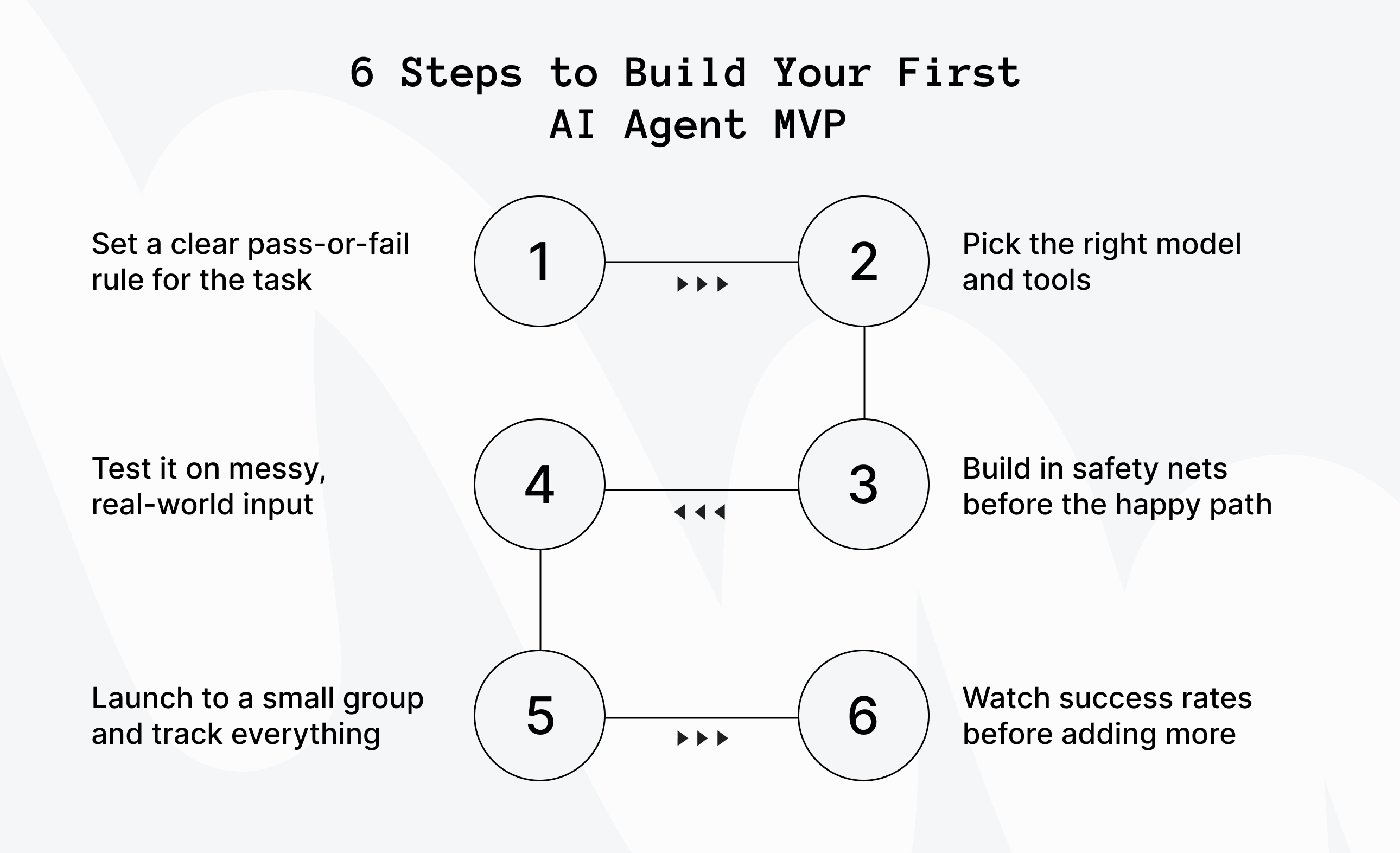
Step 1: Define the Single Task and What Success Looks Like for It
Write down the exact outcome that counts as the agent doing its job correctly, in terms specific enough that a person reviewing a transcript could mark it pass or fail without guessing. When you skip this step, every later disagreement about whether the agent "worked" can turn into a subjective debate instead of a quick check against a written standard.
Step 2: Choose the Model and Tool-Calling Setup the Task Requires
The most capable model is rarely the right default. Choose a model that can reliably handle the task’s reasoning and tool calls at an acceptable cost per run. A smaller model that consistently gets the task right will outperform a flagship model that occasionally overthinks it or calls the wrong tool.
Step 3: Build the Guardrails and the Human-Fallback Path Before the Happy-Path Logic
Design what happens when the agent is uncertain, when a tool call fails, or when an action crosses a risk threshold, before spending time polishing the case where everything goes right. These guardrails end up doing more to protect user trust than any improvement to the agent's core reasoning ever will.
Step 4: Test on Real Tasks Pulled from Actual Use
AI agent testing at this stage means running the agent against messy, real user input, not prompts written to make the demo look good. A benchmark prompt is written to be answerable; an agent MVP earns its "minimum viable" label by handling real mess on a narrow task, not a wide one tested against clean examples.
Step 5: Launch to a Narrow Group and Instrument Every Step
Early usage data on where the agent hesitates, calls the wrong tool, or hands off to a human reveals more about what to fix than a pre-launch test suite ever will. A group of 20 to 50 real users, tracked closely, will surface more edge cases in a week than months of internal testing, especially when those users are already interacting with workflows that involve preparing data for AI.
Step 6: Watch Task-Completion and Human-Intervention Rates
Expanding an agent's MVP scope before the first workflow is reliable compounds the same problem that made validation hard in the first place: more steps, more chances for an error to slip through. Only once these rates hold steady across a real sample of usage does it make sense to hand the agent a second task.
None of these steps are about building more. In AI agent development, each one exists to narrow the agent's job down to something small enough to actually prove works, which is the only real foundation a second workflow can safely build on.

How to Validate an AI Agent MVP Once It's Live
AI agent validation doesn't end at launch; it starts there. The same four numbers below determine whether an agent MVP holds up over its first weeks with real users, regardless of how well it performed in testing.
Task Completion Rate
The share of attempts the agent finishes correctly, without a human correcting or redoing the work. This is the single number that answers whether the agent does its job, and it should be tracked per task type, not as one blended average that hides which specific case is failing.
Human Intervention Rate
How often a person has to step in, whether through the designed fallback path or an unplanned correction after the fact. A high but stable intervention rate on a hard task can be fine; a rising rate on a task that used to work reliably is an early signal something upstream changed, a tool's API, the input pattern, the model itself.
Cost per Successful Task, Not Cost per Call
An agent that costs little per API call but fails half the time is more expensive per completed task than one that costs more per call but rarely fails. This is the number that determines whether the economics work at real usage volume, rather than the sticker price of a single run.
A Trust Signal
Repeat usage, a drop in the same support ticket getting reopened, a user completing a task without checking the agent's work step by step. Klarna's 25% drop in repeat inquiries is this signal at Klarna's scale; the equivalent for a smaller agent MVP is whichever behavior shows a user relied on the answer instead of re-verifying it.
None of these four numbers replace the other three: an agent with a high completion rate and a high cost per task is a different problem than one with low cost and low completion, and a dashboard that only shows one of the four hides which problem a team is facing.
Common Mistakes When Building an AI Agent MVP
Founders often repeat the same mistakes that show up again and again in early agent builds, and each one traces back to the same root cause: treating an agent MVP like a traditional software MVP instead of a system built on probabilistic, imperfect reasoning. Recognizing these mistakes in the initial phase of AI agent development often determines whether an agent earns user trust or loses it in the first session.
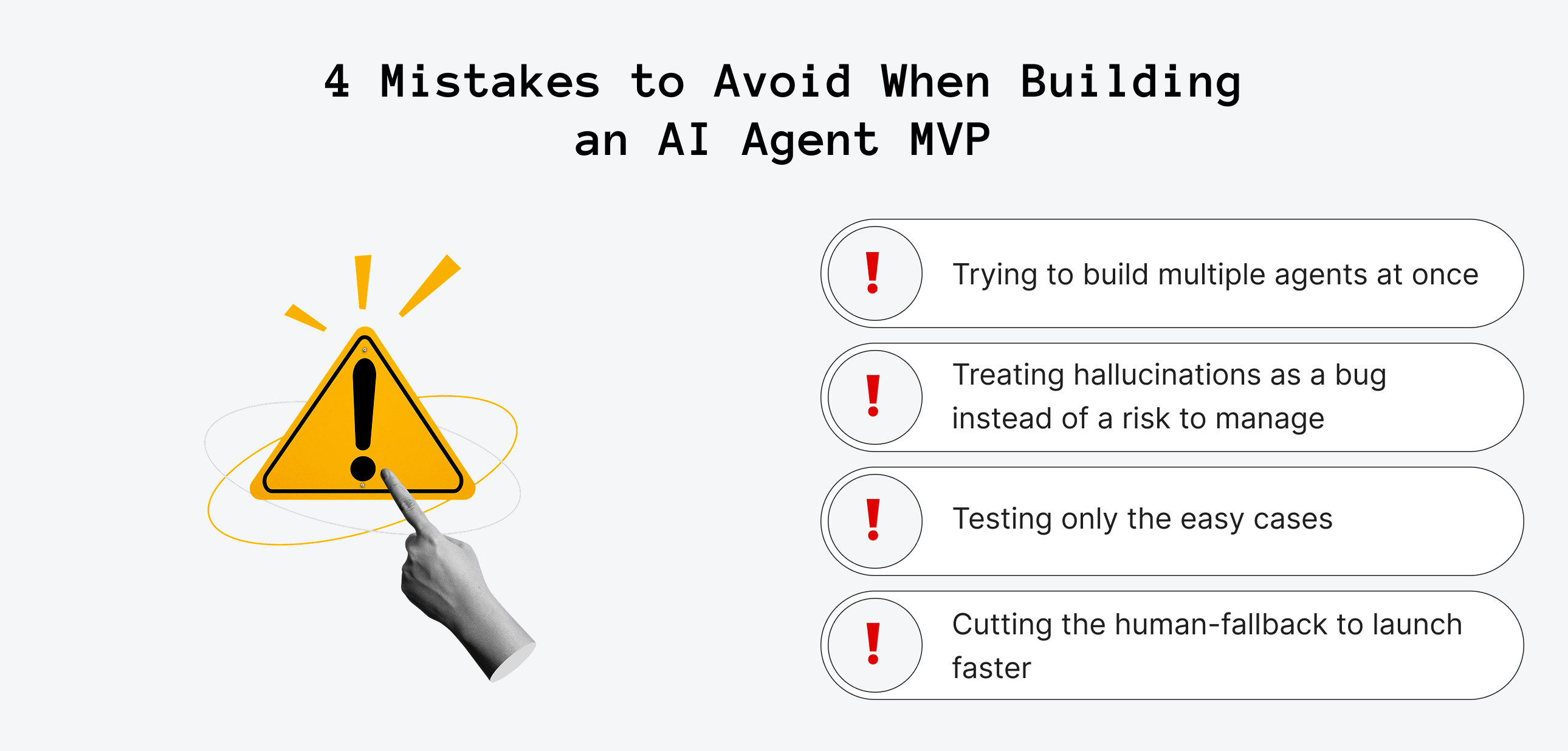
Scoping a Multi-Agent System for a First Version
Multiple agents coordinating with each other multiply the compounding-error problem covered above before a single agent has proven it can do one task reliably. Ship one agent, one task, first, and add a second agent only once the first one's task-completion rate has held steady across real usage, not projected usage.
Treating Hallucination as a Bug to Fix Before Launch Instead of a Rate to Design Around
No model available today eliminates hallucination entirely. An agent MVP that waits for zero errors before shipping never ships; the guardrails and human-fallback path exist precisely because the error rate won't reach zero.
Testing Only the Happy Path
Knowing how to test an AI agent is essential for uncovering issues before they affect people using the product. A demo built from cherry-picked prompts hides exactly the failure modes real users will hit first. The test set that matters includes messy, realistic cases rather than prompts designed to make the agent look good.
Skipping the Human-Fallback Path to Hit a Launch Date
Cutting the fallback path to ship faster removes the one piece of the system that keeps an early failure from becoming a user's last interaction with the product. A clear fallback reassures users that their request will still be handled when the agent cannot complete it on its own.
Seeking help with building your product?
Upsilon has an extensive talent pool made up of experts who can help bring your AI ideas to life!
Final Thoughts on Building an AI Agent MVP
Building an AI agent MVP is about proving that one meaningful workflow can operate reliably in the real world. Start with a clear task, limit the agent’s access to tools, prepare for failures, and measure results before expanding its responsibilities. A smaller scope also makes it easier to identify what goes wrong and improve the agent without creating unnecessary risk.
Don’t try to make a fully autonomous system from day one. A focused first version gives you the data, user feedback, and technical foundation needed to improve your AI agent MVP safely and decide where automation will bring the most value next. Over time, consistent results on one task can show whether it is ready to handle more complex workflows.
Turning an AI agent concept into a dependable product requires both strong technical execution and a clear understanding of real business needs. Upsilon helps startups scope, build, test, and improve AI-powered MVPs designed to deliver value from the start. Explore our MVP development services to see how we approach early-stage builds, or if you already have a concept in mind, contact us to discuss how we can bring your idea to market.
FAQ
1. What is an AI agent MVP?

An AI agent MVP is the first working version of a product where an AI system completes a multi-step task on its own, calling tools, making decisions, and acting with limited human review, rather than a chatbot that answers questions or a single AI feature that classifies or generates content inside a larger product. It's judged on whether it finishes a real task reliably enough for a user to hand it off, not on whether it demoed well.
2. How long does it take to build an AI agent MVP?
A scoped agent MVP, one task, bounded tools, a clear human-fallback path, takes 10 to 16 weeks, roughly in line with the general MVP timeline for a project with real technical risk. Building the reasoning and tool-calling logic usually takes less time than building the guardrails and the fallback path around it, since the failure cases need as much design attention as the happy path.
3. How do you test an AI agent before launch?
The short answer to how to test an AI agent is: on real tasks pulled from actual use, not benchmark prompts written to make the demo look good. Run it against edge cases a real user would hit: incomplete information, an ambiguous request, a tool call that fails partway through. Track how often it finishes the task correctly without help, not only whether it produces a plausible-looking answer, since a plausible answer and a correct one are not the same thing for an agent acting on a user's behalf.
4. Do I need a full agent framework to build an AI agent MVP, or can I start with a pilot?
Start narrower than a framework decision: pick the one task, define what success looks like for it, and build the smallest system that completes it reliably, whether that's a single LLM call with tool access or a lighter-weight AI agent pilot with more human review built in. A framework choice matters far less at MVP stage than the task boundary and the fallback path do; both of those transfer regardless of which framework the team picks later.
5. How much does it cost to build an AI agent MVP?
An AI agent MVP costs $50,000 to $150,000 and takes 2 to 4 months, more than a single AI feature because an agent needs more testing for the ways a multi-step plan can go wrong, and usually needs guardrails to keep it from taking an action it shouldn't.



to top