Is AI-Driven Cost Estimation the Real Game-Changer for Startups?


Every great startup begins with an idea, something bold enough to change how people work, live, or connect. You can almost see it coming to life: the features, the users, the impact. You have the drive, a solid plan, and just enough ambition to turn possibility into product. And then comes the question that defines what happens next: How much is this going to cost?
For years, that question has been the hardest part of MVP development. Founders move from agency to freelancer to spreadsheet, collecting numbers that never seem to agree. Estimates are either too vague to trust or too optimistic to survive contact with reality. The process is slow, subjective, and often detached from the true scope of work.
But what if that process could change? What if you could describe your SaaS product idea in plain English and get a detailed, data-backed estimate in minutes, not weeks? Can you imagine a machine analyzing your concept, suggesting a tech stack, mapping out the team you need, and identifying potential startup risks before you write a line of code?
This is the promise of AI cost estimation, where artificial intelligence shifts from being a development goal to becoming a practical tool. In this article, you’ll learn how startups can leverage AI to estimate project costs with greater accuracy and speed, and explore some of the innovative tools already transforming how founders plan, budget, and build.
Key Takeaways
- Traditional estimation is failing. Startups suffer from slow, subjective, and inaccurate cost estimates. This leads to budget overruns, missed deadlines, and product failure.
- Startups need more than a number. Founders need fast insights, precise results, and flexible solutions. They need to understand the why behind the startup costs and explore different what-if scenarios for their features.
- AI changes the estimation process. AI tools use natural language processing to understand your ideas and machine learning to compare your project against thousands of past projects. You get a data-driven forecast instead of a human guess.
- AI vs. traditional methods is like speed vs. snail. AI estimation delivers detailed breakdowns in minutes. Traditional methods can take weeks of manual analysis, meetings, and assumptions.
- The benefits of AI project cost estimation are clear. Artificial intelligence provides faster decisions, better budget allocation, early risk identification, and empowers non-technical founders to have technical conversations.
- It's still a blueprint, not magic. AI estimation is a powerful starting point. It provides a detailed blueprint that founders can use to plan, pitch to investors, and hire a development team.
Common Project Cost Estimation Challenges Startups Face
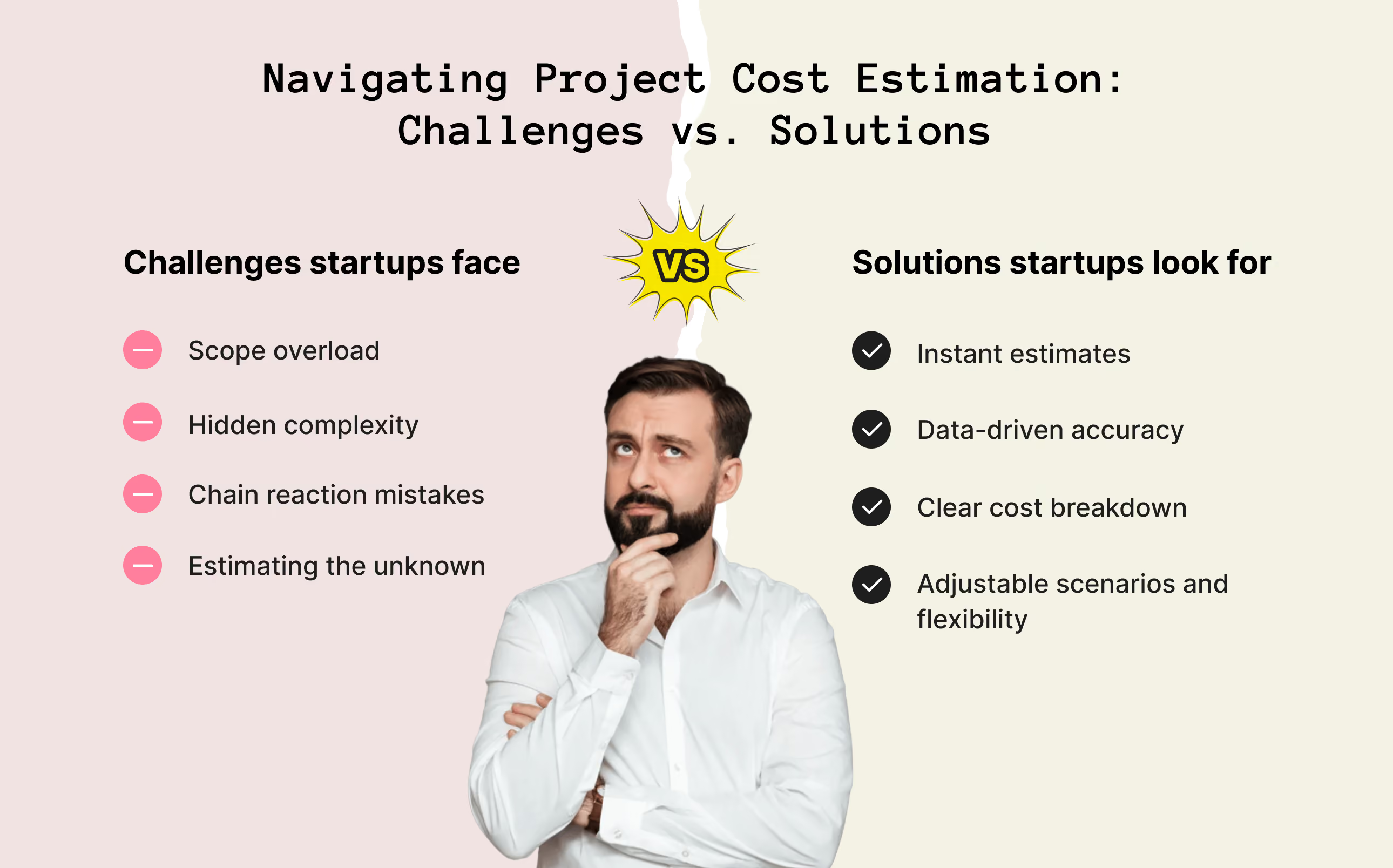
Before we look at possible solutions, it's important to understand the problem itself. Why is software cost estimation so notoriously difficult? Is it because traditional methods fail to address the unique challenges startups encounter? Or perhaps it's because startups often lack a clear understanding of what they truly need, leading them to use irrelevant or outdated estimation approaches. Let's dig deeper to find out.
If we can build rockets that land themselves, why is it still so hard to estimate the cost of a simple to-do list app? The issue is that software isn’t a physical product. You don’t build it with atoms; you build it with logic. And logic, much like people, can be unpredictable. Let's take a closer look at how this reality complicates the project estimation process.
1. Monster Under the Bed: Scope Creep
This is the most famous challenge. It starts simply.
Then,
And before you know it,
Each small request seems reasonable. But they add up. This slow, steady expansion of features is known as scope creep. A traditional estimate, made months ago, cannot account for this. It is based on a snapshot in time. For startups, which must pivot in business and adapt to user feedback, scope creep is not a risk but a guarantee. A rigid initial estimate shatters on contact with the first piece of real-world feedback.
2. "It's Just One Simple Feature" Fallacy
Founders are optimists. They have to be. But this optimism translates into optimism bias. A founder might look at a feature in another app and think, "That looks easy. It's a simple button."
They do not see the iceberg:
- the API integration that powers the button;
- the database changes required to store its data;
- the security checks to make sure it is safe;
- the testing across five different devices and three browsers;
- the analytics to see if anyone even uses this fancy button.
This bias leads to drastically underestimating the work involved. A good developer knows this, but it is hard to explain to a non-technical founder why their "simple" request is actually a two-week project.
3. Accumulating Mistakes
A bad estimate is not a single MVP mistake. It is the first link in a chain of failure. Some call this the hidden chain reaction, and it is devastatingly accurate. It looks like this:
- Bad estimate: You guess the MVP will cost $50,000.
- Bad budget: You raise $60,000, thinking you have a buffer.
- Bad planning: You hire a dedicated team of developers based on this flawed budget.
- Resource strain: Halfway through, you realize the real cost is $100,000. You are out of money.
- Cutting corners: You fire the QA tester, skip security audits, and tell the developers to rush.
- Failed product: After the MVP launch, you notice it is full of bugs, insecure, and crashes constantly.
- Startup death: Users leave, investors pull out, and the company folds.
The whole sequence starts from one bad number. AI's core promise is to break this chain before the first link is forged.
4. Estimating the Unknown
Many startups build things that have never existed before. How do you estimate the cost of a novel algorithm, a new type of social interaction, or an integration with a brand-new platform?
Traditional methods rely on experience. A senior developer estimates based on projects they have personally worked on. But if no one has worked on it before, they are just guessing. They have no data. This is like trying to guess the cost of building a house on Mars. Where do you even start?


What Startups Really Need from Software Cost Estimation
Today’s challenges reveal that the old approach is broken. A static PDF with one final number is useless in the fast-moving world of startups. What do founders genuinely need instead?
They need both an estimator and a navigator. Whether founders plan to build on their own using vibe coding or seek out a software agency for full MVP development, they need reliable data to decide their next move and to know if it’s worth pursuing at all.
1. Speed (Like, Right Now)
The startup world moves at light speed. You might have a crucial investor meeting in two days, and you cannot wait two weeks for an agency to hold discovery workshops and return with a quote.
As a founder, you need to validate startup ideas fast.
You need these answers in minutes, so you can make decisions and keep moving.
2. Accuracy Through Data, Not Guesstimates
Startups also need an estimate they can actually trust. A free estimate template can provide a solid starting point, but this trust cannot come from one person's gut feeling. It must come from data.
What you need is a system that can look at your idea and compare it to a database of 10,000 other projects. A system that knows, on average, how long a user registration flow actually takes to build, test, and secure. This means the estimators need to replace "I think" with "The data suggests."


3. A Breakdown, Not a Bill
A single number — say, $80,000 — is intimidating and unhelpful. What does that $80,000 buy? Founders need a detailed breakdown. For example, you might want to see:
- Technology: "We suggest React Native for the app and Python for the backend."
- Team: "You will need 1 Project Manager, 2 Mobile Developers, 1 Backend Developer, and 1 QA specialist."
- Timeline: "This will take approximately 16 weeks, broken down by feature."
- Risks: "The integration with the external payment gateway is a high-risk task that may add 1-2 weeks."
This level of detail transforms a scary price tag into an actionable project plan.
4. Dynamic Scenarios
This is perhaps the most important need. A startup's scope is not fixed and for a good reason. It is a hypothesis. Founders need to play with variables.
- "What if we cut the social feed feature from the solution? What does the MVP cost become?"
- "What is the time difference between building a native iOS app and a cross-platform React Native app?"
- "What if we add a pro tier with subscriptions?"
You want to adjust the scope and see the impact on cost and app development timeline instantly. This allows you to find the perfect balance between the grand vision and your current budget.
Seeking help with building your product?
Upsilon has an extensive talent pool made up of experts who can help bring your AI ideas to life!

How AI Transforms the Software Project Estimation Process
This is where AI cost estimation gets to work. It is uniquely positioned to meet all these needs. It is fast, data-driven, detailed, and dynamic.
How AI-Powered Cost Estimation Tools Work
When you type your project idea into an AI estimator, several powerful technologies start working in harmony.
1. Natural Language Processing
NLP is the same technology that powers Siri, Alexa, and ChatGPT. It reads your plain-English description ("I want to build an app like Airbnb, but for parking spaces") and breaks it down into structured components.
It identifies key elements:
- Features: User login, search for spots, booking, payment integration.
- Platforms: iOS app, Android app, web dashboard.
- User roles: Driver (user), Spot Owner (host), Admin.
It translates your human idea into a machine-readable project brief.
2. Machine Learning and Historical Data
AI in project cost estimation is trained on a vast dataset of thousands of completed software projects. This dataset includes:
- the features of each project;
- the technology stack used;
- the startup team structure and size;
- the actual time (in hours) each feature took;
- the actual final cost;
- any problems or risks that occurred.
The ML model finds complex patterns in this data. It knows that payment integration is rarely a one-week task. It knows that projects using a specific tech stack are 20% more likely to need a dedicated security engineer.
3. Predictive Analytics
The AI tools for cost estimation take the project brief from the NLP and an AI voice agent, then run it against the patterns it learned from the ML model.
It does more than calculate; it predicts and generates a comprehensive estimate that includes:
- a recommended technology stack;
- a list of required features and user stories;
- a timeline broken down by product development phases (design, development, testing, deployment);
- a team structure (e.g., 1 PM, 1 UI/UX, 2 developers);
- a cost range, with a pessimistic and optimistic scenario;
- a list of potential risks (e.g., "Third-party API dependency is a risk," "Complex user permissions may add time").
The result of an AI project cost estimation is a detailed report generated in minutes, based on more data than any single human expert could ever possess.
AI-Driven Cost Estimation vs. Traditional Methods
The difference is clear. One approach is outdated and relies heavily on human input, while the other is modern, driven by data, and adapts to changing conditions for increased precision.
Benefits of AI Cost Estimation Software for Startups
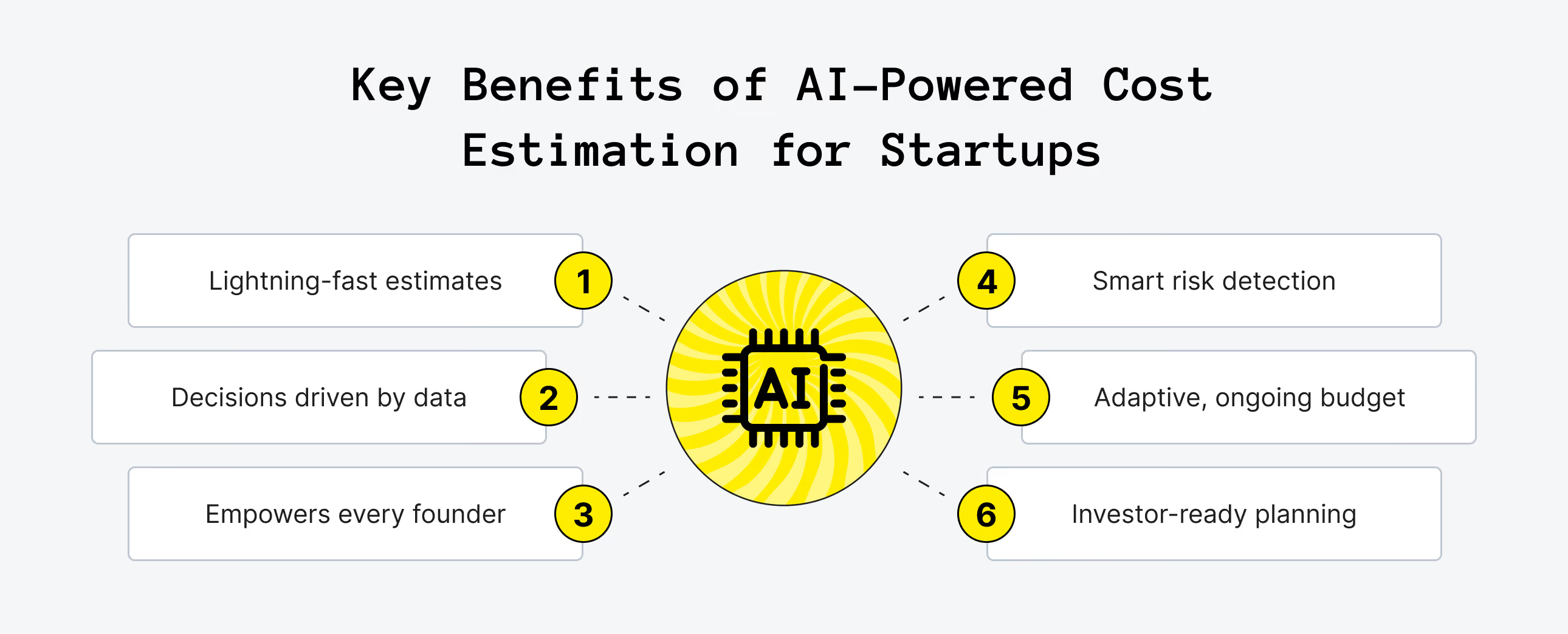
So, what does all this mean for you as a founder? The benefits go far beyond getting a faster number.
Drastic Time Savings
The weeks saved on estimation are weeks you can spend talking to users, building a prototype, or pitching to investors. Speed is a startup's single greatest advantage, and AI estimation protects it.
Data-Backed Decision Making
You can stop guessing. Should you build for iOS first or cross-platform? AI can give you the cost and time implications for both, allowing you to make a strategic, data-informed choice, not an emotional one.
Empowers Non-Technical Founders
Non-technical founders no longer have to rely entirely on a technical team. An AI-generated report can act as a technical co-founder, providing you with the vocabulary and a detailed blueprint. This enables you to engage in informed discussions about tech stacks, features, and timelines, backed by a data-driven plan.
Early Risk Identification
AI cost estimation models, trained on thousands of projects, are very good at spotting patterns of failure. The tool might flag: "Your project seems to have high data-compliance requirements (like HIPAA). This will add 30% to the testing and backend budget." A human might forget this, but the AI will not.
A Living Budget
The estimate is no longer a fire-and-forget document. It is a living and breathing tool that you can use throughout the project. As user feedback comes in, you can model the cost of a pivot before you commit.
Builds Investor Confidence
Walking into a pitch meeting with a napkin math budget is a red flag. Walking in with a detailed, AI-generated report that shows a full project plan, team structure, timeline, and risk analysis shows you have done your homework. It builds immediate credibility. Beyond financial planning and technical roadmaps, investors often look for evidence of real customer engagement and satisfaction. Real tools like Podium Reviews can help startups to collect and showcase customer feedback, strengthening proof of market demand.


Estimating Your Software Project Cost with AI: 5 Steps for Startup Founders
This all sounds promising in theory, but what does it look like in practice? Let’s walk through a realistic, five-step process for a fictional startup founder named Alex, using AI cost estimation software.
Alex has an idea for an app called EcoTrack, an MVP designed to help users track the carbon footprint of their grocery purchases.

Step 1: Define Your Core Idea (The First Prompt)
Alex does not need a 100-page technical document. Alex needs to describe the idea clearly, so he opens an AI estimation tool and types in a prompt.
Sample Prompt:
Step 2: The AI Analyzes, Asks Questions, and Suggests
The AI (which we will call Estimator-Bot 9000) processes this in about 60 seconds. It does not spit out a single number but comes back with a structured plan and some clarifying questions.
AI Response:
Step 3: Refine the Scope
Alex now has a technical plan. Alex thinks about the questions.
Alex's Reply:
Alex is also curious about that manual entry feature.
Alex's Follow-up:


Step 4: Get the Detailed Breakdown
The AI takes these refinements and generates the detailed estimate.
AI Response:
Step 5: Use the Estimate as Your Strategic Plan
Alex now has everything. Alex decides the $50K-$65K manual-entry version is the perfect MVP. The OCR feature can wait for version 2.
Alex has a price and more:
- clear scope for the MVP;
- validated technology stack;
- team structure to hire against;
- timeline to share with investors;
- a budget Alex can confidently put in an MVP pitch deck.
Alex has successfully navigated the estimation nightmare in an afternoon, all without a single two-hour project discovery meeting.
AI Tools for Cost Estimation: A Quick Overview
The market for these tools is new and in progress, just like the technology itself. Many companies (like us) are actively building specialized AI project estimation tools because the need is so clear.
However, many existing tools already use AI to help with parts of this process, particularly in project management. Here is a quick look at the landscape.
Summary of AI Estimation and Planning Tools
As you can see, the perfect tool is still emerging. The large project management platforms are great for managing a project once it is scoped, but they do not help a founder get that initial, all-important number. The new, dedicated tools enter the AI agents marketplace, and they are focused on solving this exact problem.
We’re excited about where this space is heading, which is why we’re working on our own AI-based project estimator. Our goal is to bring together the detailed, conversational capabilities of AI and the hands-on experience we have from building real-world software. Inspired by the latest advancements in AI agents, we hope this tool will feel less like a basic calculator and more like a helpful AI sidekick for startups. Stay tuned!
Need a hand with product development?
Upsilon is a reliable tech partner with a big and versatile team that can give you a hand with creating your generative AI app.
Conclusion: Why Startups Use AI to Estimate with More Accuracy
Let’s return to our original question: Is AI-driven cost estimation the real game-changer for startups? The answer is yes, though not in the way most people think. These tools are not crystal balls and don’t guarantee a perfectly precise final number. Software development is still a creative and evolving process, shaped by people, learning, and change
What AI tools for cost estimation truly change is the way decisions are made. They replace guesswork with grounded data, instinct with insight, and endless uncertainty with clear, structured scenarios. What once took weeks of estimation now takes minutes, giving founders the speed to validate ideas, the confidence to plan effectively, and the credibility to secure support. In a world where bad estimates can quietly derail great ideas, that clarity makes all the difference.
While these tools offer a fantastic start, the real power comes when you combine AI-powered insights with deep human expertise. If you are looking to build a robust, scalable application and take advantage of the power of new technology, Upsilon can help. Our team specializes in generative AI development services and is ready to turn your vision into the next big thing.
Don’t hesitate to get in touch with us, and let's build something awesome together!
FAQ
1. What is AI-driven project cost estimation and why is it important for startups?

AI-driven cost estimation uses artificial intelligence (specifically, natural language processing and machine learning) to analyze a project description. It compares your idea to thousands of past projects to predict the timeline, team, tech stack, and cost. It is critical for startups because it provides fast, data-driven, and detailed estimates, which help them avoid budget overruns, secure funding, and make better strategic decisions.
2. What factors most influence the cost of AI development in a startup?
The cost of an AI project is influenced by several key factors:
- Data: The cost of acquiring, cleaning, and labeling the massive datasets needed to train an AI model.
- Model complexity: A simple predictive model is far cheaper than building a large language model from scratch.
- Talent: Specialized AI and ML engineers are expensive and in high demand.
- Infrastructure: The cost of the powerful (often cloud-based) servers needed for AI training and operation.
- Integration and ethics: The complexity of integrating the AI into your existing app and ensuring it is fair, unbiased, and secure.
3. Which are the best AI tools for project cost estimation for startups?
The field is rapidly evolving. For project management, ClickUp and Asana now offer AI features that assist in planning tasks and allocating resources. When it comes to early-stage cost estimation, dedicated tools like CostGPT.ai and AppCost.ai can take your project idea and generate a detailed budget and scope.
The best tool depends on your current stage whether you're still brainstorming and validating your idea or you have a team assembled and need a robust planning solution.
4. Can AI cost estimation help predict and control hidden costs in software projects?
Yes, this is one of its biggest advantages. Because AI models learn from the actual outcomes of thousands of projects, they are very good at spotting hidden tasks that humans often forget, including things like:
- Complex data migration;
- Third-party API integration and testing;
- Security audits and compliance requirements (like GDPR or HIPAA);
- Server setup and deployment automation (DevOps).
By flagging these hidden costs in the initial estimate, AI cost estimation helps startups budget for them from day one, preventing bad surprises later.



to top