Top Startup Accelerators in 2026: Which One Fits Your Startup


Becoming the next big unicorn is the dream of many startup founders. And judging by the numbers, more early-stage teams are turning to accelerators to give themselves a better shot. The global startup accelerator market is expected to grow from $5.11 billion in 2025 to $6.07 billion in 2026, an 18.6% jump in just one year. That sounds pretty tempting when you are trying to get a young business off the ground.
But with the startup failure rate being disappointingly high, it's very tough to build profitable chart-topper products, especially if you're new to entrepreneurship. Where do you get the needed guidance and help? What can serve as the “nitrous oxide boost” to make your startup's engine roar and press you into the seat as you dash toward desired growth in today's hyper-competitive business landscape?
On this page, we'll provide our collection of the best startup accelerators that have become the essential pit stop helping entrepreneurs who seek to turbocharge their businesses. We'll also go over the possible benefits and challenges of entering such programs and the additional perks entrepreneurs can get hold of.
Key Takeaways
- A startup accelerator is a fixed-term program that helps founders move faster through mentorship, funding, investor access, peer support, and practical business guidance.
- The best startup accelerator depends on your biggest current gap. Some programs are better for fundraising and investor access, while others focus on corporate pilots, deep-tech resources, industry expertise, or co-founder matching.
- Top programs such as Y Combinator, Techstars, 500 Global, Antler, SOSV, and a16z Speedrun have very different funding structures. Before applying, compare the investment amount, equity requirements, follow-on rights, perks, and potential future dilution.
- Accelerator outcomes are not guaranteed. A small group of high-performing programs can create strong fundraising and growth results, while a poor-fit program may not provide enough value to justify the time and equity involved.
- A strong application should clearly show your team, product, market insight, and early traction. Choose several programs that match your stage, industry, geography, and next business milestone.
What Is a Startup Accelerator
A startup accelerator is a short, intensive program for startups that have already moved beyond the idea stage. It isn't just a popular startup term, such programs are designed to help startup teams take their business to the next level. Hence, accelerating growth and development is the main aim.
How does a startup accelerator program work? Typically, its duration is fixed. On average, it lasts three months (but may vary from one accelerator to another, at times, it can last up to six months). Depending on the accelerator, the programs are run a few times a year, often in cohorts.
The specific areas of focus (e.g., certain niches the accelerator specializes in or is involved in) could differ as well. Therefore, some accelerators are tailored around a distinct industry or sector like FinTech, EdTech, Healthcare, SaaS, or others. Getting in is not easy, either: many leading accelerator programs accept only 1% to 3% of applicants, making the selection process highly competitive.
Assisting teams with startup scaling is exactly what accelerators do. Throughout the program, they give startups the support, resources, mentorship, and guidance they’re craving, helping them grow and develop their products and businesses. Yet these programs are highly intensive not only in terms of pace, they’re demanding, challenging, pushing you through the limits, and a lot may be controlled by the accelerator.
Importantly, participation generally implies that the teams already have a product with some traction. Unlike incubators, accelerators are all about taking the business a step further instead of getting it off the ground. Hence, they’re generally interested in more mature, inspiring products and those who are at later stages of startup development.
Accelerators can help you improve your pitch, validate your growth plan, and reach the next milestone investors want to see. At times, they even provide funding, investing in select projects. Yet even the best accelerator programs for startups aren’t fairy godmothers. Participation comes at its own price, that is, usually teams have to provide equity of up to 10% in return for the gained knowledge and help.

Why Do Startups Apply to Accelerators? (And Are Accelerators Worth It?)
Getting accepted into a reputable program can trampoline a startup and its product to success. Dozens of renowned companies got their spotlight and went global after going through top accelerator programs like Y Combinator, including such names as Coinbase, DoorDash, and even Stripe (which is among the best payment gateways used by thousands around the world today).
How Startups Benefit from Accelerators
Are startup accelerators worth it? And what are the gains?

Here are some things startups can get a hold of from accelerator programs:
- new skills and fresh perspective;
- business advice, consultations, and guidance;
- allocating growth areas or ways to expand operations;
- aid with feature prioritization and product development decisions;
- assistance with vitals like product promotion and building a strong user base;
- help with business planning and refining the business model;
- valuable connections, partners, and networking opportunities;
- sometimes even additional funding.
In the end, startups can achieve a lot more during a few months than they could have in a couple of years. It's like a growth stimulant injection when entrepreneurs get invaluable insights that would have been impossible to obtain otherwise. Not to mention that many programs finish off with Demo Days, where startups get the chance to present their projects to raise funds and pitch investors.
And as you might have guessed, there are hundreds of startup teams competing to secure their spot in the programs of the best accelerators in the world, but getting in isn't that easy. It's tough to get admitted, as accelerators are picky about who can get in, expecting at least a built MVP of decent quality and traction. But if the team makes the cut, this can really change the game.
What the Data Says
So, accelerators can help startups move faster but the data suggests that not every program delivers the same value.
A Wharton study published in the Strategic Management Journal looked at 8,580 startups across 408 accelerators in 176 countries. On average, companies that completed an accelerator were 3.4% more likely to raise venture capital and raised $1.8 million more in their first year than comparable startups that didn’t take part. They also generated more revenue and hired more people.
That sounds like a strong case for joining an accelerator. However, another study from NYU Stern gives founders an important reality check. After analyzing nearly 750,000 US startups across 329 accelerators, researchers found that around 60% to 80% of programs produced worse outcomes than not joining an accelerator at all. At the same time, a small group of top-tier programs created major gains in funding, revenue, hiring, and acquisition outcomes.
We can say that accelerators can work, but the accelerator’s name, track record, network, and fit with your startup matter far more than the fact that it’s an accelerator. Joining a strong program that solves a real problem for your team can be a game-changer. Giving away equity to a weak or poorly matched program can become an expensive distraction.
The Equity Math
Equity may not feel like a big deal when your startup is still early and your shares are not worth much on paper. But before accepting an offer, it helps to understand how does equity work in a startup and do the math behind the proposed deal.
For example, imagine your startup has a $10 million post-money valuation. If an accelerator takes 7% equity, that stake is worth $700,000 at that valuation. You’re not writing the accelerator a $700,000 check today but you’re giving it a piece of the company that could become far more valuable if the business grows.
That doesn’t automatically make a 7% deal bad. If the program helps you raise a bigger round, find your first enterprise customers, avoid months of wrong product decisions, or reach investors you could not access on your own, the value can outweigh the dilution. Y Combinator, for instance, takes 7% for part of its standard deal, while other well-known programs use different equity structures or take no equity at all.
The equity is probably not worth it when:
- The accelerator can’t clearly show strong outcomes for companies similar to yours.
- Its mentor, investor, or customer network is not relevant to your industry or target market.
- You already have the traction, fundraising access, and guidance the program promises.
- The program’s time commitment would take focus away from customers, prototype product development, or a live fundraising process.
- The accelerator offers little capital or practical support while asking for a meaningful stake.
- You are joining mainly for the brand name, rather than to solve a specific bottleneck in your business.
Before signing, ask yourself one practical question: What would this accelerator need to help us achieve for 5% to 10% of our company to feel like a good deal? If you can’t answer that in concrete terms, such as customer introductions, a fundraise target, regulatory expertise, or a faster path to product-market fit, it may not be the right program for your startup.
Looking for a reliable tech partner?
Upsilon can help you develop a product that'll grow to be a success!

Top Startup Accelerators at a Glance
We have compiled a list of some of the best startup accelerators for founders at different stages of the journey. Whether you are still validating a SaaS idea, looking for a co-founder, building your first MVP, preparing to raise funding, or trying to enter a new market, these programs offer different types of support to help you move forward faster.
There is no single “best” accelerator for every founder. YC and Speedrun can make sense for teams aiming for fast growth and major venture rounds, while SOSV and Alchemist are better suited to deep-tech and enterprise startups. Plug and Play is strongest for founders who need corporate pilots, and Antler can be a good choice if you are still looking for a co-founder or validating an idea.
Now, let’s take a closer look at what each program offers, who it is best for, and what you should consider before applying.
Top Startup Accelerators in the World: Program-by-Program Overview
If you’ve made up your mind that it’s worth it for you to take a shot at entering accelerator programs for startups, how do you choose the right one to apply to? We’ve compiled a list of startup accelerators, this collection features some of the top options for you to consider, noting the must-knows about each. Building visibility alongside accelerator applications helps startups establish credibility, especially when leveraging brand mention services to boost their presence across key online channels.
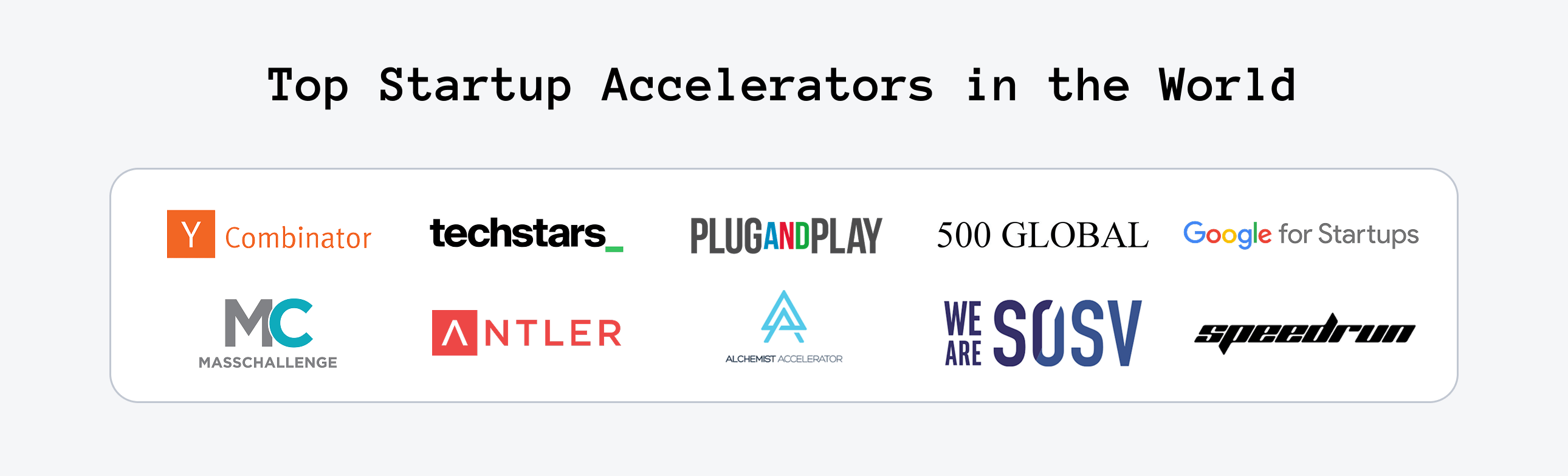
1. Y Combinator
Often ranked as the best startup accelerator there is, Y Combinator is an accelerator pioneer that has an impressive list of alumni since its start in 2005. The accelerator funded over 5 thousand startups with an overall startup valuation of more than $800 billion.
Startups at various stages of development can apply to Y Combinator, in fact, more than half of the companies that went through the program had no revenue when applying. Plus, the rate of funding that companies raise after participation in YC is impressive. A lot of that is due to YC’s extensive investor network that participants get invitation-only access to at the end of the program on Demo Day.
The YC community has over 6 thousand domain experts within the community, so startups can continue networking and collaborating with them after the batch. The competition for entering the program is intense, only 1.5% - 2% of the average 10 thousand applicants get accepted.
Top Y Combinator alumni: Stripe, Reddit, Airbnb, Coinbase, Dropbox, Webflow, Twitch, DoorDash, GitLab, Instacart, and Figma
What they give: investment before the batch even begins, a dedicated YC Group Partner as an advisor, a 3-day in-person kickoff retreat, weekly meetups, top speakers, access to exclusive founders and investors networks, startup discounts to 100+ products
Program duration: 4 batches a year (winter, spring, summer, and fall), each lasts 3 months
How to apply: applications for each batch are accepted as far as 6 months in advance, startups apply by submitting an application on the official YC website, followed by an interview invitation
Terms: according to the standard terms, YC gives $500K: $125K for 7% equity and another $375K through an uncapped MFN SAFE
2. Techstars
Techstars is definitely fairly listed among the best tech accelerators. It has been supporting early-stage and seed startups since 2006. Over 11,000 founders have participated in the accelerator and revved up their growth with an aggregated $55 billion of raised funds. About 500 startups at various stages get selected each year, and, on average, they raise about $1 million after the program culminates with a Demo Day.
Techstars holds multiple mentorship-based programs a year in various locations, including the USA, UK, Canada, Australia, Norway, Germany, Saudi Arabia, Nigeria, and others. Some programs are in-person, others have a hybrid format.
Top Techstars alumni: DigitalOcean, SendGrid, DataRobot, Chainalysis, Remitly
What they give: workshops, curated resources, mentorship in aspects like getting traction and finding the perfect market, access to capital and a world-class network of investors, founders, mentors, and industry leaders, access to more than 300 partner perks (valued >$4 million)
Program duration: 3 months
Terms: Techstars is among the top tech accelerators that invests $220,000 in each accepted company: $20,000 for 5% common stock and $200,000 through an uncapped MFN SAFE
How to apply: startups have to fill out a detailed application for the selected program to get it reviewed
3. Plug and Play
Numerous renowned companies have emerged from Plug and Play, one of the top startup accelerators founded in 2006. The company serves as a bridge between startups and large enterprises, helping businesses grow and scale to new markets.
It has more than 100 accelerator programs run each year in global locations and is one of the biggest startup accelerators. The accelerator helped more than 2800 startups that raised over $9 billion in aggregate. The specific industries of interest include Sustainability, Real Estate, Energy, Insurtech, Crypto, and Agtech, which are among the 25+ verticals revolving around technology and innovation. Startups of different sizes and stages can be accepted (from seed to Series C and further). Cohort size varies significantly by location and vertical: some programs select fewer than 10 companies, while the first Silicon Valley cohorts of 2026 included 113 startups.
Top Plug and Play alumni: PayPal, Lending Club, Dropbox, Tenor, Zoosk, GroundTruth, Guardant Health, N26, Honey, and Rappi
What they give: mentorship, investor access, corporate introductions, pilot and proof-of-concept opportunities, pitch support, curated networking, and help with business development and market expansion
Program duration: usually around three months, although the exact timeline varies by program and location
Terms: no equity is required for participating in the accelerator program, as an in-house VC, Plug and Play offers the chance to fund startups (from $50K to 250K) to become a future stakeholder and participate in the next funding rounds
How to apply: startups can apply to join the accelerator all year round, they fill out an application form on the portal
4. 500 Global
The list of the best accelerator programs for startups won’t be complete without 500 Global. Previously known as 500 Startups, their Global Flagship program was launched in 2010 and focuses on innovative tech startups from AI and SaaS to media, marketplaces, and beyond.
The company has invested in over 3k startups worldwide. It’s one of the top accelerators in the US that currently offers founder programs and seed accelerators for startups around the globe. Cohort size and the number of batches vary by program and region.
Top 500 Global alumni: Canva, Solana, Credit Karma, Talkdesk, GitLab, Twilio, Algolia
What they give: a business-focused curriculum (covers product strategy, startup marketing, product design, sales, accounting, finance, startup culture, and more), access to a broad network, preparation for investor pitches, and access to an expansive investor network
Program duration: 4 months
Terms: the accelerator provides $150K for a 6% stake, subject to due diligence and final investment terms
How to apply: startups can apply through the 500 Global Flagship Accelerator page, and then shortlisted teams go through the program’s selection process
5. MassChallenge
MassChallenge is one of the best-known global nonprofit accelerator organizations. Founded in 2009, it has supported more than 5,000 startups, whose founders have gone on to raise nearly $29 billion in follow-on funding. Unlike many accelerators, MassChallenge is built around a no-cost, non-dilutive model: startups generally don’t pay a program fee or give up equity to participate.
Rather than offering one general-purpose accelerator, MassChallenge now runs industry- and region-specific programs. Its current areas of focus include healthcare and life sciences, security and resiliency, climate, sustainable food systems, global financial systems, and advanced manufacturing.
MassChallenge programs are a good fit for early-stage startups with a scalable solution, an ambitious team, and a clear connection to the program’s focus area. However, eligibility criteria vary by cohort. Some programs are open to pre-revenue startups, while others look for companies with a working prototype, early traction, or a clear use case for corporate partners.
Top MassChallenge alumni: Bitso, Ginger, Hyliion, Spring Health
What they give: mentorship from industry experts, workshops, peer learning, curated introductions to corporate partners, investors, customers, and regulators, as well as support with validation, business development, partnerships, and fundraising
Program duration: 4 months
Terms: most programs are no-cost and non-dilutive, so startups don’t give up equity to take part. Some cohorts also offer cash prizes or in-kind awards, although the amount and availability of these rewards depend on the program and its partners.
How to apply: teams create profiles on the official website and submit an application to join the selected program, which is followed by one or two judging rounds, finalists are invited to the program


6. Antler
Antler is a global early-stage VC and startup builder that backs founders from day zero. Unlike many accelerators that expect applicants to arrive with a team, a product, or early traction, the accelerator also works with ambitious individuals who have not yet found a co-founder or finalized their startup idea.
Antler operates across more than 25 locations worldwide and has built a community of 12,000+ founders. Its portfolio includes more than 2,000 companies across AI, fintech, SaaS, healthtech, climate, deeptech, and other technology sectors. The firm has a particularly strong focus on generative AI vendors and also supports later-stage portfolio companies through Antler Elevate, its scale-up investment platform for Series A and beyond.
The core value of Antler is its founder-first model. Instead of simply offering a curriculum to existing startup teams, it helps individuals become co-founders, create a venture from scratch, and prepare it for pre-seed funding. This can make the accelerator especially useful for solo founders, experienced operators leaving larger companies, and builders who have strong domain expertise but still need a co-founder, a validated idea, or an initial investor network.
Top Startupbootcamp alumni: Airalo, Lovable, Wrtn, Marco, Treyd, Tactiq, fileAI, and AminoChain
What they give: co-founder matching, idea validation, mentorship and founder coaching, workshops and expert sessions, access to a global founder and investor network, support with customer discovery and early go-to-market strategy, as well as a chance to pitch Antler’s investment committee for pre-seed capital
Program duration: 6 to 10 weeks
Terms: investment terms vary by location. For example, Antler Singapore invests $150K for 10% equity, while Antler Australia offers AU$260K for 12%
How to apply: teams can apply through the official website, and then they are invited to an interview before the final cohort is selected
7. a16z Speedrun
a16z Speedrun is an early-stage startup program from Andreessen Horowitz, one of Silicon Valley’s best-known venture capital firms. It is built for founders creating high-growth technology companies in areas such as AI, consumer apps, gaming, fintech, developer tools, and enterprise software. Founders from around the world can apply, so being based in the USA is not a requirement.
What makes Speedrun stand out is the level of capital and practical support behind it. The program can invest up to $1 million, provide more than $10 million in partner credits, and help founders with fundraising, sales, hiring, marketing, banking, visas, and relocation. Since launching in 2023, it has invested more than $300 million across over 300 startups, giving participants access to the wider a16z network, experienced operators, and potential investors.
Top Startupbootcamp alumni: Runware, Hedra, k-ID, Superpower, and Waveful.
What they give: up to $1 million in funding, more than $10 million in cloud, AI, and software credits, direct access to a16z investors and operators, founder workshops, one-on-one office hours, help with product development, go-to-market, hiring, fundraising, banking, and legal or visa matters
Program duration: 12 weeks. The program is held in person in San Francisco and requires founders to commit full time, although structured sessions typically take place one day per week.
Terms: the accelerator provides $500K for 10% through a SAFE, with another $500k available in the company’s next round within 18 months
How to apply: founders are accepted on a rolling basis through the official Speedrun application page
8. Alchemist Accelerator
The Alchemist Accelerator was launched in 2012 and is one of the best startup accelerators oriented at early-stage startups and deeply technical teams working with enterprises and larger companies (as opposed to selling to individual consumers directly). The accelerator’s companies have raised more than $5 billion in total capital. More than 270 Alchemist startups have secured institutional or significant seed funding of at least $500K, and over 70 portfolio companies have been acquired.
Alchemist focuses on AI SaaS and deep-tech companies across B2B and B2B2C software, hardware, and enterprise services. Alongside its main Silicon Valley program, Alchemist has expanded with new regional initiatives. Alchemist Chicago, created with the University of Chicago’s Polsky Center, supports deep-tech founders working in areas such as quantum computing, AI, biotech, energy, robotics, and advanced materials. Alchemist Doha helps enterprise-tech startups from Qatar, the MENA region, and other emerging markets use Doha as a launchpad while accessing Alchemist’s global network of mentors, investors, and corporate partners.
Top Alchemist Accelerator alumni: MoEngage, Privacera, Yotascale, FarmWise
What they give: guidance from enterprise mentors, product development help, assistance with partnerships, regional industry conferences, Demo Day, access to exclusive partner deals with a value of more than $450K
Program duration: 6 months
Terms: the accelerator offers a small optional investment through a founder-friendly SAFE. The average net investment is $30,000 after the program tuition fee is offset. In return, Alchemist usually receives around 5% equity, although the terms are flexible and vary by company.
How to apply: applications are accepted on a rolling basis through the official website (there are application deadlines for entering the program), if it passes, there is a 15-minute virtual interview
9. SOSV
SOSV is a global venture capital firm and accelerator launched in 1995. The company primarily invests at the pre-seed stage, then continues to support selected portfolio companies through follow-on rounds, including Series B. SOSV has backed more than 800 companies, which raised $7.5 billion in follow-on capital between 2021 and 2025.
SOSV supports founders through three specialized deep-tech hubs: HAX in Newark for hard tech, SOSV SF for biology, healthcare, climate, and engineering biology companies, and SOSV NY for healthcare and life sciences startups. In March 2026, SOSV renamed its former IndieBio locations in San Francisco and New York as SOSV SF and SOSV NY.
HAX is designed for founders building physical technologies, including robotics, energy storage, advanced materials, industrial decarbonization, diagnostics, manufacturing tools, and climate infrastructure. SOSV SF and SOSV NY help scientist entrepreneurs commercialize biotechnology, therapeutics, diagnostics, food tech, and other solutions for human and planetary health.
Top SOSV alumni: NotCo, Upside Foods, Opentrons, Formlabs, unspun, Novoloop, Cradlewise, Smartex, and Avalo
What they give: pre-seed funding, hands-on support from investors, scientists, engineers, designers, and supply-chain experts; access to labs, prototyping equipment, and office space; help with product development, commercialization, regulatory strategy, manufacturing, and fundraising; as well as direct introductions to SOSV’s global investor and corporate network
Program duration: up to 6 months
Terms: SOSV invests up to $550K in selected pre-seed deep-tech startups (HAX), typically through a SAFE. IndieBio provides up to $525k for 6–9% equity
How to apply: after selecting the hub (HAX for hard tech, SOSV SF for biotech and climate-focused companies, or SOSV NY for healthcare and life sciences startups), teams submit an application on the official application portal, applications are reviewed on a rolling basis, if accepted, the startup is invited to a series of screening calls
10. Google for Startups Accelerator
Finalizing our list of accelerators is the Google for Startups Accelerator. It accepts growth-stage startups into equity-free programs. Each cohort typically includes 10 to 15 startups and combines remote and in-person sessions, one-on-one mentorship, group learning, and sprint projects.
The accelerator is tailored to specific regions and technology priorities. Current and recent cohorts have focused on AI, machine learning, energy, cloud technology, cybersecurity, climate, and sustainability. Programs run across the Americas, Europe, the Middle East and Africa, and the Asia-Pacific region.
Top Google For Startups Accelerator alumni: GetSteps, Hutch, Impressivo, and Localyze
What they give: one-on-one mentorship from Google and industry experts, help with specific technical challenges, sprint projects, group learning sessions, product and leadership workshops, access to Google’s founder and expert network, early access to selected AI products, and eligible access to Google Cloud credits and Cloud TPUs
Program duration: usually around 10 weeks
Terms: the program is equity-free
How to apply: mostly seed or series A startups that show traction, build scalable products, use or can benefit from deep technology such as AI or machine learning get accepted, startups apply through the page for a specific regional or industry-focused accelerator

How Do the Best Startup Accelerators Choose Participants?
When it comes to the top startup accelerators in the USA and around the globe, the competition is fierce. Programs like Y Combinator, Techstars, and Seedcamp are renowned for their rigorous selection processes, often accepting only a tiny fraction of applicants. For instance, Y Combinator runs four batches a year with roughly 150 to 200 startups per cohort. Its current acceptance rate is estimated at around 1%, compared with the larger batches YC ran in previous years.
AI is also shaping the competition for a place in 2026. Just imagine that about 60% of companies in recent YC cohorts are AI-focused, reflecting the accelerator’s growing emphasis on AI-native startups and products.
What else sets those chosen few apart? Let’s break down the key criteria and hidden strategies behind the selection process for the best startup accelerator programs.
Attention to Detail in Applications
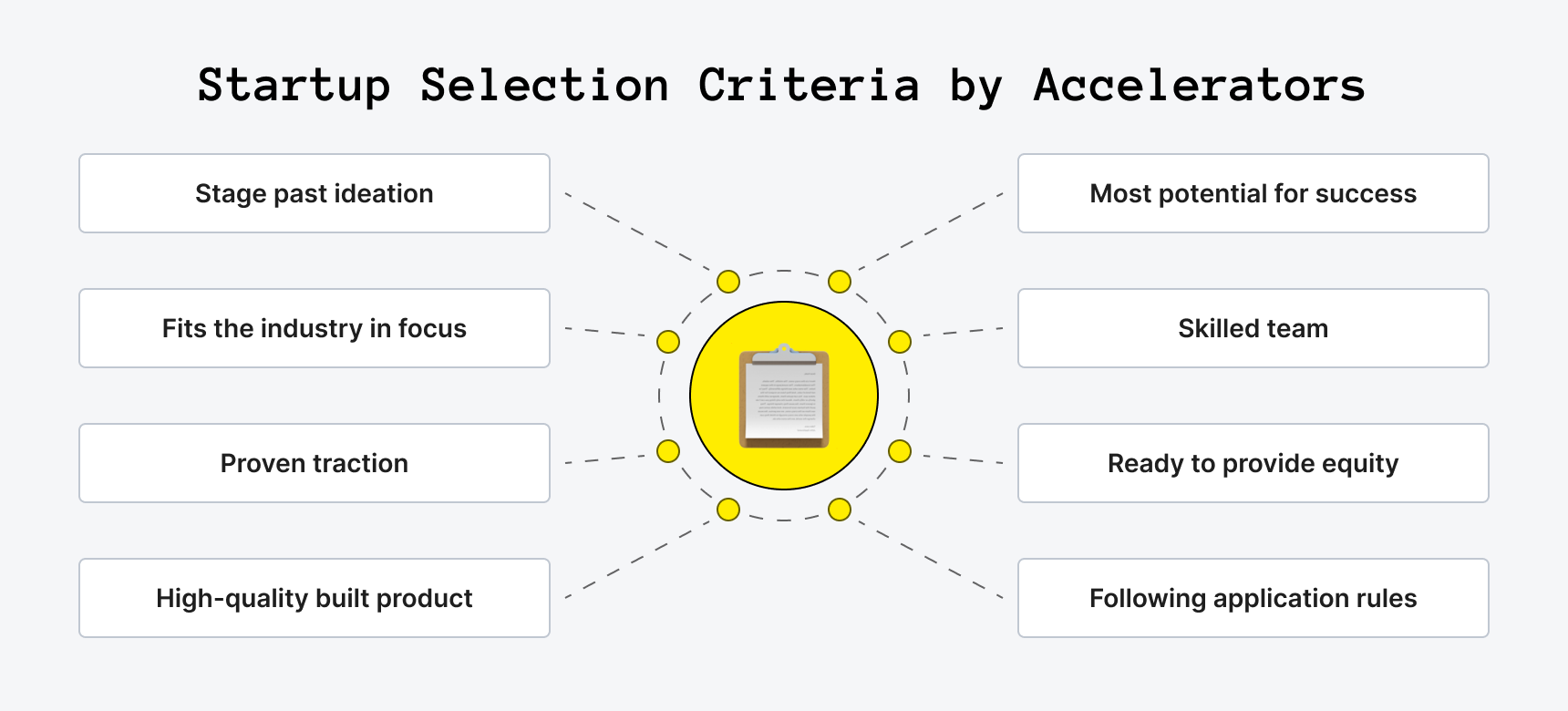
Accelerators want founders who show they’re serious, starting with how they approach the application process. Attention to detail, adherence to deadlines, and thoughtful responses demonstrate the kind of diligence that can carry over to running a business. A rushed, generic application is an instant red flag.
The Startup’s Stage Matters
Top accelerators typically favor startups that are already past the ideation phase. While some programs do accept early-stage ventures, they lean heavily towards companies with a working product and a defined market strategy. Accelerators often expect to see a fully developed and launched MVP, strong technology foundations, and a capable team ready to scale.
Fits the Industry in Focus
Evaluators also look at how well the product aligns with their agenda, so the match in terms of the specific industry focus of the accelerator matters as well. For example, many programs target certain sectors like medical tech, fintech, AI, and so on, shaping cohorts and programs around them. The suggested product's fit in the particular area, market landscape, and its competitive advantages are all seen as significant assets.
Proven Traction and Success Potential
Accelerators are in the business of betting on winners. This means startups with demonstrable traction like user growth, revenue streams, or high engagement metrics have a significant edge. A proven ability to solve a real problem and validate demand often becomes the ticket to being noticed. Equity accelerator companies, in particular, want assurance that the businesses they invest in are primed for future profitability.
The ultimate question every accelerator asks is: can this startup succeed at scale? This is where factors like market size, competitive positioning, and scalability play a role. Startups with a clear pathway to growth are far more likely to capture the attention of accelerator decision-makers.
A High-Quality Product
People in accelerators might want to peek under the “hood” of the product. They care about how it was created, as sometimes no-code MVPs might mean the need to build everything all over again. This is why they may request to conduct a technical due diligence audit to identify potential risks dealing with technology like security breaches, the used architecture, and tech stack choice. Plus, they can evaluate the product’s performance and scalability possibilities with increased demand.
Skilled Team
A strong, capable team can be the difference between rejection and acceptance. The best startup accelerators look for founders who possess complementary skills, clear leadership, industry expertise, and an unwavering commitment to their mission. They often seek those with a good startup team composition and who have demonstrated resilience and an ability to execute under pressure.
Equity Is the Norm
Most equity accelerator companies demand a stake in the startups they accept. This means accelerators are heavily invested in the success of their portfolio companies and, in turn, expect startups to be equally committed. Programs operating on a non-equity model are rare, with startup equity often acting as a mutual sign of shared risk and reward.
How to Choose the Right Startup Accelerator for Your Stage
If you’re thinking about applying, let’s look at how to pick up a startup accelerator that actually fits your stage and goals. Choose a program based on what your startup needs right now, whether that is funding, customers, industry expertise, stronger credibility, or help finding a co-founder.
Before you apply, ask yourself one question: What is stopping us from reaching our next milestone? Your answer should guide your shortlist.
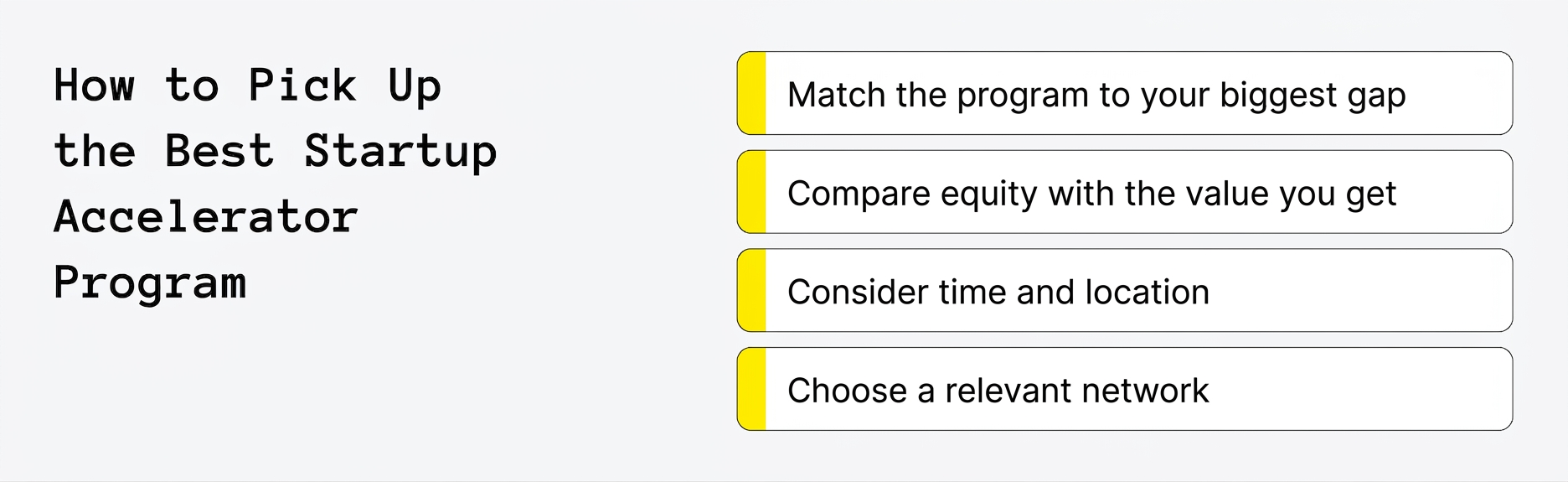
Match the Program to Your Biggest Gap
If you need money to keep building, compare investment amounts, follow-on funding, and investor access. If you need customers, look for programs with strong corporate networks in your market. If credibility is the main issue, focus on accelerators with a respected brand and relevant alumni. For example, a B2B startup selling to enterprise clients may benefit more from a program with corporate partners than from a generalist accelerator with a bigger name.
Compare Equity With the Value You Get
Don’t look only at the equity percentage. Look at the full deal. Giving up 7% for $500k, investor access, useful software credits, and follow-on funding is very different from giving up 6% for $150k and a few workshops. Compare the investment amount, the type of funding, possible future startup equity dilution, partner perks, mentorship quality, and access to customers or investors.
Equity terms across startup accelerator programs can range from 0% to 10%, depending on the program and location. Read the details carefully, especially if the investment includes an uncapped SAFE or other terms that can lead to additional dilution in your next round.
Consider Time and Location
Think about how the program will fit into your actual life and business, not just your pitch deck. Some accelerator startup programs last only a few weeks, while others can take several months. Antler, for example, offers shorter programs in some locations, while Alchemist’s flagship program lasts six months. A longer program can give you more support, but it also means more time away from product work, customers, and fundraising.
The format matters too. An in-person program in San Francisco may offer stronger networking opportunities, but it can also mean spending money on flights, accommodation, and living costs. If your whole founding team has to relocate for several months, calculate that cost before you accept the offer.
Choose a Relevant Network
An accelerator’s network is valuable only if it can help you reach the people you need. If your customers are US small businesses, a program focused on the MENA region may not be the best fit, even if it has well-known mentors. The same applies to industry focus. A fintech, climate, healthcare, or deep-tech accelerator may offer much more relevant guidance, partners, and investor introductions than a generalist program.
The best tech startup accelerator for you is the one that puts you in the right room. Look for mentors who understand your market, corporate partners who can become customers, and investors who actively fund startups like yours.
Common Mistakes When Applying to a Startup Accelerator
Applying to an accelerator takes more than filling out a form. The wrong program can cost you time, focus, and equity, so make sure it solves a real problem for your startup. What founders often get wrong when applying to startup accelerator programs?
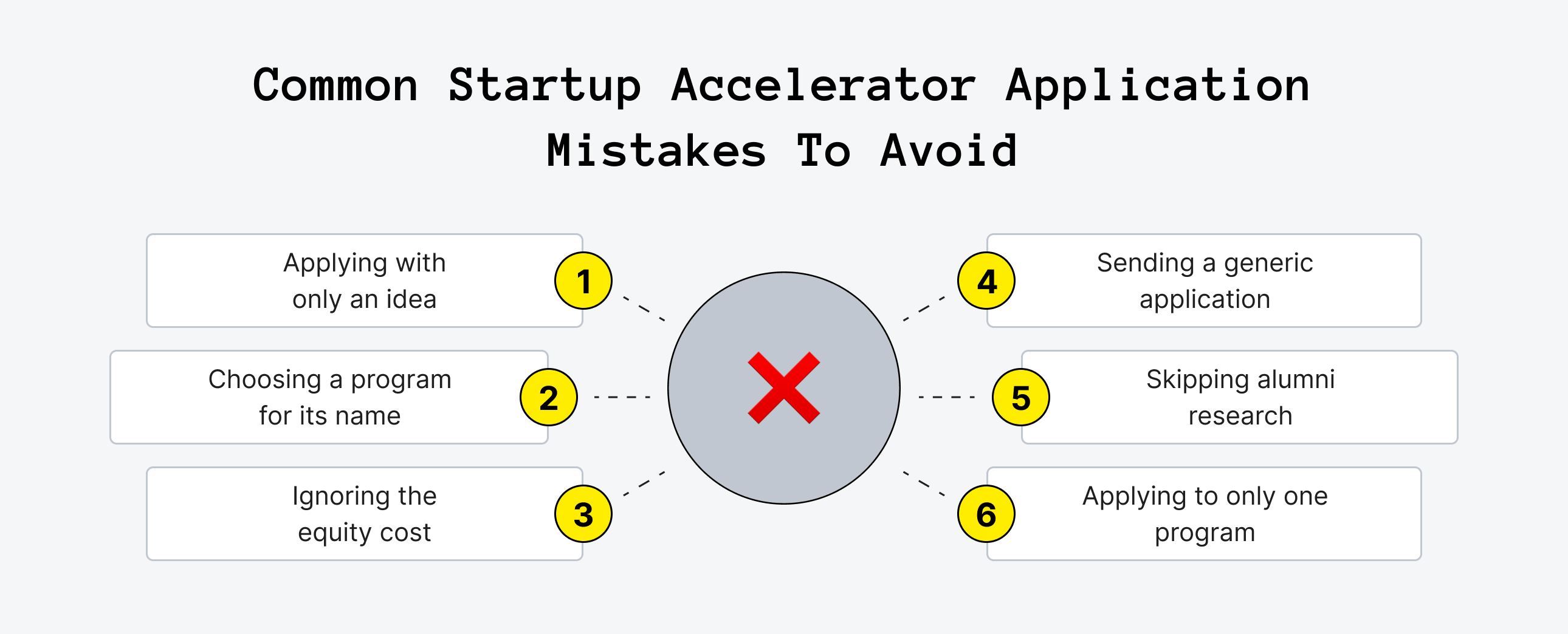
Applying Before the Product Exists
Most top accelerators want to see more than a promising slide deck. They want evidence that you can build, launch, and learn from real users. You don’t need to have revenue to apply to Y Combinator or similar programs. But having a working MVP, early user feedback, or even a small group of active users gives your application much more weight. A simple product people can try is usually far more convincing than a great idea that still exists only in a presentation.
Chasing a Brand Name Over Fit
A well-known accelerator with the wrong industry focus wastes a cohort slot. Think about what you actually need. If you are building enterprise hardware, robotics, or climate infrastructure, a specialized program like Alchemist or SOSV HAX may bring more value than a broad SaaS-focused accelerator. The right mentors, customers, technical resources, and investors are often more useful than a logo everyone recognizes.
Underestimating the Equity Cost
Giving up 5% to 10% of your startup may sound reasonable early on, but it can become expensive if the company grows. For example, 7% of a startup valued at $2 million equals $140k in paper value. Equity can still be worth it if the accelerator helps you raise a larger round, find customers, or avoid costly mistakes. Compare the full value of the program with the ownership you are giving up, not just its investment check.
Treating the Application Like a Formality
A short application does not mean an easy application. Accelerators use it to understand how your team thinks, what you have built, and whether you can execute. Avoid generic answers and buzzwords. Clearly explain the problem, your product, what you have learned from users, and why your team is the right one to solve it.
Skipping the Reference Check
Before giving up equity or committing several months to a program, speak to founders who have recently gone through it. Don’t rely only on the accelerator’s website, testimonials, or old success stories. Ask recent alumni what the mentorship was actually like, whether investor introductions were useful, how much time the program required, and whether they would join again.
Programs change over time. New partners, different mentors, larger cohorts, and updated investment terms can completely change the experience. A conversation with one or two founders from a recent batch can tell you much more than a five-year-old case study.
Applying to Only One Program
Even strong startups get rejected for reasons outside their control. A cohort may already include a similar company, or the accelerator may be looking for a different type of startup that year.
Apply to three or four accelerator startup programs that fit your stage, industry, and goals. Keep building, talking to customers, and improving your product while you wait for decisions. An accelerator can help you move faster, but it should not become your entire startup pivot strategy.
The best application is clear, specific, and honest. Show what you are building, why it matters, what you have learned so far, and how the accelerator can help you reach your next milestone.
Matching Platforms for Co-Founders Based on Accelerators
It’s no secret that there’s a specific tendency when it comes to startups: teams that strike a tech and non-tech founder balance are likelier to achieve success. Such co-founder duets or combos work well because the founders complement one other’s skills (each has ample expertise and background in versatile business spheres). So, how else can accelerator programs for entrepreneurs be beneficial for you?

If you haven't heard of matchmaking platforms, then note that some of them even exist internally within startup accelerators. Co-founder matching platforms were especially designed to help founders find like-minded co-founders to partner with. Such platforms are a safe space for people to meet suitable potential founders by connecting with those in the network who have similar aspirations and complementary skills.
But don't think of these matchmaking platforms as "Upwork for co-founders", as it's not really about hiring. Consider them more of a "Tinder for co-founders" aimed at long-term relationships that'll last in the business realm. But there's more to these tools than a swipe to the right to find an ideal match.
Here are several prominent examples of сo-founder matching platforms on the basis of accelerators:
- Y Combinator Co-Founder Matching Platform — available via their Startup School program. Individuals create and fill out their profiles, marking what they are interested in and what kind of co-founder they're ideally searching for. The solution has already helped make more than 100k matches all over the world.
- CoFoundersLab — another popular service that lets you find you someone to co-found the company with. It holds various in-person events, lets you find a match online, and boasts of a rich community of entrepreneurs, investors, and mentors made up of over 650k users in over 200 cities around the globe. It's free to join if you're seeking a founder.
Basically, the major aim is to facilitate the process of searching for founders and connecting. For instance, this could be both solo founders and teams who have good business startup ideas and would like to build products yet don't want to do it alone or lack specific skills.
In many cases, it's the tech co-founder who's missing in the puzzle. And although the candidates screened for such roles are usually experienced developers or CTOs, there are other co-founder collaboration types available. As such, non-tech founders can consider partnering up with a product studio as a technical co-founder. Such a collaboration lets you team up with an entire experienced team with both a technical and business mindset and get development services at reduced rates in exchange for equity.
Seeking a technical co-founder for your startup?
Consider teaming up with Upsilon, a Product Studio with extensive expertise in tech and launching products business-wise
Best Startup Accelerators in a Nutshell
Accelerators have the power to transform and upgrade your startup so it turns into a high-performance machine capable of conquering a share of the market and outstriding the competition past the checkered flags in the race for business success. And, certainly, accelerator startup programs can help you achieve your growth objectives.
However, applying to the best accelerators and even getting into the program doesn’t give guarantees, a lot is up to the founders. The responsibility levels of such partnerships are high, too (for one thing, giving up your equity). This means that you have to be positive that this path is right for your business.
If it is, ensure that the accelerators you shortlisted align with your business goals, niche, and that the terms are acceptable. Also, make sure that your product is of due quality to raise your chances of getting into the program. If you don't have a product or need to enhance its quality, feel free to reach out to Upsilon, we provide MVP development services for startups. And as a technical co-founder with lots of experience in scale-ups, we can help pick up your product's game if you're in need of development services for growth-stage startups.
FAQ
1. How do you decide whether to join an accelerator?

Join an accelerator when the startup already has a working product and needs one specific thing faster than it could get alone: capital, investor introductions, or enterprise access. Most programs take five to ten percent equity, so review the terms against what the program delivers before applying. Check the accelerator's track record with startups at a similar stage and in the same industry, not only its name recognition.
2. What are the advantages of a startup accelerator?
The main advantages are investor-ready mentorship, capital, and a fast-tracked network a startup would otherwise take years to build alone. A Wharton study found accelerator-backed startups raised about $1.8 million more in their first year than startups that skipped a program. Most programs end with a Demo Day that puts the startup in front of dozens of active investors in one sitting, compressing months of fundraising outreach into a single event.
3. When should a startup join an accelerator?
Join once the startup has a working product and early traction, not at the idea stage. Most top accelerators expect a functioning MVP, some user or revenue growth, and a team that can commit full-time during the program. A handful of programs, including Google for Startups Accelerator, accept earlier-stage teams, but even those expect a real product a user can try today.
4. How do you apply to a startup accelerator?
Applications open on the accelerator's official site, most starting with a written form covering the product, traction, and team. Y Combinator and AngelPad accept applications up to six months ahead of a batch; others like Plug and Play run rolling admissions year-round. A startup that clears the written screen gets an invitation to a short interview, in person or on video, before a final decision.
5. How long do accelerator programs run?
Most run three months, though the range spans twelve weeks (AngelPad) to six months (Alchemist Accelerator). The fixed timeline is deliberate: it forces a startup to hit a specific milestone, most often a Demo Day pitch to investors, rather than letting mentorship stretch on without a forcing function.
6. How do accelerators choose which startups to fund?
Accelerators fund startups that show real traction, a team that can execute, and a product that fits the program's industry focus. Y Combinator's Winter 2026 batch admitted about 1% of applicants, and most top programs now expect a working MVP rather than a pitch deck. Evaluators weigh user growth, revenue signals, and how well the founding team's skills complement each other before an interview is even scheduled.



to top