How Much Does It Cost to Build an MVP: All Price-Changing Aspects Explained


The pitch deck looks great. You have nailed the problem, the "why now," and a product vision that actually makes investors lean in. Then the deceptively simple question arises: "So, how much does it cost to build an MVP and get it into users' hands?" Suddenly, your ballpark guesses, agency proposals, and competitor anecdotes do not feel like enough to bet your runway on.
In 2026, the confusion is amplified by AI-assisted development and no-code tooling. On one side are lightweight prototypes that ship fast but often crack under real users, integrations, and security checks. On the other are serious products: B2B platforms, fintech tools, healthcare apps, and marketplaces where design, reliability, and compliance matter as much as speed. Somewhere in between is the budget tier most founders really want: not a throwaway demo, not a full-scale product, but a focused, testable MVP that feels trustworthy.
This article is written for that exact moment, between "we have raised a bit of money" and "we have to ship something real." We will unpack what you are actually buying at different MVP budget tiers, how scope, team setup, and technology choices quietly move the number, and why the cheapest-looking path often turns out to be the most expensive in the long run. The goal is simple: help you answer the cost question with confidence and build an MVP that gives you a clear signal from the market instead of noisy surprises from your codebase.
Key Takeaways:
- For most startups in 2026, a realistic MVP budget usually lands somewhere between $30,000 and $65,000, with the wider “real world” range running from about $15,000 up to $150,000 when things get more complex.
- The biggest thing that moves your budget is scope. Every extra user role, platform, integration, or compliance requirement nudges you into a higher tier, while a single clear use case, one platform, and a lean team keep things under control.
- You are not just paying for "development." Discovery, UX/UI, engineering, QA, and launch all need their own line in your mental budget, and so does the unglamorous part that follows: maintenance, marketing, and product-market fit experiments.
- The “right” MVP price is the one that lets you test your riskiest assumptions with real users without overbuilding. If you match the scope to your validation goal and use a predictable sprint-based model, you get far more control over cost, timeline, and learning than by simply chasing the lowest offer.
How Much Does MVP Development Cost? The Direct Answer
Let’s start with the numbers everyone is secretly thinking about. In 2026, a lean MVP usually sits in the $15,000–$30,000 range. A standard MVP tends to land between $30,000 and $65,000. Complex MVPs can cross $65,000 and can go up to $150,000 or more.
Those figures assume you’re paying for a working product, not just a pretty prototype. A prototype (clickable screens without real functionality) usually falls in the $5,000–$15,000 bracket and takes around 2 to 4 weeks to put together. A minimum viable product is different: it runs on real infrastructure, serves real users, and produces real usage data you can use to make decisions instead of guesses.
Here’s what that looks like in practice:
At the lower end of the spectrum, that $15,000 starting point assumes a very focused scope: one primary use case, minimal integrations, and a development team in a cost-efficient region such as Eastern Europe. At the upper end, the $150,000+ budget is usually tied to complex platforms with multiple roles, strict compliance requirements, and a lot of moving parts. In practice, MVP cost for startups with a clear concept and a single main use case tends to land in the "standard" tier (somewhere around $30,000 to $65,000) regardless of whether you are building in SaaS, marketplace, or vertical B2B.


Factors That Influence the MVP Cost
As you might have guessed, plenty of things affect how much an MVP will cost you. For example, using a no-code MVP can lower expenses and speed up validation by eliminating the need for developers. However, this shortcut comes with trade-offs such as limited customization, scalability issues, and costly rework when you outgrow its constraints. While both traditional and no-code approaches have different price points, what saves money upfront may lead to bigger costs later.
Let’s suppose you know what you want to build. You start to “guesstimate” how much money you’ll need if you hire a few developers in-house full-time and then reach out to several outsourcing providers for a project quote to compare. Chances are high that even given the exact same project description, various people will come back to you with different answers to how much does it cost to build an MVP.
Why does that happen? Well, because many variables will determine the overall MVP pricing as you make preliminary calculations for your specific project. But if you'd like to get a quick estimate of your project, you can use the MVP cost calculator.
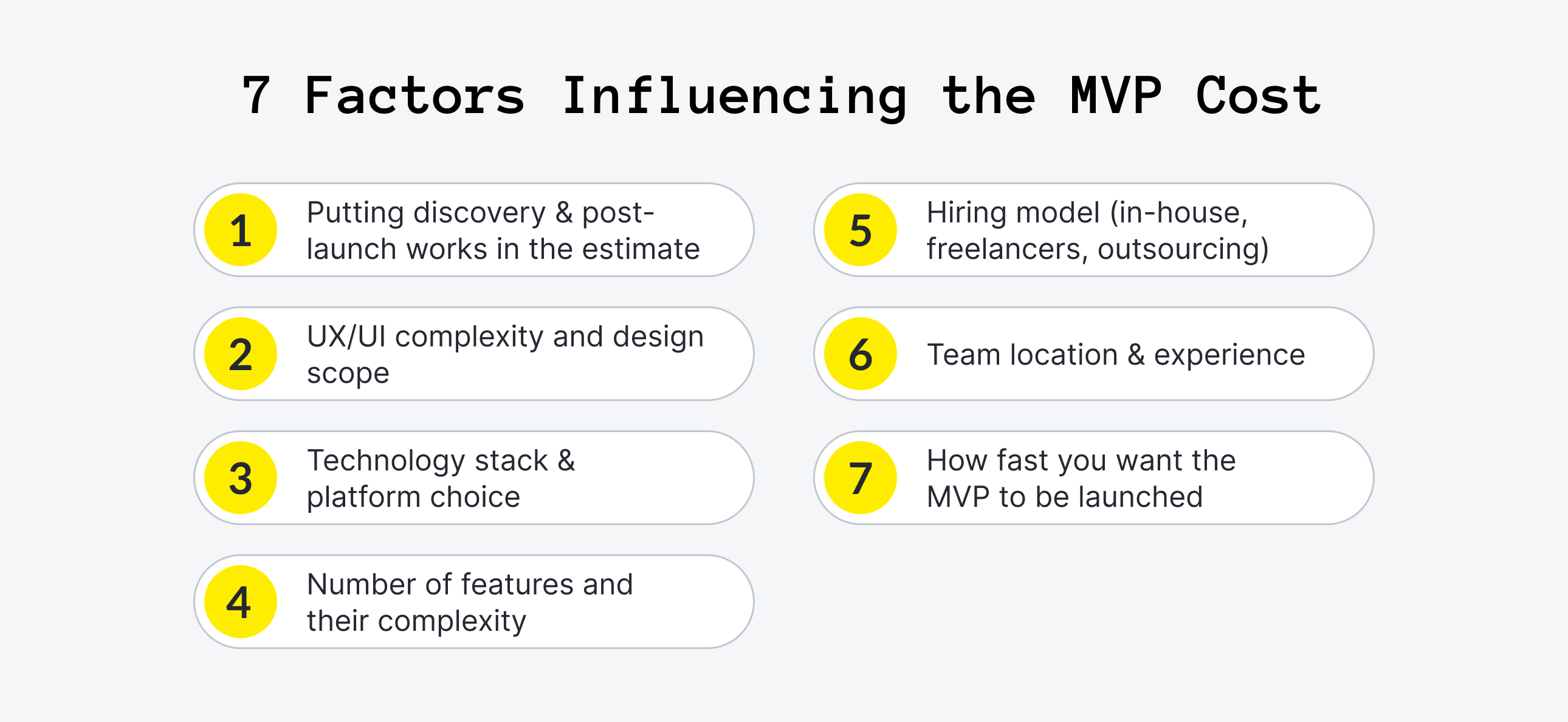
Let's take a closer look at each of these points, explaining how they can affect the overall cost of MVP development.
Idea Validation and Planning
We'd like to note that building a minimum viable product is often combined with several steps that can be attributed to the pre-MVP development process. Initiation, idea validation, proof of concept (POC), and the project discovery phase usually go before MVP development (which, in turn, involves the creation of a functioning version of the product even if it has limited features).
This non-development business-crucial step implies the input of multiple specialists and requires time. You can cut costs by eliminating this phase altogether or may not include it in the overall MVP development project estimate, counting discovery separately.
Design Scope
Prototyping is all about creating wireframes and designs to visualize the future product. It is usually included both in the MVP development process and the cost estimates.
UX/UI designers work on wireframes, mockups, user flows, and the finished product look. If the prototypes are clickable, you'll have the chance to click through the elements, "feel" the interface, and see how users will interact with the solution. There are MVP examples of products that were tested with the audience only with prototypes. Using interactive models is an outstanding opportunity to test your product before assigning tasks to developers.
However, because usability is crucial, this step can also gobble up a lot of time on MVP design alterations, influencing the MVP development cost. The scope is versatile, but it'll be hard for developers to carry on with their part if there are no clean-cut designs.
Platform and Technology Stack
What are you building? Is it a web application or a mobile app? Is it a software-as-a-service solution, a game, or something else? This will affect your platform and MVP tool choice.
Put simply, the more complex your solution will be in terms of tech, the more resources you'll need for its development. Therefore, the tech stack you settle on for the project will also influence the MVP pricing. Choosing in favor of some frameworks or programming languages can cost you extra if they're:
- more in demand;
- challenging to code on;
- or have fewer specialists in general.
To give you a rough estimate from our experience, globally, a developer coding on a more popular framework like React Native may have an average hourly rate of $50 USD, whereas one for blockchain or crypto technologies can come at over $100 USD per hour and up.
To determine which path will help get your MVP running faster yet not limit its scaling capabilities after the MVP launch, you'll need to consider many options, such as low-code vs traditional development. Perhaps, if you're planning to build a mobile application, your project can benefit from cross-platform app development frameworks like React Native instead of coding separate solutions for iOS and Android.
Of course, choosing an optimal technology stack may be a tough call for a non-techie founder, so it makes sense to find someone to consult you.


Number of Features and How Complex They Are
The minimum viable product is called "minimum" for a reason: you shortlist the must-have features that should be present in the solution for its first launch. It is wise to work on feature prioritization and emphasize those features that cater to the users' needs and show your product's uniqueness, saving the rest for post-launch.
You can easily end up having a massive list of features (some of which can definitely be eliminated at the MVP stage). In fact, this is one of the most lethal MVP mistakes teams often make. Many founders treat an MVP almost like a full product, which creates extra complexity and expenses. In this case, Jeffrey Furtado, founder of FurtadoFirm, a real estate investment and development company, shares his experience:
"The most expensive aspect of the MVP was the decision engine in the backend that evaluated real estate lending risk based on dozens of variables beyond just loan to value. We initially tried to incorporate every possible variable, logic branch, and exception for geography, property type, unit composition, tenant history, rental income, lease terms, and so on. In hindsight, we should have launched with a core set of risk indicators and layered complexity after validation. The mistake was treating the MVP like a near-finished product. If I were starting again, I would remove the long tail of rare-edge scenarios and high-variability rules. They introduced cost, technical debt, and slower iteration without meaningful early value."
Even when the features are chosen wisely, the overall MVP development cost can still go up if you need to build many of them, especially if they are complex and require significant time and expertise to implement (for example, cybersecurity features in fintech app development).
Hiring Model
The overall MVP cost will also vary depending on how many developers you need and how you'll hire them (that is if you go for in-house vs. outsourcing software development).
Option 1: In-house Teams
The first scenario implies the hassle of finding and hiring developers to join your team's staff full-time. It has pros and cons but requires a lot of time for recruitment.
Moreover, there are numerous challenges in hiring developers for startups. For instance, oftentimes startups don't have the budget to spare for high salaries or the social perks that established enterprises provide their employees. Plus, in-house also means paying for sick leaves, time off, software and hardware, office space, taxes, and other things. Furthermore, project coordination and management are on you.
To give a rough estimate, given all the factors mentioned above, an in-house team in the USA with 4 specialists can cost you over $50,000 USD per month.
Option 2: Working with Freelancers
The non-in-house options will also differ based on the chosen collaboration path. Frankly, you can even take on individual contractors via freelance web developer sites as the cheapest alternative. Yet this isn't always the most reasonable decision as freelancers might not be available to the extent you need and may flee the project.
Option 3: Partnering with an IT Outsourcing Company
For many, reaching out to an IT outsourcing company is an outstanding alternative. There's more than one outsourcing model to choose from too.
What does outsourcing or signing a dedicated development team allow for?
- saving time on recruitment;
- accelerating time to market;
- visibly cutting costs;
- obtaining a well-versed team of experienced developers from the provider's talent pool;
- sharing management and coordination responsibilities.
Most commonly, you issue payouts for sprints or for the completed work depending on the hourly rates multiplied by the number of hours. So, how much is MVP creation going to cost you if you outsource? To compare, typically, an MVP will cost you less than $30,000-$50,000 USD per month if you go for an outsourcing development team in Eastern Europe with 5-6 experienced specialists (an analogous team in the USA will cost over $70,000 per month).
How Experienced the Specialists Are and Their Location
Even the hiring model can't give you a solid answer on how much you'll need to spend. Obviously, the more experience the developers have, the higher their rates are. A Junior specialist working for less than a year will cost less than a Middle one with 1–3 years or a Senior with 5+ years.
But even different Senior Developers coding in the same programming languages can have an hourly rate ranging from $25 to $150 USD or higher. Why is there such a visible price rift?
Their location also plays a vital role in influencing the rate. For example, referring to Clutch as a source, a developer from the USA can have an average hourly rate of $75-$150 USD, one from Eastern Europe may be available for $40-$60 USD, while one from Asia can work for $20-$40 USD per hour.

Therefore, to cut costs, it may be reasonable to consider developers from other overseas countries. The same applies to remote IT outsourcing firms, as long as you take outsourcing vendor evaluation seriously.
Deadlines
This may be quite self-explanatory, but if you have very short project timeframes and want the MVP launched as fast as possible, the MVP price will go up too. The shorter the deadline you want to meet, the more workforce will be needed. Hence, as the team size (or the expertise level of the specialists you include on the team) grows, so does the price.


What Each Budget Tier Delivers
Before comparing numbers, it’s worth understanding what each budget range actually looks like in the real world, and whether it aligns with your expectations for your MVP or answers the question how much does an MVP cost for your specific product.
A Lean MVP ($15,000–$30,000) delivers:
- 1 core user flow end to end (sign-up → primary action → outcome);
- email and password authentication;
- a functional UI built with a template component library;
- 1 to 2 third-party integrations such as Stripe for payments or AWS S3 for file storage;
- deployment to a production environment, for example AWS, GCP, or Vercel;
- roughly 6 to 8 weeks of development from a lean team.
That is enough to onboard your first dozens of users, collect real usage data, and show investors a working product rather than slides or mockups.
A Standard MVP ($30,000–$65,000) delivers:
- 3 to 5 core user flows across two user types, for example admin and end user;
- authentication with social login (Google, GitHub) plus role-based access control;
- custom-designed UI with consistent branding and a polished onboarding experience;
- 3 to 5 third-party integrations including payment processing, email delivery, and file handling;
- an admin dashboard for managing users, content, or transactions;
- event tracking integrated with tools such as Mixpanel or PostHog for product analytics;
- roughly three to four months of development from a full team (designer, 2 to 3 developers, QA engineer).
That is usually enough for a soft launch, a Product Hunt campaign, and a credible seed fundraise where you can point to real usage instead of promises.
The real question is not simply “which tier can we afford.” The real question is “which tier gives us enough product to test the core assumption our business depends on.”
A Complex MVP ($65,000–$150,000+) may include:
- advanced AI features built into core workflows;
- multi-tenant SaaS infrastructure;
- enterprise SSO and more complex identity management;
- real-time collaboration features that have to work at scale;
- handling of regulated data, for example HIPAA or PCI-DSS requirements;
- mobile native applications in addition to a web product.
This kind of MVP can become infinitely complex. When you stack several of these elements together, the cost of a “minimum viable” product moves into the $80,000 to $150,000 plus range and the timeline stretches by a few extra months beyond a standard build.
That said, complex MVPs are not the typical story for the majority of startups. In most cases, your realistic options are either the lean tier or the standard tier. If you are not in a heavily regulated space and you do not need enterprise-grade features on day one, you probably do not need to start in the complex bracket.
Remember: the real question is not simply “Which tier can we afford” The real question is “Which tier gives us enough product to test the core assumption our business depends on.”
Need a hand with estimating the MVP cost?
Calculating the MVP development cost can get tricky, but Upsilon is here to help.

Hidden Costs Founders Underestimate
Every founder who has gone over budget on an MVP runs into the same issue: the quoted number is real, but it is not the whole picture. The gap usually comes down to hidden costs, and in most cases, the same 3 items are what catch founders off guard.
Third-Party Integrations
Many projects require integration with third-party tools, extensions, and plugins. This is done as an alternative to building your own analogous custom solutions. For instance, you can use:
- an external payment gateway;
- a chatbot;
- marketing tools, startup analytics solutions (such as Mixpanel or Amplitude);
- among other things.
Third-party API costs are ongoing. Stripe, Twilio, AWS, SendGrid, and similar services charge by usage. These costs are invisible at launch but become real line items once you have 500–1,000 active users. For example, a messaging-heavy app with Twilio can spend $500–$2,000/month on 1,000 users before it has meaningful revenue.
In 2026, AI is an additional integration factor that cuts both ways. AI coding assistants and automation tools can reduce routine development time on well-defined tasks by a significant margin, yet those efficiency gains are often absorbed by the team as faster delivery rather than directly lowering the headline budget. At the same time, adding AI product features such as LLM-based chat, recommendation engines, or computer vision increases the scope and typically adds a noticeable extra cost for implementation.

MVP Post-Launch Work
Your work doesn't stop after the MVP is launched, you'll still be investing in it. In fact, this is when you enter a new round of tasks that include:
- attracting real users and investors;
- collecting and analyzing feedback for MVP testing;
- studying data and product performance metrics;
- fixing bugs and flaws;
- prioritizing which features to build next or how to mold the product if it needs changes.
Post-launch maintenance may run 15–20% of your initial development cost per year. A $40,000 MVP costs approximately $6,000–$8,000 per year in cloud hosting, security updates, dependency patches, and bug fixes — before adding any new features.
What else will you be spending money on? On marketing, improving your sales funnel, and other things. As a rule, post-launch expenses are also not included in the initial MVP development cost estimate.
QA and Testing
This phase is routinely underscoped. End-to-end test coverage, cross-browser checks, and load testing add 15 to 20% to development time when done properly. Cutting QA from the MVP scope does not save money; it defers cost to post-launch bug fixes, which research from NIST puts at 30x the cost of fixing the same defect in the design phase. QA inside every sprint, rather than as a phase at the end, is the only approach that keeps timeline and total MVP cost predictable.
None of these costs are surprises once you know to look for them. Build them into your budget before you sign a contract, not after the first invoice lands.
MVP Development Costs and Timeline Breakdown
Overall, it typically takes between 2 and 4 months to build an MVP, depending on scope, complexity, and team structure. Before you commit to a budget, it helps to understand how that time and money actually split across the main phases.
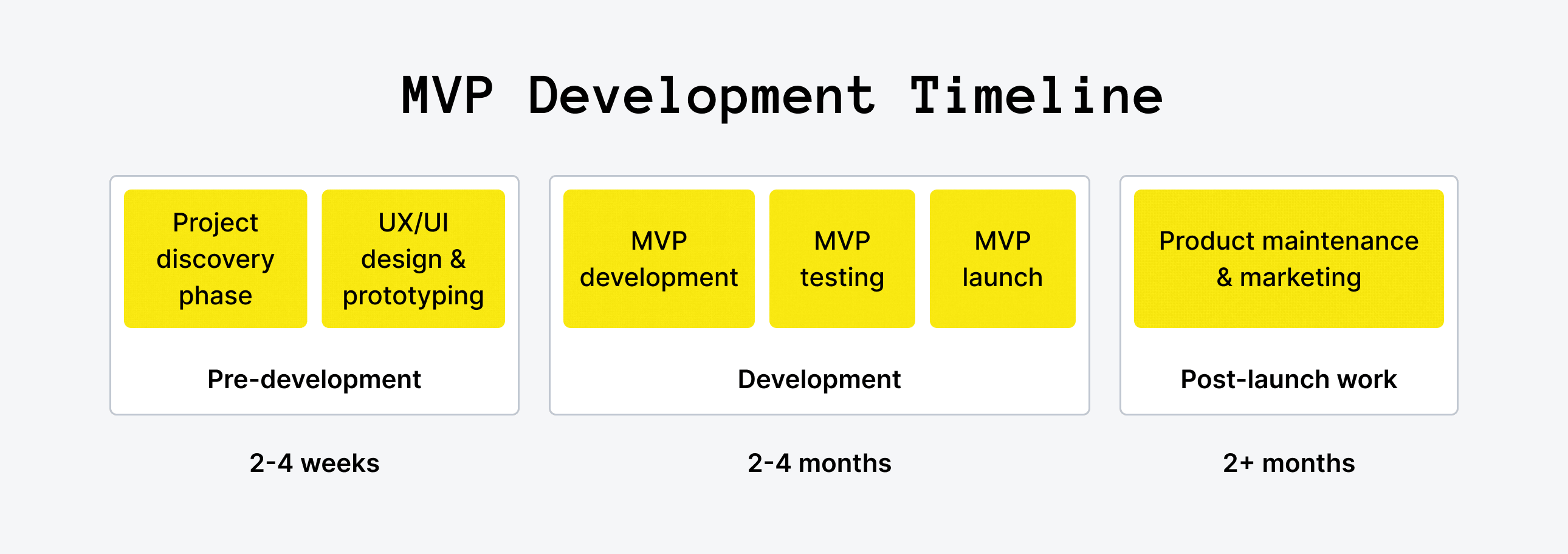
1. Pre-Development: Discovery
The discovery phase may be scoped separately from agile MVP development and is often treated as an independent mini-project. During discovery, you and the team:
- research the market and competitors;
- work on UX discovery for future designs;
- define the target audience and core personas;
- analyze user needs, pain points, and the current market state;
- determine idea feasibility and risks;
- clarify goals, success metrics, and the value the product will bring;
- outline how to build the product and prioritize features for launch;
- evaluate tech stack options and estimate how much it will cost to build an MVP.
In practice, the cost of this pre-MVP stage varies with project size. A light discovery can take only a few days; complex products can require several weeks. A discovery phase that lasts about 14 to 21 business days with a full-time Senior Developer, a part-time Project Manager, and a part-time UX/UI Designer can cost roughly $6,000 to $10,000.
2. Pre-Development: UX/UI Design & Prototyping
The UX/UI design phase usually takes at least two weeks and shapes how users will move through the product. Typical activities include:
- mapping user journeys and key scenarios;
- defining user flows for core actions;
- creating UX wireframes;
- building interactive prototypes;
- producing mockups and final MVP designs.
If a UX/UI designer spends around 10 business days on this phase, the design work may cost approximately $2,500 to $7,500, with higher numbers for more intricate visual design or “minimum lovable product” expectations.
3. Development, Testing, and Launch
This is the largest and most variable part of the budget. Development is often planned in sprints, but you can also think of it as total hours multiplied by team rates. A typical outsourced team in Eastern Europe might include:
- 1 part-time Project Manager;
- 1 full-time Senior Developer;
- 1 full-time Middle Developer;
- 1 part-time Quality Assurance Engineer for testing.
A team of this composition can cost around $28,000 per month for active development, testing, and preparation for launch. Total development time for an MVP usually falls between 2 and 4 months, depending on whether you are aiming for a lean, standard, or complex MVP.
4. Post-Launch Work: Product Maintenance and Marketing
Once the MVP is live, you still need a budget to keep it running and evolving. Post-launch work usually covers:
- keeping the product up and stable in production;
- fixing bugs and handling security issues;
- paying for servers, APIs, and other infrastructure services;
- developing second- and third-priority features planned for after MVP launch.
On average, ongoing product maintenance and iteration often require at least one-fifth of your original MVP budget each year.
You will also invest in marketing: paid advertising, startup tools, social media presence, and content to support distribution. This can start around $5,000 per month and scale with your strategy. In parallel, you will keep working toward product–market fit, which means spending on sales funnel optimization and growth experiments, often another $5,000 to $10,000 per month.
When you look at this table, it becomes clear that “MVP cost” is not just a single line item for development. You are budgeting for a full lifecycle: discovery, design, build, launch, and the ongoing work needed to keep learning from real users. The more clearly you map these phases, the easier it is to decide where to invest heavily, where to stay lean, and how to build an MVP that moves your startup forward instead of just consuming your runway.

MVP Development Cost and Calculation Process at Upsilon
Looking for a trustworthy partner to develop an MVP? Upsilon's team focuses on MVP development services for early-stage startups. Our goal is to help founders and startups bring their ideas to life faster, more effectively, and with minimal risks.
How do we do this? The key is our core values and approach to every project. Throughout the whole development process, we are involved in product management and feature ownership to match clients' business goals with customer needs. We provide our clients with complete transparency and control over the project, our decisions, and reasoning. Following the sprint-based approach, we accelerate value delivery to let business owners validate ideas, gain traction, and attract investments in less time.
How Does Upsilon's Team Estimate the MVP Cost?
Our MVP cost estimates for clients are usually based on the PERT estimation method that shows optimistic, realistic, and pessimistic scenarios. We put our project estimate calculations in the table format, clearly showing how much each feature costs, the time it takes to develop it, and for which milestone it's planned.
The cost estimates in each column are generally provided in days. They're calculated according to the developers' or other specialist's rates multiplied by the number of hours required for each task or feature. As a result, there's a final calculated estimate sum with a breakdown of every item. This way, we give clients the opportunity to modify the inclusions and decide which features they wish to develop during the MVP stage.
Likewise, we always give personal recommendations for each project on the ways to cut corners and save time and money. For instance, this regards cases like bringing user authentification to life using third-party integrations like Auth0, linking up payment gateways such as Stripe, PayPal, or Braintree, or using Retool for admin panels instead of building such functionality from scratch when custom coding might not be necessary.

How does Upsilon work on creating MVPs, and what can you count on? Below we list a few major points worth noting.
The Discovery Phase
There are cases when our clients decide not to go through project discovery or come to us with the results they've already obtained when conducting this step on their own.
If not, as a rule, Upsilon offers the project discovery phase service separately. Hence, it's usually not included in the MVP development work scope or the cost. We remove discovery from the first invoice, and if a client decides to entrust our team with this step, discovery is issued as a separate payment.
After this stage is complete, Upsilon puts together a more specific and accurate MVP development project estimation based on the findings made as a result of the discovery phase.
Sprints
Upsilon approaches MVP development and the corresponding cost estimates in sprints. Each sprint usually takes 2 weeks (or 10 business days) and includes grouped tasks and features the team will bring to life in a given time period.
The MVP development cost is thus estimated depending on the team size and web development team structure multiplied by the hourly rate of the specialists who'll be working on the project during the 2-week sprint.
Of course, the team size also influences the overall MVP price and how quickly it gets developed. As such, the composition of a team per sprint can look like this:

- a small team: 1 Senior Developer (full-time), 1 Middle Developer (full-time), 1 UX/UI Designer (part-time), 1 Quality Assurance Engineer (part-time), and 1 Project Manager (part-time);
- a mid-sized team: 1 Senior Developer (full-time), 3 Middle Developers (full-time), 1 UX/UI Designer (full-time), 1 Quality Assurance Engineer (full-time), and 1 Project Manager (full-time).
You're probably wondering how many sprints it takes to develop an MVP. We can definitely state that one 2-week sprint won't be enough for the MVP launch. On average, we can say that it's 6 sprints (which is 3 months in equivalent). By the way, post-launch work can also be put into sprints.
Ready to kick off your MVP development?
Share the details of your idea or project and we will provide you with a full-cycle team under one roof.
Final Thoughts on the MVP Price
Seeing your product come to life is very satisfactory. But it's vital to ensure that it happens within your budget limit. Otherwise, it'll be challenging to accumulate your excessive spending.
Therefore, calculating your MVP cost in advance is crucial. As you have seen, the final price depends on many factors: how complex the solution is, which technology stack you choose, who you hire, and the way you structure the work. In practice, a well-scoped MVP for most startups typically falls in the $30,000–$65,000 range and takes about 2 to 4 months, while the wider band that covers around 98% of cases sits between $15,000 and $150,000 with timelines of roughly 1 to 6 months. Upsilon’s dedicated team pricing is based on sprints, so your final cost depends on how many sprints you need and the specific mix of roles involved in your project.
If you're still wondering "How much does it cost to build an MVP?" and would like to get a more accurate project estimation, don't hesitate to contact Upsilon to discuss your needs and get a consultation with our experts!
FAQ
1. How much does it cost to build an MVP?

MVP development costs in 2026 range from $15,000 to $150,000, depending on scope, team model, and geography. A lean MVP with one core user flow and minimal integrations typically costs between $15,000 and $30,000. A standard MVP with two to four features and a polished UI usually falls in the $30,000 to $65,000 range. More complex MVPs that include AI integration, multi‑role platforms, or regulated data (such as fintech or healthcare) can cost from $65,000 up to $150,000 or more.
2. What factors increase MVP development cost the most?
The three biggest drivers are feature scope, team model, and geography. Every feature added multiplies design, development, and QA time. A US-based agency typically charges between $100 and $200 per hour, while an Eastern European team with equivalent skill usually charges between $35 and $75 per hour, and that difference compounds across a three-month build. Compliance requirements (HIPAA, PCI-DSS, GDPR) can add between $10,000 and $30,000.
Unlike CPM, which relies on fixed task durations, PERT generates a probabilistic range of possible completion times rather than a single deterministic schedule. In general, PERT provides a more realistic outlook for projects with unpredictable or variable task lengths, but it may be less precise when task durations are already well-defined.
3. How long does it take to build an MVP?
A lean MVP typically takes 4 to 8 weeks. A standard MVP with 2 to 4 features and custom UI takes 2 to 4 months. A complex MVP takes 4 to 8 months. The most reliable way to hit a timeline is to run a 2‑week discovery sprint before development, since a scoped backlog and solid technical architecture remove the rework that extends most builds by 30 to 50 percent.
4. What is the cheapest way to build an MVP?
No-code tools like Bubble and Webflow let you launch for $5,000 to $15,000, but only if your core workflow fits within the tool's constraints. For most SaaS or marketplace products, no-code reaches its limits when you need custom business logic, third-party integrations, or stronger performance. A lean custom MVP from an Eastern European agency typically costs $15,000 to $30,000 and gives you owned code from day one, without the later migration cost when no-code is no longer sufficient.
5. Is an MVP the same as a prototype?
No. A prototype is a clickable mockup with no working code, used to test design and user experience before any development begins. It typically costs between $5,000 and $15,000 and takes around 2 to 4 weeks. An MVP is a working product with real code, real infrastructure, and real users. It usually costs between $15,000 and $150,000 and takes about 2 to 6 months. Most founders need both in sequence: first a prototype to validate the concept and UI, then an MVP to validate market demand with real usage data.
6. What does post-launch cost for an MVP?
Budget 15 to 20% of your initial build cost annually for ongoing maintenance, including cloud hosting, dependency updates, security patches, and bug fixes. A $40,000 MVP costs approximately $6,000 to $8,000 per year before adding any new features. Keep a “Day 2” fund of 20 to 30% of your MVP budget to cover the first round of iterations after you see real user behavior, as this amount is almost always spent within the first 60 days after launch.



to top