Why Python Is the Best Programming Language for Startups


Every startup begins with a spark, a vision that demands to be brought to life. Yet between that first flash of inspiration and a functioning product lies a series of complex decisions, and few are as critical as choosing the right technology stack for startups. It is a choice that determines how quickly you can move, how much you can spend, and how gracefully your company will grow.
More and more founders are placing their trust in Python. With its clear syntax, vast ecosystem, and flexibility across industries, Python has become the language that empowers startups to move fast without sacrificing quality. According to the Stack Overflow 2025 Developer Survey, Python is the fourth most popular technology for all developers (behind JavaScript, HTML/CSS, and SQL). More importantly, for people learning to code, it’s number one, and has been for years. The TIOBE index, which measures language popularity, consistently ranks Python as the #1 language in the world.
Once considered a simple scripting language, Python has evolved into the foundation of modern technology. It drives breakthroughs in artificial intelligence, data science, and automation, and powers the web applications that define today’s high-growth startups. In this article, we’ll uncover the key benefits of Python, highlight real-world examples of successful Python-powered startups, and share practical insights on how to build your own development team.
Key Takeaways
- Speed is everything. Python's simple syntax allows for rapid development. It's the perfect language for building a minimum viable product fast.
- It's built to scale. Don't let its simplicity fool you. Python powers global giants like Instagram, Netflix, and Spotify, handling millions of users.
- The talent pool is massive. As one of the world's most popular languages, it is easier and more cost-effective to find and hire a dedicated team of Python developers.
- Future-proof your startup. Python is the undisputed king of AI, machine learning, and data science. If your product roadmap includes any smart features, Python is the way to go.
- Python's ecosystem is giant. With over 500,000 packages in the Python Package Index (PyPI), you never have to build from scratch. There’s a free, open-source library for almost anything.
- There's a flexible framework for every task. Whether you need the all-inclusive power of Django or the minimalist speed of Flask and FastAPI, the Python ecosystem has the right tool for the job.
What Do Startups Need from a Programming Language?
Before we dive into Python, let's create the Startup Wishlist for a programming language. What really matters when you have a great idea, limited funds, and a clock that’s ticking?
It boils down to a few key factors:
- Speed to market: This is the big one. Can you build your MVP and get it in front of users before your funding runs out? You need a language that allows for rapid product prototyping and iteration. You don't have time for complex and verbose code.
- Cost-effectiveness: Your budget is tight. You need a language that is open-source (no licensing fees) and has a large ecosystem of free libraries. Just as important, the talent to build it must be available and affordable.
- Scalability: Your dream isn't to have 100 users. It's to have 100 million. You need a language that can handle that growth. It must be able to grow from a simple monolith to a complex system of microservices without a painful rewrite.
- A large, available talent pool: You can't afford to spend six months trying to hire a developer with a too-niche skillset. You need to find, hire, and onboard developers quickly. A popular language means a deep well of talent to draw from.
- A strong community and ecosystem: Startups don't have time to reinvent the wheel. You need access to a massive collection of libraries, business frameworks, and packages. When your team gets stuck, they need to find an answer on Stack Overflow in five minutes, not five days.
- Flexibility: The startup pivot is a classic story for many founders. You might start as a simple web app, but then discover your real value is in data analytics. Or you might need to add an AI-powered recommendation engine. Your language needs to be a Swiss Army knife, not a butter knife.
As you've probably guessed, Python checks every single one of these boxes. Let's find out how.
What Is Python Programming Language?
Python is a high-level, interpreted, general-purpose programming language. It was created by Guido van Rossum and first released in 1991. His guiding philosophy was "readability counts." He wanted to create a language that reads almost like plain English.
This focus on simplicity is its secret weapon. Where other languages use complex syntax with brackets, semicolons, and dollar signs, Python uses simple indentation and clear keywords. This makes it incredibly easy to learn, read, and maintain, especially when you’re building fundamentals through a structured Python programming course.
For a startup, less time spent deciphering code means more time spent building features.
It's also an interpreted language. This means you don't have to go through a lengthy compilation step every time you make a change. You just write your code and run it. You go through a super-fast feedback loop for development and debugging, which is exactly what you need when you're trying to build an MVP. Its versatility is legendary.
Today, Python is used by giants like Google, NASA, Disney, and countless others for web development, data science, automation, AI research, and more.
Now that you know what the Python programming language is, let’s see how it has evolved into a whole ecosystem of handy startup tools for everything you need in software.


Most Popular Python Frameworks
You rarely write pure Python for a web application. You use a framework. A framework is a set-container of tools, libraries, and code that provides a structure for your application. It saves you from writing all the boring and repetitive code for things like handling web requests, managing databases, or securing user sessions.
While there are many frameworks, a Python development team for a startup will almost always focus on three of the best Python frameworks. At Upsilon, these are the tools we use to build fast and scalable products.
1. Django
Django is the batteries-included framework. It follows the Don't Repeat Yourself (DRY) principle and gives you almost everything you need out of the box. It’s a high-level framework that encourages rapid SaaS app development and pragmatic design.
Features and Advantages of Django
- Includes a powerful Object-Relational Mapper for database tasks, a built-in admin panel, and robust security features.
- The built-in admin panel alone can save a startup weeks of development on a dashboard or content management system.
- Automatically protects against common web threats like SQL injection, cross-site scripting, and clickjacking.
- It was built to handle the high traffic of a newsroom and today powers massive sites like Instagram and Pinterest.
The framework is best for a complex web application architecture, content-heavy sites, CRMs, and projects where you need a full-featured backend fast.
2. Flask
Flask is a "micro-framework." It’s the polar opposite of Django. It’s minimalist, lightweight, and gives you only the absolute basics: web request handling and routing. Everything else, such as database integration, or user authentication, is up to you to add with extensions.
Features and Advantages of Flask
- You have total control. There's no "Django way" of doing things. You build your app structure exactly as you see fit.
- Has a very small footprint and is easy to learn.
- Perfect for building a simple prototype, a single-purpose API, or a smaller web app.
- A massive ecosystem of extensions lets you add features (like an ORM or user logins) as you need them.
Use it for microservices, simple APIs, prototypes, and projects where you want full control over your components.
3. FastAPI
FastAPI is one of the most popular Python frameworks today, and for good reason. It’s a modern, high-performance framework built for creating APIs. As its name suggests, it is fast — both in terms of code execution and development speed.
Features and Advantages of FastAPI
- It's built on modern Python features (async/await) and has performance on par with fast languages like Node.js and Go.
- Automatic Docs are its killer feature. FastAPI automatically generates interactive API documentation (using standards like Swagger UI and ReDoc). Your frontend team will love you for it.
- It uses Python type hints to validate all incoming data, which reduces bugs and errors.
- Its simple syntax and built-in data validation let you build production-ready APIs in record time.
FastAPI works best for building high-performance APIs, backends for mobile apps, and serving AI/ML models.

Benefits of Python for Startups
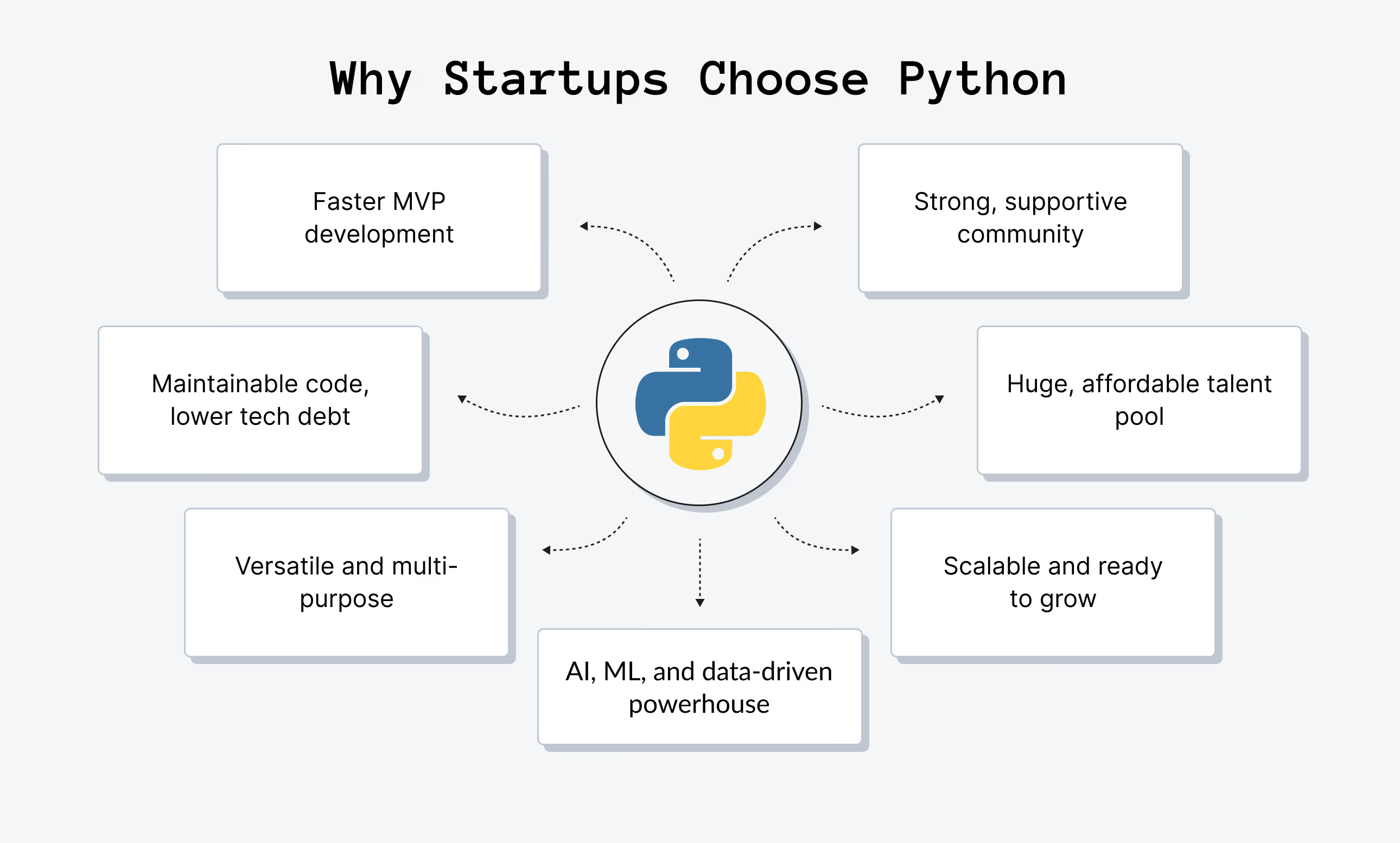
We've seen what startups need and what Python offers. Now let's connect the dots. Here are the core Python benefits that make it the ideal choice for a new business.
1. Unmatched Speed for MVP Development
This is the number one reason. Startups operate in a race against time. The faster you can build an MVP, the faster you can get user feedback, find product-market fit, and show traction to investors.
Python's simple, English-like syntax means you write less code to get the same result. Less code means fewer bugs and faster development. Combined with frameworks like Django or FastAPI, a small team can build a functional, secure, and scalable web app in weeks, not months. This is one of the most critical benefits of using Python.
2. A Massive and Welcoming Community
When you're a small startup team, you can't be experts in everything. With Python, you don't have to be. The Python community is one of the largest and most active in the world.
PyPI (Python Package Index)
PyPI is the official library of third-party Python packages. It contains over 500,000 projects. Need to process images? There's a library for that (Pillow). Need to talk to an API? (Requests). Need to analyze data? (Pandas). Your team can import these free libraries and immediately have powerful functionality.
Support
Stuck on a bug at 2 AM? Someone on Stack Overflow has almost certainly had the same problem and solved it. The documentation, tutorials, and forums are endless. This free support network is like having thousands of developers on-call.
3. A Huge Talent Pool (That's Easier to Hire)
An amazing tech stack is useless if you can't find anyone to build it. Because Python is so popular and easy to learn, the global talent pool is enormous. It's taught as the introductory language in top universities and coding bootcamps.
For a startup, this means:
- You can hire Python development team staff more quickly.
- A larger supply of developers means more competitive and affordable rates, especially when you look beyond your local city.
- Python's readability means a new developer can get familiar with your codebase in days.
4. It Scales. Really
There's a persistent myth that Python is slow. This is mostly false, especially for startups.
First, developer speed is almost always more important than execution speed in the early days. Second, most web applications are I/O bound, not CPU-bound. This means your app's bottleneck isn't the code; it's waiting for the database to return data or an external API to respond. Python handles this beautifully.
And when it's time to grow? Python is ready. It's built for horizontal scaling — just add more servers. Its microservice architecture, supported by Flask and FastAPI, is how giants run. If Python can handle the scale of Netflix's backend, Spotify's Wrapped data analysis, and Instagram's user base, it can handle your startup's success.
5. The Go-To Language for AI, Machine Learning, and Big Data
This is Python's superpower. If your startup idea has any connection to data, Python is not a good choice. It's nearly the only choice.
- Want to build a recommendation engine?
- Need to analyze user behavior?
- Want to add image recognition?
- Plan to use a chatbot or AI model?
All of this runs on Python. The global ecosystem for AI — Google's TensorFlow, Meta's PyTorch, data science (Pandas), and scientific computing (NumPy) — is built in Python. By starting with Python for your web app, you create a seamless tech stack. Your web backend and your smart AI models can live in the same language, repository, and team. This is a massive strategic advantage.
6. Incredible Flexibility and Versatility
Python is the ultimate Swiss Army knife that satisfies a startup's need to do many different things with a small team. With Python, one developer can:
- Build the web app backend (Django/FastAPI).
- Analyze user sign-up data (Pandas/Jupyter).
- Write an automation script to manage your cloud servers (Boto3).
- Prototype a new machine learning feature (Scikit-learn).
The versatility simplifies your tech stack, reduces the need for specialists in multiple languages, and makes your team more agile.
7. Simple, Readable Code = Lower Maintenance Costs
A startup's code is a long-term asset, but it can also be a long-term liability. This is especially true with the complex and write-only code (or code that's hard to read). You soon find yourself stuck in a technical-debt nightmare.
On the other hand, Python's clean syntax forces developers to write readable and maintainable code. This might seem like a small thing, but its long-term impact is huge.
- When you hire a developer, they can understand the code.
- When you need to fix a bug, it's easier to find.
- When you need to add a feature, you can do it without breaking five other things.
All these things lower your total cost of ownership and keep you moving fast.
Have a project in mind and need a good team?
Our experts will be happy to help you build your next project at the top level of quality.

Python App Examples: What Successful Startups Have Built
Theory is great, but proof is better. The Python benefits aren't theoretical. They are the foundation for some of the biggest tech companies in the world, many of which started as small startups.
Here are just a few Python app examples you might use every day.
The entire backend of Instagram runs on Django. It is one of the world's largest deployments of the Django framework. They chose it for its simplicity and speed of development, which allowed them to scale from zero to a global phenomenon.
The flexibility of the framework allows the platform to evolve and borrow the best competitor features fast. Remember, we only had TikTok? It wasn't too long until we got Reels, too.
Spotify
While Spotify uses a mix of languages, Python is a key component. It powers many of their backend services (using a microservices architecture) and is the primary language for their data analysis and machine learning. That Discover Weekly playlist that knows you so well? You can thank Python.
Netflix
Netflix relies on Python a lot for everything from its backend logic to its powerful recommendation algorithms. They use it for data analysis, monitoring, automation, and more. They are so invested in the ecosystem that they have open-sourced numerous Python libraries for the community.
Dropbox
The original Dropbox desktop client was built almost entirely in Python. The founders chose it for its cross-platform support (it worked on Windows, Mac, and Linux) and, you guessed it, its development speed.
Uber
Uber's global operations are a massive data-processing challenge. They use Python (along with frameworks like Flask) for many of their core backend services, from processing ride requests to calculating ETAs and surge pricing.
One of the internet's largest communities was originally written in another language (Lisp). The founders famously rewrote the whole platform into Python early in its life. Why? To get access to Python's massive ecosystem of libraries and its much larger developer talent pool.
These companies all chose Python for the same reasons a startup should: it’s fast to build with, it has the libraries you need, and it scales to the moon.


How to Build a Python Development Team for Your Startup
Okay, you're convinced. You've decided why to use Python. Now you need the builders.
For a non-technical founder, this can be the scariest part. What does a Python development team even do? Who do you need to hire?
Responsibilities of a Python Developer
A Python Developer isn't just one job. The role can vary, but for a startup, their core responsibilities will include:
- Writing clean, efficient, and testable server-side code.
- Building the application's backend logic using a framework like Django, Flask, or FastAPI.
- Integrating the application with databases (like PostgreSQL) and other services (like Stripe for payments or SendGrid for email).
- Creating and maintaining APIs for your web or mobile frontend.
- Writing unit and integration tests to ensure code quality and prevent regressions.
- Deploying the application to a cloud provider (like AWS or Google Cloud).
Roles in a Python Development Team
A team is more than one developer, even in an early-stage startup. You'll need a few key roles despite one person wearing multiple hats.
- Backend Developer(s): These are your Python experts. They build the engine of your application.
- Frontend Developer(s): Your front-end team builds the user interface (UI) — the part your users see and interact with. They use technologies like React, Vue, or Angular.
- DevOps Engineer: This person manages your cloud infrastructure and automated deployment pipelines (CI/CD). In a young startup, this is often a hat worn by a senior backend developer.
- QA Engineer (Quality Assurance): This person's job is to find bugs before your users do. They test the application, write automated tests, and try to break things.
- Project Manager (or Scrum Master): This person keeps the team on track, manages tasks, and removes obstacles. In a startup, you are likely to see the founder doing this job.
Available Options for Building Your Team
You have three main options to build your team.
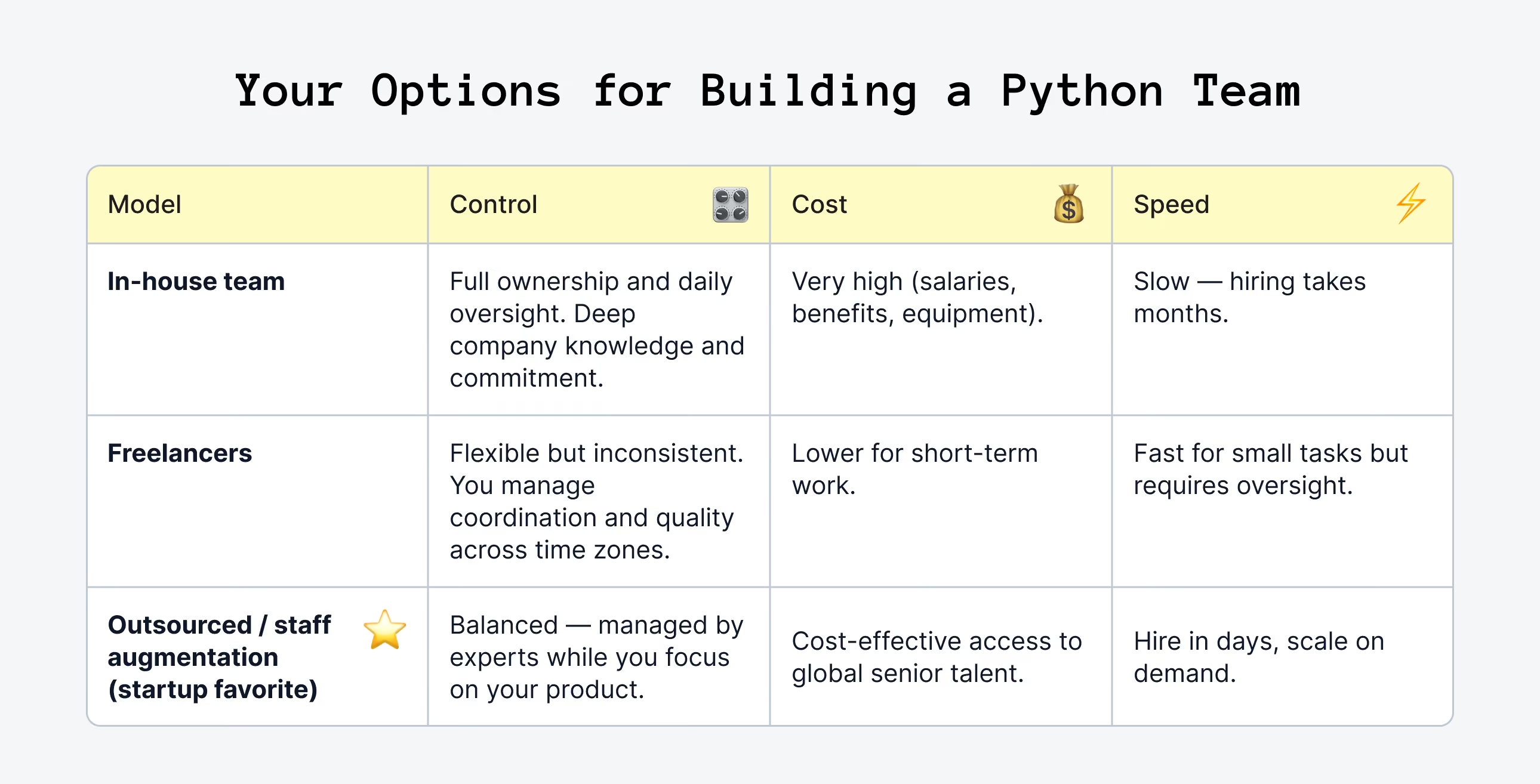
- Hire an in-house team
- Pros: Full control, total dedication, and they build deep company knowledge.
- Cons: Extremely expensive (salaries, benefits, taxes, equipment). Incredibly slow to hire (it can take months to find one good developer). High risk — if you make a bad hire, it's a costly mistake.
- Hire freelancers
- Pros: Flexible and can be cheaper for small and well-defined tasks.
- Cons: A management nightmare. You have to coordinate multiple individuals from different time zones. There's a risk of them disappearing, and quality can be very inconsistent.
- Outsource / staff augmentation (the #1 startup choice)
- Pros: This model gives you the best of all worlds. You partner with a company that provides a pre-vetted, managed team of developers.
- Cost-effective: You get access to a global talent pool of senior-level developers at a cheaper rate than hiring in-house in the US or Western Europe.
- Fast: You can hire a dedicated team of Python developers in days or weeks.
- Flexible: You can easily scale your team up or down. Need two more developers for a big feature push? No problem. Need to scale back after launch? Also simple.
- Managed and vetted: You get a high-performing team that already knows how to work together, managed by an expert technical leader. You get to focus on your product, not on recruiting.
- Cons: Communication can be more complex, and you rely on a partner’s processes for delivery quality. It also requires trust and clear agreements to ensure transparency and alignment with your startup’s goals.
Outsourcing is how today’s smartest startups go to market faster while keeping costs under control. At Upsilon, our team augmentation services help founders bring experienced Python developers on board quickly, so they can build, launch, and scale their products with ease.
Not sure which programming language is the right one for you?
You can turn to our experts and they will be happy to answer any questions you may have.
Final Thoughts on Python for Startups
Choosing the right technology is one of the most important steps in any startup journey. Python continues to prove itself as a language that combines simplicity, versatility, and scalability, all the qualities that help young companies move fast and grow with confidence. Whether you are building your first MVP, testing an AI idea, or scaling a platform to thousands of users, Python helps you move fast, stay adaptable, and focus on what you do best: creating something people want.
At Upsilon, we get it — building your product shouldn’t feel overwhelming. Our Python development services are all about helping you go from idea to live product without the stress. You’ll get a team that speaks startup, works in sprints, and knows how to ship quality fast.
If you’re ready to bring your Python project to life, let’s chat about how we can make it happen together.
FAQ
1. Why is Python popular among startups and tech founders?

Python is popular for three main reasons:
- Its simple syntax and vast libraries let startups build, test, and launch an MVP faster than almost any other language.
- It's open-source, and the massive global talent pool makes it more affordable to hire a Python development team.
- It is the #1 language for AI, data science, and machine learning. It allows startups to easily add smart features and data analysis as they grow (due to the vast ecosystem of ready-to-use tools).
2. What are the best Python frameworks for building MVPs?
For most MVPs, Flask or FastAPI is fantastic.
- Flask is minimalist and flexible, letting you build exactly what you need very fast.
- FastAPI is also very fast to develop with and is ideal if your MVP is primarily an API (e.g., to support a mobile app), as it creates automatic documentation.
- Django can also be great for an MVP if your product is more complex and fits its structure (like a social network, marketplace, or dashboard), as its built-in admin panel can save you weeks of development.
3. How much does it cost to hire a Python development team?
The cost varies based on location, experience, and hiring model.
- In-house (USA/Western Europe): A single senior Python developer costs $120,000 - $180,000+ per year, plus benefits, taxes, and overhead. A full team is prohibitively expensive for an early-stage startup.
- Freelancers: Rates range from $50 - $150 per hour, but you also pay a hidden cost in management, coordination, and quality control.
- Outsourcing/agency (e.g., Eastern Europe): This is often the most cost-effective model. You can hire a pre-vetted, full-time, senior-level developer for a lower cost than a US-based one, or get a whole managed team for the price of one or two in-house hires.
4. What types of applications can you build with Python?
You can build an enormous variety of applications. The most common examples of Python applications include:
- Web applications and backends (using Django and Flask)
- High-performance APIs (using FastAPI)
- Data science and machine learning models (TensorFlow, PyTorch)
- Data analytics and visualization dashboards (Pandas, Dash)
- Automation scripts for DevOps and IT
- Microservices and backend systems for mobile apps



to top