RAG vs Fine-Tuning: How to Choose the Right Approach for Your AI Product


Your AI support assistant quotes last month’s refund policy. You give it the current policy and ask the same question again. This time it gets the refund window right, but still leaves out the next step even though the policy spells it out and your instructions say to include it. The first mistake was about the information the model had. The second was about what it did with that information.
That distinction is the starting point for the fine-tuning vs RAG decision. If giving the model the right source fixes the answer, look at how your app gets that source. If the model still makes the same mistake with the right information in front of it, try a clearer instruction or a worked example before you consider fine-tuning. One rerun gives you a clue; test the fix on similar requests before you commit to a bigger build.
This guide breaks down fine-tuning vs RAG vs prompt engineering by what each approach fixes, what it costs to build and maintain, and how to tell when the simplest option is good enough to ship.
Key Takeaways:
- Start your RAG vs fine-tuning comparison with a real failure: is the model missing information, following unclear instructions, or making the same mistake on a repeatable task?
- If the right information is there and the same mistake keeps happening, try clearer instructions, examples, or a fixed output structure before fine-tuning.
- Fine-tuning is worth testing when errors on a well-defined task persist across new requests and cost your team real time or money.
- Rules your product must always follow belong in the application, not in the prompt or the model's training.
- Compare options on quality, speed, and the cost of a correctly handled request, not on the price of a single model call.
RAG vs Fine-Tuning vs Prompt Engineering in Simple Words
All three approaches can improve an AI feature, but they change different things. Prompt engineering changes the instructions you give the model. RAG changes the information it gets with each request. Fine-tuning changes the model itself through additional training.
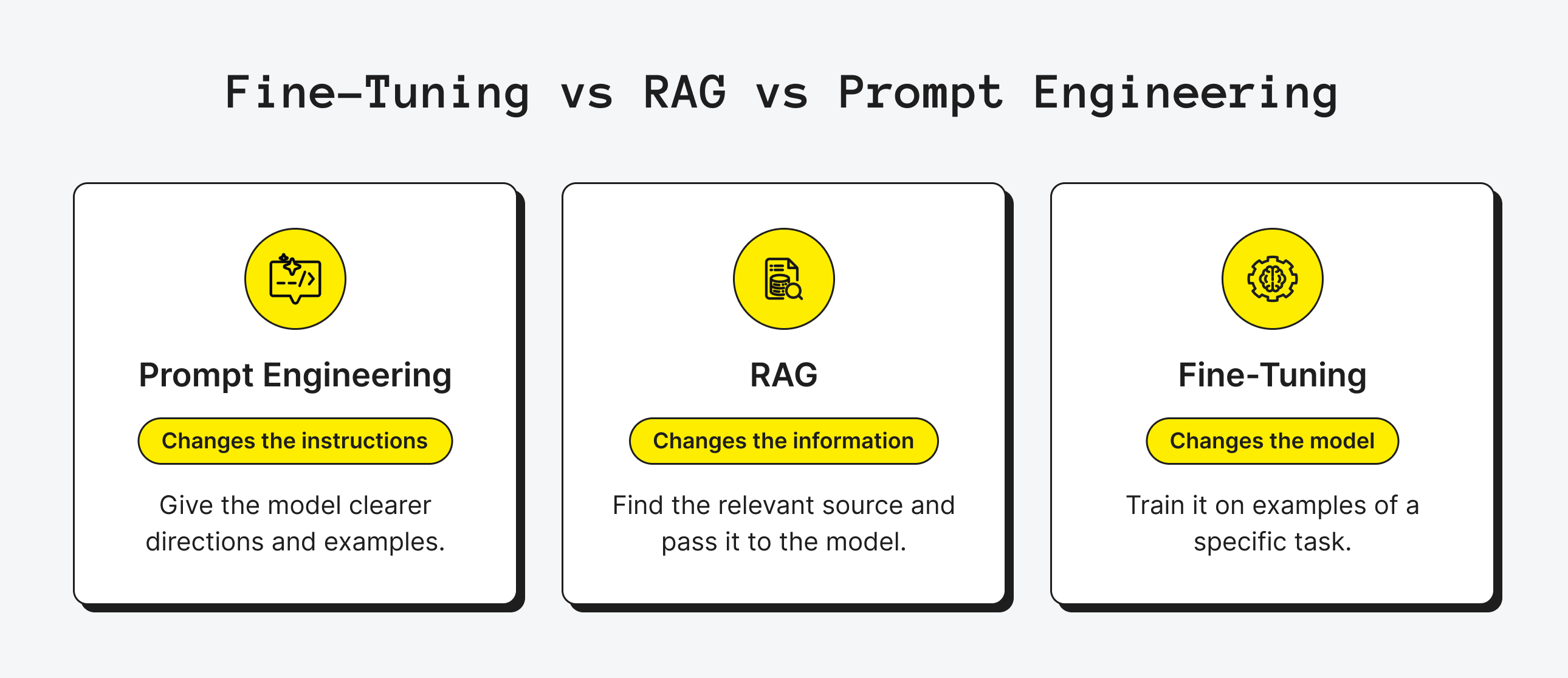
With prompt engineering, you tell the model what to do, what not to do, and what a good answer looks like. For example, you might give it a sample of a well-written product description and a list of claims it must never make. You're using the same model; you're just giving it a clearer brief.
RAG stands for retrieval-augmented generation. Before the model writes an answer, your application searches for relevant information and passes it along with the user's question. It could pull the right section of a contract, the latest version of a help article, or the account details for a specific customer, giving the model evidence to work from.
Fine-tuning means taking an existing model and training it further on examples of the task you want it to perform. For instance, you could show it past support tickets labeled with your team's internal categories so it gets better at sorting new ones. That can help it handle a recurring task more consistently, but it doesn't give it access to information that changed after training.
If your app needs to look up information, test retrieval. If the model already has the right inputs, a prompt engineering vs fine-tuning comparison can show whether clearer instructions are enough or whether training improves how the model handles the task.
When to Use RAG vs Fine-Tuning: Start With What’s Failing
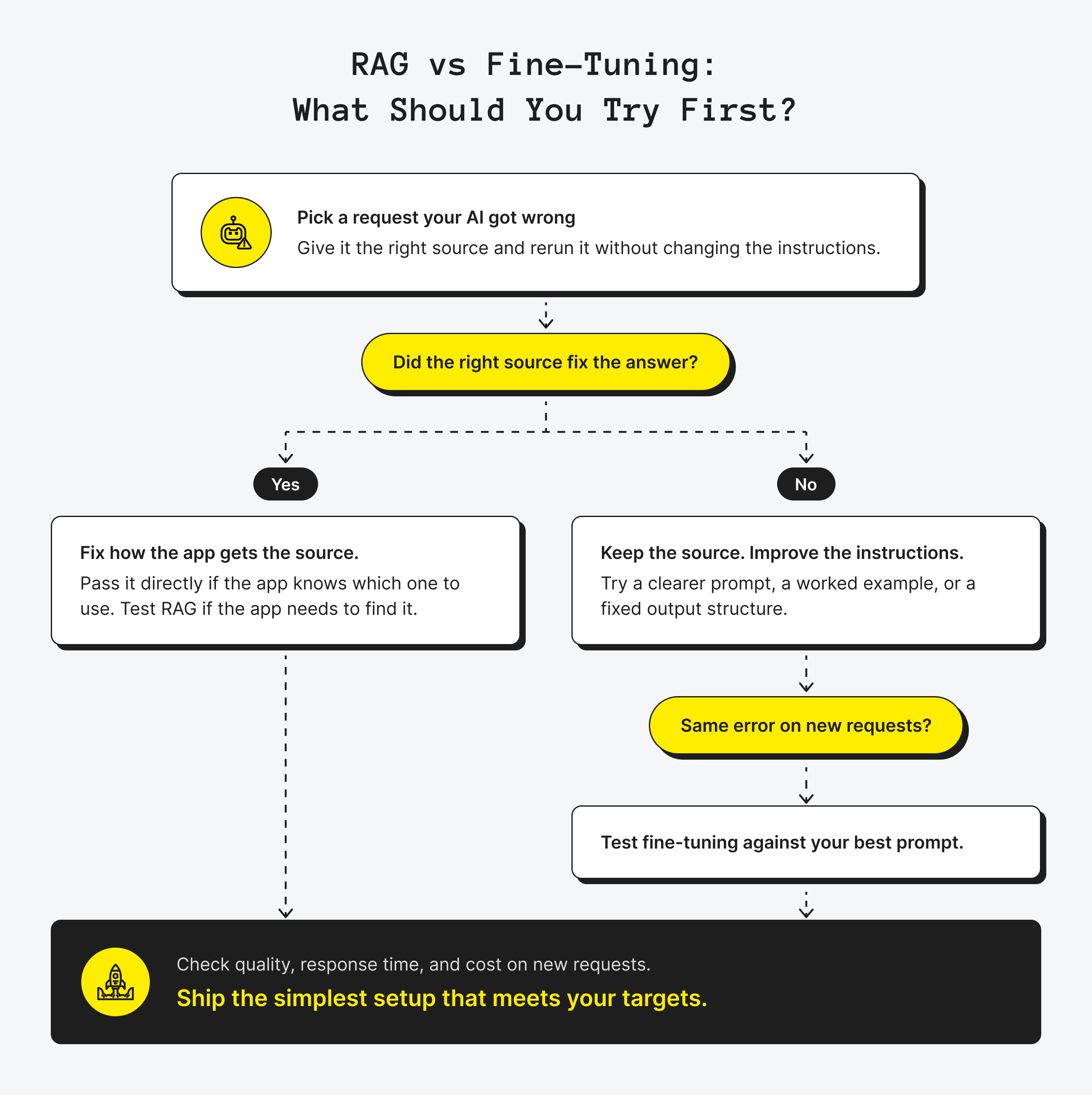
Before you build a search pipeline or prepare training data, take one request your AI got wrong and run it again. This time, give the model the exact passage it should have used, but leave the instructions unchanged. If the answer is still wrong, keep the passage in place and try a clearer instruction or a good example of the answer you expect. Change one thing at a time so you can tell what helped.
Some failures aren’t the model’s job to prevent. If you’re building a custom AI assistant, check what each user can access before sending any data to the model. If an action needs approval, block it until approval is recorded. The model can explain the rule; the application should enforce it.
RAG vs Fine-Tuning vs Prompt Engineering: Build Cost and Maintenance
Refining instructions for one workflow is a different scope from connecting documents, setting access rules, and testing search. Fine-tuning adds a different kind of work: preparing examples, training the model, and checking that the new version doesn’t break what already works.
The figures below are illustrative budget ranges for the AI work in a narrowly scoped MVP, not provider fees, market benchmarks, or quotes for an entire product. Think of one text-based workflow, with reference material available and a clear way to test the output. Messy data sources, complex permissions, or training examples that need to be labeled from scratch can change the scope.
Treat prompting and RAG as alternative starting scopes, not two full budgets to add together. If you already have a prototype, estimate the extra work needed to add retrieval. The fine-tuning range is an additional budget for preparing data, training, and evaluating the new version.
Say your AI feature handles 10,000 requests a month. Assume no prompt caching, an average output of 300 tokens in both setups, and illustrative rates of $2 per million input tokens and $10 per million output tokens. The table isolates token costs; it doesn’t assume the two setups produce equally good answers.
RAG saves $70 a month in token charges here. If search and indexing cost $100 a month, the RAG setup costs $160 to run versus $130 for the direct prompt, before you count what either took to build. But if your test suggests that 100 fewer requests per month would need manual review, and each review takes five minutes, RAG could save more than eight hours of review time a month. That’s the trade-off to measure.
Fine-tuning has its own test: does the new model reduce corrections enough to justify the extra development and running costs? Compare the cost per correctly handled request, including retries and human review, rather than comparing model calls in isolation.
The AI MVP Ladder: What to Try First and When to Move On
In AI MVP development, the first version only needs to prove that the core task works. The symptom table helps you choose what to test. The ladder helps you decide whether a fix is good enough to ship.
Before you change anything, put together an evaluation set: a list of real or realistic requests and what an acceptable response looks like for each. Include straightforward questions, requests with missing information, and edge cases where the model should hold back or hand off to a person. Decide which errors would block launch. An awkward sentence might be fine; a confident answer that’s wrong in a way that costs a customer money isn’t.
Run your current setup first so you have something to compare against. Then use the same test requests for each version. Keep them separate from the examples you put in the prompt or use for training. Alongside answer quality, track how long a response takes and how much it costs to handle the request.
For example, say your support assistant needs to handle at least 95 of 100 test requests correctly, including handing off cases it can’t resolve. You also set two launch conditions: no incorrect refund promises in the test set, and at least 95 of the 100 responses ready within three seconds. If a new setup handles 97 requests correctly but only 90 responses are ready within three seconds, it hasn’t passed. The quality score tells you what met the bar; the timing tells you what still needs work. These are example targets, not universal launch thresholds.
1. Start With Prompts and a Long-Context Check
Give the model a clear instruction, a few examples of good answers, and a defined output structure if another part of your app needs to read the response. If the feature only needs a handful of reference documents, try passing those documents directly with the request before building a search layer.
Anthropic suggests when your knowledge base is under roughly 200,000 tokens, or about 500 pages. Treat that as a starting point for an experiment, not a cutoff. A document can fit in the model’s context and still make each request too slow or expensive. And the model should only receive material the user is allowed to access.
Stop here if the answers pass your tests and the setup meets your cost and response-time targets. Move on if the app regularly needs to pick the right material from a larger collection instead of sending the same documents every time.
2. Add RAG When the Model Needs the Right Source
Give the app a way to find the right source for each request. In a contract review tool, semantic search can help surface relevant clauses even when the user’s question uses different wording. Use filters to limit the search to the applicable contract type and jurisdiction, and enforce access permissions before passing any excerpts to the model.
Test retrieval and the final answer separately. Did the app find the right source? And did the model apply it correctly? If the search returns an outdated document, fix how the app selects sources. If it returns the right one but the model misreads it, work on that failure directly.
In one Anthropic retrieval experiment, the share of relevant passages missing from the top 20 results fell from 5.7% to 1.9% after changes to how passages were contextualized, retrieved, and ranked. That’s what a retrieval test measures: whether the right evidence makes it into the results. It doesn’t tell you whether the model used that evidence correctly.
Stop here if the app reliably finds the right source, uses it correctly, and stays within your cost and response-time limits. Consider fine-tuning only if the same behavior problem keeps showing up even with the right source and clear instructions.
3. Fine-Tune Only When the Remaining Problem Is Behavior
Say your model has the right information, but your team keeps correcting how it classifies incoming documents. If the categories are stable, fine-tuning is worth testing. Start with AI data preparation: agree on what each label means, review examples the team disagrees on, and set aside a separate batch for testing.
Compare the fine-tuned version with your current setup on requests you didn’t use to develop either version. How many fewer outputs need manual correction? Did any high-priority cases get worse? Do the savings justify preparing training data and maintaining another model version?
Ship the fine-tuned version only if it makes a meaningful improvement without making critical cases worse. And don’t treat the ladder as a required build order. If your product classifies or rewrites content without looking up external information, skip RAG. Run a prompt engineering vs fine-tuning comparison on the same held-out requests to see whether training fixes errors that persisted with your best prompt.
Not sure whether your AI product needs RAG or fine-tuning?
Upsilon can evaluate your use case, identify the right architecture, and help you choose an approach that balances performance, development costs, and scalability.

How Upsilon Approached Fine-Tuning for an AI SaaS Platform
Before you decide where to fine-tune a model, decide what you want it to do. For Neudesk.ai, a platform for creating and sharing B2B proposals, the goal wasn’t just to generate polished copy. The AI copilot needed to give users a draft they could keep working on, with sections they could edit and pricing suggestions they could review and adjust.
We used LangChain, one of the AI frameworks we use for rapid prototyping, to build an early version of the AI workflows. Once we identified proposal generation and pricing recommendations as the most valuable features, we moved those two tasks to a model fine-tuned on the client’s data. The 22 weeks covered the full MVP build, not fine-tuning alone.
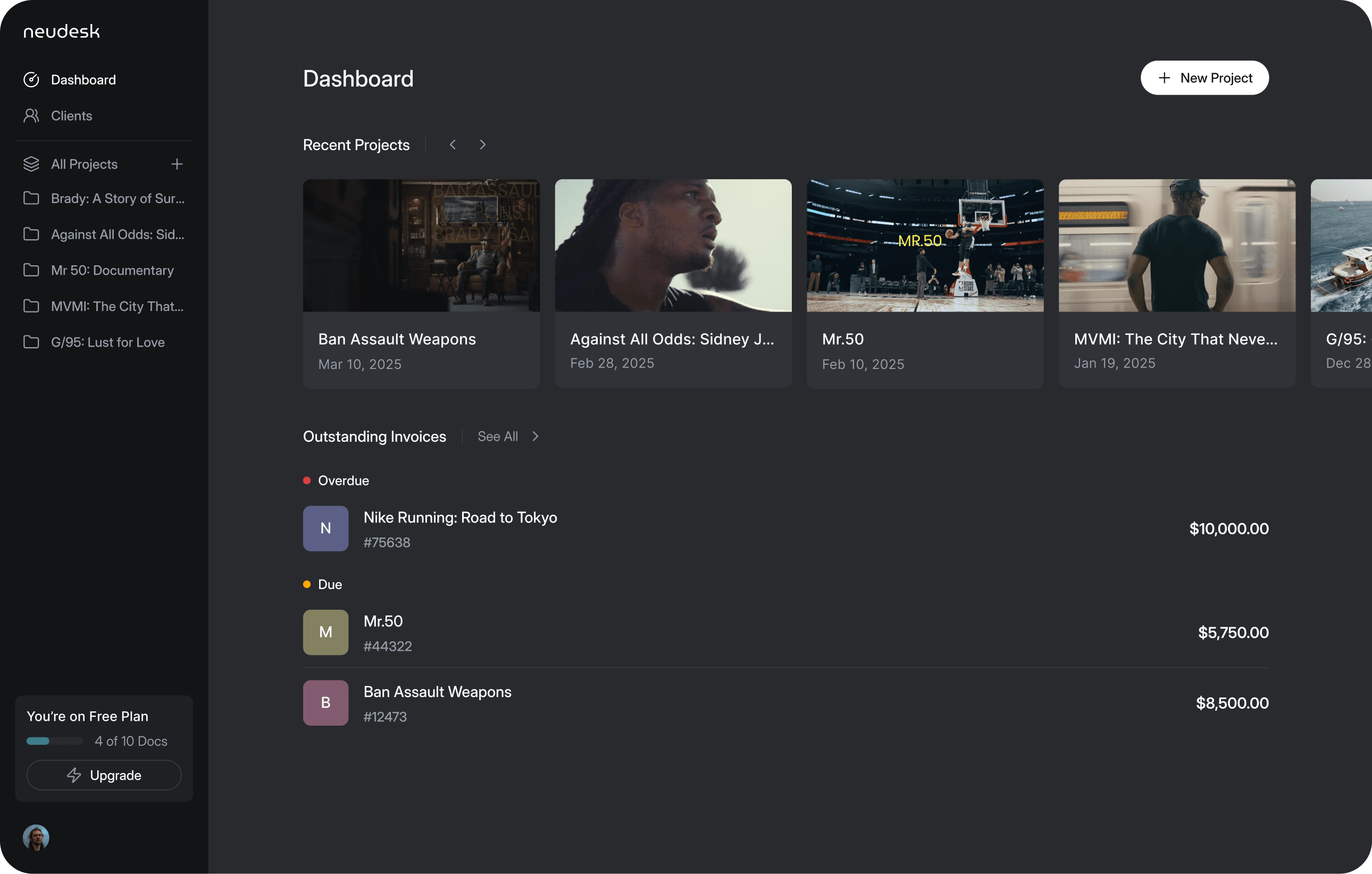
The case shows when we made the switch, not how much fine-tuning improved the output. If you’re making a similar decision, compare your best prompt with the fine-tuned model on briefs you didn’t use to develop either version. Look at the work users still have to do: Are they tweaking a few lines or rewriting whole sections? Can they review the pricing as presented, or do they have to reformat it first? Fine-tuning earns its place if it saves enough of that work to justify maintaining another model version.


Can You Use RAG and Fine-Tuning Together?
Yes, if they solve two different problems. In a customer-facing assistant, RAG can find the policy or product information that applies to the request. A fine-tuned model can help with a separate task, such as routing the request to the right team. An answer can use the right source and still land with the wrong team.
You don’t have to fine-tune the model that writes every reply. If classification or routing is the only step that needs improvement, test a fine-tuned model just for that step. And if the issue is simply that the reply doesn’t follow a template, try a fixed output structure before you add another model to maintain.
To see whether the combination is worth it, keep retrieval and reply generation unchanged and swap only the routing step. On the same test requests, count how often a person has to reassign a ticket, check whether urgent cases reach the right team, and measure any extra cost or delay. If the new router doesn’t make a meaningful difference, keep the simpler setup.
Managed vs Open-Weight Fine-Tuning: What to Check Before You Commit
Once you know what you want to train, decide who will run the model and how you’ll update it. You can use a managed service or fine-tune an open-weight model and choose where to host it. The decision affects not just the first training run, but also what you can do when you need to retrain or roll back.
- Managed fine-tuning. If you’re considering a service such as Google Cloud’s Vertex AI, check whether the exact model version supports tuning, when it retires, and whether you’ll be able to create new training jobs after launch. If you already use a fine-tuned OpenAI model, check training access and inference availability separately: being able to run an existing model doesn’t mean you can train a new version.
- Open-weight models. If you want more control over where the model runs, choose a model whose license permits your intended use. One tuning option is LoRA, which trains a small set of added parameters instead of updating the whole model. You still need a plan for hosting, monitoring, and testing new versions before they go live.
Before you commit, ask what happens six months after launch. Can you roll back a bad update? If your base model is retired, can you compare a replacement against the same tests? Keep your training examples and test set in a location you control so you can reuse them if you switch providers.
Seeking help with building your product?
Upsilon helps businesses design, build, and optimize AI-powered products.
Concluding Thoughts: Choose the Simplest Setup That Passes Your Tests
Start with a request your AI got wrong, not a technology you want to use. If the right source fixes the answer, make sure your app can get that source reliably. You may only need to pass a document the app already knows about. If the app has to find the right passage for each request, test RAG. If the model keeps making the same mistake even with the right information and clearer instructions, test fine-tuning against your best prompt.
Decide what would make the extra work worthwhile before you build. Would it mean fewer answers based on outdated policies, fewer tickets sent to the wrong team, or less time spent rewriting drafts? Test on requests you haven’t used to develop either version. If the simpler setup already meets your targets for quality, response time, and cost, ship it.
If you’re building an AI MVP or fixing a feature that isn’t working as expected, explore our AI product development services or contact us to talk through what’s failing and what to test before you invest in a bigger build.



FAQs
Is RAG better than fine-tuning?

Neither is better across the board. RAG helps when your product needs to find the right information before answering, such as the latest policy, contract clause, or product data. Fine-tuning is worth testing when the model already has what it needs but keeps making the same mistake on a specific, repeatable task, such as assigning content to the wrong category.
When should I use RAG vs fine-tuning?
Use RAG when the app has to find the relevant material for each request and tests show that supplying it improves the answer. Test fine-tuning when the model already gets the right inputs but keeps making the same mistake on new requests despite clearer instructions, examples, or a fixed output structure.
Is fine-tuning cheaper than RAG?
Not necessarily. When you compare fine-tuning vs RAG on cost, start by separating development from day-to-day usage. In the illustrative MVP budgets above, RAG costs $8,000–20,000 to build, while fine-tuning adds $15,000–40,000 to an existing setup. These figures cover different kinds of work, not competing provider fees. To compare running costs, include model usage, search where applicable, retries, and human review. A cheaper model call isn’t a saving if your team has to fix more outputs.
Can you use RAG and fine-tuning together?
Yes, if each solves a different problem. An assistant can use RAG to find current information and a fine-tuned model to handle a specific step, such as routing or classification. Keep the rest of the workflow unchanged when you test the tuned step so you can see whether it reduces enough errors to justify the extra cost.
Does fine-tuning stop an AI model from hallucinating?
No. Fine-tuning can help a model perform a task more consistently, but it doesn't guarantee factual answers or give the model access to new information. RAG can supply the evidence, but the model can still misread it. Test whether the app finds the right source, whether that source supports the answer, and whether the model avoids guessing when evidence is missing.
Is there anything better than RAG?
Sometimes the simpler option is to put the source directly in the prompt. If the app already knows which document it needs, it can load the current version without searching for it. Test that setup for quality, response time, cost, and access permissions. Add RAG when finding the right material is itself part of the problem.
to top