Build-Measure-Learn Loop: Why Does It Matter for Your MVP?

Startups often glorify speed, launching products quickly, raising capital at record pace, and scaling operations as fast as possible. Yet beneath this obsession with velocity lies a harsh reality: the startup failure rate hovers around 90 percent. What makes this figure even more unsettling is not the failure rate itself, but the underlying reason behind so many of these collapses.
According to a landmark study by CB Insights, over 35% of startups fail because they build a product with no market need. Teams invest months, sometimes years, perfecting features, refining interfaces, and writing flawless code, only to realize their product solves a problem that doesn’t really exist. The tragedy is not in the lack of effort or talent, but in the absence of early validation.
So, how do you avoid this fate? This is where the discipline of the Build-Measure-Learn loop becomes essential. Rather than relying on intuition or unchecked assumptions, this framework encourages founders to approach product development as a series of experiments.
In the pages ahead, we will explore how this approach can serve as both a safeguard against wasted effort and a catalyst for discovering genuine product–market fit, turning risky guesses into actionable knowledge one iteration at a time.
Key Takeaways
- The Build-Measure-Learn loop is a continuous cycle that helps turn assumptions and ideas into validated business truths through customer feedback and data.
- The framework prioritizes learning and reduces the risk of building something nobody wants.
- For a minimum viable product, the framework moves the focus from shipping a product to systematically testing the core business hypothesis with minimal resources.
- Successful implementation requires clear hypotheses before the Build phase, a focus on actionable metrics in the Measure phase (metrics that show cause and effect), and discipline in the Learn phase to either pivot (change strategy) or persevere based on evidence.
- Common pitfalls that derail the process include vanity metrics that feel good but don't inform decisions, ignoring customer feedback, and becoming too attached to the initial idea.
Understanding the Build-Measure-Learn Cycle
The Build-Measure-Learn tactic is the engine of the Lean Startup methodology. It is a simple and powerful framework for navigating the extreme uncertainty that every new venture faces. Under the framework, you avoid spending too much time in a secret lab perfecting a product; you get out of the building and confront reality as fast as possible.
The core idea of this tool is to minimize wasted time, money, and effort by iterating your product based on real user feedback.
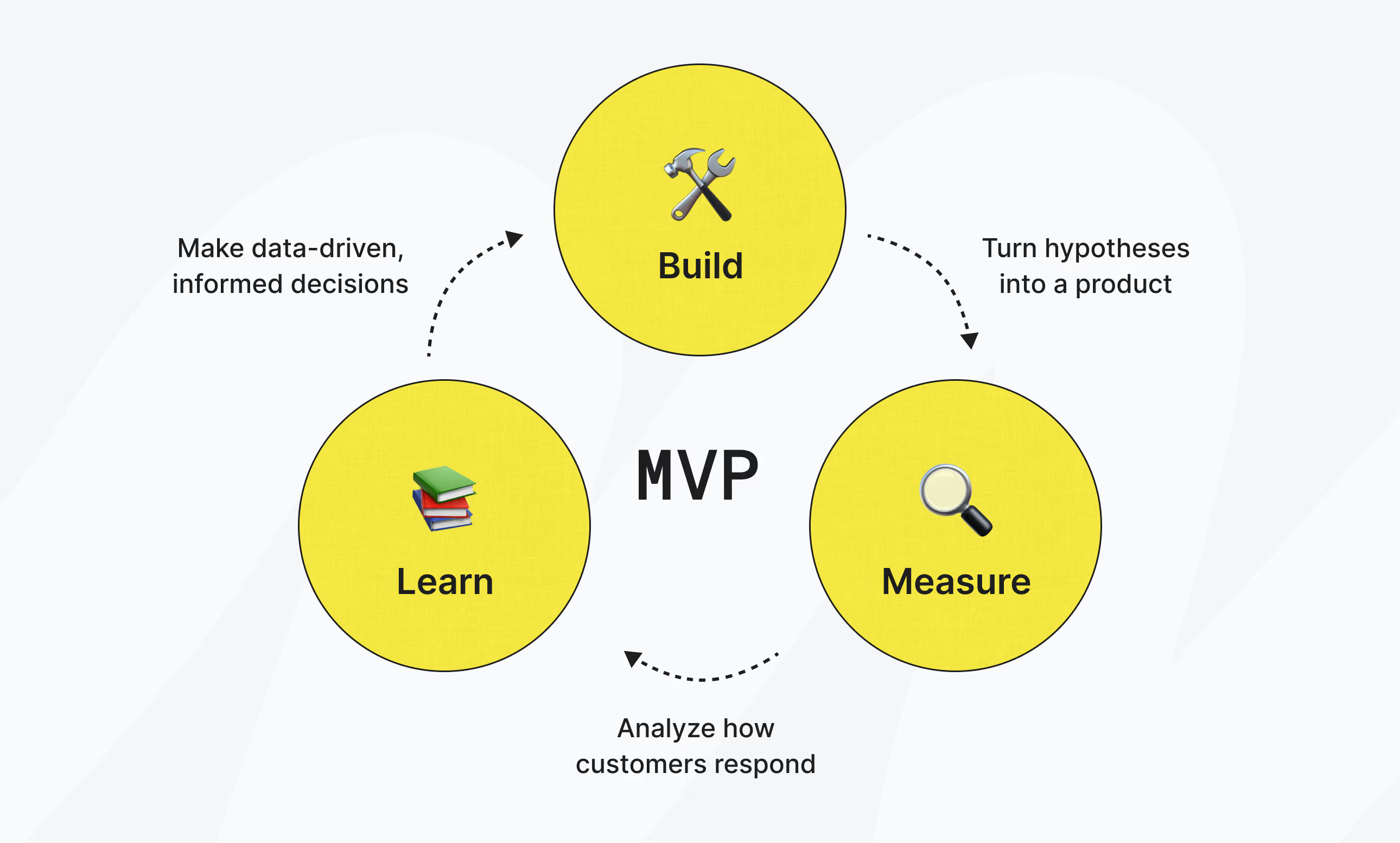
Let's break down the three components:
Build
In the first step, you create a basic version of your product, a minimum viable product (MVP). The keyword here is minimum, because your goal is not to build a feature-rich and polished product. Instead, you’re expected to build just enough to test a specific hypothesis about your business.
For example, if your hypothesis is "People will pay for a service that summarizes daily tech news," your Build phase might end up with a simple landing page that describes the service and includes a Subscribe for $5/month button.
Measure
Once you have something to show users, you need to measure their reaction with data:
- Did people visit the landing page?
- How many clicked the subscribe button?
The Measure phase is not about tracking every possible metric, though. It is about focusing on actionable KPIs for startups, or data that helps you make a clear decision. In our news summary example, the conversion rate (percentage of visitors who click Subscribe) is a vital actionable metric.
Learn
This is the most important part of the product development cycle. You take the data from the Measure phase and ask, "What did we learn?" Did the results validate our hypothesis or prove it wrong?
If the conversion rate on our landing page was 0.1%, we learn that our initial offer is not compelling enough. This learning then informs the next cycle. The priority is not rapid development, but accelerating validated learning. Each trip around the loop should bring you closer to a sustainable business.
For the ease of tracking, teams often break down their loops in a lean startup Build-Measure-Learn diagram to analyze their progress and stick to the planned scope without overdoing it.
So, this entire concept is a feedback loop. It's a scientific method applied to business. You start with a product hypothesis, run an experiment (your MVP), measure the results, and then learn from these results to create a more informed hypothesis for the next cycle.
How to Implement Build-Measure-Learn into MVP Development
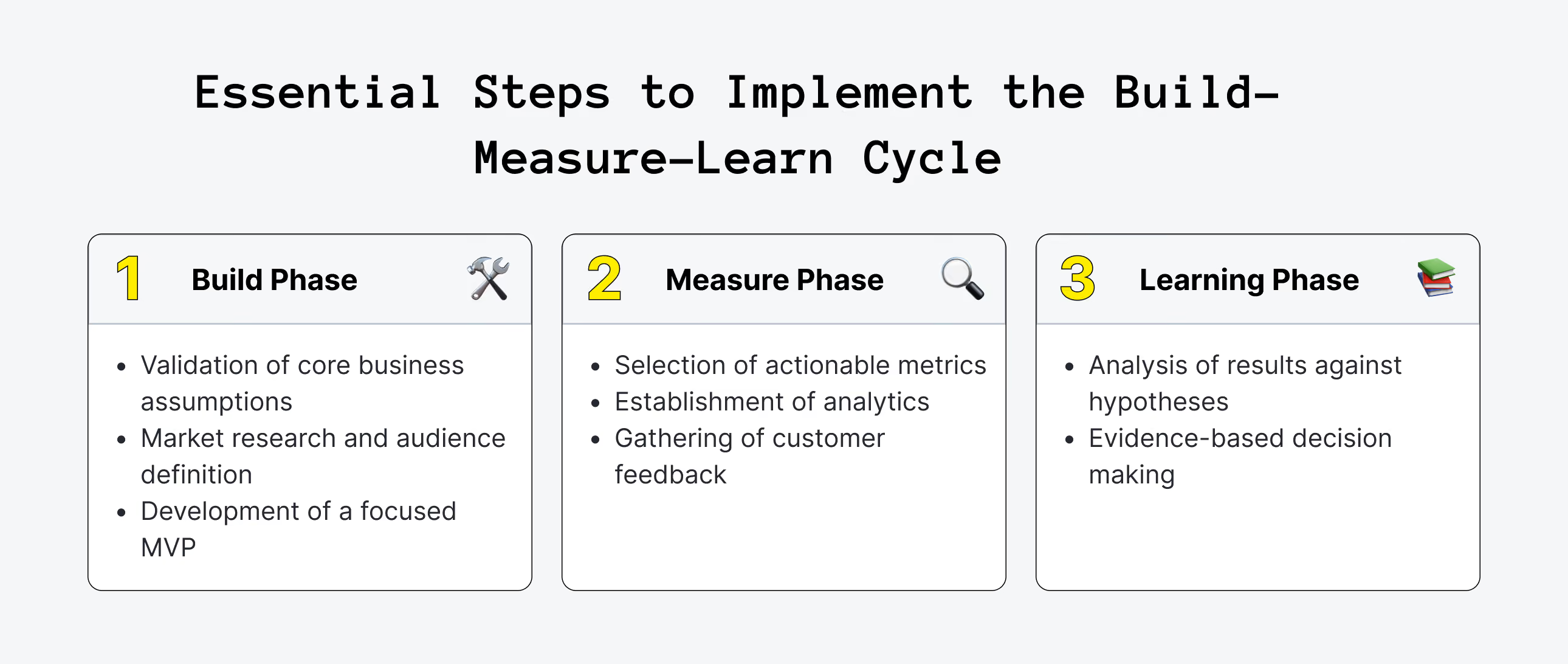
By applying the Build-Measure-Learn cycle for MVP development, you turn a vague idea into an evidence-based process. You also transform the act of creation from a shot in the dark into a series of calculated experiments. Below, we describe a step-by-step MVP development using Build-Measure-Learn.
Step 1. Executing the Build Phase
Before you write your first line of code or design a single screen, you start the Build phase with your SaaS ideas and underlying assumptions. Your primary job is to identify the riskiest assumptions and figure out the smallest possible thing you can build to test them.
1.1 Clarify Business Assumptions
Every business idea rests on a foundation of assumptions. Thus, for a new ride-sharing app, the assumptions might be: "People are unhappy with current taxi services," and "Drivers are looking for flexible work." The problem is, these are guesses, and you need to make them explicit.
A fantastic tool for this is the Value Proposition Canvas. It forces you to map out your customer's jobs (what they are trying to accomplish), pains (the obstacles they face), and gains (the outcomes they desire). Then, you map your product's features, pain relievers, and gain creators to that customer profile.
Let's imagine your startup wants to create a meal-planning app for busy families.
- Customer jobs: Plan weekly meals, create grocery lists, cook healthy food, and reduce food waste.
- Pains: Takes too much time, hard to find new recipes, kids are picky eaters, and groceries are expensive.
- Gains: Feel organized, save money, eat healthier, and have less stress around dinner time.
Your app's value proposition must address these points, and the canvas helps you see where your assumptions lie. You might assume the biggest pain is the time it takes to plan. But what if the real pain is the cost of groceries?
The Build-Measure-Learn approach will help you find the answer without building the entire app first.
1.2 Conduct Market Research and Define Your Audience
Once you have your assumptions, you need to do some initial startup idea validation. This does not mean you need a six-month market research study. It means getting out and talking to potential customers. Your next steps can be:
- Surveys and interviews. Create simple surveys with Google Forms or Typeform. Ask open-ended questions: Not "Would you use an app that plans your meals?", but "What is your biggest challenge when it comes to feeding your family during the week?" The second question gives you much richer information. Conduct 15-20 interviews with your target demographic. Listen more than you talk.
- Competitor analysis. Look at existing solutions. How are people solving this problem now? They might use cookbooks, Pinterest boards, or other apps. What are the complaints in their app store reviews? These complaints are your opportunities.
- Create a persona. Based on your market research, build a detailed user persona, a fictional character that represents your ideal customer. Give them a name, an age, a job, and a story. For our meal-planning app, our persona might be Stressed Sarah, a 35-year-old working mother of two who values convenience and health.
From now on, every decision you make about the MVP should be with Sarah in mind.
1.3 Build Your MVP
Now it's time to build. Remember, the goal is maximum learning with minimum effort, meaning you must be ruthless about what you include. First, you'll want to select the proper MVP type.
An MVP does not have to be a piece of software. It can be much simpler:
- Landing page MVP is often the fastest to build. It describes the product and its benefits and has a clear call to action (e.g., "Sign up for early access"). Your key metric will be the conversion rate. Dropbox famously started this way. They created a simple landing page with a video that explained the concept. The sign-up rate was so high it validated their core idea before they had a public product in any form.
- Explainer video MVP. Like the Dropbox example, a video can demonstrate how a product works. It is much cheaper to produce a 90-second animated video than to build a complex backend system. You can gauge interest based on views, shares, and comments.
- Clickable prototype. Figma or InVision will help you create a realistic-looking prototype of your app. It won't have any real functionality, but users can click through the screens. You can then watch people use it and see where they get confused or what features excite them.
- Concierge MVP. This approach involves manually delivering the service to a small group of customers instead of building automated software. For the meal-planning app, it could mean personally creating weekly meal plans for a few families and observing their reactions. Concierge MVP allows you to test assumptions, gather qualitative insights, and refine your value proposition before committing resources to full development.
Once you come up with a product prototype, you will be able to gather invaluable feedback on your user interface and user experience flow.
Next, you need to identify core MVP features.
At this stage, many founders make a critical mistake: instead of prioritizing features, they attempt to pack too much into the very first version. But, in reality, your MVP should do one thing in a perfect way. In our meal-planning app, the core feature might be generating a weekly meal plan based on a user's dietary preferences. That's it. No grocery list integration, no coupon finder, no social sharing.
Ask yourself this question for every feature on your list: "Can we still test our primary hypothesis without this?" If the answer is yes, cut it.
Third, set clear hypotheses. A good hypothesis is a statement that can be proven true or false. It should be specific and measurable.
A bad hypothesis: "People will like our meal-planning app."
A good hypothesis: "At least 10% of visitors to our landing page will provide their email address to get a sample one-week meal plan, because they find the process of meal planning too time-consuming."
This structure, [Specific action] because [reason], will force you to articulate both what you expect to happen and why you expect it to happen.
1.4 Iterative Development and Customer Interaction
The Build phase is not a one-time event, but a cycle within a cycle. You might build a small piece, show it to five customers, collect user feedback, and make changes before you launch the official MVP. Such a tight loop of feedback prevents you from going too far down the wrong path. Involve your target users from the very beginning. They are your co-creators.


Step 2. Perfecting the Measure Phase
Building the MVP is the start. The Measure phase is where you continue to refine it by collecting the hard data that will tell you if you are on the right track. Without good measurement, your learning will be based on guesswork and intuition, which is exactly what we want to avoid. Data activation helps turn this raw information into actionable insights, allowing businesses to make informed decisions, optimize strategies, and focus on metrics that truly drive engagement and growth.
2.1 Choose the Right Metrics
The world is full of data. It is easy to get lost in a sea of vanity metrics (numbers that look good on a presentation slide but don't help you make decisions). Examples of these metrics are total page views or total registered users. They always go up and to the right, but they don't tell you if users are actually engaged or if your business is healthy.
Instead, you need to focus on actionable MVP success metrics. These are ones that tie specific actions to specific outcomes.
Let's compare:
- Vanity metric: 10,000 people visited our website. (So what? Did they stay? Did they buy anything?)
- Actionable metric: Our new user retention rate for week 1 is 15%. (This tells us that 85% of new users did not come back after the first week. We have a problem to solve.)
When it comes to a minimum viable product, you should focus on metrics that measure customer engagement and the validation of your core value proposition. Good examples are:
- Conversion rate: What percentage of users take a key action? (sign up, make a purchase, create a project).
- Activation rate: What percentage of new users experience the moment they understand the core value of your product? For example, when Facebook came in, its moment was to get a user to connect with 7 friends in 10 days.
- Customer acquisition cost: How much does it cost you to get one new customer? If your CAC is $50 but your customer only pays you $10, your business model is broken.
- Customer lifetime value: How much revenue can you expect from a single customer over their entire relationship with your product? You need to have a CLV that is way higher than your CAC (a common target is a 3:1 ratio).
2.2 Implement Analytics Tools
As simple as it is, you can't measure what you don't track. You need to have the right MVP tools in place from day one.
- For web/app analytics: Google Analytics, Mixpanel, or Amplitude are the most popular tools. They help you track user behavior in detail. You can see which features people use, where they drop off in the sign-up process, and how often they return.
- For landing pages: Hotjar or Crazy Egg can create heatmaps that show you where users click and how far they scroll. This is incredibly useful for optimizing your messaging and layout.
- For performance: Sentry or Datadog helps you track errors and performance issues. A slow and buggy MVP will skew your measurement because users will leave out of frustration, not because they don't like your idea.
Here, you want to set up your startup analytics to track the specific actionable metrics in Build-Measure-Learn for MVPs you defined earlier. Create a simple dashboard that shows you your key numbers at a glance.
2.3 Gather Customer Feedback
Quantitative data (the numbers) tells you what is happening. Qualitative data (customer feedback) tells you why it is happening. You need both. This type of data can be collected in these ways:
- Use in-app surveys (like from Hotjar or Userpilot) or email surveys to ask users about their experience. Keep them short and focused. If you’re reaching out via email, using a cold email generator can help you craft clear, personalized messages that increase response rates without spending hours writing each email manually.
- Talk to your users! Reach out to a handful of people who signed up (and some who didn't). Ask them open-ended questions like, "What did you expect the product to do?" or "Was there anything that surprised you or confused you?"
- Make it very easy for users to give you feedback. A simple Feedback button in your app can be a goldmine of information.
Combine the what and the why. If your data shows that 70% of users drop off after the first screen, your user interviews can tell you it's because the Next button is not obvious. Many teams use a learning management system to capture these insights, train new team members, and ensure learnings from user feedback are shared consistently across the organization.
Looking for a reliable tech partner?
Upsilon can help you plan and develop an MVP that'll grow to be a success!

Step 3. Maximizing the Learning Phase
Let's close the loop. You have built an MVP and measured the results. Now, you must learn from that information and decide what to do next. This phase requires honesty and a willingness to be absolutely wrong.
3.1 Interpret Your Data
The first step is to analyze the results of your experiment. Go back to the hypothesis you set in the Build phase.
Let's use our meal-planning app hypothesis: "At least 10% of visitors to our landing page will provide their email address to get a sample one-week meal plan, because they find the process of meal planning too time-consuming."
Now, let's look at the data we measured:
- Total visitors: 2,000
- Email sign-ups: 60
- Conversion rate: (60 / 2,000) * 100 = 3%
Our conversion rate of 3% is well below our target of 10%. The quantitative data tells us the hypothesis was invalidated. We failed.
But failure is another word for learning. Now we need the qualitative data to understand why we failed. We interviewed 10 people who visited the page but did not sign up. We learn that while they do find meal planning time-consuming, they are more worried about whether their picky kids will eat the meals. This means our core assumption about the main pain was slightly off.
That's what learning looks like. We combined the what (low conversion rate) with the why (fear of picky eaters) to gain a real insight.
3.2 Make Data-Driven Decisions
With this new insight, you face a choice: pivot or persevere.
Persevere means you stick with your core strategy but make a small change, or an iteration, to improve the results. In our example, we might persevere with the idea of a meal-planning app but change the messaging on our landing page.
The new headline might be: "Kid-Approved Meal Plans for Busy Families." Then we run the experiment again, with a new hypothesis: "By changing the headline to focus on 'kid-approved' meals, we will increase our conversion rate to 8%."This is another turn of the Build-Measure-Learn crank.
Pivot is a much bigger change. A startup pivot is a "structured course correction designed to test a new fundamental hypothesis about the product, strategy, and engine of growth." (Wikipedia)
If, after several iterations, we still can't get people to sign up for our meal-planning app, we might conclude that the entire concept is flawed. The learning phase tells us that our fundamental hypothesis is wrong.
Perhaps through our interviews, we learned that what families really want is not a plan, but a service that delivers pre-portioned ingredients for specific recipes. This would be a major pivot. We would be changing our product from a software app to a logistics and food delivery service. It is a big move, but it is based on the evidence we gathered.
The pivot is not an admission of failure; it is an admission that you have learned something so significant that it requires a new direction.
Finally, the learning phase feeds back into the build phase. Your learning from one cycle becomes the foundation for the next hypothesis you will test.
Benefits of Using Build-Measure-Learn Loop for Startups
So, how does the build-measure-learn loop help the entrepreneur?
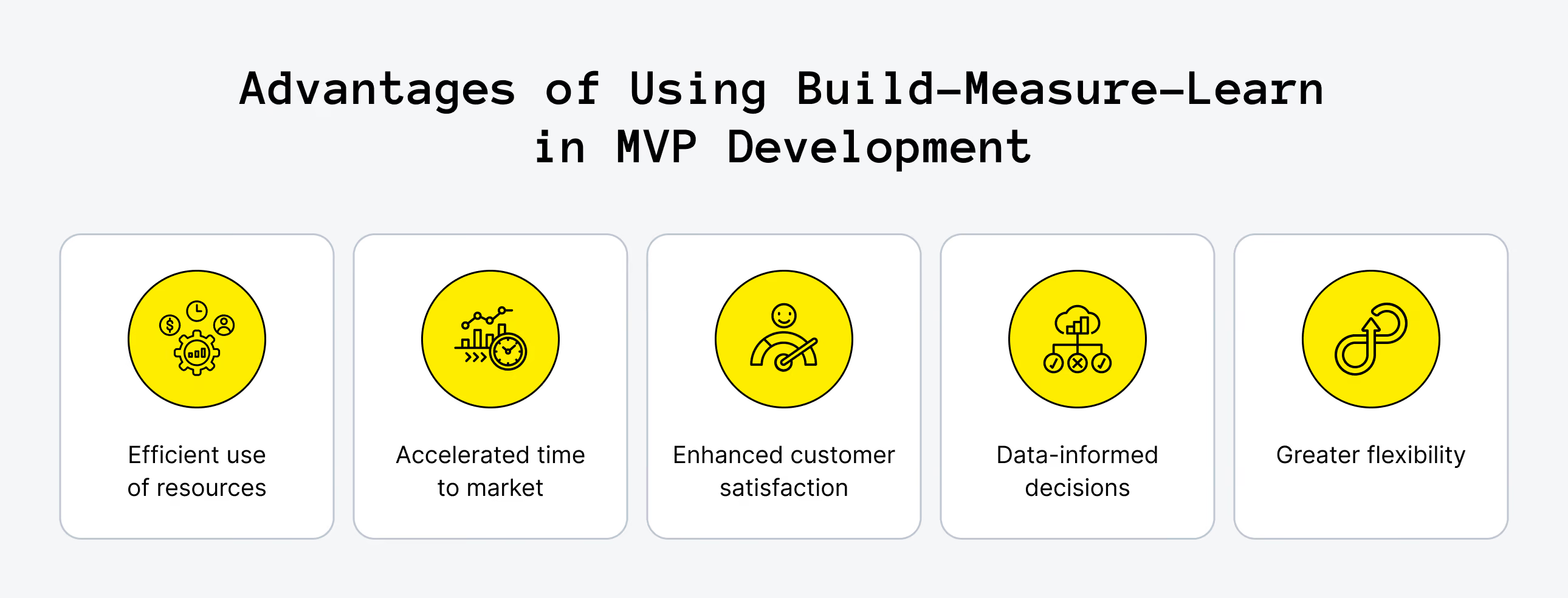
Adopting the Build-Measure-Learn model is a cultural shift that moves a startup from a we know what the customer wants mindset to a we have a hypothesis about what the customer wants, and we need to test it mindset. The benefits are profound.
Reduced Waste
The most significant benefit is the reduction of waste. The biggest waste in a startup is building a product that nobody uses. But sticking to the framework, you test your core assumptions with a small MVP and avoid spending a year and a million dollars on a perfect product that fails to find a market.
Every line of code you write and every feature you build is tied to a testable hypothesis, which minimizes wasted engineering effort.
Faster Time to Market
While the loop emphasizes learning over speed, a natural side effect is that you get a product into the hands of real users much faster. The initial version might be simple, but it starts the feedback loop sooner. Speed is not about how fast you can code, but about how fast you can learn.
Customer-Centric Development
The Build-Measure-Learn approach also forces you to be obsessed with your customer. You are constantly talking to them, measuring their behavior, and learning from their feedback. You build your product roadmap not based on the founders' opinions in a conference room. You have validated learnings from the people who are actually supposed to use and pay for the product.
Data-Informed Decision Making
The loop replaces "I think" with "The data shows." You remove a lot of the ego and internal politics from product development. When faced with a decision about which feature to build next, the answer can be found by asking, "Which feature allows us to test our most critical assumption right now?" The framework helps you shape a culture of intellectual honesty and focus.
Increased Flexibility
Since startups operate in a world of uncertainty, the market can change, a new competitor can emerge, or your initial assumptions can be flat-out wrong. The Build-Measure-Learn loop gives you the agility to adapt to these. Because you are working in small, iterative cycles, you can pivot your strategy based on new information without having to scrap a massive, monolithic product.
But it's not all fun and games. You need to be aware of some things that can make your strategy go south.

Common Pitfalls to Avoid
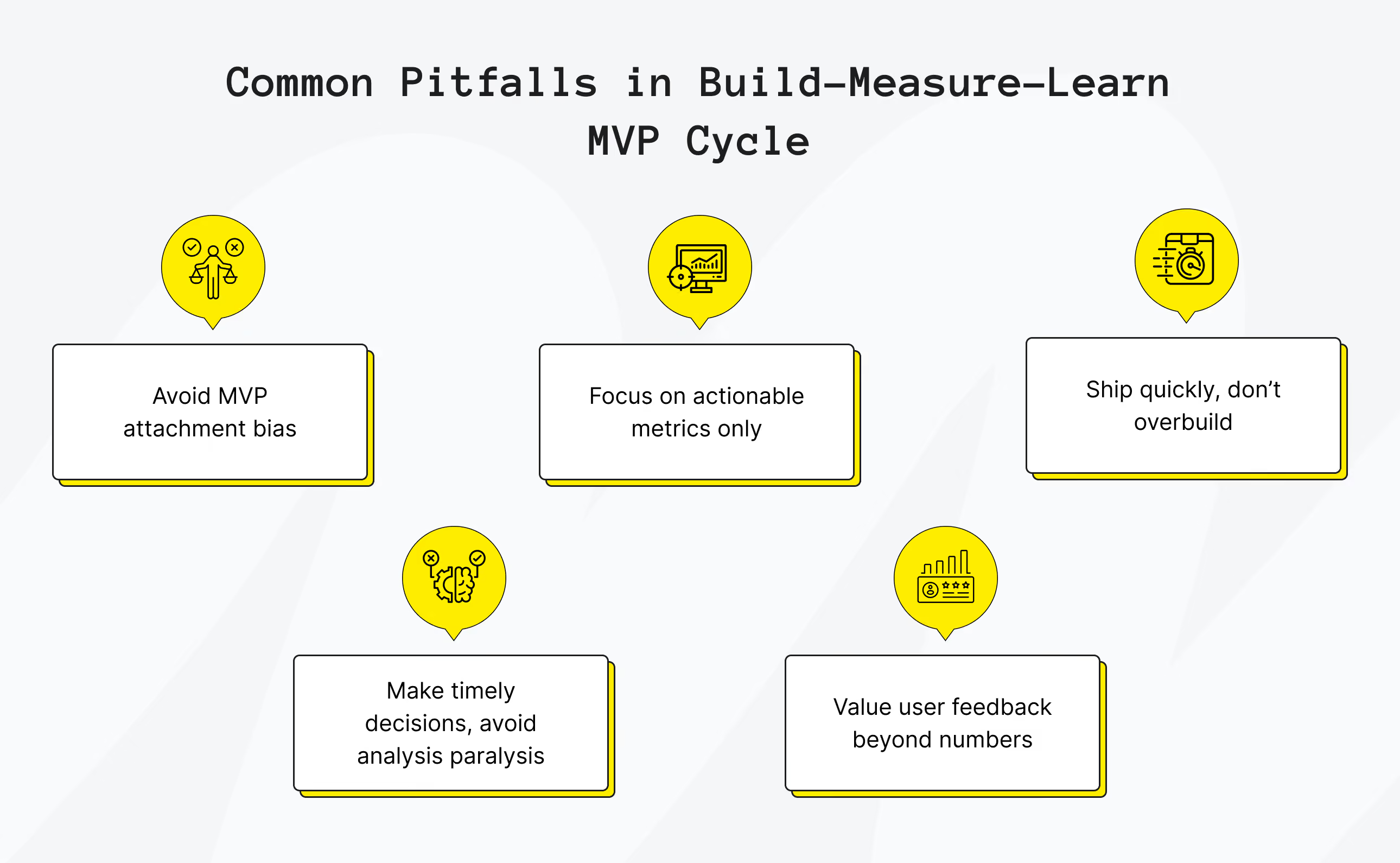
The Build-Measure-Learn model sounds simple in theory, but it is surprisingly difficult to execute well. Many teams fall into common traps that sabotage the process. Read on to get ready for avoiding MVP mistakes in Build-Measure-Learn process
Falling in Love with Your MVP
You spend weeks building your MVP. You become attached to it. Then, the data comes back and tells you that users hate it. The immediate temptation is to ignore the data and blame the users.
In reality, you must be willing to kill your darlings because the MVP is an experiment, not the final product. Its purpose is to generate learning, and sometimes that learning is "this idea is bad."
The Vanity Metrics Trap
Getting caught up in numbers that look impressive but don’t impact real progress is a common pitfall. For example, a surge in followers after a blog post isn’t enough to confirm success with your MVP. The Build-Measure-Learn loop for product-market fit requires discipline—focus on actionable metrics that directly validate or reject your core hypothesis, rather than data that just feels good on paper.
Skipping the Measure and Learn Phases
Some teams also get stuck in the Build phase. They keep adding one more feature before MVP launch, driven by a fear of getting negative feedback. But you have to have the courage to put your creation out into the world and let it be judged. An imperfect product that generates learning is infinitely more valuable than a perfect product that never ships.
Analysis Paralysis
The opposite problem is getting so bogged down in data that you never make a decision. You can run endless A/B tests and collect mountains of survey data. At some point, you have to make a call. You don't need perfect information. You only need enough information to make the next decision and start the next loop. Learning is valuable, but it has a cost: time.
Ignoring Qualitative Feedback
Numbers can tell you that you have a problem, but they rarely tell you why. If you rely only on your analytics dashboard, you will miss the crucial context that comes from talking to real human beings. You might see a huge drop-off in your payment flow and assume your price is too high.
But a five-minute conversation with a user might reveal that a bug is preventing the Submit button from working on their browser.
Not sure whether to start with your MVP?
From creating a functional core to delivering a polished experience, we tailor our approach to meet your unique needs.
Concluding Thoughts
The Build-Measure-Learn feedback loop is a development methodology and a survival guide for startups. In an environment defined by uncertainty, your most valuable asset is your ability to learn and adapt faster than your competitors. When you start treating your business ideas as scientific hypotheses and your MVPs as experiments, you systematically de-risk your venture.
Need help confronting the brutal truth about your ideas early and often? Don’t hesitate to reach out to us. At Upsilon, we provide expert team augmentation for growth-stage companies, helping you bring your MVP from concept to market-ready product efficiently. Using a flexible, sprint-based model, our specialists integrate seamlessly with your team to validate assumptions, prioritize features, and ensure every iteration moves you closer to product–market fit.
FAQs
1. What’s the goal of the Build-Measure-Learn cycle in MVP development?

The main goal is to learn as quickly as possible whether your core business idea is viable. In MVP development, it means you don't need to build just a small version of a final product. Instead, you run an experiment to test your most critical assumption (such as "Will people pay for this feature?") with the least amount of effort and resources. The cycle helps you turn guesses into facts by using real customer data and feedback.
2. How long should a Build-Measure-Learn loop take?
There's no magic number, but what really helps is speed. The faster you complete a cycle, the faster you learn. If you're a software startup, a single loop might take anywhere from one to four weeks for you. The ideal length depends on the experiment you're running.
A simple landing page test might take a few days, and testing a core feature with a functional prototype could take a month. The rule of thumb is to make the loop as short as possible without compromising the quality of the learning.
3. How do you embed the Build-Measure-Learn loop into the team’s process?
Embedding the Build-Measure-Learn feedback loop requires a cultural shift towards experimentation and data. Here are a few ways to do it:
- Structure work in short, iterative sprints (like two weeks) that align with a single Build-Measure-Learn cycle.
- Each sprint or cycle should be dedicated to testing one clear and measurable hypothesis.
- Make the key metrics for your current experiment visible to everyone on the team. This way, you will keep everyone focused on the Measure phase.
At the end of each cycle, hold a meeting dedicated to analyzing the data (both quantitative and qualitative) and deciding whether to pivot or persevere. Consider imposing a lean startup Build-Measure-Learn diagram for interactive analysis. You need to do so to formalize the Learn step.
4. Can the Build-Measure-Learn loop be used after product launch?
Absolutely. The loop isn't just for MVPs. It suits product development and optimization, too. After launch, you can use it to test new features, optimize user experience, and explore new markets or customer segments.
Such as before committing to a six-month roadmap, build a small version of a new feature to see if users actually engage with it. Then, formulate a UX hypothesis like, "Changing the sign-up button from blue to green will increase conversions by 5%," and then build, measure, and learn from the A/B test.
Most importantly, use the loop to run small experiments to see if your product resonates with a new audience and can uncover fresh revenue streams. It's the advanced side of how to apply Build-Measure-Learn in startups.



to top